








Huobi Research: Current State and Development Outlook of the DePIN Sector, Long-Term Potential Returns from Entering DePIN Exceed 400x
TechFlow Selected TechFlow Selected
Huobi Research: Current State and Development Outlook of the DePIN Sector, Long-Term Potential Returns from Entering DePIN Exceed 400x
DePIN's strategic composability with other ecosystems positions it to transform economic systems through data integrity and scalable solutions.
 Navigating Web3 tides with focused insights
Introduction: DePIN – Current State and Outlook
Decentralized Physical Infrastructure Networks (DePIN) are reshaping the blockchain landscape through innovative utilization of existing infrastructure and data-centric business models. DePIN goes beyond traditional IoT frameworks, standing out with its decentralized efficiency and cost-effectiveness.
This report explores the rapidly evolving DePIN space, particularly within the Solana network, renowned for its robust infrastructure and innovative applications. DePIN projects prioritize actual profitability over speculative finance and play a key role in integrating privacy-enhancing technologies, zero-knowledge proofs, and artificial intelligence. The strategic composability of DePIN with other ecosystems positions it to transform economic systems through data integrity and scalable solutions.
As a leading platform for DePIN, Solana embodies the integration of high-performance blockchain technology with physical networks, promising significant economic returns and pioneering new ways of merging technology with real-world applications.
This article was written by the research team under HTX Ventures. HTX Ventures is Huobi HTX’s global investment arm, integrating investment, incubation, and research to identify the most outstanding and promising teams worldwide. To date, HTX Ventures has supported over 200 projects across multiple blockchain sectors, with several high-quality projects already listed on Huobi HTX Exchange.
Conclusion
-
Although called Decentralized Physical Infrastructure Networks, the core growth logic of DePIN does not lie in hardware itself, but rather in how data can be utilized more effectively—whether for storage, transmission, sharing, or usage.
-
DePIN does not need to benchmark against traditional IoT; when thinking about it, there's no need to distinguish between Web2 and Web3. Anything that enables more efficient data utilization and better economic distribution is valuable.
-
The development of DePIN will combine blockchain to solve data trust issues, while expanding large-scale protocols across the Internet of Things, creating an infinite web connecting people, machines, and machine-to-machine interactions.
-
When evaluating DePIN projects, one should move away from speculation or financial attributes—these are more relevant to DeFi, memes, BRC20, etc. Evaluation of DePIN should focus on the project’s genuine profitability.
-
In the short term, what makes DePIN worth watching is its composability with other ecosystems—including DePIN x Privacy, DePIN x Gaming, DePIN x ZK, DePIN x AI. In the long run, the envisioned future of DePIN includes the gig economy, shared economy, and trusted data.
-
The Solana network has become the preferred blockchain for deploying DePIN projects. Solana DePIN represents over $10 billion in FDV and $4 billion in market capitalization.
-
Solana’s advantages in DePIN development include:
-
Performance advantages combined with technical upgrades
-
Strong token standards and ecosystem
-
Cost advantages
-
Concentrated liquidity, strong ecosystem composability, and unified community
-
Active developer community, continuous innovation, and emerging concepts
-
What is DePIN?
Messari formally introduced the concept of DePIN (Decentralized Physical Infrastructure Networks) in its early 2023 report titled "The DePIN Sector Map," defining it as “using crypto-economic protocols to deploy real-world physical infrastructure and hardware networks.” In simple terms, DePIN uses blockchain-based token incentives to encourage participants to collaboratively build physical infrastructure networks.
Beyond terminology evolution, projects based on the principle of “using crypto-economic protocols to deploy real-world physical infrastructure and hardware networks” have existed for a long time. For example, the decentralized network Helium was founded in 2013, and decentralized storage Storj launched in 2014. These teams had already begun exploring decentralized construction of physical infrastructure in fields like communications and storage. Later, internet, AI, energy, and data collection sectors gradually joined. Despite differences across subfields, the core logic remained consistent, ultimately forming today’s thriving DePIN sector.
Overall Status of the DePIN Sector
Overview of the DePIN Sector
According to Messari and Depin.Ninja data, the DePIN ecosystem grew to over 650 projects in 2023, with a market cap of $35B, spanning six sub-industries: computing (250), artificial intelligence (200), wireless (100), sensors (50), energy (50), and services (25). Messari estimates the total addressable market (TAM) for the DePIN sector at approximately $2.2 trillion, potentially reaching $3.5 trillion by 2028.
Per CMC data, there are currently 60 tokenized DePIN projects with a total market cap of $1.33 billion. The top 100 market-cap DePIN projects include FIL, RNDR, HNT, THETA, BTT, AKT, and AR. Other notable projects include IOTX, ANKR, and AI-related TAO. Most of the current top 10 DePIN projects by market cap belong to the AI, storage, and computing sectors. DePIN still represents a very small share of the overall crypto market, smaller than meme, DeFi, and NFT sectors. Comparatively, in the traditional IoT industry, only 4 projects exceed a $1 billion valuation, while 21 exceed $100 million.
Based on this data, potential short- to mid-term gains in DePIN could reach around 243x, with long-term expectations exceeding 400x.
Breakdown of DePIN Projects
Here we refer to IOTEX’s categorization method, broadly dividing into software and hardware components.
Hardware includes sensors and wireless networks; software includes computing, storage, network distribution, and artificial intelligence.

Although named Decentralized Physical Infrastructure Networks, all core business logic of DePIN revolves around extracting value from data.
-
Sensors – responsible for data collection
-
Wireless networks and distribution – responsible for data transmission
-
Computing – responsible for data processing
-
Storage – responsible for data storage
-
Artificial Intelligence – responsible for data application
Therefore, although DePIN projects start with hardware, their true development lies in how well they utilize data—a trajectory similar to traditional internet economies.
When assessing a DePIN project’s prospects, consider it from a data perspective: those who best use and control data are the strongest projects.
Move beyond speculative aspects of crypto and return to practical value.
Investors in DePIN
As previously mentioned, the DePIN sector has always attracted investment firms and entrepreneurs, but the market environment in early 2023 was unfavorable, and the new DePIN paradigm was still being explored, resulting in few new projects launching. By late 2023, with improved market conditions and accumulated entrepreneurial efforts, many projects evolved from initial ideas into tangible prototypes and began entering the market. DePIN quickly gained prominence amid a market lacking technological innovation.
For instance, VCs such as Multicoin, Borderless, a16z, and HTX Ventures have made significant investments in DePIN, backing highly practical, low-speculative projects. However, even for these firms, DePIN projects represent only a small portion of their portfolios.
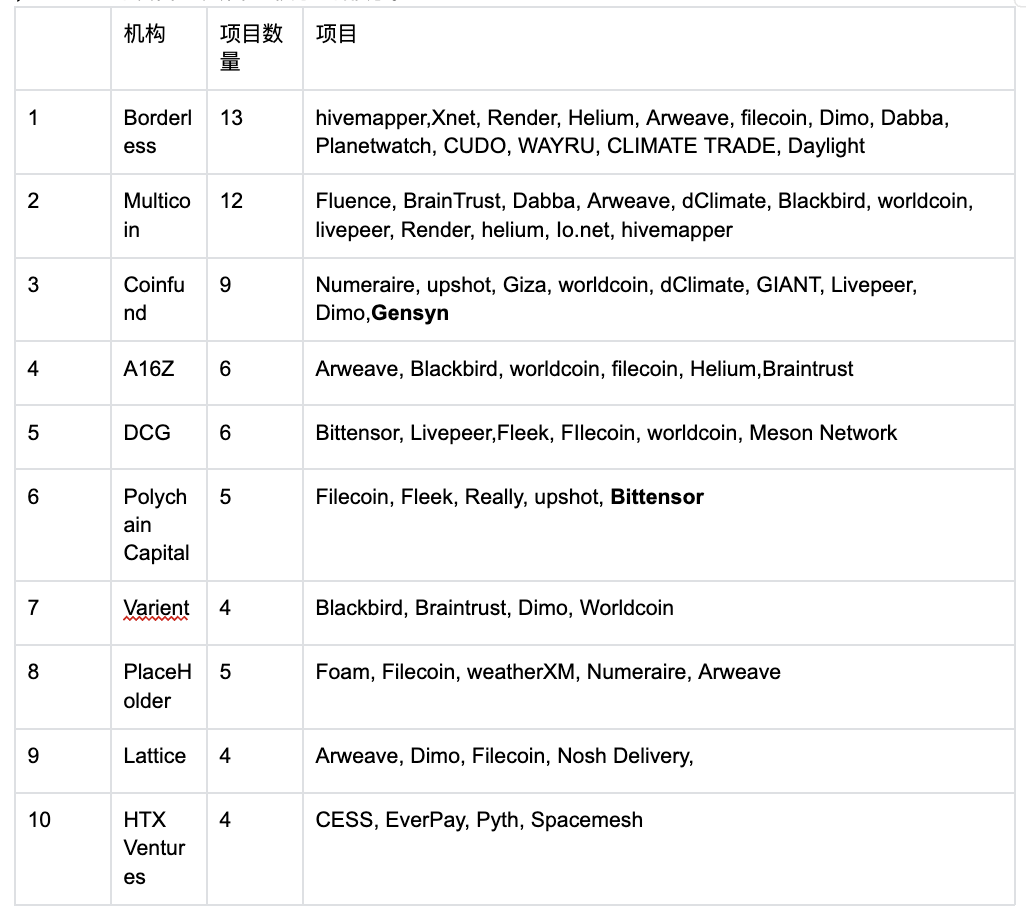
The following chart provides additional details on funding for leading DePIN projects:

Top DePINs by Capital Raised
Survey of Solana’s DePIN Ecosystem
Solana Has Become the Preferred Blockchain for Deploying DePIN Projects
-
Solana DePIN represents over $10 billion in FDV and $4 billion in market capitalization.
According to CMC, the top 500 Solana DePIN projects by market cap include Render Network (RNDR), Helium Network (HNT), and Helium Mobile (MOBILE). Other notable projects include Helium IoT (IOT) and Hivemapper (HONEY). Recently popular projects include the Solana-linked HNT series (MOBILE and IOT), along with getgrass, a bandwidth networking project likely to launch its token soon.
-
The relationship between the DePIN sector and the Solana network is mutually beneficial.
Irreplaceable for mass adoption, especially for DePIN and Web2 applications. Solana successfully handled demand from STEPN, a project that truly brought Web3 into the mainstream.
Solana’s cNFTs provide DePIN / PoPW nodes with more cost-effective authorization certificates, a common practice.
The migration of projects like RNDR and Helium has enhanced their capabilities. For example, Render gained new features including real-time streaming, dynamic NFTs, and state compression, significantly improving network performance and scalability while unlocking richer, more diverse applications for users.
Unlike high-value DeFi applications, DePIN projects are closer to traditional edge computing and IoT concepts, prioritizing stability and low cost. Solana naturally excels in synchronization speed. Taking the currently popular Helium as an example, with over 300,000 IoT devices and more than 3,000 5G devices, only Solana can manage such massive hardware coordination.
-
DePIN Brings High Value to the Solana Ecosystem
Projects like Helium significantly increase the number of active wallets. Helium alone reports over 60,000 active wallets monthly participating in activities such as claiming rewards, staking, delegating, or burning tokens, while over 30,000 other wallets use various SPL programs—highlighting Helium’s impact on Solana’s ecosystem.
From a regulatory standpoint, DePIN demonstrates Solana’s real-world utility in the eyes of regulators and policymakers, enhancing its legitimacy and brand recognition.
Solana’s Advantages Are Even More Pronounced
-
Performance Advantages Combined with Technical Upgrades
High throughput: Solana officially claims to handle over 65,000 transactions per second, with typical operations running at 2,500–3,000 TPS. Other performance metrics include fast transaction confirmation, scalability, and block size. After the upcoming Firedancer upgrade, theoretical TPS could exceed 1 million, with daily TPS estimated at over 100,000—this is the primary reason Visa and DePIN projects choose Solana.
-
Strong Token Standards and Ecosystem
A vibrant ecosystem with battle-tested DEXs and established standards such as cNFTs (compressed NFTs), pNFTs (programmable NFTs), and Token Extensions provides fundamental building blocks for DePIN projects to develop and launch their on-chain products.
-
Cost Advantage
Even after the Cancun upgrade, Solana remains one of the lowest gas-cost Layer 1 blockchains. Among top L2s, DA layers have switched to Ethereum mainnet blobs, including ZK Rollup chains like zkSync and Starknet, and Optimistic Rollups like Optimism and Base. These four L2s reduced gas fees by an order of magnitude but did not adopt Celestia, so costs haven’t reached rock bottom.
-
Concentrated Liquidity, Strong Composability, Unified Community
Ideological fragmentation among Ethereum and its Layer 2s leads to fierce competition for liquidity—especially evident in the current mini bull market, where technological and ecological distinctions are minimal and wealth-generation effects are weak. General-purpose L2s are no match for competitive chains like Solana.
Recently driven by strong meme coin momentum, Solana’s DeFi ecosystem has exploded, reaching a TVL of $3.3 billion. This means stronger yield and speculative products on Solana, further enhanced by RWA, AI, and DePIN projects, increasing DeFi composability.
-
Active Developer Community, Continuous Innovation
Through hackathons and various incentive programs, Solana has cultivated an active developer community, fueling ecosystem growth. Top projects like Magic Eden, Stepn, and Jito emerged from this environment. Even during bear markets, Solana maintained developer activity and community engagement, continuously refining infrastructure and inspiring new innovations, further driving ecosystem prosperity.
-
Wealth creation is the best marketing tool
Saga’s massive airdrop pioneered a new trend in crypto phones, unifying the Solana ecosystem. Projects including Solend, Helius, Chads, and Solcial have announced airdrops, benefits, and giveaways for Saga 2 owners. Recently, meme coin $BOME achieved the miracle of listing on Binance within three days.
Ecosystem Development Overview

The following table summarizes Solana’s DePIN projects:
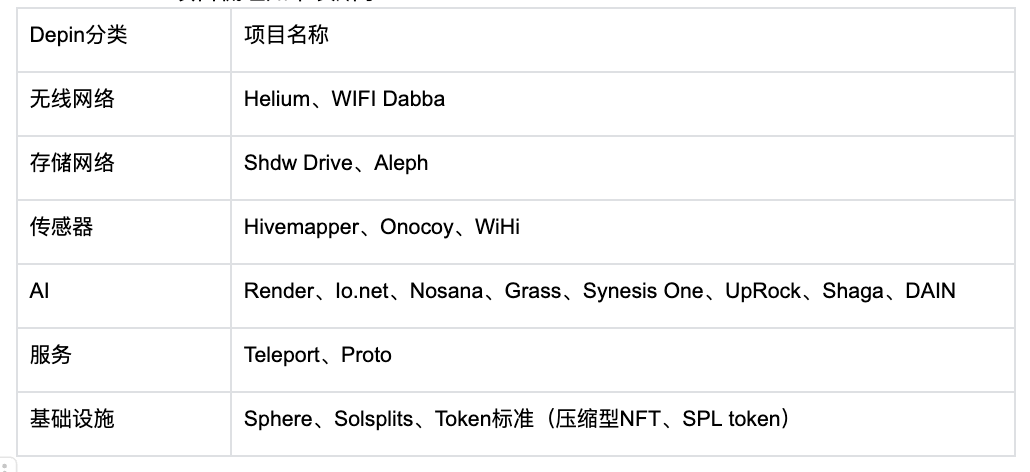
Summary of Solana’s DePIN Ecosystem:
Leading Projects: RNDR, Helium
-
RNDR, a decentralized rendering platform.
-
Helium Network, a wireless networking project. Developed since 2014, it has raised over $350 million in funding from prominent investors including a16z, Deutsche Telekom, Google, and Tiger Global. Helium migrated to the Solana blockchain in April this year. HNT is currently ranked #64 on CMC.
Second-tier Projects: Helium suite (MOBILE and IOT), io.net, Nosana
-
MOBILE and IOT are part of the Helium ecosystem.
-
IOT: The protocol token for the Helium IoT network, mined via LoRaWAN hotspots through data transfer revenue and proof of coverage.
-
MOBILE: The protocol token for Helium’s 5G network, rewarding contributors who provide 5G wireless coverage and validate the Helium network. MOBILE is currently ranked #166 on CMC.
-
io.net, positions itself as a “GPU aggregator” by leveraging computing power from data centers, crypto miners, and established projects like Render for machine learning applications. Not yet tokenized, with 426K Twitter followers. Raised $30 million in Series A funding led by Hack VC, with participation from Multicoin Capital, 6th Man Ventures, M13, Delphi Digital, Solana Labs, and Aptos Labs. Currently hosts over 50,000 GPU miners.
-
Nosana, a marketplace connecting user-provided GPU networks with consumers developing AI products.
Emerging Projects: ALEPH, HONEY, Shadow
-
ALEPH, a storage solution and cross-chain database.
-
Hivemapper (HONEY), launched in November 2022, is a decentralized global mapping network that rewards contributors using dashcams to collect vast amounts of 4K street imagery via a Drive-to-Earn model. In April 2022, it raised $18 million in funding led by Multicoin Capital, with participation from Solana’s founder, former Apple Maps executives, and Helium’s CEO. Currently ranked #513 on CMC.
-
Shadow, competing with Filecoin, Shdw Drive reduces enterprise-grade data center storage costs using high-performance traditional and mobile computing—its technology dubbed “DAGGER.”
Future Predictions for DePIN
-
The DePIN sector has high infrastructure demands, requiring high throughput, so DePIN projects will likely build on high-performance Layer 1s, or even on Layer 2s or Layer 3s.
-
More project possibilities, such as clean energy infrastructure and virtual power plants: projects like Daylight and Etheos
-
DePIN projects transitioning toward large platforms—e.g., Helium and Render—enabling smaller DePIN projects to build upon them
-
Dedicated DePIN chains: we’ve already seen two EVM/Substrate chains specifically targeting DePIN, such as Peaq and IoTeX. Additionally, one of the blue-chip DePIN projects, DIMO, is building its chain using Polygon CDK, indicating growing demand for app-specific chains.
-
Composability between DePIN and other ecosystem sectors. This is especially evident on Solana—e.g., Bonk’s airdrop creating wealth effects for Saga. We’ll see more integration of DePIN with DeFi to enhance yields and speculation, and with RWA to provide financing solutions or real-world data for projects.
Specific examples include:
-
DePIN x ZK,
As technology evolves, tools like ZK TLS can effectively prove the authenticity of Web2 or Web3 data, bridging Web2 data into Web3. Combining DePIN with ZK technology will spawn a wave of Web3 projects capable of vampire attacks on Web2 platforms—worth close attention.
For example, the project Space and Time:
Space and Time is a verifiable compute layer that scales zero-knowledge proofs over decentralized data warehouses, enabling trustless data processing for smart contracts, LLMs, and enterprises. It connects indexed on-chain blockchain data with off-chain datasets, using Proof of SQL to ensure tamper-proof large-scale computations and to verify that query results have not been manipulated.
Proof of SQL is a new ZK-proof developed by Space and Time, allowing data warehouses to generate SNARK cryptographic proofs of SQL query execution, proving that queries were computed accurately and that both queries and data are verifiably untampered.
Developers can use this project to connect indexed on-chain and off-chain data, transform data using SQL, execute low-latency cached queries and large analytics jobs, shape data into business-specific schemas, publish queries to APIs, and build dashboards—all while zero-knowledge technology ensures tamper-proof query results are sent to smart contracts or published directly on-chain in a trustless manner.
Currently, Space and Time has built indexes for Ethereum, Polygon, Sui, Sei, and Avalanche, and continues to support more chains, having already integrated with Chainlink.
-
DePIN x AI,
The development of decentralized physical infrastructure networks may fundamentally change how data is used—for example, decentralized machine learning, as exemplified by Bittensor.
Bittensor is an open-source protocol supporting a decentralized, blockchain-based machine learning network. Machine learning models collaborateively train on TAO and are rewarded based on the informational value they contribute to the collective. TAO also allows external access, enabling users to extract information from the network while adjusting network activity to their needs.
-
DePIN x Privacy,
As emphasized earlier, although DePIN refers to decentralized physical networks, the core lies in data utilization. Protecting data privacy within large-scale decentralized networks will inevitably become a critical issue. Therefore, if DePIN is destined to grow, privacy protection is unavoidable—making DePIN x Privacy a direction to watch closely.
-
DePIN x Gaming,
The convergence of DePIN and gaming can be understood in several ways:
-
Large-scale decentralized hardware networks may enhance gaming experiences
-
The concept of wearable devices + gaming + metaverse could regain popularity
-
DePIN hardware may transform game incentive mechanisms and gameplay experiences
References
-
https://www.panewslab.com/zh_hk/articledetails/8vy12wz3Ft.html
-
https://mp.weixin.qq.com/s/DE28WI5hE7OE5s2D-TFLxw
-
https://foresightnews.pro/article/detail/53218
-
https://depin.ninja/leader-board
-
https://depinhub.io/rankings/investors
About HTX Ventures
This article was written by the research team under HTX Ventures. HTX Ventures is Huobi HTX’s global investment division, integrating investment, incubation, and research to identify the world’s most outstanding and promising teams. As a pioneer in the blockchain industry for over a decade, HTX Ventures drives cutting-edge technologies and emerging business models, providing comprehensive support—including funding, resources, and strategic consulting—to partner projects to build a sustainable blockchain ecosystem. To date, HTX Ventures has backed over 200 projects across multiple blockchain sectors, with several high-quality projects already listed on Huobi HTX Exchange. Meanwhile, HTX Ventures is one of the most active fund-of-funds (FOF) investors, partnering with global top-tier blockchain funds such as Bankless, IVC, Shima, and Animoca to jointly build the blockchain ecosystem.
Join TechFlow official community to stay tuned
Telegram:https://t.me/TechFlowDaily
X (Twitter):https://x.com/TechFlowPost
X (Twitter) EN:https://x.com/BlockFlow_News
 @Ventures_HTX






