Piercing Eigenlayer Tokenomics: A New Social Consensus Mechanism Addressing Where ETH Falls Short
TechFlow Selected TechFlow Selected
Piercing Eigenlayer Tokenomics: A New Social Consensus Mechanism Addressing Where ETH Falls Short
EIGEN's intersubjective staking and dispute resolution mechanism complements ETH's on-chain staking mechanism by addressing subjective disputes and failures that cannot be handled by ETH alone.
 Navigating Web3 tides with focused insights
By TechFlow
After much anticipation, Eigenlayer has today finally unveiled more details about its token economics, announcing that 15% of the EIGEN tokens will be allocated to early restakers through linear vesting.
Does the EIGEN token hold additional value? What exactly is it used for? And what impact could it have on restaking—and even the broader Ethereum ecosystem?
All answers lie within Eigenlayer’s comprehensive, over-40-page tokenomics whitepaper.
Unlike typical projects that offer only simplistic diagrams of token distribution, Eigenlayer dedicates extensive space—detailed, meticulous, and somewhat technical—to explaining the role of the EIGEN token and its relationship with ETH.
TechFlow’s research team has thoroughly reviewed this whitepaper, distilling its key technical points into accessible language to help you quickly grasp the function and value of EIGEN.
Key Takeaways
Functions of the EIGEN Token and Problems It Solves
-
Universality and Restaking
Traditional blockchain tokens are typically limited to specific functions—for example, ETH is primarily used for block validation on Ethereum. This restricts flexibility and utility.
The restaking mechanism allows users to reuse their already-staked ETH across multiple services and tasks without unlocking or transferring assets.
-
Intersubjective Verifiability
The whitepaper uses the term "Intersubjectively"—a concept difficult to translate directly into Chinese—to describe complex network tasks that cannot be easily verified by automated programs alone and instead require consensus among human observers.
In such cases, the EIGEN token acts as a medium of "social consensus." In scenarios requiring diverse subjective validation, EIGEN can serve as a voting tool, allowing token holders to influence network decisions through governance.
-
Forking Tokens and Slashing Mechanisms
Disagreements may arise in the network regarding certain issues or decisions, necessitating a resolution mechanism to maintain consistency.
In the event of major disputes, the EIGEN token may undergo a fork, resulting in two separate versions, each representing a different decision path. Token holders must choose which version to support; the abandoned version may lose value.
If network participants fail to correctly perform staking duties or act maliciously, their staked EIGEN tokens may be slashed as punishment.
Relationship Between EIGEN and ETH
-
Complement, Not Replacement: The EIGEN token does not aim to replace ETH but rather complements it.
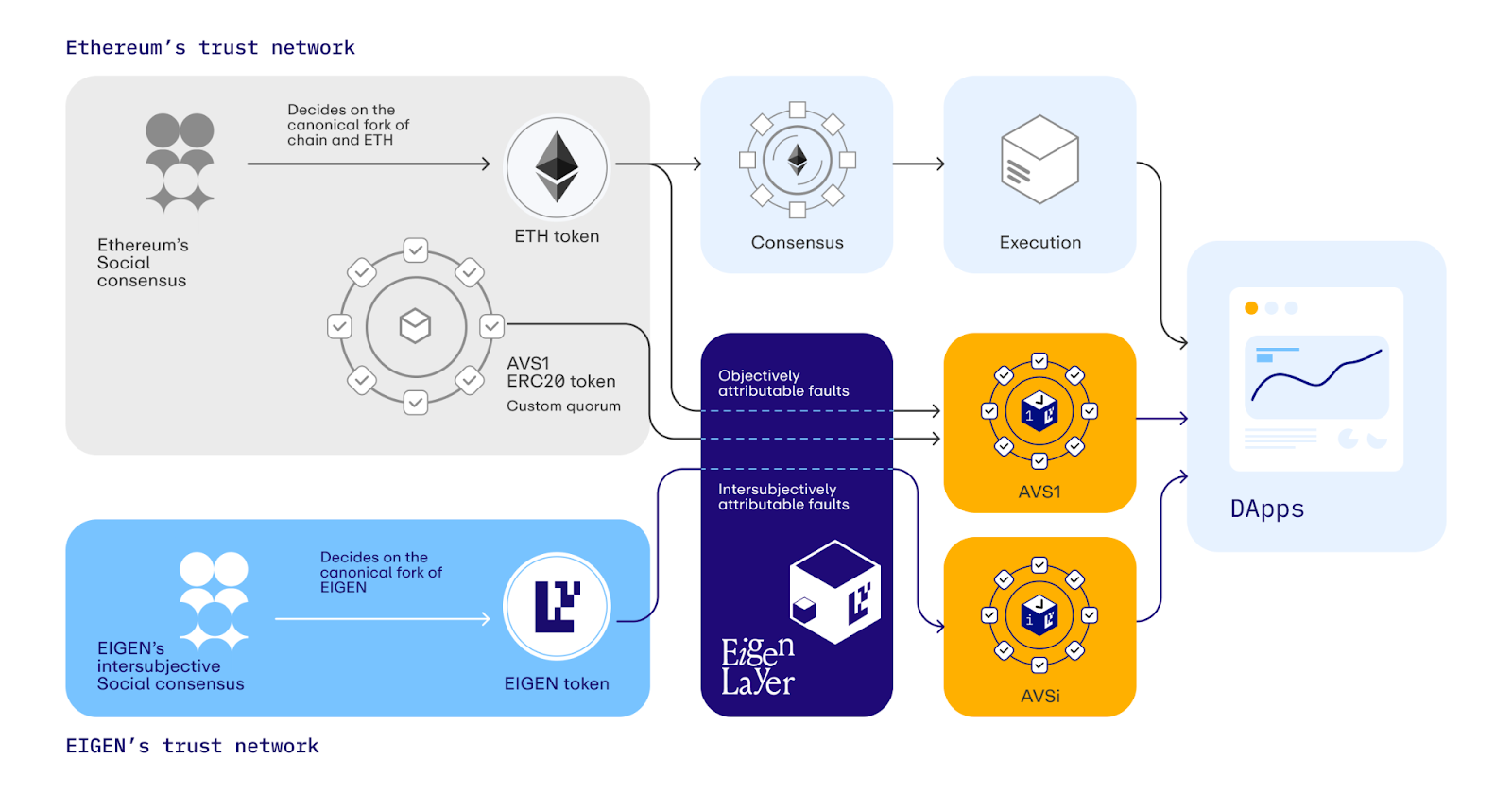
ETH is primarily used for staking and securing the network, serving as a general-purpose work token. ETH staking enables slashing for objective faults (e.g., validator misbehavior that can be automatically detected).
EIGEN staking supports slashing for intersubjective faults—errors that cannot be verified on-chain, such as an oracle reporting an incorrect price—thereby greatly expanding the range of digital tasks that blockchains can securely support.
EIGEN Token: A New Social Consensus Mechanism for Handling Subjective Errors Beyond ETH's Reach
To understand the purpose of the EIGEN token, one must first understand the role of ETH.
Before Eigenlayer and restaking, ETH could be seen as a "special-purpose" work token. In plain terms:
ETH was used solely to secure the network, produce new blocks, and perform tasks related to Ethereum’s maintenance—not for anything else.
Under this model, ETH had two key characteristics:
-
Highly specific utility;
-
Strong objectivity—for instance, double-signing violations or Rollup errors on Ethereum can be objectively detected via pre-coded rules, leading to ETH slashing.
With Eigenlayer, however, ETH effectively becomes a "general-purpose" work token. In simpler terms:
You can now restake ETH into various services—new consensus systems, Rollups, bridges, MEV solutions—beyond just Ethereum’s native chain. This is one of Eigenlayer’s core innovations.
Yet even in this expanded context, ETH retains a limitation:
-
It remains constrained by “objectivity,” since slashing can only apply to on-chain, objectively verifiable faults.
But not all errors in crypto can be attributed on-chain, nor can all disputes be resolved by consensus algorithms.
Some failures—subjective, hard-to-prove, contentious—are critical to blockchain security yet fall outside ETH’s scope.
For example, imagine an oracle reports 1 BTC = 1 USD. This data is fundamentally wrong at the source. No on-chain code or consensus algorithm can detect this. Even if you slash the validator’s ETH, the damage remains—the point being:
You cannot use an objective on-chain solution to punish a subjective off-chain error.
Questions like: What is an asset’s true price? Is a data source available? Is an AI interface functioning correctly? These cannot be resolved on-chain. They require “social consensus”—human judgment and discussion.

Eigenlayer refers to these as intersubjectively attributable faults: a set of failures on which all reasonable, active observers in the system broadly agree.
This is where EIGEN comes in—to provide a complementary social consensus mechanism beyond ETH, maintaining network integrity and security by specifically addressing these “intersubjective” failures.
Implementation: EIGEN Staking and Token Forking
ETH remains the general-purpose work token, while EIGEN serves as the universal “intersubjective” work token—complementary roles.
If a validator stakes ETH and an objective fault occurs, their staked ETH can be slashed.
Likewise, if a user stakes EIGEN and an intersubjective fault occurs—one that cannot be judged on-chain and requires human consensus—their staked EIGEN can be slashed.
Let’s walk through a concrete scenario to see how EIGEN works.
Imagine a decentralized reputation system built on Eigenlayer, where users rate service providers. Each provider must stake EIGEN tokens to back their credibility.
Before this system launches, two stages are essential:
-
Setup Phase: Coordination rules among stakeholders are encoded, defining how disputes should be resolved;
-
Execution Phase: Pre-agreed rules are executed, ideally in an automated manner.
Within this system, users can autonomously enforce conditions they previously agreed upon.
Now, suppose a service provider is accused of fraudulent behavior. The platform’s community consensus may trigger a challenge, initiating a token fork—resulting in two versions: EIGEN and bEIGEN.
Users and AVSs are then free to decide which version to recognize. If the broader community deems the slashed party at fault, they will value only the new forked token (bEIGEN), disregarding the original.
Thus, the malicious staker’s original EIGEN tokens are effectively slashed via the fork.
This forms a social consensus-based adjudication system for resolving disputes that ETH alone cannot handle objectively.
Notably, regular users and other stakeholders need not worry about the impact of such forks.
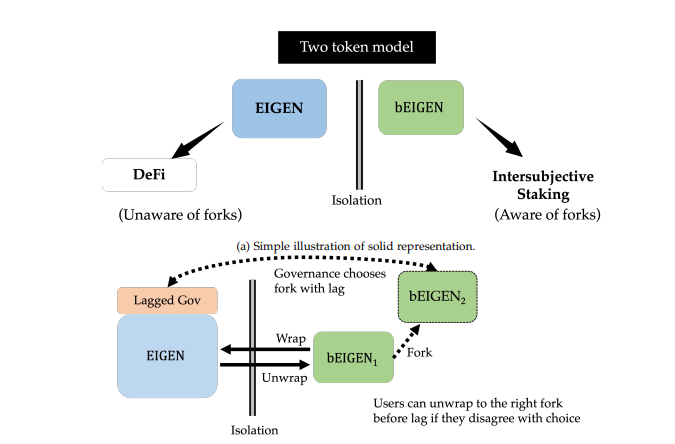
Typically, when a token forks, users must make a choice, which affects how their holdings are used elsewhere.
However, Eigenlayer creates an isolation barrier between CeFi/DeFi use cases and EIGEN staking. Even if bEIGEN is affected by an intersubjective fork dispute, EIGEN holders using the token in non-staking applications need not worry—they can redeem their forked bEIGEN tokens at any future time.
Through this fork-isolation mechanism, Eigenlayer enhances both the efficiency and fairness of dispute resolution while protecting non-participating users, ensuring overall network stability and asset security.
Conclusion
As shown, EIGEN’s intersubjective staking and dispute-resolution mechanisms complement ETH’s on-chain staking by handling subjective faults and controversies that ETH alone cannot address—unlocking numerous previously impossible AVSs with strong cryptoeconomic security.
This could open doors to innovation in oracles, data availability layers, databases, AI systems, gaming virtual machines, intent and order matching, MEV engines, prediction markets, and more.
That said, according to the roadmap laid out in the whitepaper, current EIGEN use cases remain in a very early, conceptual phase—more of a theoretical framework than practical implementation.
With users expected to begin claiming EIGEN tokens after May 10, it remains to be seen whether the envisioned utility of EIGEN will effectively support its market valuation. Watch this space.
Join TechFlow official community to stay tuned
Telegram:https://t.me/TechFlowDaily
X (Twitter):https://x.com/TechFlowPost
X (Twitter) EN:https://x.com/BlockFlow_News
 深潮TechFlow