Top 9 Eigenlayer AVS Projects: Who Will Become the Next AltLayer?
TechFlow Selected TechFlow Selected
Top 9 Eigenlayer AVS Projects: Who Will Become the Next AltLayer?
Restaking is the fastest-growing sector in 2024.
 Navigating Web3 tides with focused insights
Author: IGNAS
Translation: TechFlow
Introduction
In 2024, restaking has experienced explosive growth, becoming a major trend in the DeFi space. This article will analyze EigenLayer’s restaking mechanism and use cases of Active Validation Services (AVS). Additionally, it will introduce different types of AVS such as Ethos, AltLayer, Espresso, Omni, and examine their features and roles.
Main Content
Remember my words: restaking is the fastest-growing sector in 2024. Restaking ranks as the 9th largest DeFi category, with EigenLayer alone holding $2 billion in TVL.
Don’t forget “liquid restaking” at #13, which has already reached $1 billion in scale.
With the launch of the first AVS token ALT and EigenLayer opening deposits on February 5, it's time to track all developments in this space.
I’ll briefly explain EigenLayer’s restaking mechanism and highlight emerging use cases enabled by restaking through AVS.

EigenLayer will open deposits on February 5. Here’s what you need to know.
They have revised their points system, encouraging decentralization by limiting single deposits and LST/LRT allocations to 33%. Currently, no single LST/LRT has reached the 33% cap.
Swell and EtherFi offer double points via native token airdrops. My strategy is to diversify across multiple LST/LRTs for balanced point accumulation and risk management.
Regarding LRT competition, I’m placing hedged bets on several projects:
-
EtherFi: The leading LRT with 51% market share. Using my referral link earns an extra 1,000 EtherFi points per ETH and double points in partner DeFi protocols.
-
Kelp DAO: Earn EigenLayer points and KelpDAO miles by restaking stETH or ETHx.
-
Renzo: Like EtherFi, uses Eigenpods for native ETH restaking.
-
Swell: Deposit ETH to receive swETH LST and restake on EigenLayer, or directly deposit rswETH LRT.
-
Eigenpie: Already has $100M TVL, supports six LSTs, and offers double points in the first two weeks. These points contribute to a 10% EGP token airdrop and a 60% EGP IDO at $3M FDV to incentivize early participation.
Restaking: ELI5
Back in September 2023, I detailed restaking and liquid restaked tokens (LRT). But much has changed since then. Now there are multiple LRT protocols live on mainnet, and things are heating up with AltLayer launching its token.
Many people still find restaking confusing and often overcomplicate it.
Simply put, it allows you to stake (or back) your ETH for various Active Validation Services (AVS), enhancing security for selected protocols. This includes bridges, oracles, sidechains, and many more innovative concepts soon to emerge.
For example, Optimism and Arbitrum could bypass the 7-day fraud proof window for instant withdrawals, provided sufficient economic security (in this case, ETH) backs those withdrawals.
These "insured bridges" guarantee proper redistribution if validators act maliciously. You re-stake your ETH into an "insured bridge AVS," so if validators misbehave, you risk losing some ETH. (Currently, if a smart contract has a vulnerability, these "insured bridges" won't protect your funds.)
You can restake ETH directly or via liquid staking tokens like stETH, rETH, cbETH, etc. This round, EigenLayer added LSTs sfrxETH, mETH, and LsETH.
Benefits of Restaking:
-
Multi-protocol rewards: Earn yield from multiple protocols using the same ETH
-
Enhanced security: Leverage Ethereum's security for new protocols
-
Developer freedom: No need to build new security layers, saving developers time and resources
Risks of Restaking:
-
Slashing risk: Increased chance of losing staked ETH due to malicious activity
-
Centralization risk: If too many stakers move to EigenLayer, it may pose systemic risks to Ethereum
-
Smart contract risk: As elsewhere in DeFi
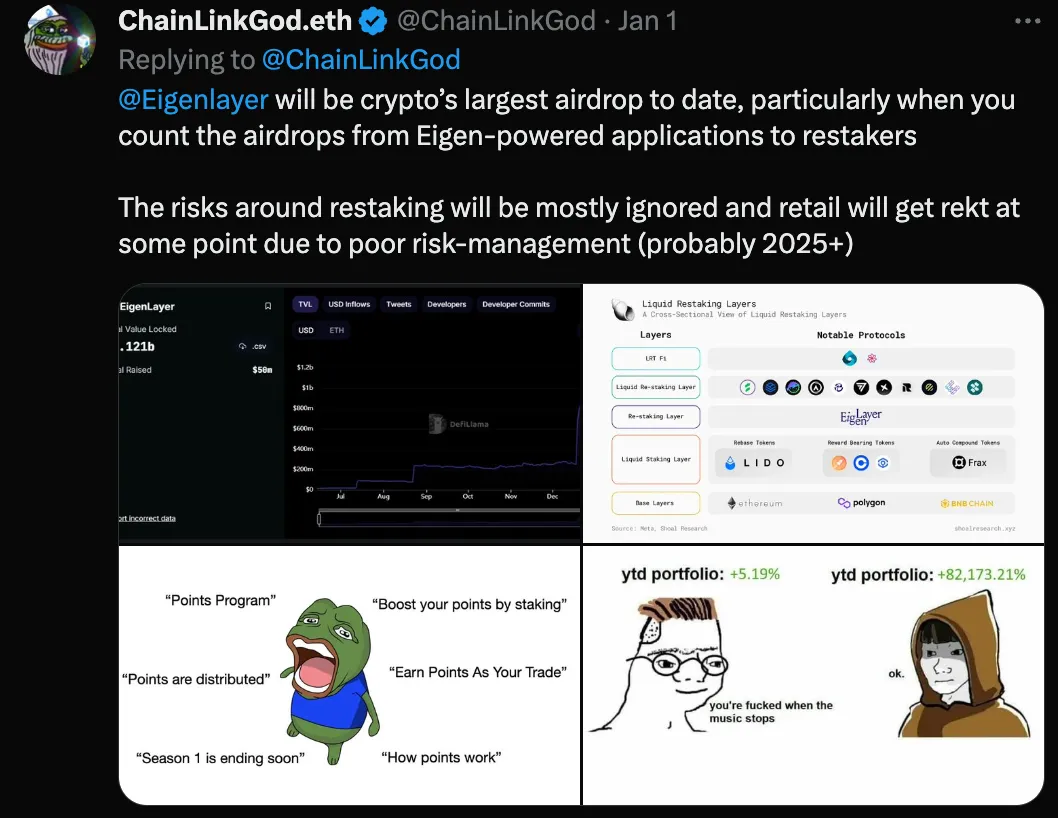
I believe current risks are limited because EigenLayer is still on Stage 2 testnet and hasn’t enabled permissionless AVS deployment. I agree with ChainLinkGod — while risks are mostly overlooked, we should feel fine at least until 2025.
On the current Stage 2 testnet, restakers like you delegate to operators. These operators validate AVS. So, you're not restaking directly into AVS!
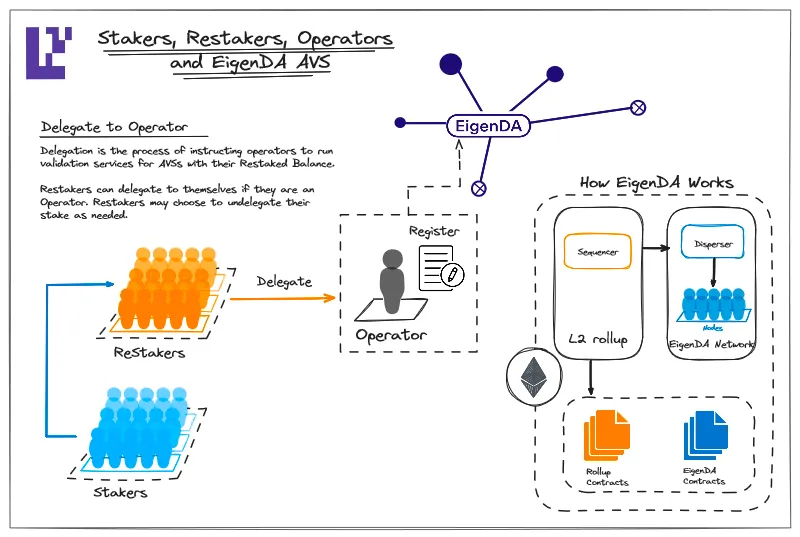
EigenDA (data availability) is the first AVS in Stage 2. Rollups can integrate it to increase throughput. The Stage 2 mainnet will launch in the first half of 2024, followed by Stage 3 later that year, bringing more AVS.
You can actually see how operator delegation works on the Goerli testnet. Follow this guide to get some goerliETH and exchange it for stETH. Then go to the Eigenlayer testnet page and deposit stETH. Then select an operator running the EigenDA AVS.
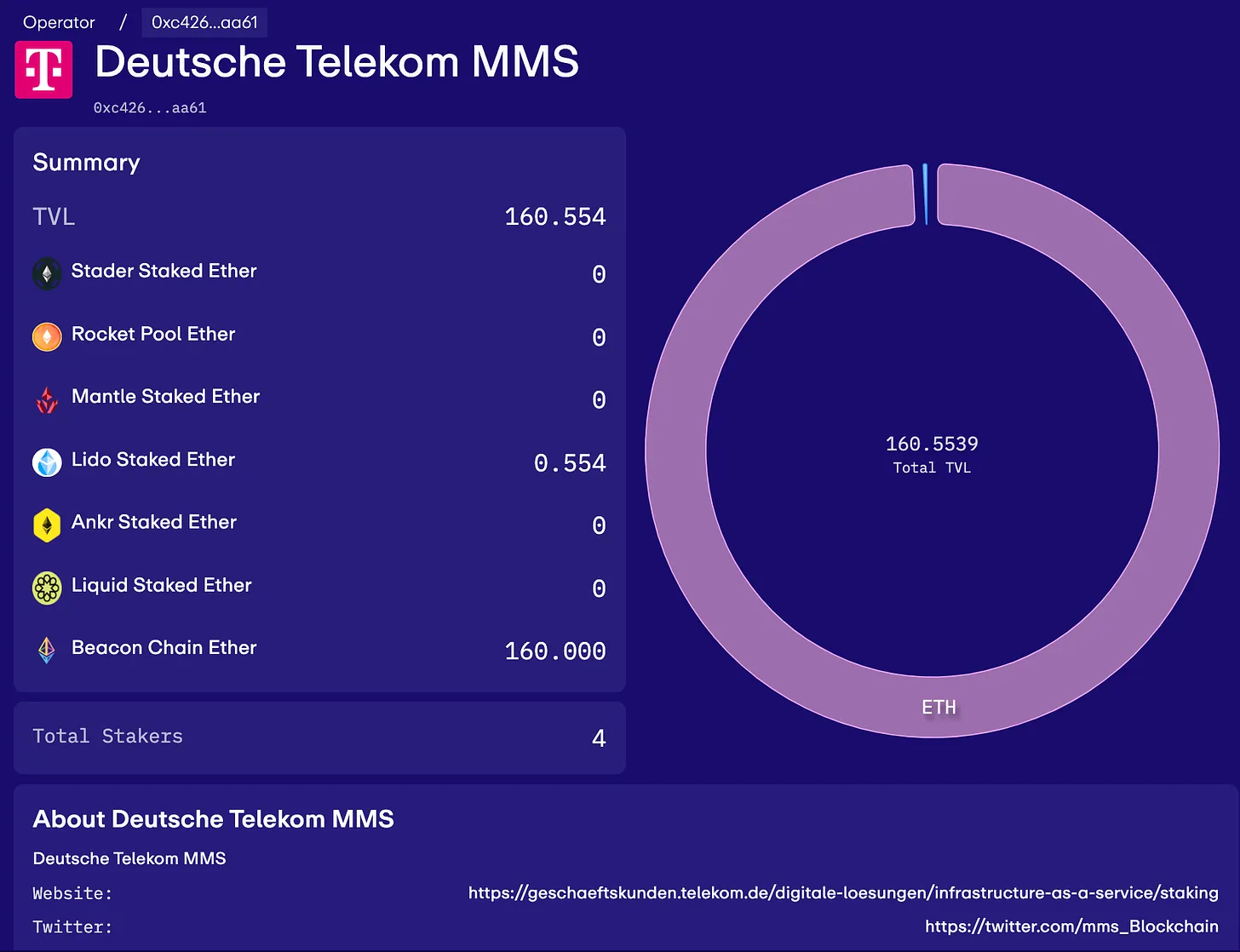
Interestingly, among the many operators, one stands out: Deutsche Telekom. Telekom appears to be using EigenLayer for staking services.
Anyway, are you ready to manually choose AVS and operators on mainnet yourself? Considering high gas fees? Then claim rewards from AVS? Then sell rewards to compound more ETH? Unless you’re particularly wealthy, you’d probably think gas costs here would be prohibitively high.
I bet you can guess what I’m about to say next: Liquid Restaking Tokens (LRT). But more on LRTs in another article. For now, let’s focus on use cases for new tokens that AVS will airdrop to us.
The first AVS is EigenDA, but I won’t dive deep since I doubt it will have a separate token (it’s a data availability layer for rollups to save storage costs).
Active Validation Services
Don’t be misled by the name. AVS are fully functional protocols that use restaked ETH to enhance their operations. I mentioned “insured bridges” earlier, but the scope and impact of AVS will quickly become clearer.
In this blog post, I’ll introduce seven AVS in very simple terms. Because if we’re investing ETH into the restaking ecosystem, we need to understand AVS.
Ethos: Bringing ETH Security to Cosmos
Ethos brings Ethereum’s economic security and liquidity to Cosmos.
So-called Cosmos Consumer chains typically issue native staking tokens to secure the network. However, this introduces additional complexity and inflationary token economics. While Cosmos ATOM stakers provide an Interchain Security (ICS) solution, the Ethereum ecosystem, through Ethos and restaking, is now expanding into Cosmos’ own domain.
With Dymension, ATOM forks, and now Ethos launching, ATOM seems under significant pressure.
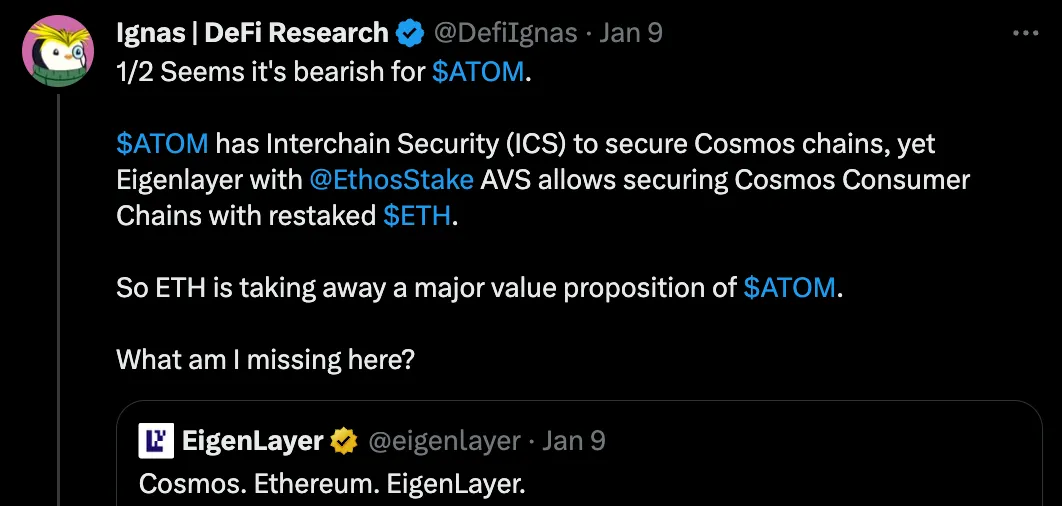
Inspired by Mesh Security (which allows a chain’s staking token to be used on another chain), Ethos enhances economic security without requiring additional nodes. Click here for more details in the Ethos blog post.
Which security solution wins depends on adoption. Ethos is gaining strong momentum.
Sommelier is the first partner — an automated yield vault provider with $60 million TVL. To my knowledge, more consumer chains are coming soon.
A key advantage: ETHOS may receive partner chain token airdrops (and revenue). Meanwhile, the ETHOS token itself will be airdropped to those who restake ETH on EigenLayer, as part of earning EIGEN tokens.
All you need to do is restake ETH and claim the airdrop.
AltLayer: Restaking for Rollups
I just covered AltLayer in a previous article, so I won’t go deep into its functions here. Click here to read more.
But you should know that AltLayer introduces three AVS that bring:
-
Fast finality
-
Decentralized sequencing
-
Decentralized validation
The ALT tokenomics are interesting because ALT must be staked alongside restaked ETH to protect these three AVS.
If you lived through DeFi Summer 2020, you’ll recognize the potential Ponzi dynamics it might create.
Currently, only 3% of total supply was airdropped to the community, but more airdrops are planned. Initial circulating supply is 11%. Does a $4.3B FDV (at time of writing) justify a protocol hardly anyone had heard of just weeks ago?
Unsure, but it makes me even more bullish on the entire restaking ecosystem.
Moreover, I suspect AltLayer reserves liquidity mining rewards for restakers. As more AVS launch, various services will compete to attract valuable ETH deposits. After all, an AVS with no deposited ETH holds no value.
Espresso: Decentralized Sequencers
Espresso focuses on decentralized sequencers for Layer 2. As you know, L2s face heavy criticism for centralized sequencers. There’s a great visual explanation of how Espresso leverages its HotShot consensus for this goal — visit their website here.
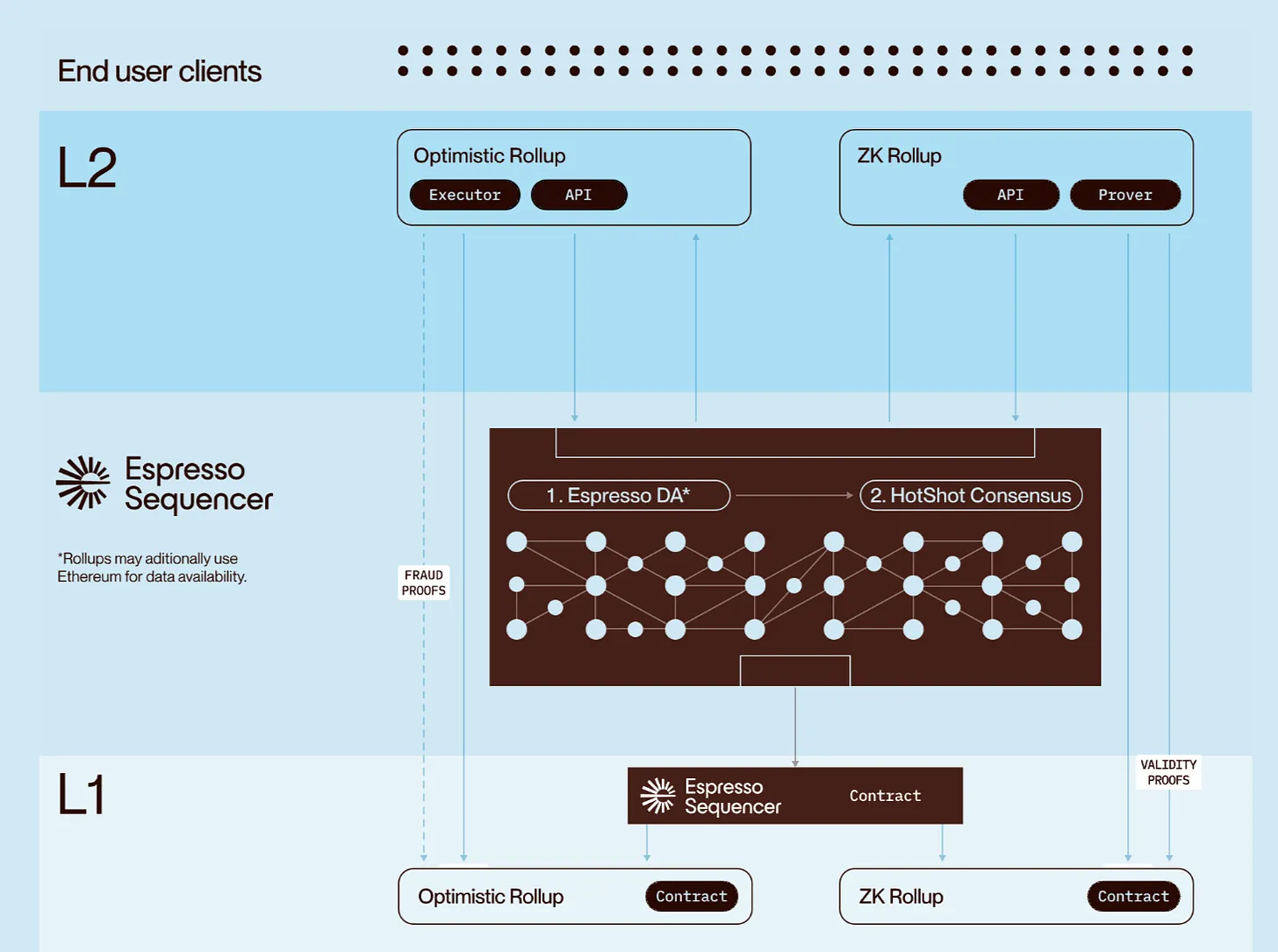
AltLayer actually integrates Espresso, allowing developers to choose between AltLayer’s decentralized validation solution and/or Espresso’s sequencer when deploying on the AltLayer stack.
Omni: A Blockchain Connecting All Rollups
Problem: L2s reduce transaction costs but fragment the ecosystem. This makes it hard for developers to reach broad audiences, complicates user experience, and fragments liquidity.
Bridges become necessary, but often issue wrapped tokens, introducing risk. If a bridge is hacked, there may not be enough underlying assets to back the bridged wrapped tokens, causing them to lose their peg.
Solution: Omni
Omni is a “L1 blockchain secured via restaking,” aiming to unify all Ethereum rollups under one roof.
Omni introduces a “unified global state layer” secured through EigenLayer restaking. This layer centralizes cross-domain application management.
Use cases include:
-
Cross-rollup margin accounts and leveraged trading: Post margin on one domain and trade using that margin on another
-
Cross-rollup NFT minting
-
Cross-rollup lending: Deposit collateral on one domain and borrow against it on another
And more — but does this sound familiar? It’s similar to what LayerZero does.
LayerZero’s cross-chain messaging enables Omnichain Fungible Tokens (OFT), avoiding wrapped tokens. Manta’s STONE token is an ETH OFT; LayerZero issued Lido’s wstETH OFT.
But what if LayerZero’s messaging system has a vulnerability? Well, Omni protects it with restaked ETH, which gets slashed if validators misbehave.
Consider a speculative degen wanting to use his ETH on Arbitrum to borrow USDC on Optimism. The degen’s Arbitrum transactions are monitored by Omni validators, who ensure data integrity when transferring to Optimism. Validators are incentivized by rewards and deterred by slashing risks on their staked ETH.
LayerZero might use token staking to secure cross-messaging, but if the LayerZero contract fails, the token price drops, rendering that security useless. ETH is an asset external to the system, harder to compromise, making network protection stronger.
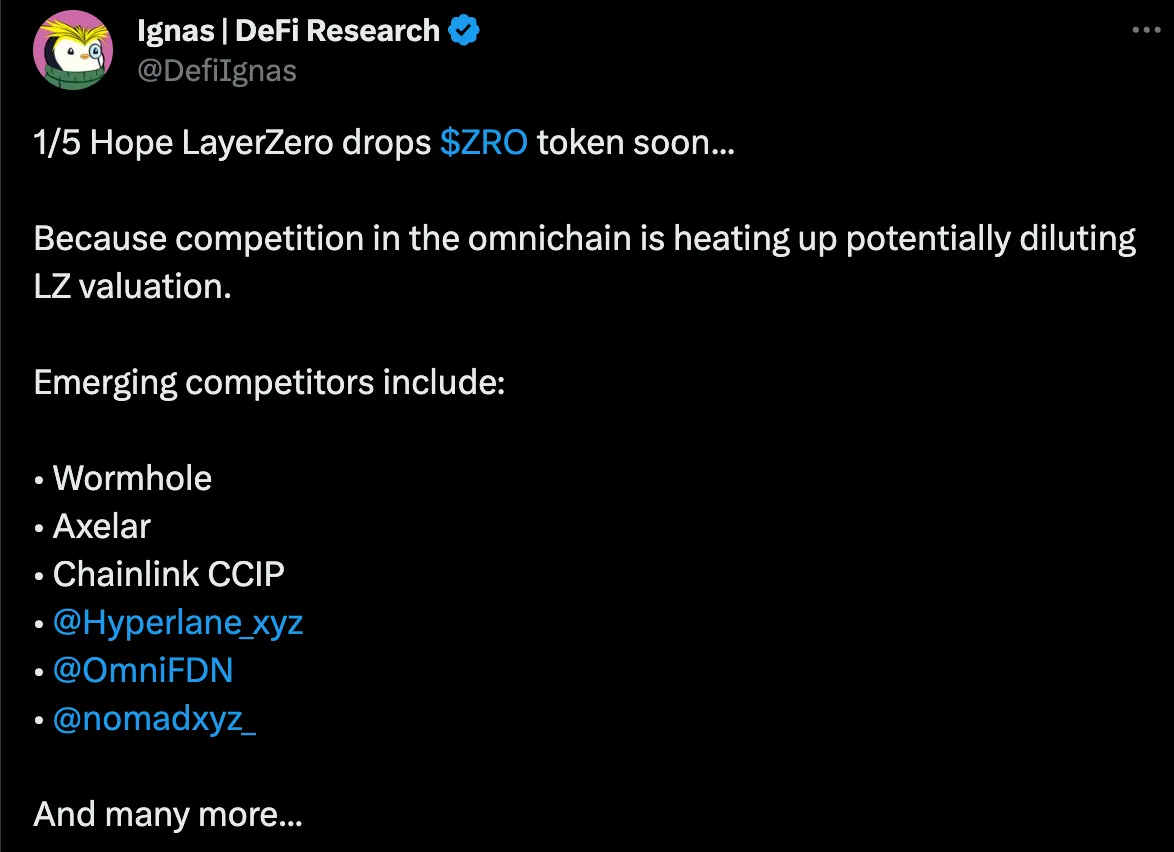
Competition for LayerZero is heating up
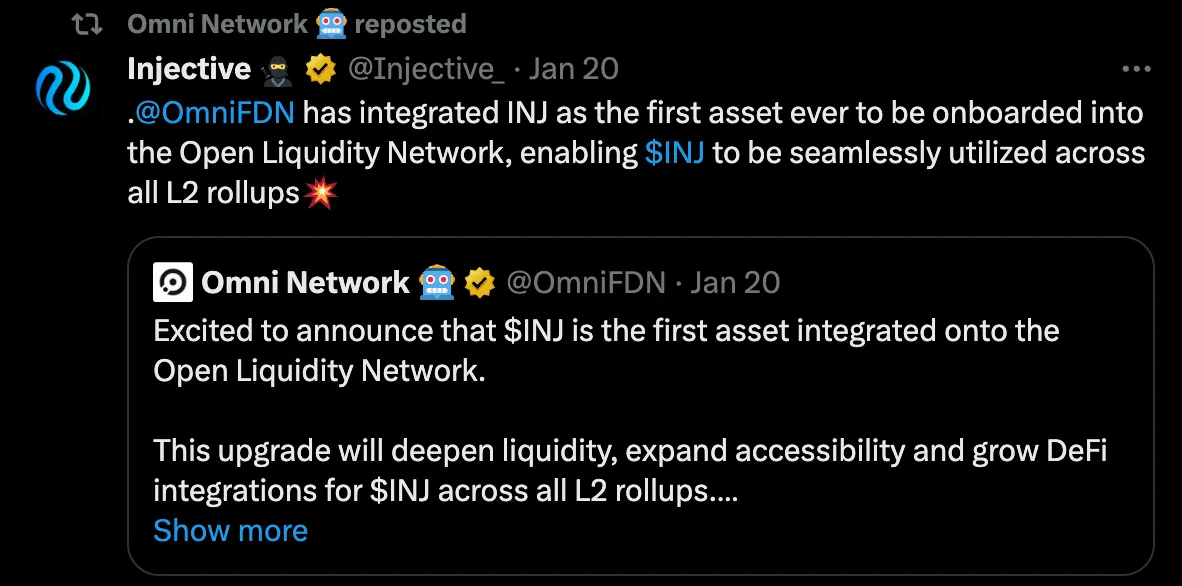
Injective partnered with Omni, making $INJ the first asset on Omni’s open liquidity network. Omni issues xERC20 INJ tokens, bringing INJ into the Ethereum rollup ecosystem.
Omni received $18 million in funding from notable investors including Pantera Capital, Two Sigma Ventures, and Jump Crypto. So, I expect it to perform well.
Hyperlane: Similar to Omni, but Seems Better
Think Omni is impressive at connecting Ethereum rollups? Hyperlane seems even better — because it aims to connect all L1s and L2s.
With Hyperlane, developers can build cross-chain applications spanning multiple blockchains, protected by its modular security stack, which includes cross-chain security modules and restaked ETH.
According to documentation, Hyperlane will support Ethereum L2s, Cosmos ecosystem chains, Solana, Move-based chains, and more.
Hyperlane’s permissionless interoperability sets it apart — rollups can connect themselves without cumbersome governance approvals. They’re proud of this, as seen in the tweet below. That said, LayerZero v2 also appears to allow permissionless deployment.
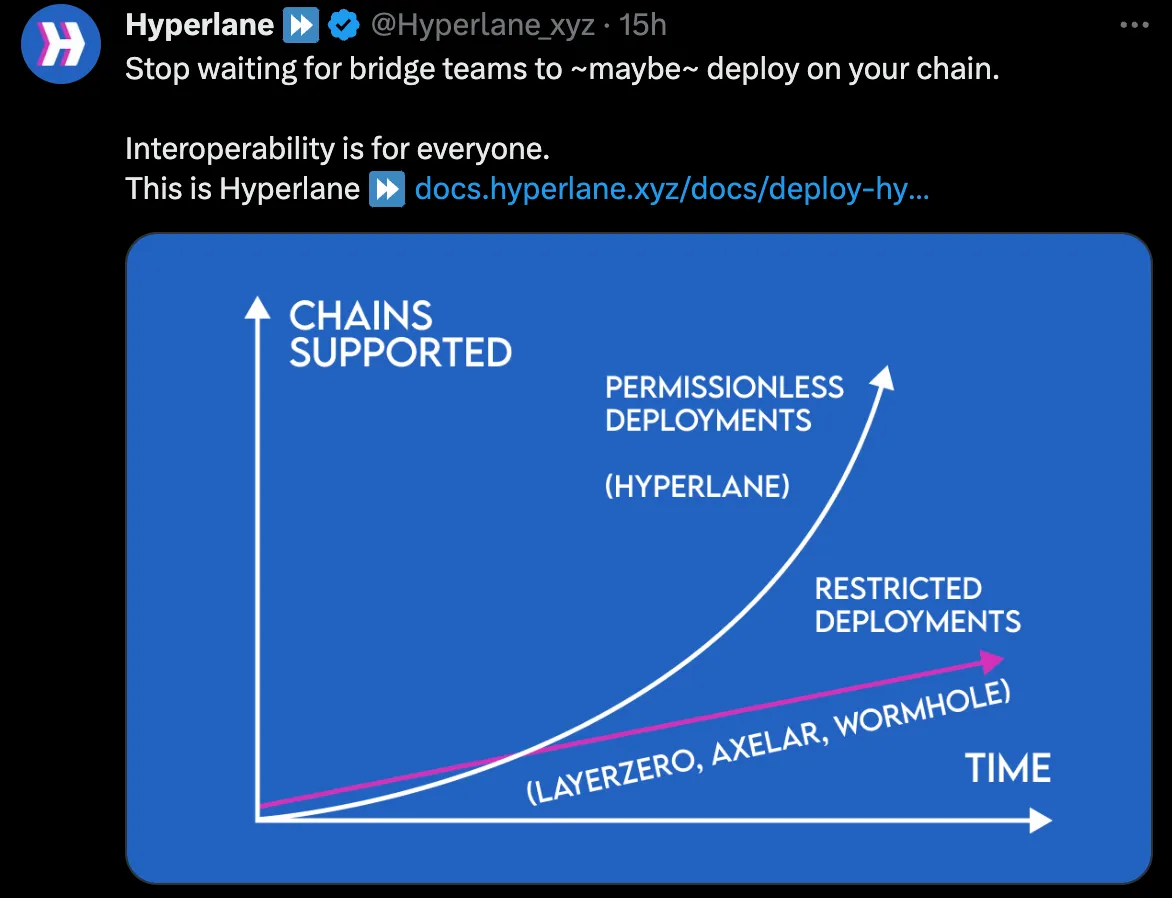
Unfortunately, I currently can’t find any token information for Omni or Hyperlane.
The Blockless: Powering dApps as You Use Them
In regular dApps, users can’t directly contribute computing power. Apps are constrained by specific L1/L2 limitations like latency, transaction speed, gas fees, etc.
Hence, Blockless adopts network-neutral applications (nnApps), allowing users to support apps simply by using them. It uses “nested nodes,” where each user’s device acts as a node, contributing resources to the network. This means app computational capacity scales with user growth — a significant shift from traditional models.
In short, you run a node while using the app.
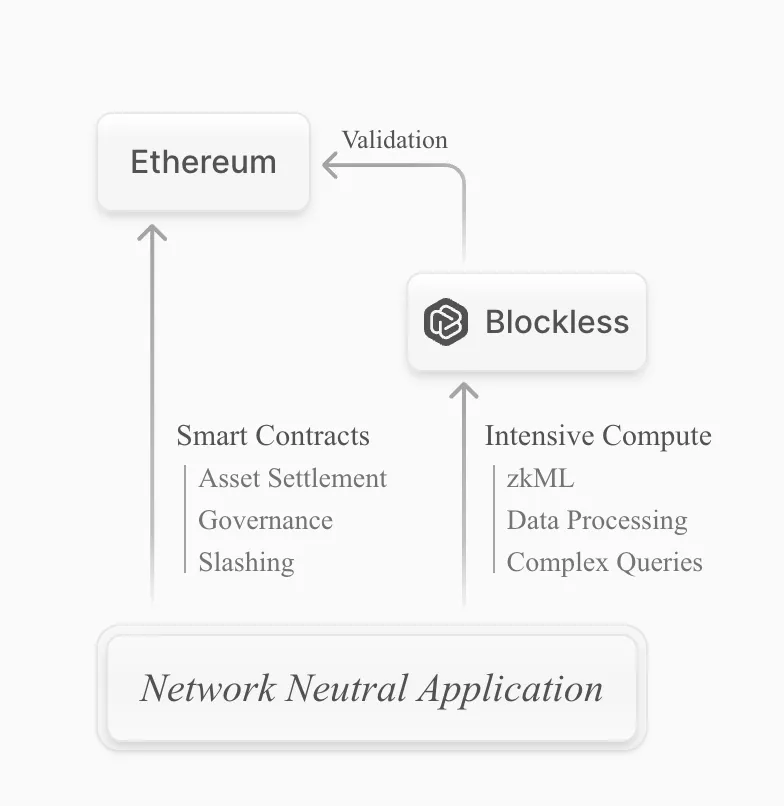
Blockless landing page
For instance, some dApps may keep governance on Ethereum and data availability workloads on Celestia or EigenLayer. But intensive computing tasks for machine learning, AI interfaces, and gaming will execute off-chain in faster, more efficient environments.
This causes app compute support to scale directly with user count — more users mean more community-provided computing power.
This reminds me of Grass, a Solana app that sells idle internet bandwidth to train AI, though it’s not part of Blockless.
Blockless uses proof-of-stake to secure its network, so its token isn’t just a meme.
Regarding restaking, Blockless will offer its network to apps built on EigenLayer to minimize unintended slashing.
Others
You can view the full list of AVS on the EigenLayer website. Notable mentions include:
-
Lagrange: Another competitor to LayerZero, Omni, and Hyperlane, building cross-chain infrastructure capable of generating universal state proofs across all major blockchains. Recently raised $4M seed funding from 1kx and others.
-
Drosera: An “incident response protocol” for breach control. When hacks occur, Drosera’s traps detect and act to mitigate attacks.
-
Witness Chain: Uses restaking for Proof of Diligence to secure rollups and Proof of Location to establish physical node decentralization.
Join TechFlow official community to stay tuned
Telegram:https://t.me/TechFlowDaily
X (Twitter):https://x.com/TechFlowPost
X (Twitter) EN:https://x.com/BlockFlow_News
 Ignas | DeFi Research