Restaking on Eigenlayer: The Bull Market Engine and the Origin of a Crypto Subprime Crisis
TechFlow Selected TechFlow Selected
Restaking on Eigenlayer: The Bull Market Engine and the Origin of a Crypto Subprime Crisis
"From the perspective of industry development trends, the market in which Eigenlayer operates is an extremely large market."
 Navigating Web3 tides with focused insights
By Kong
I posted a tweet over the weekend suggesting that Eigenlayer might become a double-edged sword. Now, while the market is quiet, I’ll share some of my highly subjective thoughts on Eigenlayer.
Before diving in, let’s clear up a common mental trap: we are investors, not builders. Technical details aren’t our main focus—they’re just nice-to-have extras. For us, every analysis must revolve around two key questions: “Can this project make us a lot of money?” and “How do we participate?”
So, the core issues we need to consider are:
-
What is Eigenlayer, and what does it do?
-
Is there real demand for Eigenlayer’s security services?
-
Are the promised restaking yields from Eigenlayer safe and sustainable?
-
Is Eigenlayer a future trend?
-
Do we have any opportunities with Eigenlayer?
...
What is Eigenlayer, and what does it do?
I believe many people get overwhelmed by technical jargon when researching Eigenlayer. But if you skip past all that, it becomes much easier to understand.
Eigenlayer is a middleware protocol built on Ethereum. It enables restaking of Ethereum staking derivatives (like stETH), allowing Dapps to inherit Ethereum-level security through this mechanism.
This process has two parts. First, creating a liquid restaking pool. For example, if I stake ETH via Lido and receive stETH, I can then restake that stETH into Eigenlayer’s liquidity pool and earn additional yield.
Second, opening up a marketplace where Dapps can access this pooled security, paying service fees to Eigenlayer in return. This boosts their security since it's now backed by ETH staking.
2. Is there real demand for Eigenlayer’s security services?
Many projects genuinely need this kind of security assurance.
Earlier discussions about Layer0 cross-chain solutions touched on similar points. Normally, PoS blockchains secure their networks by having users stake tokens to become validators. This is known as "staking."
More validators mean higher security and decentralization. To incentivize participation, PoS chains offer staking rewards—usually funded by token inflation. Conversely, malicious behavior results in slashing penalties.
But it's not just public chains that require security—Dapps like cross-chain bridges, DeFi protocols, and oracles also need robust protection.
However, most Dapps lack sufficient capital and technical resources. They often have fewer, more centralized nodes and handle critical functions like cross-chain messaging, making them among the weakest yet most important components in crypto.
For these teams, only two options exist: either build their own chain like dYdX or MakerDAO—but not every project can afford that—or outsource security to third-party providers like Eigenlayer. Otherwise, they remain vulnerable to serious security risks, especially cross-chain bridges.
Therefore, from an industry evolution standpoint, the market that Eigenlayer serves is enormous.
3. Are Eigenlayer’s promised restaking yields safe and sustainable?
For infrastructure projects like Eigenlayer, the stability and safety of staking yields are crucial. Because under Eigenlayer’s model, we could end up with infinite layers of recursive dependencies—an "infinite Lego tower." If the foundation cracks, it could trigger a 2008-style subprime crisis within crypto, causing massive damage.
And this is precisely where Eigenlayer faces its biggest challenge—one I still struggle to fully grasp.
The main appeal for stakers is the higher returns enabled by restaking. But where does Eigenlayer get the funds to pay these enhanced yields?
Money doesn’t appear out of thin air. There are only three ways to borrow and pay interest: first, a Ponzi scheme, using new investor money to pay old ones; second, generating revenue through operations; third, earning profits by investing in other projects.
Eigenlayer claims operational revenue—earning fees by providing AVS (Actively Validated Services) security to other protocols. Currently, around 500,000 ETH are restaked on Eigenlayer. To offer users an extra 1% yield, Eigenlayer would need to distribute 5,000 ETH. Many analysts predict excess yields as high as 9%, meaning Eigenlayer would need to cover over 5% beyond base ETH staking returns. At ETH = $2,200, that amounts to over $55 million annually.

$55 million means either 10 projects paying $5.5M each per year, 100 projects paying $550K, or 1,000 projects paying $55K. Given current industry conditions, this seems unrealistic in the short term.
Moreover, since Eigenlayer currently only accepts ETH-based derivatives and lacks B2B income, how can it offer yields above standard LSDs? The only way is for operators to deploy restaked assets into DeFi protocols to generate yield.
But then it becomes pure recursion. Even if DeFi protocols are secure, they may still fail due to poor management or high-risk strategies—and typically, higher-yielding protocols carry greater risk.
In theory, Eigenlayer ends up securing the very projects most likely to collapse—making the entire setup inherently risky.
Of course, some stakers aren’t chasing small yield gains at all—they’re here for potential airdrops. Their focus is on whether Eigenlayer will deliver generous token distributions and meaningful price appreciation.
From this perspective, the risk of pure yield recursion is somewhat mitigated. But clearly, this isn't sustainable long-term. Then again, it doesn’t need to be. Given Eigenlayer’s current trajectory, managing perception and token value may be enough…
Eigenlayer’s latest funding round raised $50 million. Combined with earlier rounds, total funding exceeds $60 million—an elite level for a protocol project. Backed by top-tier investors like Polychain, Coinbase, and Blockchain Capital, its secondary market price will likely enjoy solid support.
In the short run, Eigenlayer’s economic model may not hold water. But being positioned at the center of the airdrop frenzy works wonders. Institutional backing gives early-stage credibility, attracting massive numbers of yield farmers and boosting overall ETH staking rates.
Vitalik once wrote an article titled “Don’t Overload Ethereum’s Consensus,” but specifically noted that Eigenlayer’s restaking is acceptable—likely after weighing the trade-offs. After all, if something goes wrong, Ethereum won’t need a hard fork to fix it, and meanwhile, Eigenlayer helps increase staking adoption for Ethereum 2.0.
Back to Eigenlayer: if the story doesn’t work today, will it work tomorrow? I think yes—and it could become huge.
4. Is Eigenlayer a future trend?
Strictly speaking, Eigenlayer offers a SaaS (Software-as-a-Service) solution. If it were targeting Chinese projects and users, I’d be skeptical. Human nature and local conditions shape outcomes. China has spent years developing SaaS but produced few profitable giants—telling evidence indeed.
But in crypto, given its SaaS nature and niche, Eigenlayer naturally lends itself to a powerful narrative.
If the endgame for crypto is Metaverse or Web3, we’re inevitably heading toward a multi-chain world. Countless Dapps will deploy across chains, but most lack the funds to achieve strong security independently. As discussed earlier, they’ll have no choice but to rely on projects like Eigenlayer.
That market is worth billions—and in some ways, even encroaches on Layer0’s territory.
Layer0 also aims to provide shared security for cross-chain apps, but doing so via Layer0 is far less convenient than using Eigenlayer. Convenience drives progress.
As more projects join Eigenlayer, the restaking pool grows exponentially—like mortgage contracts piling up before 2008, forming towering structures that push Ethereum to unforeseen heights.
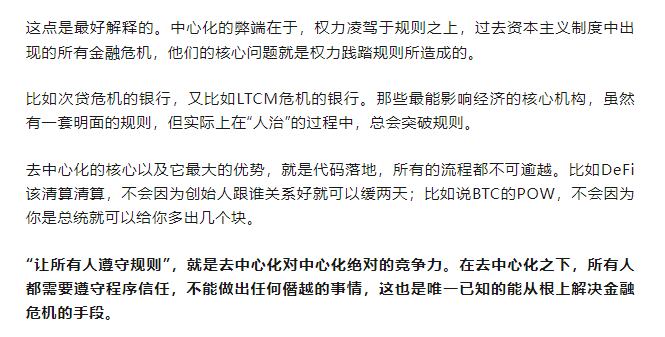
And it could withstand such systemic risks—if Eigenlayer remains sufficiently decentralized. For details, see this article—I won’t elaborate further:
5. Do we have any opportunities with Eigenlayer?
In summary, Eigenlayer is a narrative rich in long-term potential but unlikely to see tangible progress in the near term—and already well-populated by institutional storytellers.
For us retail participants, there’s only one practical way to engage right now: farming airdrops.
The reason is simple: while no real progress is expected soon, the market doesn’t demand it either. What matters is profit potential. With top-tier VCs already involved, there’s little room for undervalued gems in the secondary market. That leaves airdrops as the primary source of low-cost exposure.
Given its vast long-term vision and positive impact on Ethereum, another viable strategy is simply buying ETH and leading LSD sector tokens.
Still, remember: a great project doesn’t automatically mean a good buy—you also need a good price. Defining what constitutes a “good price” is beyond the scope of this article. I’ve covered it before and will write more on valuation frameworks in the future.
That’s all.
Join TechFlow official community to stay tuned
Telegram:https://t.me/TechFlowDaily
X (Twitter):https://x.com/TechFlowPost
X (Twitter) EN:https://x.com/BlockFlow_News