








Understanding Theta Network: A Blockchain-Based Decentralized Video Delivery Network
TechFlow Selected TechFlow Selected
Understanding Theta Network: A Blockchain-Based Decentralized Video Delivery Network
Theta Network has an ambitious development roadmap for 2024, primarily focused on the launch of Theta EdgeCloud.
 Navigating Web3 tides with focused insights
Author: Chain Tea House
1. Project Overview
Theta Network is a blockchain-based decentralized video delivery network designed to address key challenges in the current video streaming landscape.
Traditional video streaming services face the so-called "last-mile" delivery problem inherent in their reliance on content delivery networks (CDNs). Typically, CDNs require data centers located close to viewers around the world. However, due to the limited number of such data centers, they are often too far from most users. This creates bottlenecks in the streaming pipeline, resulting in unstable streams and poor video quality.
To solve this, Theta Network builds a peer-to-peer network that incentivizes viewers to share excess computing power and unused bandwidth. Since users’ devices are much closer to each other than to distant CDN data centers, this approach effectively solves the last-mile delivery issue.
The network and protocol are open-source, meaning anyone can build on the Theta blockchain. Content providers can develop decentralized applications (DApps) tailored to their audiences. DApps on the network can offer various forms of entertainment, including movies and TV shows, music, esports, live streaming, and remote learning. Video platforms already operating on Theta Network include Samsung VR, Cinedigm, Shout! Factory, and THETA.tv.
At the heart of the Theta blockchain are two native cryptocurrencies: THETA tokens (used for voting on protocol changes) and TFUEL (used to execute transactions).
2. Core Mechanisms
The core mechanisms of Theta Network revolve around its unique decentralized video streaming technology and economic model, which work together to improve video delivery efficiency and incentivize network participants.
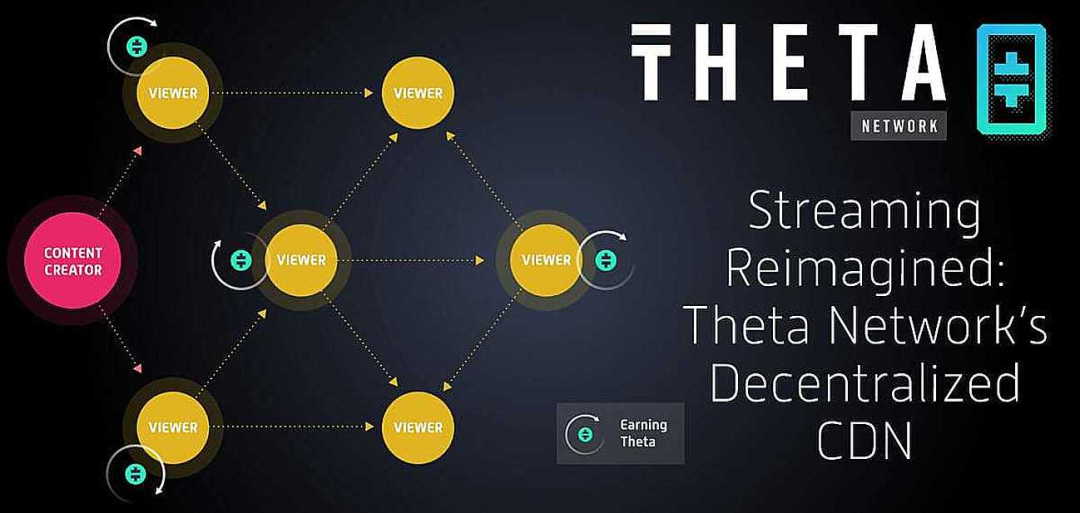
Below is a detailed overview of its core mechanisms:
Multilayer BFT Consensus Mechanism
Theta Network employs an enhanced Byzantine Fault Tolerance (BFT) consensus mechanism—a type of algorithm that maintains network security and consistency even when some malicious nodes exist. Theta improves efficiency and scalability by introducing two tiers: a small set of validator nodes and a larger group of guardian nodes. Validator nodes produce blocks and process transactions, while guardian nodes participate in finalizing consensus, enhancing decentralization and security.
Resource Sharing and Incentive Mechanism
Theta Network innovatively applies blockchain technology to video delivery by encouraging users to share unused bandwidth and computing resources for content distribution. Users who contribute resources are rewarded with Theta Fuel (TFUEL), the network’s utility token used for transaction fees, streaming services, and other functions. This mechanism drives greater user participation, increases available bandwidth and caching capacity, and ultimately improves video delivery quality while reducing costs.
Decentralized Edge Content Delivery Network (DEC)
Traditional CDNs rely on distributed servers to deliver content to end-users and reduce latency. Theta Network instead builds a Decentralized Edge Cache (DEC), leveraging idle computing resources and bandwidth from users worldwide to cache and transmit video content. This reduces dependency on traditional CDN infrastructure, lowers operational costs, and enhances delivery efficiency and scalability.
Smart Contract Platform
Theta Network integrates a smart contract platform on its blockchain, enabling developers to create decentralized applications—especially those requiring efficient video content distribution. Through smart contracts, creators, advertisers, and other stakeholders can interact directly without intermediaries, increasing transparency and efficiency.
Two-Token System
Theta Network uses a dual-token system consisting of Theta Token (THETA) and Theta Fuel (TFUEL). THETA is primarily used for governance—holders can vote on network upgrades and protocol parameter adjustments. TFUEL serves as the utility token for transaction fees, smart contract execution, streaming services, and more.
Together, these mechanisms form the foundation of Theta Network. By combining decentralization, resource sharing, participant incentives, and improved video delivery efficiency, Theta aims to overcome the limitations of traditional video distribution networks and provide a highly efficient, cost-effective solution for next-generation video streaming.
3. Tokens: THETA and TFUEL
Theta Network operates on a two-token system comprising Theta Token (THETA) and Theta Fuel (TFUEL), each playing distinct but complementary roles within the ecosystem.
Theta Token (THETA)
Primary Use: Theta Token (THETA) is primarily used for network governance. THETA holders can participate in decision-making processes such as proposing or voting on network upgrades and parameter modifications. This mechanism encourages active involvement in the development and maintenance of the network ecosystem.
Total Supply: The total supply of THETA is capped at 1 billion tokens. This fixed supply helps prevent inflation and supports long-term value stability.

As of now, the THETA token price stands at $2.54, down slightly by 0.09% over the past 24 hours, but up 127.71% over the past year. The market capitalization of THETA is $2,537,939,366, representing the total value of all circulating THETA tokens. The ratio of 24-hour trading volume to market cap is approximately 1.57%. Overall, THETA has experienced volatility over time, with significant peaks followed by declines visible on the right side of the chart. Current prices appear to have stabilized, though a slight increase in trading volume coupled with a price drop may indicate recent selling pressure or increased trading activity.
Theta Fuel (TFUEL)
Primary Use: Theta Fuel (TFUEL) acts as the "fuel" of the Theta network, powering transactions, smart contract execution, content-sharing incentives, video streaming, advertising, and more. TFUEL is essential for day-to-day operations, providing the necessary economic incentives to ensure healthy network growth and functionality.
Acquisition Methods: Users can earn TFUEL by sharing spare bandwidth and computing resources, watching ads, or participating in content distribution. Additionally, TFUEL is tradable on major cryptocurrency exchanges.
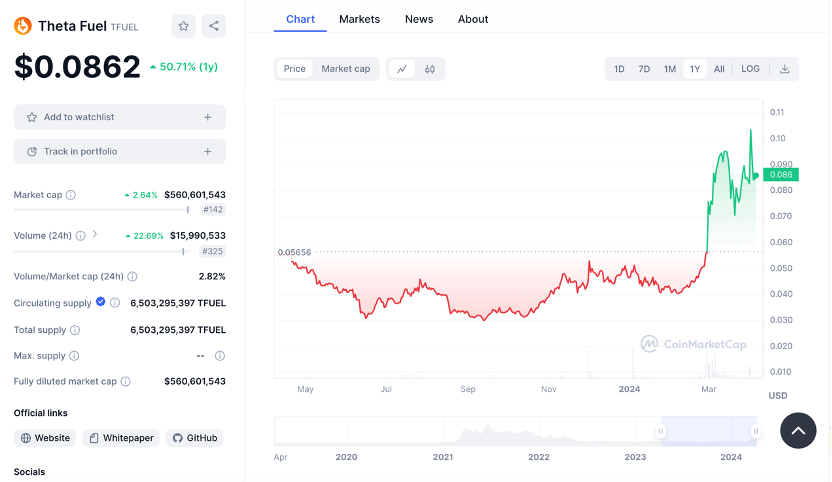
Supply Mechanism: Unlike THETA, TFUEL does not have a fixed supply. New TFUEL tokens are generated as rewards for network participants—including content sharers and validator nodes—in a process similar to crypto mining. This dynamic supply mechanism is designed to continuously incentivize user contributions and support ongoing network operations.
Token Complementarity
THETA and TFUEL serve complementary roles within the Theta Network: THETA focuses on governance and network security, while TFUEL powers daily transactions and operations. This dual-token design ensures both decentralized governance and sustainable economic operation. Through this mechanism, Theta Network encourages user participation and resource contribution while maintaining overall network health and security.
4. EdgeCloud
EdgeCloud is a decentralized software platform developed by the Theta team, scheduled for launch in May 2024. It aims to provide virtually unlimited GPU processing power for AI and video tasks at competitive pricing. Combining the best aspects of cloud computing, EdgeCloud is powered by Theta’s edge network—comprising nearly 10,000 active edge nodes globally—and ranks among the world's largest distributed GPU computing clusters. The first phase of Theta EdgeCloud is set to go live on May 1, 2024.
Key Features:
Decentralized AI Computing Platform: Theta EdgeCloud will enable developers, researchers, and enterprises of all sizes to access GPU computing power at optimal cost. Advanced AI developers will be able to manage full AI development pipelines—from prototyping using Jupyter Notebooks to training models, including hyperparameter tuning, neural architecture search, and fine-tuning. These trained models can then be easily deployed and served across EdgeCloud’s GPU network—optimized, instantly accessible, and scalable. They can run either on Ray clusters or bare-metal machines, offering greater control for expert AI practitioners.

Theta Edge Network: Launched in 2021 as Mainnet 3.0, it specializes in GPU-intensive video processing tasks such as encoding, transcoding, and distribution.
Processing Power: The global network delivers approximately 80 petaflops of computing power through high-performance GPU nodes—equivalent to about 250 Nvidia A100 GPUs.
Hybrid Cloud Decentralized Architecture: This enables Theta EdgeCloud to efficiently run large language models (LLMs) and text-to-video AI models such as Stable Diffusion and Llama2.
Software Development: Theta first patented its edge computing platform in 2021—a blockchain network supporting smart contracts that enables the creation of next-generation hybrid computing architectures.
Upcoming Features: AI developers will soon be able to easily select, deploy popular models, and build AI-powered applications on Theta EdgeCloud. Upgrades to the edge node software featuring Elite+ Booster capabilities are planned for release in spring/summer.
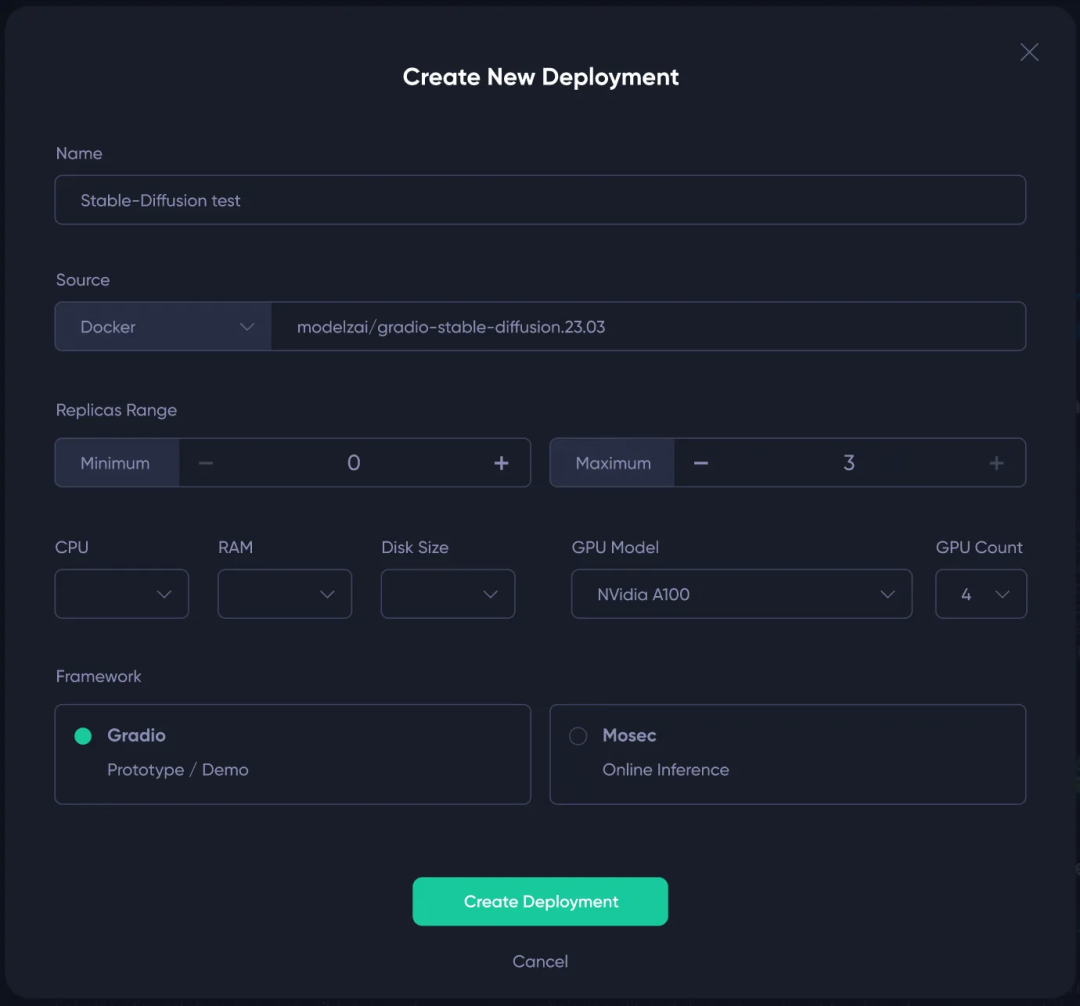
Community Engagement and Support: The Theta team encourages participation via Discord and Twitter to help drive development during the initial rollout of EdgeCloud.
Theta EdgeCloud demonstrates Theta Network’s ambitious expansion into AI and video processing, showcasing its strong capabilities in distributed edge computing. As it continues to evolve and scale, we can expect a wave of innovative applications and services to emerge.
5. Team
Theta was founded in 2018 by CEO Mitch Liu and CTO Jieyi Long.
Mitch Liu holds a degree in Computer Science and Engineering from MIT and an MBA from Stanford Graduate School of Business. He is also a co-founder of several ventures, including mobile social gaming studio Gameview Studios, ad and app monetization platform Tapjoy, and the live-streaming dApp THETA.tv.
Jieyi Long earned a Ph.D. in Computer Engineering from Northwestern University and co-founded THETA.tv with Liu. He has developed multiple patented technologies, including instant replay systems for video games and live virtual reality broadcasting. The Theta leadership team also includes CPO Ryan Nichols, formerly Director of WeChat Applications at Tencent.
Notably, the project has attracted investors such as Samsung, DHVC, IBC, and Sony Innovation Fund. Theta’s advisory board includes YouTube co-founder Steve Chen, Twitch co-founder Justin Kan, and executives from Verizon, Rakuten Viki, and CJ Hello.
Theta Network has completed one known funding round—an undisclosed private investment on May 3, 2023.

6. User Guide
How to Use Theta Network?
Members of the Theta community can stake THETA to become Guardian nodes. They can also contribute computing resources by hosting Theta Edge Nodes, which support video capture, transcoding, caching, and relaying. THETA tokens are used for staking as Validator and Guardian nodes, as well as for participating in protocol governance.
How to Choose a Theta Network Wallet?
-
THETA tokens can be stored in the project’s official Theta Wallet, available for Android, iOS, and Web platforms.
-
Hardware wallets or cold wallets such as Ledger or Trezor offer the highest level of security through offline storage and backup. However, they require more technical knowledge and come at a higher cost, making them better suited for experienced users holding large amounts of THETA.
-
Software wallets provide another option—they’re free and easy to use, downloadable as smartphone or desktop apps, and can be either custodial or non-custodial. With custodial wallets, your private keys are managed and backed up by the service provider. Non-custodial wallets store private keys securely on your device. While convenient, they are considered less secure than hardware wallets and may be more suitable for smaller holdings or beginners.
-
Online or web wallets are also free and user-friendly, accessible from multiple devices via web browsers. However, they are classified as hot wallets and generally less secure than hardware or software alternatives. Since you trust the platform with your assets, it’s important to choose reputable services with strong track records in security and custody. These are best suited for holding small amounts of cryptocurrency or conducting frequent transactions.
7. Future Outlook
Theta Network has an ambitious roadmap for 2024, centered on the launch of Theta EdgeCloud.
The company’s 2024 plans include launching the next-generation EdgeCloud network, featuring cloud-hosted nodes operated by Theta and the Theta Elite+ booster module to enhance EEN (Elite Edge Node) performance; focusing on developing MetaChain, EdgeCloud, and DePIN (Decentralized Physical Infrastructure Networks); introducing new adoption metrics and subchain statistics to support new ecosystem projects, sidechains, TN20 tokens, and staking; enhancing the Theta Video API with features like self-service NFT DRM support for live and on-demand streaming, along with advanced analytics dashboards, among others.
Of course, as an innovator in video streaming and distributed technologies, Theta Network also faces several challenges ahead.
First, it remains a relatively new project, and longevity plays a significant role in determining platform reliability. Second, liquidity is low. Combined with its centralized and private initial token offering—which reduces transparency—and issues such as high buffering requirements on Theta.TV, these represent clear drawbacks.
Moreover, as the number of users and use cases grows, ensuring seamless network scalability to meet rising demand becomes a challenge. This includes maintaining low latency, high throughput, and optimized performance. Additionally, despite its strong technological potential, the pace of adoption by users and content creators could impact the network’s success. Simplicity of user experience and practical utility are critical for attracting non-technical users. Maintaining the stability of the Theta token economy—including supply, demand, and incentive structures—is essential for sustained participation.
Overall, Theta Network’s future depends on multiple factors, including technological innovation, ecosystem growth, community engagement, regulatory developments, and competitive dynamics. Despite facing challenges, Theta leverages blockchain technology to solve real-world problems, backed by a clear growth strategy and strong partnerships, positioning itself as a potential leader in the industry.
Join TechFlow official community to stay tuned
Telegram:https://t.me/TechFlowDaily
X (Twitter):https://x.com/TechFlowPost
X (Twitter) EN:https://x.com/BlockFlow_News






