








AI Arena: An AI model training factory disguised as a game, with TGE coming in May (airdrop tutorial included)
TechFlow Selected TechFlow Selected
AI Arena: An AI model training factory disguised as a game, with TGE coming in May (airdrop tutorial included)
AI Arena is more like an AI model training camp wrapped in the shell of a game.
 Navigating Web3 tides with focused insights
Written by: TechFlow
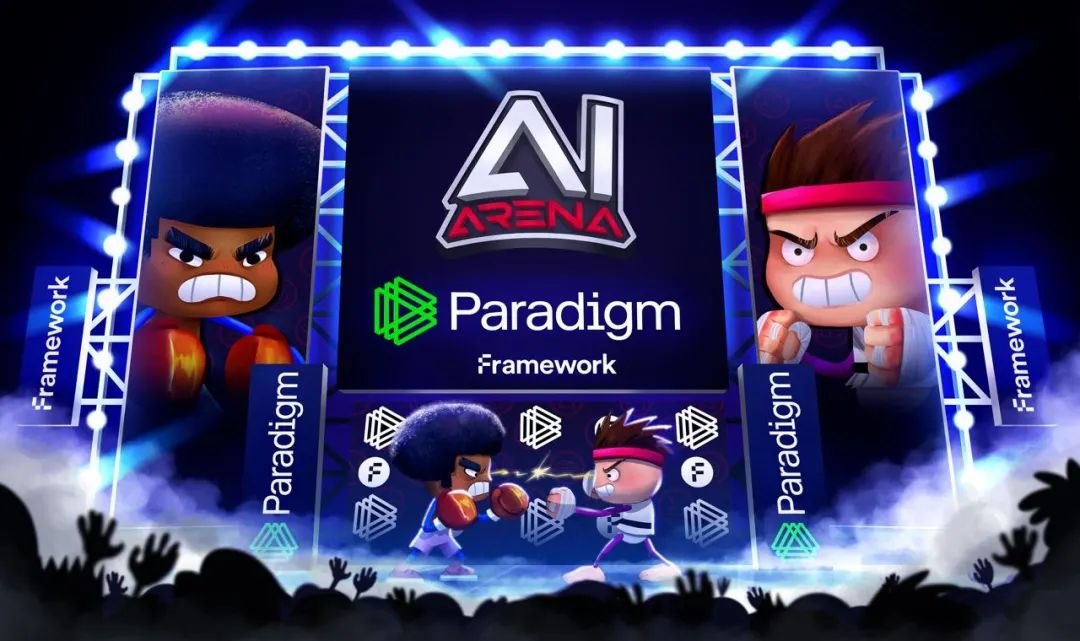
Whether attending industry events in Hong Kong or Dubai, one conclusion stands clear: AI is the biggest consensus between East and West in this bull market.
We openly express our enthusiasm for the AI narrative. However, most current AI concepts focus on infrastructure—too distant from end users, like castles in the air. So, are there truly applications that let users tangibly experience AI?
The answer is yes: AI Arena, a blockchain game integrating AI, with its seed round led by Paradigm.
As someone born in the 90s, my childhood joy was filled with classic fighting games like "King of Fighters" and "Street Fighter." Whether playing against the machine or head-to-head with friends, the core of gameplay remained human-driven.
In the age of AI, let’s expand our imagination: what if, in player-versus-machine battles, the machine side were an intelligent agent with thoughts? What if we could infuse our own consciousness into game characters, giving them digital souls—digital avatars of ourselves? Wouldn’t that be cool? This is exactly what AI Arena aims to achieve.
AI Arena is a PvP fighting game where players evolve their characters through AI learning. Through AI Arena’s training platform combined with artificial intelligence, we can store our operations, awareness, and thinking within AI models. As a result, game characters fight according to how we’ve trained them. In AI Arena, it's not just avatars battling—it’s our digital souls, a version of ourselves from another world.
AI Arena’s combat mode resembles Nintendo’s “Super Smash Bros.”
Currently, two game modes are available: Research Competition and Gaming Competition.
In the Research Competition, researchers compete using their best machine learning (ML) models. Researchers train their AI models in the Python environment provided by AI Arena and upload them on-chain to battle against other researchers’ AI models. Top-performing researchers earn rewards in AI Arena’s native token.
In the Gaming Competition, players from around the world compete by developing optimal training strategies to maximize their NFT’s performance in the arena. As mentioned earlier, each NFT character contains an AI model that learns to fight by mimicking your actions and then autonomously controls your NFT during battles. As players climb the global AI Arena leaderboard (ranked matches), they also earn the game’s native token as rewards.
If I were to define AI Arena simply as a Web3.0 game applying AI, I’d consider that view too narrow. AI Arena is more like an AI model bootcamp wrapped in a gaming shell—using gaming as a scenario to help more users access, understand, and experience AI, while enabling AI engineers to contribute various AI algorithms on the platform.
If you see AI Arena merely as a game, its tokenomics follow the traditional “Play to Earn” model. But if you see it as an AI model training project, then its tokenomics become “Train to Earn.”
AI Arena’s native token is called $N. It incentivizes both researchers and players to participate in this AI competition and forms the foundation of AI Arena’s economic flywheel.
Players
-
Players train AI characters to participate in ranked matches. Entry requires staking $N, with the chance to earn more $N as rewards;
-
Game items: Players can use $N to purchase batteries, charge their NFTs, and then battle in ranked matches;
-
Deposit $N into the merging pool to obtain stronger NFTs (explained in detail below).
Researchers
-
Researchers can stake $N to participate in research competitions (AI algorithm models) and have the chance to earn additional $N rewards.
The merging pool is a unique mechanism in AI Arena, primarily designed to control NFT inflation, burn $N, and give players a chance to obtain more powerful NFT characters.
Before entering a ranked match cycle, players may choose to deposit a portion of their $N winnings from that round into the merging pool. The more $N contributed to the merging pool, the higher the probability of winning an NFT. All $N deposited into the merging pool is permanently burned.
As the name suggests, the system selects NFTs that were staked during a specific round of ranked matches and makes them compete. Through competition, the system determines which NFTs will be merged to create more powerful ones.
Once merging is complete, a new batch of enhanced NFTs is generated, inheriting the skills of the original NFTs. These then re-enter competition, creating a continuous cycle through which NFTs keep evolving and growing stronger over time.
Therefore, overall, the main use cases for $N include staking in ranked matches, consumption in the merging pool, and in-game item purchases.
AI Arena’s parent company, ArenaX Labs, announced in October 2021 the completion of a $5 million seed funding round led by Paradigm, with participation from Framework Ventures.
On January 9, 2024, ArenaX Labs completed another $6 million funding round led by Framework Ventures, with participation from SevenX Ventures, FunPlus/Xterio, and Moore Strategic Ventures.
Compared to the front-facing AI Arena, the developer behind it—ArenaX Labs—may be even more worth watching.
AI Arena is the first flagship AI game launched by ArenaX Labs. As an AI company, ArenaX Labs has developed two foundational AI platforms:
-
ARC- A platform allowing other game developers to build AI-powered games using its core technology, enabling human players to teach AI through imitation learning. AI Arena is a prime example of such a game.
-
SAI - A platform that gamifies complex machine learning training and competitions, engaging the AI community in solving real-world problems through compelling game environments.
Through these two platforms, traditional game studios can leverage their underlying technology to quickly build their own AI game models.
Gaming is the ideal user engagement scenario. Ultimately, ArenaX Labs aims to change gaming with AI—and also change AI through gaming. That’s why I call it an AI company disguised as a game studio.
According to information previously released by the official team, the $N token is expected to launch via TGE in May. 0.8% of the total supply will be allocated to participants of the “TGE Points” airdrop campaign. By completing related social tasks, users can earn points redeemable for tokens in the future.
For example, posting a tweet on X with the theme “Why $N is AI Gaming” and tagging #Nisaigaming earns you TGE points. Participation isn’t limited to KOLs—anyone can join.

Participation link:
https://hub.aiarena.io/ref/2A66MW9N
The three co-founders of ArenaX Labs are Brandon Da Silva, Wei Xie, and Dylan Pereira. Brandon Da Silva and Wei Xie both spent years working at OPTrust, one of Canada’s largest pension funds. Dylan Pereira serves as Art Director and previously worked as a designer at Titmouse, an independent animation studio in the U.S., with deep collaborations with NETFLIX.
Among currently issued tokens, the highest market cap AI-related gaming asset is likely $PRIME. Whether AI Arena can succeed $PRIME as the next star in AI gaming remains to be seen—but it’s certainly worth anticipating.
Join TechFlow official community to stay tuned
Telegram:https://t.me/TechFlowDaily
X (Twitter):https://x.com/TechFlowPost
X (Twitter) EN:https://x.com/BlockFlow_News
 深潮TechFlow


