Quick Overview: The 8 Projects That Made It to the Final Round of Scaling Ethereum 2024
TechFlow Selected TechFlow Selected
Quick Overview: The 8 Projects That Made It to the Final Round of Scaling Ethereum 2024
TxFusion introduces a new wallet method called wallet_sendCalls.
 Navigating Web3 tides with focused insights
Written by: TechFlow
From April 5 to 26, Ethglobal hosted a hackathon event named Scaling Ethereum 2024.
The event brought together some of the top thinkers and experts in the Ethereum ecosystem, providing rich Web3 resources (such as mentors, partners, and software) enabling teams to accomplish great things in just over two weeks.
Below are eight projects that made it into the final round.
Monadic DNA: Privacy Protection for Personal Genetic Data

Monadic DNA is an illustrative example showcasing what a new privacy-respecting paradigm for personal genomic services might look like.
We envision a future where individuals own their genomic data without having to disclose it to any provider, yet still enjoy the benefits of this rapidly advancing field.
Once someone receives a raw DNA file from a provider, the Monadic DNA portal allows them to upload the data and receive a DNA passport.
In the background, the raw data is processed (and then discarded), with portions stored as secrets on the Nillion network. The actual DNA passport returned to the user contains an identifier, some useful hashes, and metadata about the secrets stored on the Nillion network.
On-chain proofs based on off-chain computation provide an open, scalable paradigm for medicine that respects anonymity and privacy.
SignKaleidoscope: Visualizing Signature Paths Through Dynamic Graphics
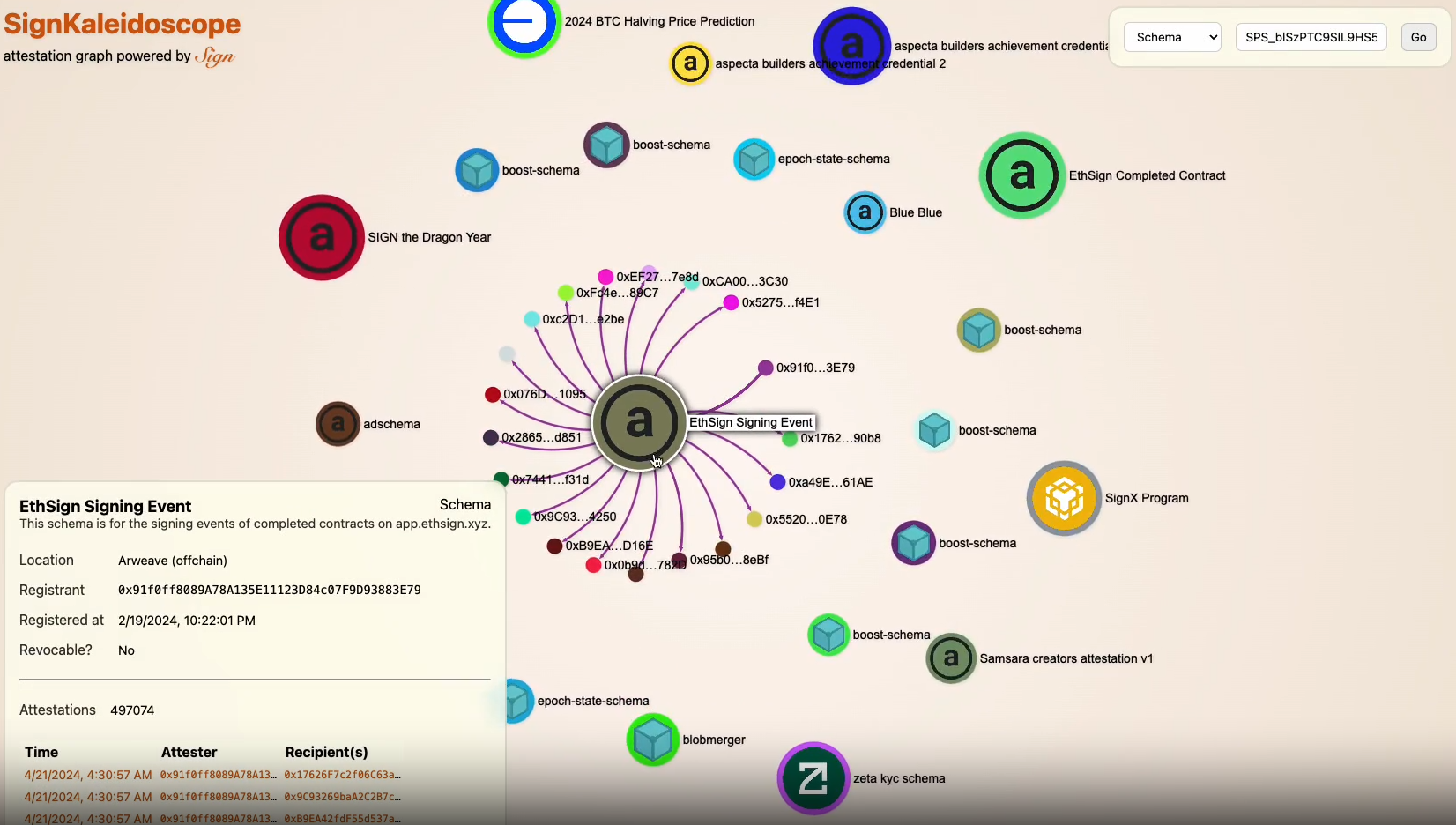
SignKaleidoscope is a Sign Protocol browser with interactive graphical visualization capabilities.
Explore accounts, patterns, and attestations by clicking nodes and edges in the graph, using the search field, or navigating links within detail overlays. Drag to pan the graph and scroll to zoom in and out. Nodes and edges automatically appear and connect in the graph when new entities are discovered.
EthereumL10nService: Decentralized Translation Network with AI and Human Validation
To enable Ethereum to reach the next billion users, we need to break down language barriers. Only 16% of the global population speaks English, yet over 60% of online content is in English.
Therefore, the project is building an incentivized network for AI translation agents and human validators.
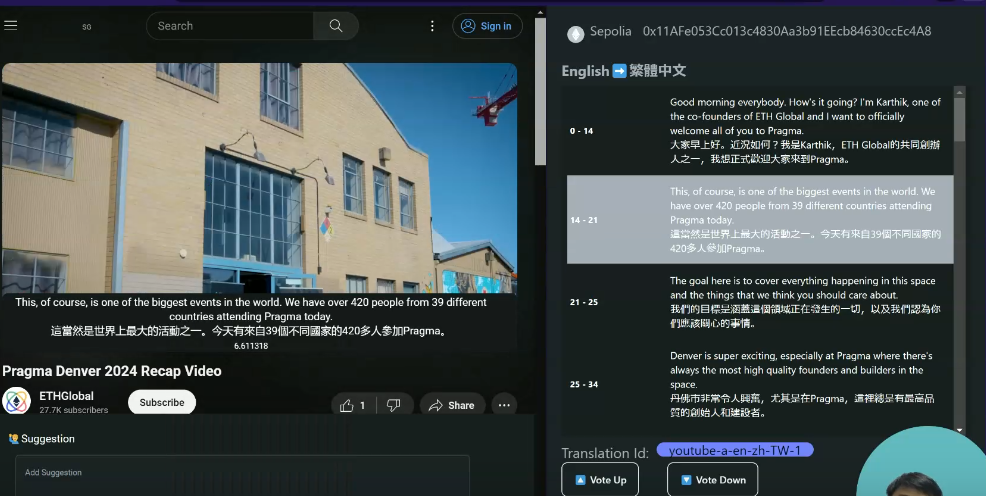
In the project's demo, it translated videos from the Pragama Denver Playlist on YouTube. Using OpenAI Whisper for ASR to transcribe audio into original English transcripts, then prompting OpenAI LLMs to generate final translations (in Traditional Chinese) in vtt format.
The vtt subtitle files are uploaded to IPFS for decentralized processing and execution by AI; through a Chrome extension, we can view translated subtitles, and end-users can provide feedback via upvotes/downvotes similar to StackOverflow. These votes create cryptographic proofs via users' wallets and are sent back to our server.
This enables us to prevent abuse and further calculate incentive distribution based on contributions.
TxFusion: Executing Multiple Transactions in One Call and Signature
TxFusion is a platform designed to simplify and improve the user experience of managing multiple DeFi transactions. It leverages the new EIP5792 standard, introducing a new wallet method called wallet_sendCalls. This method enables users to create batched transactions, allowing them to execute multiple operations through a single call and signature.
DeFi users often face the complexity of managing numerous transactions across various protocols such as Uniswap, Compound, and Aave. This process can be extremely time-consuming and cumbersome, leading to suboptimal user experiences. Executing multiple transactions also requires more gas fees.
The project addresses this challenge by offering a unified platform that simplifies the execution of multiple DeFi transactions.

forge flamegraphs: Solidity Development Optimization Tool
When we have reliable code and want to optimize it, currently there are limited tools available to help. There is no actively maintained open-source Solidity profiler compatible with Foundry or Hardhat. This makes the gas optimization process very time-consuming and certainly requires significant expertise.
For these reasons, only experienced Solidity developers excel at gas optimization, as they are better at guessing and drilling down which parts will consume more gas.
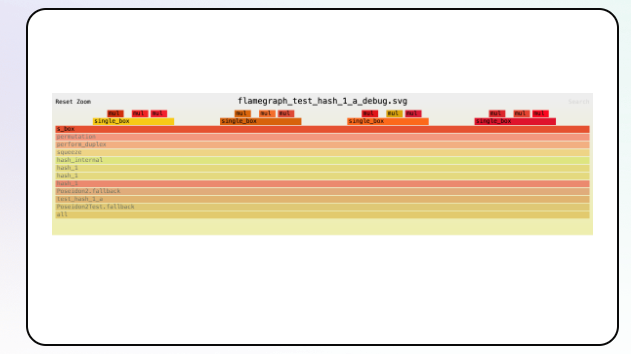
Flamegraphs are used to analyze system software and identify performance bottlenecks. We built a Forge plugin that parses low-level debug traces to generate folded stack traces and visualizations, clearly showing which areas should be optimized, thereby lowering the development barrier.
CreateToolBelt: Smoother Smart Contract Deployment
CreateToolBelt is a comprehensive toolkit designed to address multiple challenges developers face when deploying contracts on the Ethereum blockchain.
The suite consists of three main components: Create2Deployer, Create2SafeDeployer, and Create3Deployer.
Create2Deployer allows deterministic contract deployment using the CREATE2 opcode, enabling developers to deploy contracts at predictable addresses. We enhance this with Create2SafeDeployer, which employs a novel approach to prevent frontrunning by utilizing salts linked to the first 20 bytes of msg.sender, ensuring only the deployer can execute as intended. Finally, Create3Deployer extends these capabilities across multiple blockchains, allowing deployment at the same address on different chains using only the deployer’s address and salt—a groundbreaking step for developers handling interdependent contracts across multiple platforms.
ChainSweep: Cross-Chain Version of the Blockchain "Minesweeper" Game
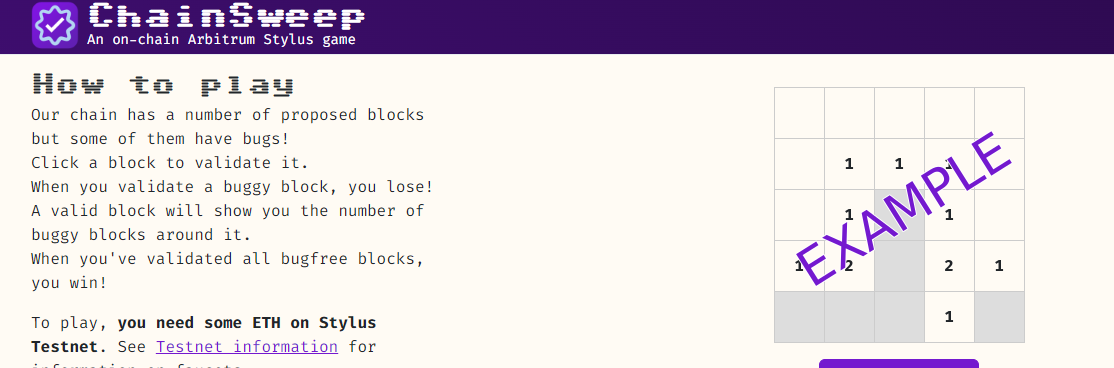
The game is a blockchain-based implementation similar to the famous "Minesweeper" game.
In the block field, you must verify blocks while avoiding those containing errors. If you click on a defective square, you lose. When you successfully verify all blocks without error, you win.
The game runs entirely on-chain (on the Arbitrum Stylus testnet). Every move you make is a separate transaction.
Critical information in the game is the exact location of errors (fields that should not be clicked). If the smart contract were to choose these locations and store them on-chain, winning the game by simply checking a block explorer or other tools would be trivial. To avoid this, the contract stores only fields revealed so far. When a player makes a new move, the smart contract regenerates possible error configurations consistent with all previous moves, keeping the game unpredictable.
BlobFusion: Making Blob Space More Affordable for Everyone
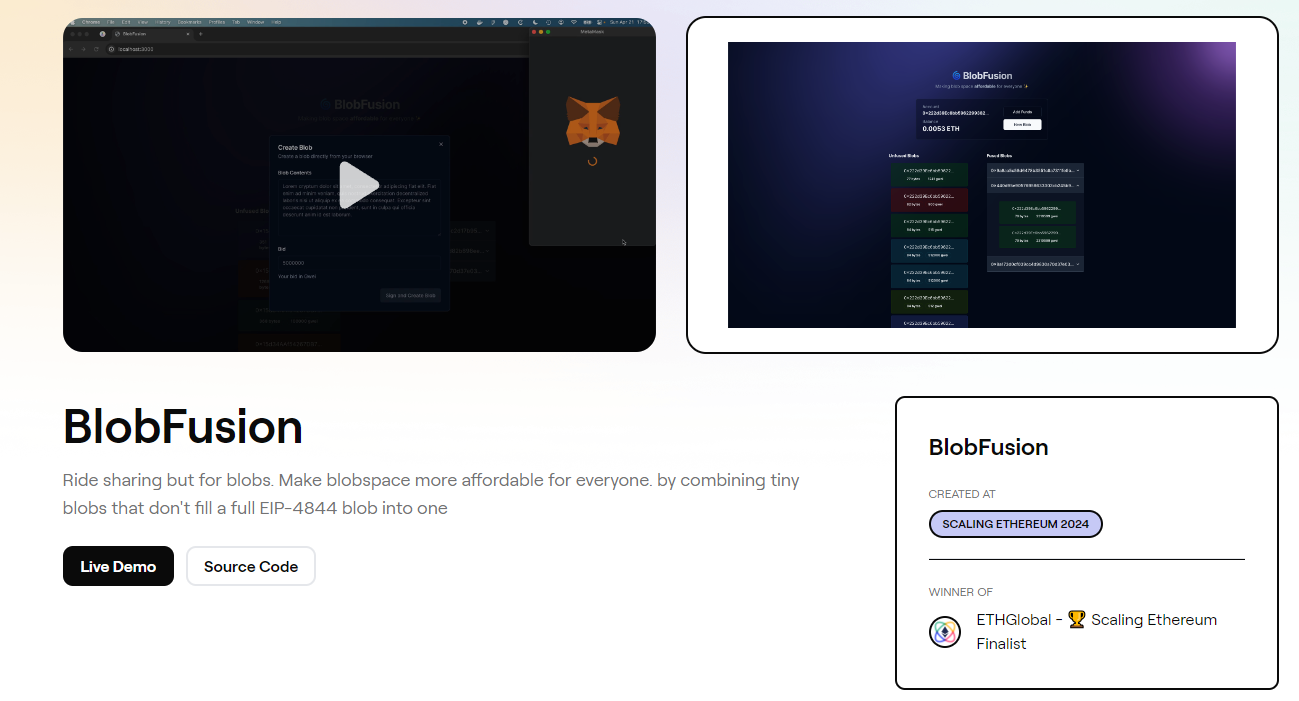
A month ago, Dencun launched, bringing us EIP-4844 and blobs.
The problem: You always have to submit a full 128KB blob. Even if your data is smaller, you still need to submit 128KB. This wastes unnecessary space and costs a lot of money.
BlobFusion allows you to share a blob with others by packing smaller blobs into a single regular blob. This maximizes blobspace efficiency (= good for the network) and cost savings (= good for users).
How does it work?
-
Users send some ETH to an Arbitrum smart contract
-
The server indexes transactions and allows users to submit blobs
-
Users send their blob along with a signature and the fee they are willing to pay to the server
-
The server saves the blob to its database
-
The server periodically attempts to construct a blob meeting all conditions (e.g., shared blob cost < sum of all bids, etc.)
Join TechFlow official community to stay tuned
Telegram:https://t.me/TechFlowDaily
X (Twitter):https://x.com/TechFlowPost
X (Twitter) EN:https://x.com/BlockFlow_News
 深潮TechFlow