








Decoding MOMO AI: An AI-Powered Gaming and Social Growth Platform Built on the Ton and Solana Ecosystems
TechFlow Selected TechFlow Selected
Decoding MOMO AI: An AI-Powered Gaming and Social Growth Platform Built on the Ton and Solana Ecosystems
The emergence of MomoAI has validated the effectiveness of its growth model through its own game.
 Navigating Web3 tides with focused insights
Author: TechFlow
Regardless of market fluctuations, the pursuit of Alpha remains an unchanging truth.
While the crypto market has recently shown uncertain volatility, several localized hotspots have emerged on-chain:
For example, the TON ecosystem is gradually gaining momentum, with its TVL increasing by 661% over the past two months. Backed by Telegram, which boasts 900 million users, expectations are sky-high. Meanwhile, official initiatives like the Open League are attracting developers and users, leading to a surge in Web3 mini-games built on Telegram.
On another front, Solana continues to heat up. High transaction activity and low fees make it inevitable for Solana to generate new Alpha through a transition from quantitative to qualitative change.
At the same time, AI remains a year-round focal point across the crypto space, with the narrative that "AI helps crypto become better" now widely accepted as correct.
So what should we be paying attention to?
On-chain opportunities often arise at the intersection of multiple trends—seeking new seeds within this convergence greatly increases the likelihood of significant gains.
With this in mind, MOMO AI—a project that recently hit multiple sweet spots—may be a candidate impossible to ignore:
An innovative AI-driven game and social growth platform integrating viral mechanisms and AI-bot interaction technology, focused on rapid user acquisition and deep engagement within the Telegram ecosystem.
Its Telegram-based points and airdrop game MOMO has attracted over 500,000 users in just half a month, standing out on active dApp rankings. Public information indicates that its project token $MTOS is expected to launch at the end of April or early May.

How did such a simple mini-game spark such massive user enthusiasm and growth? What did MOMO AI get right?
Beyond curiosity, we’re more interested in whether this growth momentum can be sustained. After all, experience in crypto shows that standalone games typically face hard ceilings.
What could be the ultimate outcome for a small game? How can AI agent technology enable broader ambitions and empowerment?
In this article, we examine MOMO AI’s first game to analyze a compelling story of growth and viral expansion, while glimpsing the larger ambition behind building a game growth platform.
Growth First: An Effective Path to Rapid User Acquisition
What exactly is MOMO AI?
Before answering that, many readers may not have heard of it at all.
But this reflects the reality—and harshness—of Web3: No one cares who you are until you succeed; only when you gain traction do people start asking.
Thus, growth becomes paramount. Web3 is an attention economy—locking users into your product and rapidly converting them into measurable growth forms the foundation for any evolving narrative.
When growth becomes the key metric for Web3 projects, those who excel are far more likely to be remembered.
From this perspective, MOMO AI has already delivered strong results:
First, rapid growth of the flagship game. Before launching its platform token, MomoAI released a Telegram-based airdrop game called Momo. Within just 14 days, it surpassed 500,000 users, consistently ranking among the top 4 Solana dApps (on-chain interactions on Solana) and entering the global dApp top 20.

Beyond user acquisition, retention metrics are also impressive.
Data shows that Momo’s daily active users reached 200,000, with a 35% 7-day retention rate and 25% 14-day retention—outstanding figures for a Web3 game.
Cold start, virality, and growth—by these metrics, Momo performed well. Why has its growth strategy proven effective?
We believe the key lies in fusing minimal interaction, viral mechanics, and reward anticipation into one seamless experience.
First, MOMO is a game embedded in Telegram, accessible via BOT commands. For Telegram users, there's virtually no learning curve—just click and play.
The core gameplay is easy to grasp—you can think of it as a Telegram version of “harvest games” or “Ant Forest”:
Plant a tree, collect Kiwi points regularly. As the tree levels up, its Kiwi generation efficiency increases. Eventually, Kiwi points can be redeemed for $MTOS, the native token of the MomoAI project.
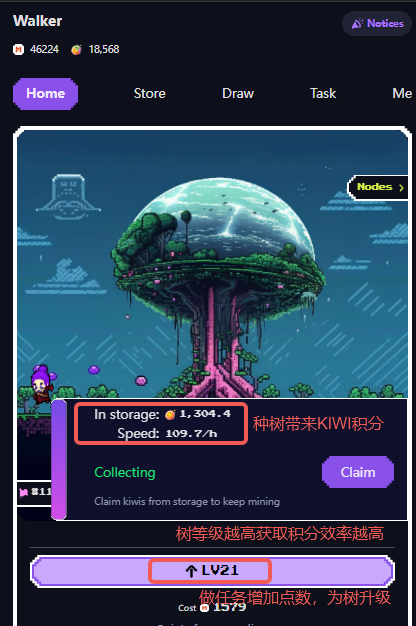
From a gameplay standpoint, the first key feature is: ultra-simple interaction, extremely low barrier to entry. Users don’t need to spend much time actively “playing”—just periodically check in to harvest points, complete tasks to level up the tree, earn more points, and repeat, eventually claiming airdrops.
Since higher tree levels yield faster Kiwi accumulation, the resource Points—which help upgrade the tree—become the key lever driving viral spread:
Points are primarily earned through in-game “lucky draws.” To increase draw attempts and win probability, users must complete tasks like following, referring, and sharing—actions that naturally drive user virality.
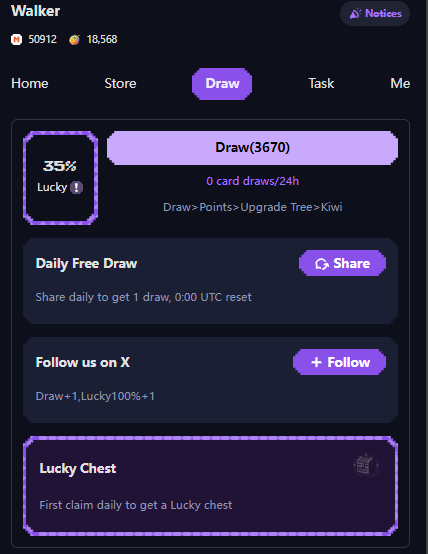
This mechanism closely resembles Pinduoduo’s “invite friends to cut price” model—turning platform growth into gamified user tasks. Under the expectation of redeeming points for tokens, users voluntarily complete marketing actions, indirectly boosting new user acquisition, activation, and promotion, creating a self-sustaining viral loop.
For players, MOMO thus becomes a lightweight cycle: log in, harvest, upgrade, harvest more, and eventually claim future token rewards.
What makes this product design advantageous for Web3 project growth?
On the demand side, Web3 users play MOMO primarily for economic incentives rather than entertainment.
MOMO’s design directly targets this core motivation—no detours, no hurdles. It straightforwardly rewards greater contributions with more points and airdrops. Simultaneously, through sharing and inviting, the game achieves rapid viral growth.
On the experience side, MOMO serves as light entertainment during Telegram interactions. Minimal effort leads to reward expectations, cultivating a subconscious habit where players feel: “I can benefit without heavy investment, and recommending it benefits me even more.” This gives MOMO a unique niche in the Web3 gaming landscape.
On the operational side, this single product mechanism supports three distinct user segments:
For zero-cost (“0撸”) users willing to invest time, additional viral tasks are provided. For frequent on-chain interactors, claiming Kiwi boosts output, encouraging continued engagement. For investors, purchasing in-game items directly increases resources and Kiwi yield, satisfying their ROI-focused mindset.
When all three user types are engaged, user growth and retention naturally become more significant.
But the project is named MomoAI—where does AI come into play?
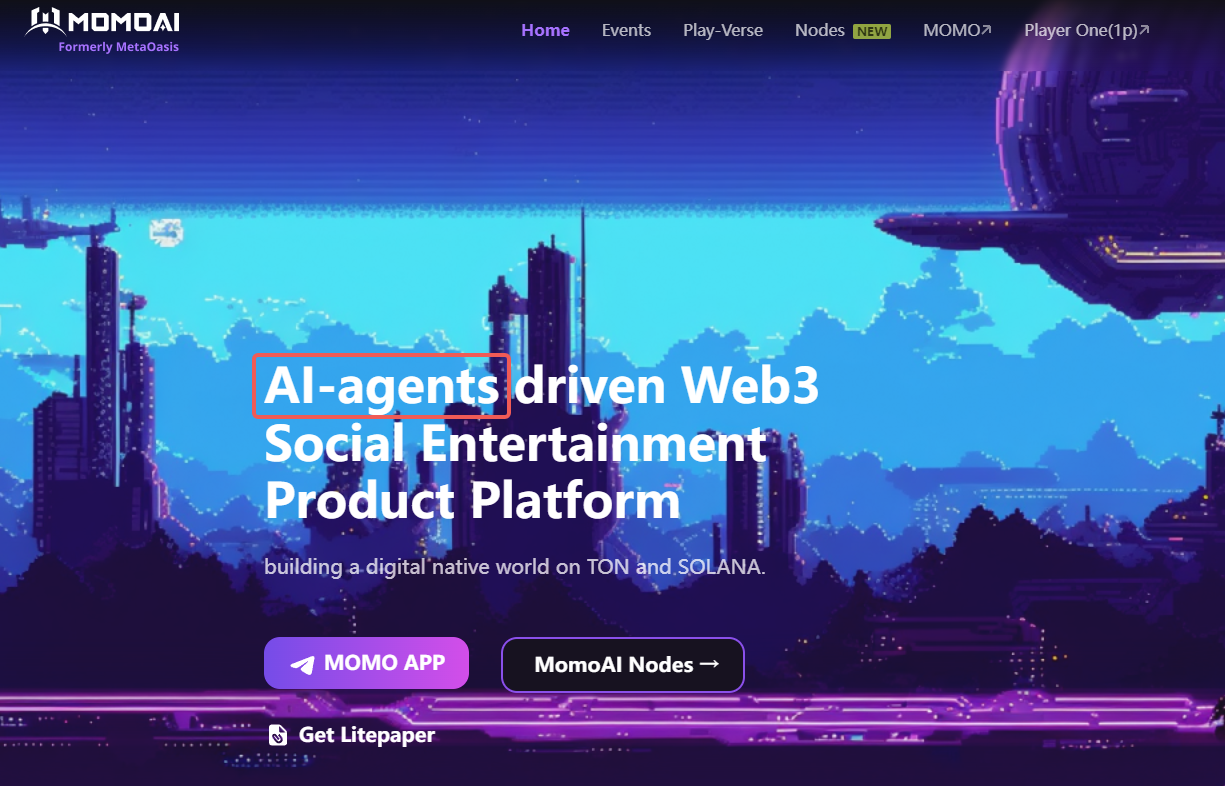
The answer lies in AI agent technology elevating the game interaction experience.
Whether MOMO or other Telegram mini-games, most rely on simple fixed commands to earn airdrops and points—filled with mechanical, repetitive steps.
As a result, despite different skins, games in the TON ecosystem share similar cores. To stand out in competition, even a small step forward in interaction could become a major leap in user acquisition.
In MOMO’s roadmap, later stages will introduce AI-BOTs enabling natural language interaction with the game.
Players could input phrases like “Collect my Kiwi points every day at 8 AM” or “Write a sharing post for today’s task to earn Points,” transforming rigid commands into user-friendly conversations.
This might be just a basic implementation of AI agents, but as they evolve into intelligent game assistants, making gameplay easier and smarter—and influencing character behavior and interactions—the ceiling for Web3 games will rise significantly.
Therefore, MOMO may be the first Telegram game seriously considering AI agents, giving it a head start in fierce category competition.
In summary, MOMOAI’s rapid user acquisition stems from combining viral referral mechanics, simple harvest gameplay, the TON ecosystem boom, low Solana fees, and AI expectations.
Capitalizing on Momentum: Building an AI Agent + Social-Powered Game Growth Platform
MOMO’s growth is effective and has quickly accumulated users—but this doesn’t seem to be MomoAI’s final destination.
MomoAI defines itself more broadly as an "AI-driven game and social growth platform." A single game alone cannot sustain long-term success, but MOMO has proven its growth model works, establishing a replicable best practice. Moreover, it has applied AI agent capabilities to itself, which can later be packaged and offered as a universal service to other games.
Strategically, the value of a single game’s growth lies in paving the way for the platform.
If launching MOMO was like growing food to test ourselves, the next phase is a natural progression—leveraging that success to feed others, building a true AI agent + social-empowered game growth platform.
Put simply: open up capabilities, transform the business into a platform.
The low ceiling of individual Web3 apps is a proven fact. Only by building platforms and ecosystems can projects unlock greater narratives and positive expectations.
But “platform” is an abstract concept—what exactly will MomoAI do?
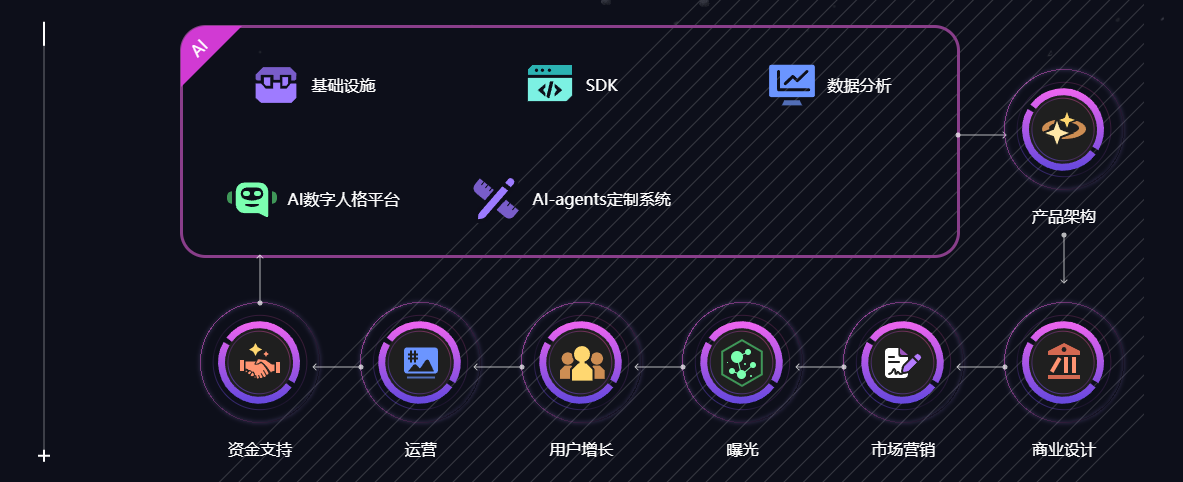
Grounded in AI agent technology, MomoAI is prioritizing the development of AI agents tailored for gaming scenarios, aiming to create digital intelligence systems. When applied in games, these enable intelligent dialogue, behavioral decision-making, and personalized expression—crafting immersive digital characters and worlds.
Once developed, these capabilities can be offered to developers as multi-layered technical services:
-
Integration Layer: Provide open SDKs and APIs that hide underlying complexity, allowing third-party apps to easily load and invoke AI agent capabilities—enabling AI-powered games without rebuilding from scratch.
-
Digital Character Generation Layer: Graphical tools using natural language to efficiently define a character’s appearance, personality, and background—reducing dev workload and improving efficiency.
-
Functional Logic Layer: Handle relationship modeling, memory retention for dynamic character evolution, and on-chain identity and asset management for persistence.
-
Foundation Technology Layer: Leverage large language models for content generation and blockchain for on-chain identity verification.
By opening these service layers, MomoAI enables in-game characters to possess rich personalities and emotions, along with verifiable on-chain identities and asset ownership—delivering unprecedented immersive experiences in interactive entertainment.
Beyond technology, MomoAI also provides support in funding, operations, user growth, exposure, marketing, and tokenomics—comprehensively empowering game projects across traffic, product/token design, and AI technology.
In this role, MomoAI functions as a growth engine for the entire industry—critical momentum packaged into an engine, ready-to-use to accelerate any project.
Currently, MomoAI’s platform is evolving from 1.0 to 2.0.
Before reaching 2.0, MomoAI has been building resource reserves through its game publishing platform, effectively solving the question of “who to sell capabilities to.”
Because game publishing is channel-oriented, MomoAI gains access to more Web3 game developers. According to its website, 25 Web3 games—including major titles like DeFi Kingdoms and Big Time—are already onboarded to MomoAI’s Play-verse publishing platform, with growing application interest.
These developers and projects will become strong partners for MomoAI 2.0. Under a unified AI agent capability model, MomoAI can handle tech empowerment, publishing, marketing, and more—forming a complete game matrix.
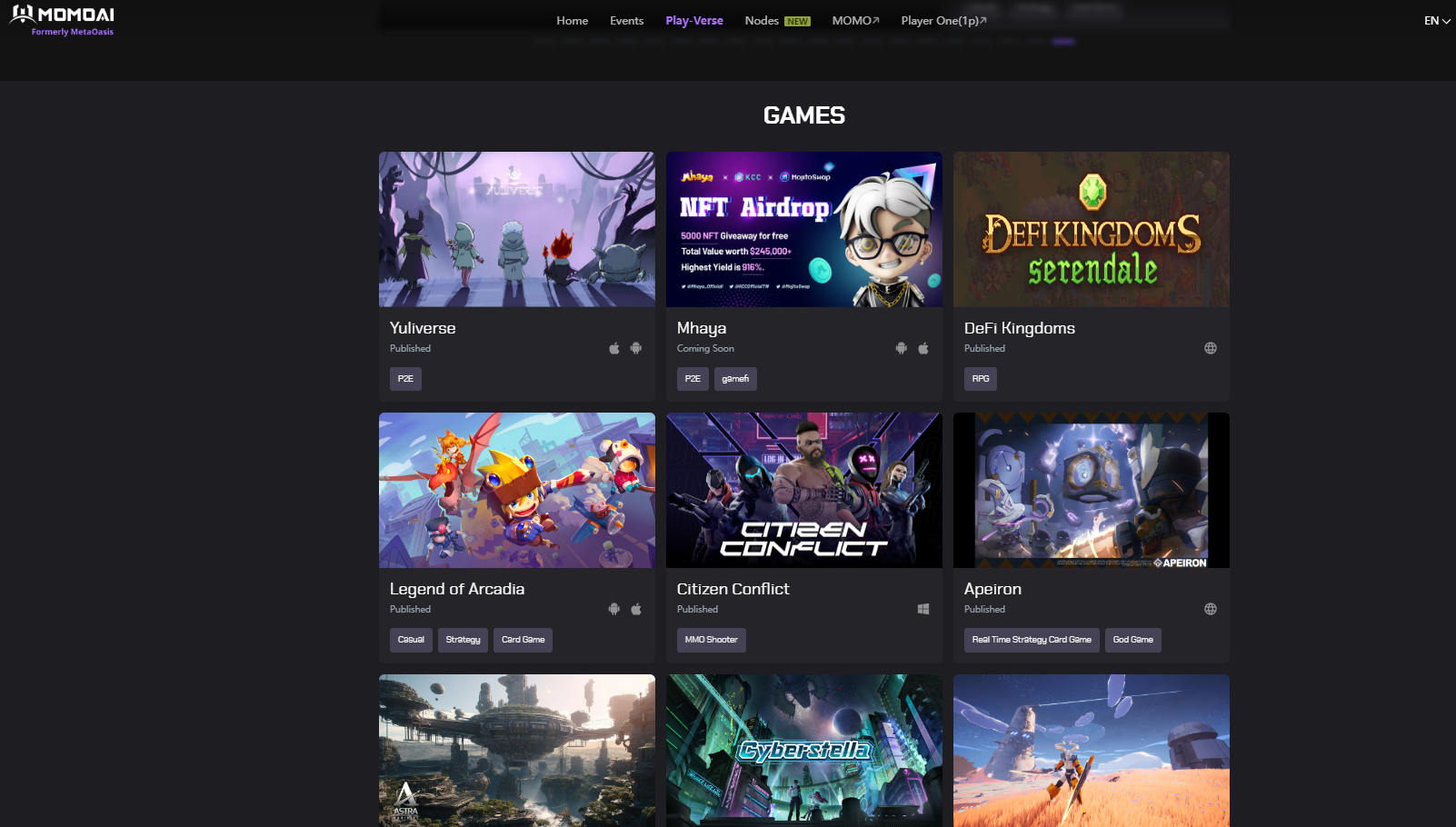
Under this platform strategy, MomoAI’s native token $MTOS becomes more than just an airdrop reward—it evolves into the connective tissue linking players and developers across the ecosystem.
For players, MTOS becomes the primary cross-game currency within the platform. Players can use MTOS to acquire assets across various sub-games.
For developers, MTOS can purchase customized AI services and data analytics from the MomoAI platform. Additionally, developers can use MTOS to buy ad space, host events, and implement effective user acquisition strategies within the ecosystem.
When both B2B and B2C sides are connected via MTOS, the token captures more ecosystem value, indirectly driving consumption and supporting price stability.
According to official announcements, MomoAI plans to launch its TGE at the end of April, a development worth watching.
Near-Term Catalyst: Node Sale
For players bullish on Momo AI but waiting for the TGE, what participation opportunities exist now?
On April 18, the sale of MomoAI Node—one of the project’s key assets—went public. At the time of writing, total sales had reached $2 million, with over 10,000 units sold, highlighting strong market interest.

In the short term, for the Telegram-based MOMO game, the Node’s utility is clear: it significantly boosts in-game resource generation.
Node owners receive more daily lucky draw chances, accelerating Points acquisition to level up their trees and increase Kiwi output. Additionally, Nodes earn a share of all players’ Kiwi production based on tier—adding a form of “passive income” on top of personal farming rewards.
Looking beyond the current game, the Node acts more like a long-term mining rig, extracting value from multiple areas within the MomoAI ecosystem. For instance, regarding the $MTOS token, Node holders collectively receive 30% of total MTOS revenue—similar to a profit-sharing NFT “golden shovel.”
Moreover, Node holders gain priority access to future ecosystem games and early eligibility for potential airdrops.
From an AI narrative perspective, since MomoAI’s endgame is platformizing AI agent capabilities, holding a Node is akin to owning equity in the platform. As more projects adopt these AI capabilities, Node holders stand to benefit significantly.
According to current details, Nodes run as cloud services hosted by top-tier global providers and MomoAI’s own data centers. Upon deployment, users receive an NFT as proof of ownership.
Nodes are fully managed by MomoAI. Holders only need periodic activation to maintain status. No special hardware or network setup required—ownership and rights are granted upon purchase.
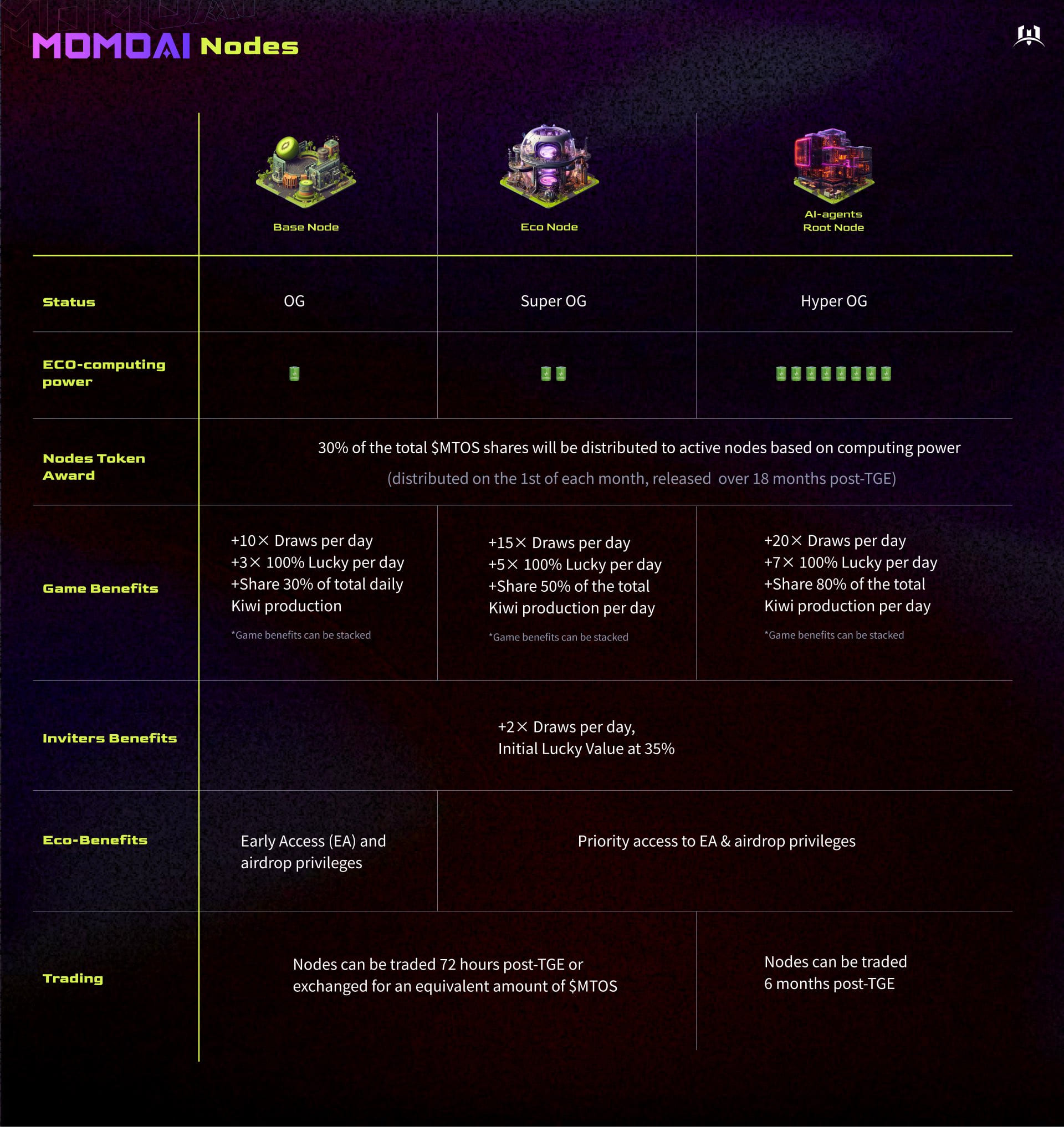
Players interested in Nodes can find more details here.
Conclusion
Growth is the eternal challenge for Web3 projects, and game-related projects have been notably absent in this cycle.
MomoAI emerges by validating an effective growth model through its own game, then aiming to elevate the entire gaming sector via a game growth platform vision.
As technologies like AI agents aim to improve crypto, enhanced game experiences may be the most tangible place users feel this progress. Beyond popular narratives, this area holds high non-consensus opportunity.
Sometimes, new opportunities don’t require entirely new entrants—veterans deeply familiar with industry pain points may be better positioned to succeed.
MomoAI’s predecessor was MetaOasis, with extensive experience in metaverse, AI, and gaming ecosystems. Its rebranding to MomoAI isn’t merely a marketing move—it reflects a strategic shift aligned with market trends and its own capabilities.
Having the ability, starting with your own product, then expanding to empower the industry—that’s the right path of thinking and execution.
In crypto, new trends and narratives emerge daily. But those projects that choose the right path, position accurately, and possess real strength during transitions between old and new—these are always the ones worth watching for Alpha.
Join TechFlow official community to stay tuned
Telegram:https://t.me/TechFlowDaily
X (Twitter):https://x.com/TechFlowPost
X (Twitter) EN:https://x.com/BlockFlow_News
 深潮TechFlow


