








Mango Network: The Bridge to Building the Bitcoin Layer 2 Ecosystem — A Superior Native BTC L2 Bridging Solution
TechFlow Selected TechFlow Selected
Mango Network: The Bridge to Building the Bitcoin Layer 2 Ecosystem — A Superior Native BTC L2 Bridging Solution
Mango Network's Layer 1 solution is strongly supported by the Move language, providing developers and users with a secure, modular, and high-performance Web3 infrastructure.
 Navigating Web3 tides with focused insights
As a transactional omnichain infrastructure network, Mango Network provides an innovative omnichain bridging protocol solution that addresses Bitcoin's challenges in asset yield generation, transaction confirmation delays, lack of smart contracts, and high transaction fees. It also enables cross-chain interoperability for native assets like Bitcoin, significantly expanding interaction capabilities for users and various protocols. This breakthrough technological advancement arrives at a time when the Bitcoin Layer 2 ecosystem is gaining increasing momentum, injecting new vitality and opportunities into the cryptocurrency market.
Mango Network supports a range of Bitcoin protocols including BRC-20, BRC-420, Atomicals, and Pipe, enhancing the liquidity and usability of Bitcoin assets across different blockchain ecosystems. This comprehensive compatibility establishes Mango Network as a key hub connecting Bitcoin with traditional smart contract chains such as Ethereum and its Layer 2 solutions, while also providing unprecedented smart contract functionality to non-smart-contract chains like Bitcoin and Dogecoin, greatly expanding their application potential and market participation.
Mango Network’s Layer 1 solution is powerfully supported by the Move language, offering developers and users a secure, modular, and high-performance Web3 infrastructure. With a transaction processing speed reaching up to 297,450 transactions per second (TPS), it demonstrates exceptional performance while maintaining high levels of standardization, scalability, and interoperability. This is particularly important in today’s evolving Bitcoin Layer 2 ecosystem, where growing demand exists for efficient, low-cost cross-chain solutions amid the rapid development of DeFi and other blockchain applications.
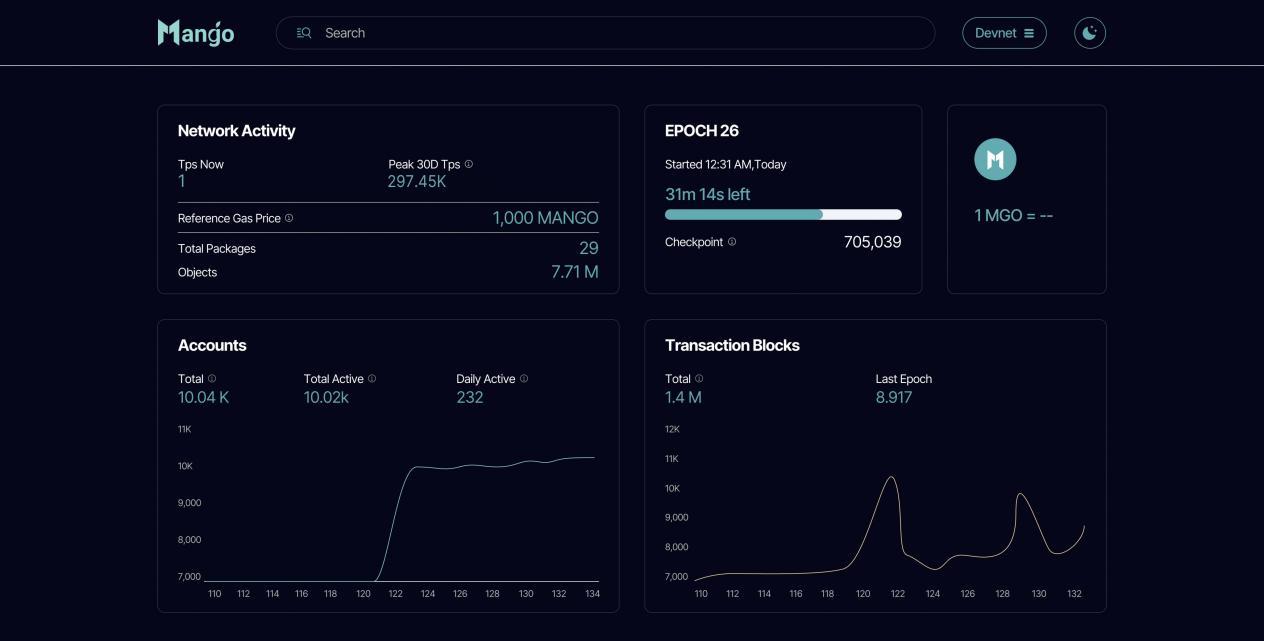
Mango Network Devnet Up to 297.45K TPS
With support from Mango Network, users can freely transfer BTC assets into the Mango ecosystem and utilize them across various DeFi applications without concerns about asset security or transaction complexity. This seamless cross-chain experience not only offers Bitcoin holders new investment and yield opportunities but also brings greater innovation and growth potential to the entire blockchain industry.
Mango Network’s cross-chain bridging capability allows it to connect multiple blockchains and layers, including the Ethereum mainnet, Layer 2 solutions, and Optimism Stack chains (such as Base). More importantly, Mango Network also supports non-smart-contract chains like Bitcoin, enabling these traditional chains to access unprecedented smart contract functionality and greatly expanding their application potential and market engagement. In this way, Mango Network not only provides robust support for cross-chain liquidity of Bitcoin assets but also makes significant contributions to interoperability and the development of decentralized finance (DeFi) across the broader blockchain industry.
1. What is Mango Network — A Transactional Omnichain Infrastructure Network and Comprehensive Platform for Omnichain Interaction
As a transactional omnichain infrastructure network, Mango Network is a comprehensive platform integrating a Layer 1 blockchain with smart contract functionality, featuring built-in interoperability with various blockchains and layers. This unique characteristic enables unified management of assets, data, and liquidity across different blockchain ecosystems. Mango Network’s smart contract functionality is especially beneficial for blockchains like Bitcoin that natively lack smart contract support—through Mango Network, assets on these chains can become active participants in the Web3 space, enabling value transfer.
2. Why Create Mango Network — Bridging Blockchain Fragmentation
The motivation behind creating Mango Network stems from a deep understanding of the cryptocurrency industry’s rapid expansion and growing fragmentation. With the rise of DeFi, blockchain gaming, social applications, and more, new blockchains and layers continue to emerge to meet demands for speed, flexibility, and low-cost transactions. However, such a diverse ecosystem also introduces challenges, including complex cross-chain operations, security risks, and inconsistent user experiences.
Mango Network aims to solve these issues by providing a unified platform that allows users and developers to easily access and interact with different blockchain ecosystems. With Mango Network, users can manage multiple crypto assets without needing separate wallets for each blockchain or layer, and they avoid complex cross-chain procedures. Additionally, by offering advanced smart contract capabilities, Mango Network adds new dimensions of utility to traditional chains like Bitcoin and Dogecoin, driving innovation and progress across the industry.
Mango Network’s omnichain technical architecture is a highly integrated system designed to achieve seamless interoperability between different blockchains. At its core is a unified platform enabling free flow and interaction of assets, data, and smart contracts across multiple blockchain networks.
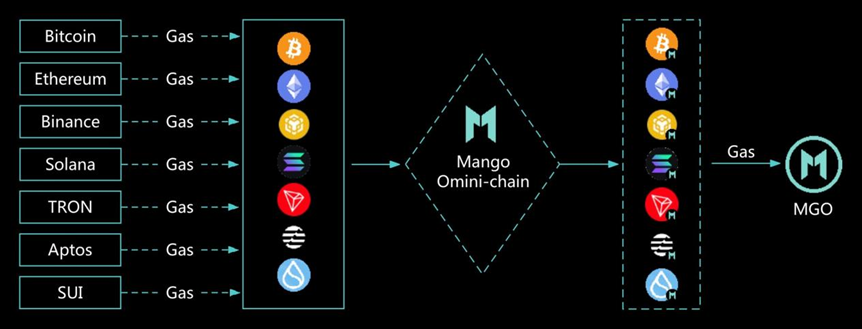
Mango Network Omnichain Technical Architecture Diagram
(1) Multi-chain Compatibility: Mango Network has developed a set of protocols compatible with multiple blockchains and layers. It can recognize and process transactions and assets originating from diverse networks such as Bitcoin, Ethereum, Binance Smart Chain, Solana, Tron, Aptos, and Sui.
(2) Cross-chain Bridging: Mango Network employs cross-chain bridging technology to connect different blockchains. These bridges act as intermediaries, allowing assets to be transferred from one chain to another while preserving their value and properties. Bridging technology is essential for enabling cross-chain transactions, ensuring both security and accuracy during asset transfers.
(3) Smart Contract Platform: Mango Network is not just a cross-chain bridge—it is also a smart contract platform. It allows developers to create and deploy smart contracts on Mango Network that can execute across different blockchains, thereby extending the scope of smart contract applications.
(4) High-performance Infrastructure: As a Layer 1 solution, Mango Network delivers high-performance infrastructure. Its design supports high-throughput transaction processing, low-latency confirmation, and efficient resource utilization—all critical requirements for modern blockchain applications.
(5) Security and Decentralization: Mango Network implements a suite of security measures to protect the network and user assets. These include cryptographic techniques, multi-signature verification, and offline distributed validation nodes, ensuring decentralization and resilience against attacks.
(6) User-friendly Interface: Mango Network provides intuitive interfaces that allow users to easily conduct cross-chain transactions and manage assets. This design lowers the barrier to entry, enabling even non-technical users to conveniently access blockchain services.
Through these technical principles, Mango Network aims to build a comprehensive blockchain ecosystem that supports cross-chain asset liquidity, fosters the development of DeFi and other blockchain applications, and provides users with a secure, efficient, and convenient interaction platform.
3. How Does the Mango Network Omnichain Protocol Work?
The operation of Mango Network’s omnichain protocol relies on a series of sophisticated technologies and mechanisms designed to enable interoperability and asset liquidity across different blockchains. The core components and operational mechanisms of the Mango Network omnichain protocol include:
(1) Multi-layer Architecture: Mango Network is more than just a base-layer blockchain; it functions as a connectivity layer linking different blockchains together. This multi-layer architecture enables Mango Network to interact with various blockchains and layers, facilitating cross-chain movement of assets and data.
(2) Multi-signature Validation Nodes: Mango Network uses offline distributed validation nodes to monitor and confirm events on external chains, such as token transfers. These nodes operate independently even without real-time network connectivity, reaching consensus to verify the authenticity of events. Once consensus is achieved, the nodes sign and confirm these events on the connected chain, ensuring the security and consistency of cross-chain transactions.
(3) Omnichain Smart Contracts: Mango Network’s omnichain smart contracts handle events originating from external chains. These contracts can read data from external chains, execute corresponding logic, and return results back to the source chain. Serving as the single source of truth, omnichain smart contracts ensure consistent state representation regardless of which chain holds the assets or data.
(4) Cross-chain Message Transmission: Mango Network enables smart contracts to send data and value across different chains and layers via a cross-chain message transmission mechanism. This process typically involves calling unique identifiers on the chain, such as transaction hashes or block IDs. Through this method, a smart contract on one chain communicates with a relayer on another chain, enabling cross-chain transfer of assets and data.
By leveraging these mechanisms, Mango Network’s omnichain protocol achieves seamless connections between different blockchains, laying a solid foundation for asset liquidity and cross-chain applications. This design enhances transaction efficiency and security while delivering a more flexible and user-friendly cross-chain interaction experience for developers and users alike.
4. Bridge Security Is Crucial
Mango Network has carefully designed a comprehensive set of security measures to ensure bridge safety.
First, it employs offline distributed validation nodes, which can independently validate transactions even without direct network connectivity. This means that even if the network is under attack, these nodes can still maintain transaction integrity and security.
Multi-signature verification is another key component of Mango Network’s security framework. This mechanism requires multiple independent signatures to confirm a transaction, increasing resistance to potential fraud. On Mango Network, a transaction is only finalized after receiving consensus confirmation from multiple validator nodes, ensuring both network security and decentralization.
Additionally, the Mango Network decentralized proof-of-stake network further strengthens security. In this setup, no single node has full knowledge or control over private keys. This design safeguards private key security and mitigates risks of leakage or misuse.
Mango Network’s omnichain bridging protocol signs and holds assets in their native form, meaning assets retain their original state throughout the transfer process and are neither replaced nor tampered with. Idle funds are never at risk.
Through measures such as offline distributed validation nodes, multi-signature verification, and a decentralized proof-of-stake network, Mango Network’s bridging protocol creates a highly secure environment that ensures safe transmission of data and value. Together, these mechanisms form the security foundation of Mango Network’s bridge, making it a trusted cross-chain solution for users and developers.
The Unique Advantage of Mango Network — Omnichain Technical Architecture
Mango Network’s distinct advantage lies in its innovative omnichain technical architecture. It is not only a high-performance Layer 1 platform offering fast transaction processing and rich smart contract functionality but also enables seamless integration with multiple blockchain networks—including non-smart-contract chains. Through its advanced cross-chain bridging protocol and multi-signature verification mechanisms, Mango Network significantly enhances asset liquidity and interoperability while ensuring transaction security and decentralization. This positions Mango Network as a pivotal force in advancing Web3 development and expanding the cryptocurrency market.
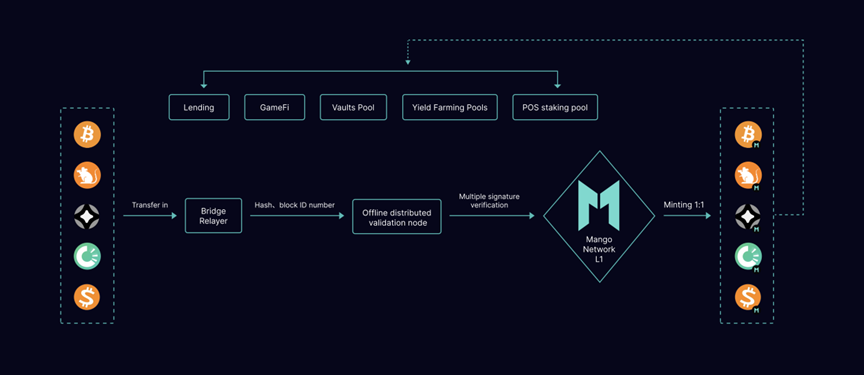
BTC Bridge Technical Operation Principle
The diagram above illustrates the operational principle of Mango Network’s BTC Bridge technology—a cross-chain bridging mechanism designed to enable the transfer and use of Bitcoin (BTC) assets within the Mango Network. Below is a logical overview of this mechanism:
(1) Asset Transfer: Users first send their BTC assets to the Bridge Relayer’s address—an dedicated smart contract address responsible for receiving and processing cross-chain BTC transfers.
(2) Offline Distributed Verification: After receiving BTC, the Bridge Relayer locks the assets and initiates multi-party validation. This step involves offline distributed validation nodes that verify and reach consensus on the BTC transfer without relying on real-time network connectivity.
(3) Multi-signature Verification: To ensure transaction security, Mango Network employs a multi-signature verification mechanism. Multiple independent signatures are required to confirm the BTC transfer, thereby enhancing overall security.
(4) Minting 1:1 MBTC: Once BTC is successfully locked and verified, Mango Network mints an equivalent amount of MBTC (Mango Bitcoin Token), a tokenized representation of BTC within the Mango Network. This process guarantees asset authenticity and maintains value parity.
(5) Asset Distribution: The minted MBTC is then sent to the user’s Mango Network wallet, enabling them to use MBTC within the Mango ecosystem for lending, GameFi, vaults, liquidity pools, PoS staking, and more.
(6) Role of the Relayer: Throughout the process, the Relayer is responsible for transmitting transaction information and asset states between different chains in the Mango Network. The Relayer ensures accurate and timely cross-chain communication.
(7) Layer 1 and Layer 2 Interaction: As a Layer 1 blockchain, Mango Network provides foundational security and decentralization. It also interacts with Layer 2 solutions (such as Optimism, Arbitrum, etc.), further expanding the application scope of BTC assets.
Through this cross-chain bridging mechanism, Mango Network achieves liquidity and usability of BTC assets across different blockchain ecosystems, offering users broader application scenarios and investment opportunities.
Supported by the Mango Network, users can freely transfer BTC assets into the Mango ecosystem and utilize them across various DeFi applications without concerns about asset security or transaction complexity. This seamless cross-chain experience not only unlocks new investment and yield opportunities for Bitcoin holders but also drives greater innovation and growth potential across the entire blockchain industry.
The underlying architecture of the Mango Network provides the necessary security, performance, and interoperability for these applications, ensuring users retain full control over their assets while enjoying efficient and low-cost transaction experiences. Mango Network will serve as a key platform driving Web3 advancement and enabling widespread adoption of blockchain technology, empowering all participants to enjoy unprecedented freedom and flexibility in the Web3 world.
Mango Network official
Web:
X:
https://twitter.com/MangoOS_Network
Mail:
Mango Network Dev
Blockchain Browser:
Github:
https://github.com/MangoNet-Labs
GitHub open source:
https://github.com/MangoNet-Labs/mango
Developer Documentation:
Swap interactive application:
Join TechFlow official community to stay tuned
Telegram:https://t.me/TechFlowDaily
X (Twitter):https://x.com/TechFlowPost
X (Twitter) EN:https://x.com/BlockFlow_News
 Mango Network


