








DePIN Hunting Journey: Baited with AI Computing Power, the Road Ahead is Long and Arduous
TechFlow Selected TechFlow Selected
DePIN Hunting Journey: Baited with AI Computing Power, the Road Ahead is Long and Arduous
The most popular AI large model training is not the best落地 scenario for DePIN.
 Navigating Web3 tides with focused insights
Author: Hedy Bi, OKG Research
The Hong Kong Web3 Festival has concluded, yet the pulse of Web3 freedom continues to beat strongly, steadily permeating into other industries. Compared to the previous cycle, the logic behind this bull market has shifted from "native innovation narratives" to a model driven by "mainstream acceptance and capital." The stage of Web3 development I've observed has also evolved from one of "closed, niche absolute freedom" to a phase of "relative freedom under genuine inclusivity."
Under this new paradigm, failing to think beyond conventional frameworks means that passively waiting for native innovation narratives can no longer keep pace with the current evolution of Web3. Since Web3 began embracing compliance, it has been refocusing on finance under continuous support from the Hong Kong government. Mainstream financial institutions are also accelerating their participation in Web3 through RWAs and spot ETFs.
Beyond mainstream financial institutions entering Web3, this conference also revealed an opportunity to bridge Web2 and Web3—the DePIN sector. In particular, the advancement of large AI models has reignited interest in one of DePIN’s sub-sectors: the redistribution of computing power.

Source: OKG Research
Computing Power as Bait, but Large AI Model Training Is Not the Best Use Case for DePIN
"Blockchain builds trust through technology, and AI is an industry that desperately needs trust," said Dragonfly Capital's managing partner Haseed Qureshi at the conference.
DePIN is not a new concept; it was proposed several years ago. However, the recent explosion of large AI models has sparked extensive discussions around computing power and data. Estimates suggest that the cost of large model computations increases 31-fold annually. With a global GPU shortage, companies like NVIDIA currently dominate market demand and wield significant pricing power. The debate between monopoly and decentralization has thus become a key reason why the Web3 DePIN sector is back in the spotlight.
While large AI model training triggered this wave, Rome wasn’t built in a day—large AI model training is not currently the optimal use case for DePIN. Requirements for computing power in large AI model production mainly fall into two areas: inference and training. During training, massive datasets are fed to develop complex neural network models. During inference, these trained models process large volumes of data to generate conclusions.
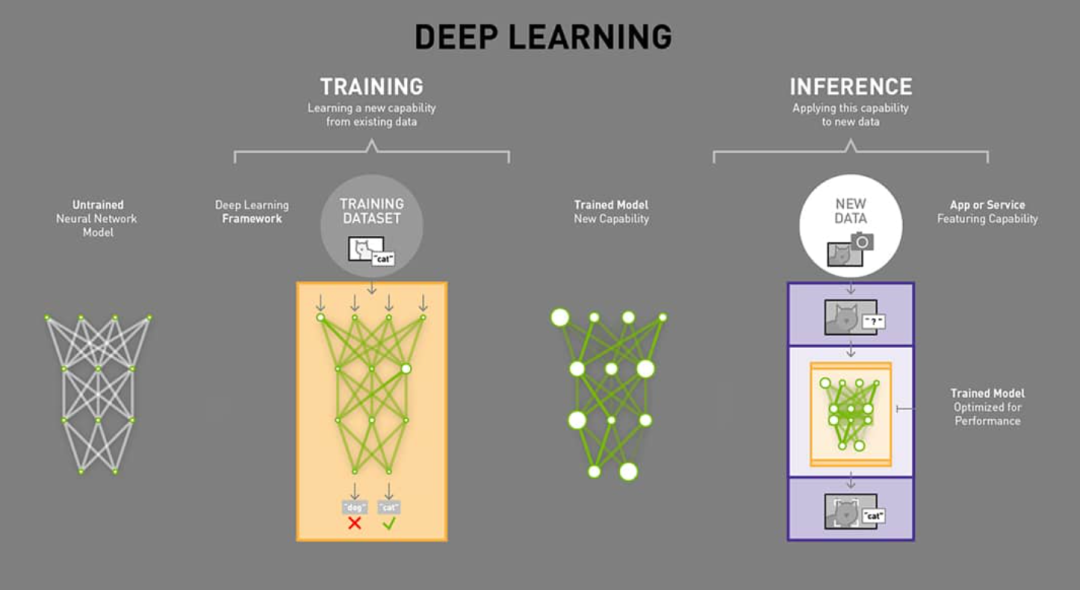
Source: NVIDIA
The difficulty of integrating decentralization with computing power decreases progressively from training to fine-tuning, then to inference. In the DePIN space, most projects focus on inference rather than training. Most enterprises rely on NVIDIA GPU clusters for AI training due to their superior parallel processing capabilities and memory bandwidth. In contrast, inference demands much less in terms of parallel computation and bandwidth. Moreover, stability is critical during model training—any interruption requires restarting the entire process. Building a decentralized computing application on Ethereum for GPT usage would result in gas fees as high as $10 billion for a single matrix multiplication operation, taking about a month to complete.
Additionally, after analyzing several popular projects showcased at the event, I found that supply currently exceeds demand—a surplus of globally distributed computing power relative to the needs of AI developers conducting model training or inference tasks. This doesn't mean demand is absent. OpenAI co-founder Sam Altman has proposed raising $7 trillion to build an advanced chip manufacturing facility over ten times larger than TSMC's current capacity, dedicated to chip production and model training. Stanford University research also shows that regardless of language model type, once training parameters exceed a certain threshold, performance (e.g., accuracy) improves dramatically. This contradicts the "brute force miracle" theory and indicates that many challenges remain before decentralized computing becomes practical.
The "Historical Roots" of the DePIN Sector Can Be Traced Back to the "Sharing Economy"
The concept of DePIN itself is not difficult to grasp—it can even be traced back to Web2. Looking at the internet industry, for at least 15 years, Web2 players have been deeply engaged in aggregating individuals' tangible assets to create the "sharing economy." If intangible assets (such as idle servers) are directly redistributed to users via peer-to-peer (P2P) or peer-to-business (P2B) models, blockchain's decentralized technology can optimize production relationships through incentive mechanisms. That’s exactly what DePIN aims to achieve.
Therefore, enthusiasm among suppliers within the DePIN sector remains high. In fact, Web2 has long laid the groundwork for "redistribution"—this time, intermediaries are being removed entirely. There are already nearly a thousand DePIN projects, especially within the Solana ecosystem. According to Messari, Solana leads in DePIN infrastructure due to its high level of integration and performance. Geographically, it is expected that multiple top-10 DePIN projects from 2024 to 2025 will originate from Asia.
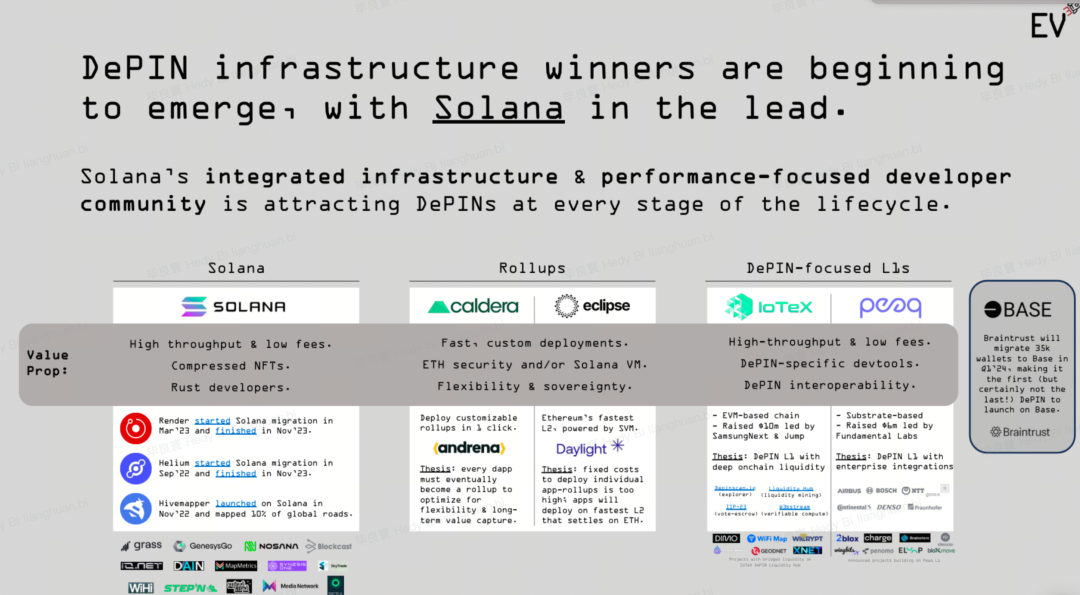
Source: Messari
Web3 and AI intersect in many ways. Computing power, as the universal currency of the future digital world, is naturally the first area people focus on. Yet, despite being the most logical application scenario, decentralized computing is far from the easiest to implement.
At the intersection of Web3 and AI, beyond overcoming technical hurdles, there are many other promising avenues worth exploring—such as granting creators ownership via AI agents, or focusing on small-scale AI model computing scenarios—which may prove more viable for real-world implementation. Business model success and technological breakthroughs must always balance each other. DePIN is accelerating this process, and its "hunting journey" will ultimately yield rich rewards.
Join TechFlow official community to stay tuned
Telegram:https://t.me/TechFlowDaily
X (Twitter):https://x.com/TechFlowPost
X (Twitter) EN:https://x.com/BlockFlow_News
 @OKGResearch






