Interview with io.net: Apple Chip Controversy, Layer1 Plans, and Token Launch
TechFlow Selected TechFlow Selected
Interview with io.net: Apple Chip Controversy, Layer1 Plans, and Token Launch
io.net still plans to launch its token on April 28, coinciding with NVIDIA's earnings release, making it a well-timed opportunity.
 Navigating Web3 tides with focused insights
Author: TechFlow
What crypto projects are people most anticipating in April?
io.net is definitely on that list.
As a distributed computing network within the Solana ecosystem, io.net was born with golden credentials—capitalizing on both the AI+DePIN and Solana narratives. At a time when AI is surging and GPU shortages persist, io.net aggregates 1 million GPUs to form the world’s largest GPU cluster, building a “GPU Internet.”
As more users connect their GPUs to the io.net network, controversies have emerged—such as frequent disconnections, and why Apple M-series chips, which lack competitive AI compute performance, can still join the network and earn rewards—even outperforming other chips in early stages.
Addressing questions from the io.net Chinese community, TechFlow interviewed Garrison, CMO of io.net, uncovering exclusive insights.
Key Takeaways:
-
io.net provides flexible and low-cost computing resources, aiming not only to power AI workloads but also to become genuinely decentralized infrastructure for the crypto industry, which currently heavily relies on centralized cloud services.
-
io.net plans to build a DeFi ecosystem centered around computational power, enabling trading, staking, lending, borrowing, and leverage—creating a dynamic, accessible financial model based on compute resources.
-
io.net does not aim to replace AWS; decentralized cloud services won’t supplant centralized ones. But when unexpected demand spikes occur, centralized providers lack the necessary flexibility. The io.net system enables rapid resource deployment—no contracts, permissions, or KYC required—to instantly access computing clusters.
-
The IO token is designed as a currency for computational power and will be treated as secure collateral, with a full ecosystem built around staking functionality.
-
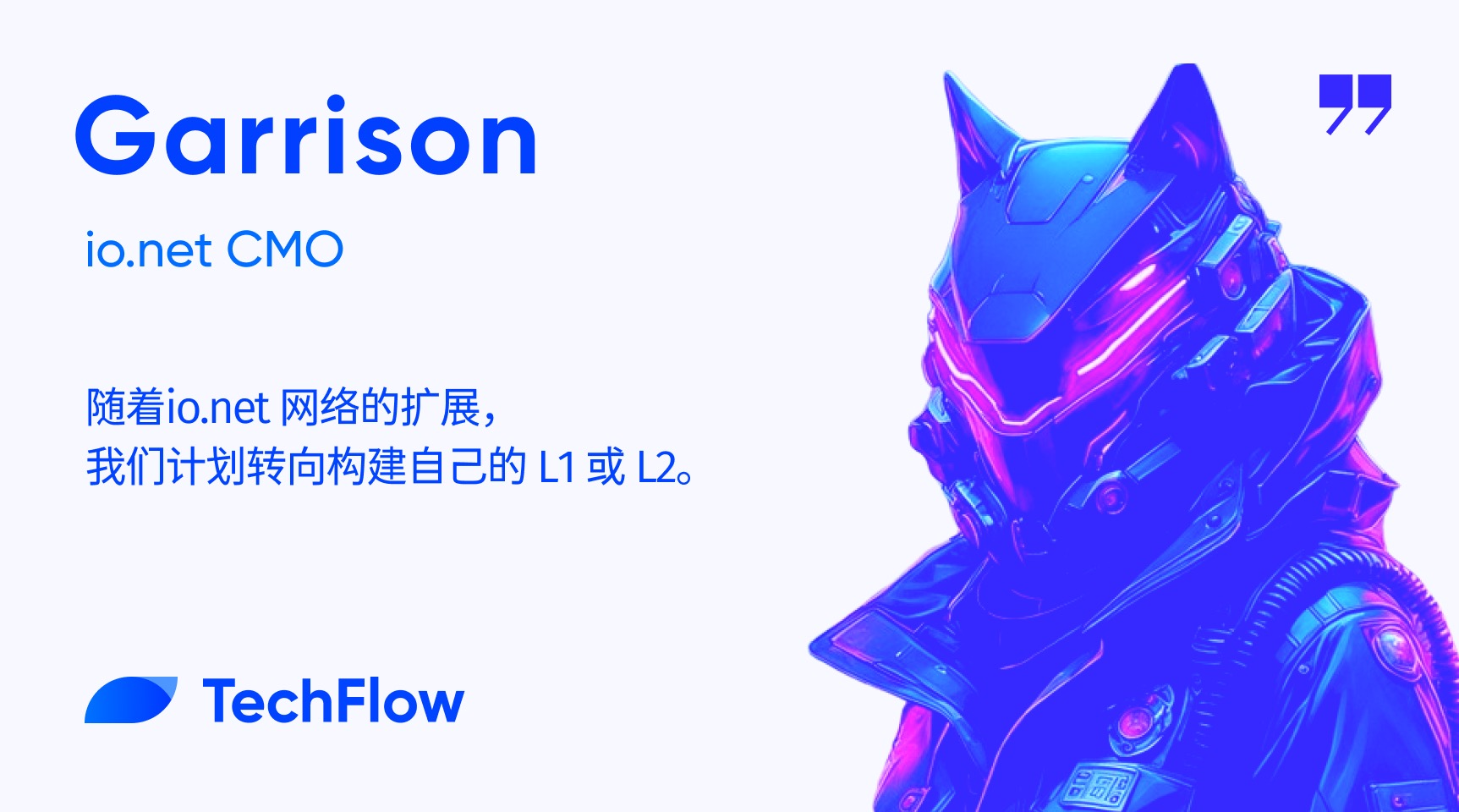
As the compute network scales, io.net plans to develop its own L1 or L2 blockchain, particularly interested in leveraging the Solana Virtual Machine (SVM), offering greater flexibility and decentralization. IO would then serve as the native token of this blockchain network.
-
Including Apple’s M1 ARM chips in the network was an experimental move. It was later found that older M-series chips contribute little to network efficiency. Thus, io.net is shifting focus toward advanced Pro and Ultra series chips, exploring uses beyond traditional AI tasks. These chips may be better suited for low-risk operations such as model inference rather than training, or supporting validators, ZK provers, and sequencers.
-
io.net has always treated Apple chip integration as an experiment. To ensure high-end GPU contributors (e.g., 4090, 8600, 4810, A100) don’t feel their rewards diluted by Apple chip participation, a dedicated incentive pool has been created for Apple chips. As more Apple devices join, they only affect distribution within their own pool—other contributors remain unaffected.
-
io.net still plans to launch its token on April 28, coinciding with NVIDIA’s earnings release—an opportune timing.
-
io.net will implement anti-cheat measures, including detecting virtual private servers (VPS), and collaborating with Galxe to remove bots.
Interview Transcript:
TechFlow: Please introduce yourself. What’s your journey in the crypto world been like?
Garrison:
My background is in chemical engineering, and I started my career working on distributed systems for power grids. Later, I joined Meta, focusing on advertising, then moved to Avalanche where I led market growth and played a key role in brand development.
I’ve always been deeply interested in the DePIN space—looking for projects that solve real-world problems. While many DePIN projects seem more experimental or novelty-driven, io.net stood out because it addresses a massive need with no existing solution. That makes io.net different—it aims to tackle real challenges and deliver tangible value.
I’ve been active in crypto since 2018, initially focused on investing and closely tracking market trends. My interest later expanded into Web3 gaming, where I worked on game development.
TechFlow: Can you elaborate on the specific challenges your platform aims to solve in today’s decentralized environment?
Garrison:
At io.net, we’re tackling several critical issues. Our primary goal is to offer a decentralized alternative to traditional computing resources—we’re essentially exploring the feasibility of creating a decentralized AWS.
This initiative stems from our understanding of cloud services: despite being widely used, they’re expensive and inflexible. Users often get lower per-unit pricing with long-term commitments, but these typically require multi-year contracts. This becomes impractical when sudden scaling is needed.
By introducing a decentralized option, we aim to provide flexible and cost-effective computing resources. We’re intentionally focusing on AI—we believe decentralization can significantly accelerate AI progress by lowering costs and avoiding censorship. Given AI’s expanding role in consumer products and potential regulatory restrictions across jurisdictions, a decentralized framework fosters innovation and prevents gatekeeping.
Additionally, we’re committed to achieving true “decentralized Web3.” Currently, much of the infrastructure supporting Web3—including blockchain validator nodes—relies on centralized cloud providers, undermining core decentralization principles.
Our solution aims to become the hosting infrastructure for decentralized blockchain validators and dApps, restoring genuine decentralization to the Web3 ecosystem.
As we grow, we’ll go beyond decentralized cloud computing to build a compute-centric DeFi ecosystem around processing power. We view compute as “digital oil”—the driving force behind the new industrial revolution. Yet, there’s currently no mechanism for financial exposure to this “commodity.” io.net envisions creating a tokenized asset representing compute value, enabling trading and powering a full DeFi ecosystem. This will allow trading, staking, lending, borrowing, and leveraged positions—a dynamic, accessible financial model built on computing resources.
TechFlow: Why did you choose to build on Solana?
Garrison:
Because it’s fast, cheap, and effective.
Running model inference on Ethereum is impractical due to high costs—each inference requires four on-chain transactions, making it prohibitively expensive. Therefore, we determined io.net must operate on a platform like Solana. We’re especially interested in using the Solana Virtual Machine (SVM), as we plan to eventually launch our own blockchain.
Currently, our payment and token infrastructure are hosted on Solana. However, our inference infrastructure runs on Aptos. We’re exploring Aptos’ Move language and other modular Move-based languages, while testing SVM capabilities. This exploration is crucial—after our token launch, as the company and network scale, we plan to build our own L1/L2. This will provide significant flexibility and a more decentralized blockchain and compute infrastructure.
TechFlow: We all know the decentralized computing space is highly competitive. What key differentiators make io.net stand out from traditional Web2 providers and emerging Web3 platforms?
Garrison:
In the Web2 context, we don’t aim to replace AWS. Clearly, due to their reliability, capacity, speed, maturity, and data security, decentralized cloud services won’t replace centralized ones.
However, centralized providers like AWS are like nuclear power—they provide base load for predictable computing needs. They become cost-efficient when buying capacity years in advance. The challenge arises during unpredictable demand surges, where centralized services lack the necessary flexibility.
Decentralized cloud computing fills this gap, providing on-demand resources to manage fluctuating needs. This is especially valuable for researchers, individuals, or universities needing short-term compute power. The system allows instant access to computing clusters—no contracts, permissions, or KYC required.
io.net stands out for several reasons. First, we’re the largest decentralized compute network, with 190,000 nodes across 139 countries, delivering compute ranging from MacBook chips to A100s. This diversity allows us to customize clusters for each user’s exact needs, preventing over- or under-provisioning.
Additionally, our expertise in resource orchestration and networking gives us an edge. While we operate one of the largest first-party compute networks, our strength lies in integrating partners like Filecoin and Render. This collaboration enhances our ability to form clusters meeting diverse customer needs—from gaming to AI—optimizing scale and minimizing latency.
Our ability to efficiently aggregate nodes across regions while minimizing latency solves a core challenge in decentralized computing. We offer “superclusters” for those needing high-speed, high-capacity setups, plus flexibility in cluster size and security configurations. This makes io.net a versatile platform capable of serving a broad spectrum of compute demands.
Essentially, io.net aims to be the “Expedia” of decentralized cloud—aggregating specialized resources from storage, gaming, and rendering. When GPUs in these domains sit idle, we make them available to AI companies.
TechFlow: What are the main functions of the io.net token once launched?
Garrison:
As I mentioned earlier, this token is designed as a currency for computational power. Our goal is for IO to become the primary method for transactions and unlocking advanced features on io.net. Additionally, we envision IO as secure collateral, building an ecosystem around staking—very similar to Filecoin’s tokenomics. Once we launch our blockchain, IO will serve as the native token.
A key aspect of compute tokens is enabling the trading of compute resources—part of building a dynamic DeFi ecosystem. As a commodity, compute is something ordinary people usually can’t invest in directly. Through cryptocurrency, we aim to make this asset class financializable. The token not only secures and operates the network but adds utility and gives people access to an otherwise unreachable commodity.
When IO becomes the native token for both a decentralized network and a blockchain, it creates a scenario we haven’t seen before. Most tokens focus on securing either a blockchain or a dApp. Our goal is to create the first token that does both—ensuring cryptographic-economic security and incentives for both the blockchain and decentralized network.
TechFlow: Now let’s talk about your actual business. As GPU miners increase participation in the network, how does io.net ensure participants receive real value and genuine profitability?
Garrison:
We typically see tokens inflated and distributed to validators as compensation. Validators and miners play a vital role—providing hardware and storage in exchange for tokens.
However, especially for AI-focused decentralized networks, the crypto-economics around compute consumption are unique. Demand for AI compute is enormous. When launching and operating our network, we don’t solely rely on tokenomics to compensate operators. Operators usually want to recoup hardware investment within 18 months. Traditionally, this means deploying hardware in data centers and selling compute directly to end users.
With io.net, operators can generate revenue by providing services to AI companies—and also earn tokens as rewards. This dual-income stream strengthens our ability to offer competitive rewards and payments to partners and individual contributors on the network.
Moreover, we emphasize performance-based compensation. Availability and reliability are critical. Nodes that fail to deliver promised compute resources face penalties. We continuously tune network mechanisms to ensure high-performance nodes receive larger rewards, while those with inferior hardware or performance receive less. This strategy prevents system abuse and ensures only contributors delivering real value are rewarded.
TechFlow: What role do Apple chips play in the compute network? Garrison:
Exploring Apple’s M1 ARM chips in our network was an experimental effort. These chips feature a neural engine, giving us a new opportunity to assess their capabilities within a cluster.
However, we found that some older M-series chips don’t significantly contribute to network efficiency. Therefore, we’re shifting focus to more advanced Pro and Ultra series chips, which offer greater onboard memory and are better suited to strengthen Web3 infrastructure operations.
We remain strongly interested in exploring different chip architectures for AI applications. NVIDIA currently leads with AI-optimized chips, but we believe processors with comparable processing power and RAM could also be viable—if equipped with the right software layer. NVIDIA’s solutions, while effective, are costly. Unlocking the potential of high-end MacBook chips for AI could therefore present significant value.
Furthermore, given the massive user base of M1-equipped devices, we’re exploring their use beyond traditional AI tasks. These chips may be better suited for low-risk operations, such as model inference rather than model training, or supporting validators, ZK provers, and sequencers. Identifying suitable workloads for these chips can unlock substantial value.
TechFlow: So you’re not even sure if Apple’s M-series chips can deliver the computing power needed for AI?
Garrison:
M-series chips are delivering compute. Given their novelty, exploring their capabilities is highly intriguing. The premise is simple: if we can effectively harness these chips, we unlock vast amounts of computing power. Their suitability for AI tasks is still under investigation. M1 chips and successors like M1 Pro and M1 Ultra have varying specs. In particular, the M3 Ultra represents a major leap in power, costing around $6,000–$7,000.
io.net is at the frontier because we embrace innovation and experimentation. Despite skepticism about M-series chips for AI, we believe in personally exploring their potential. We have the capability to cluster thousands of M-series chips and test their performance in AI applications. Success would make us pioneers; failure would still be invaluable, guiding our next steps. Innovation requires this experimental approach.
TechFlow: Back to rewards—can you share more details about rewards for Apple device users?
Garrison:
Within our system, Apple chips are grouped into a completely separate category. Specifically for airdrops, we allocate one set of rewards to the general pool and another exclusively for Apple chips. We’ve always treated Apple chip integration as an experiment. Therefore, our goal is to ensure contributors using high-end GPUs—like 4090, 8600, 4810, and A100 models—don’t feel their rewards diminished by the influx of Apple chips. Hence, we’ve established a dedicated incentive pool for Apple chips. As more Apple chips participate, they only affect allocation within their own pool—other contributors’ rewards remain untouched, drawn from an independent pool.
TechFlow: Considering various participants—large studios versus individuals mining with laptop GPUs—which type of “miner” do you favor? Are there any restrictions or incentives?
Garrison:
Our operations are demand-driven. We expect AI to be a primary use case, alongside running Web3 infrastructure. We’ve already identified the node types best suited for these tasks, and our system dynamically adjusts to incentivize the most valuable nodes. Typically, GPUs in the 4090 series and above are expected to be most beneficial and will thus receive the highest rewards. That said, consumer-grade GPUs still play a key role—especially for validator workloads and certain Web3 infrastructure tasks—and will be correspondingly incentivized.
TechFlow: How does this restriction work? For instance, if a user’s mining activity is deemed ineligible, will they be banned outright?
Garrison:
We never outright ban anyone—that goes against decentralization principles. Instead, we adjust incentives, reducing rewards for resources with lower demand. For example, if a Nvidia 3016 GPU sees reduced demand due to limited utility, its corresponding reward on the network decreases. This doesn’t mean they exit entirely—some users may still choose to participate with these GPUs, accepting lower returns. Our approach relies on market dynamics, naturally incentivizing or discouraging activities based on their value to the network.
TechFlow: Many miners are also speculative airdrop hunters. How do you attract GPU owners to consistently provide computing power long-term, especially during bear markets?
Garrison:
Filecoin and Bitcoin are prime examples of crypto market resilience. Despite bear market challenges, there are always people willing to mine these cryptocurrencies. Mining during such periods can even be advantageous—competition is lower, so you might capture a larger share and higher rewards.
From a market dynamics perspective, volatility is expected. Even in bearish conditions, partnering with io.net generates returns. If you contract via io.net at market rates, your earnings may exceed what those GPUs could earn elsewhere.
Additionally, contributors to our network benefit from a dual-income model. They earn USDC by providing compute to AI companies, and also accumulate IO tokens. This ensures participation delivers higher value compared to other ventures—making it a more attractive option even in unfavorable market conditions.
TechFlow: Previously, Ahmad Shadid (CEO) mentioned the token was expected to launch on April 28. Has this plan changed?
Garrison:
Our current plan is to launch the token on April 28. However, some suggest Monday might be better to avoid the weekend. If necessary, we could delay by one day to ensure it lands on a weekday. The decision date is approaching quickly, and coinciding with NVIDIA’s earnings report, given all concurrent events, makes this a fitting moment.
TechFlow: Regarding token airdrops, are there any anti-cheat measures you can disclose?
Garrison:
We’ve implemented several countermeasures to ensure the integrity and authenticity of our network. This approach has multiple layers. First, we can detect when participants are operating fake nodes. We can also identify when users run virtual private servers (VPS), as this activity is visible in our backend. Those engaging in such behavior will face penalties.
Our goal is for participants to contribute functional, usable nodes. Bot operations have been common on Galaxy, and we’re collaborating with the Galaxy team to eliminate bots. This effort ensures genuine participants receive their rightful reward share without dilution. Detecting such activities is relatively straightforward for us.
TechFlow: How exactly are Galaxy and you removing bot accounts?
Garrison:
We’ve implemented two methods within the Galaxy platform to verify participant authenticity. Galaxy uses a “humanity score” to evaluate user activity and profiles for authenticity. Additionally, a programmatic approach analyzes wallet activity to determine whether a wallet is operated by a real individual or part of a network controlled by a single entity.
Specifically, this includes monitoring incoming transactions—such as SOL needed for transaction fees—and tracing the origin of these tokens to determine if the wallet is operated by a real person or part of a bot network. While some bots may initially bypass these measures, our goal is to identify and eliminate them as thoroughly as possible to minimize their impact.
This strategy is crucial to me, as it ensures genuine community members—those who have supported the project long-term—receive their deserved rewards, rather than having them diluted by bots.
Join TechFlow official community to stay tuned
Telegram:https://t.me/TechFlowDaily
X (Twitter):https://x.com/TechFlowPost
X (Twitter) EN:https://x.com/BlockFlow_News
 深潮TechFlow