Understanding io.net: A DePIN Rising Star on Solana, Restructuring GPU Resource Utilization
TechFlow Selected TechFlow Selected
Understanding io.net: A DePIN Rising Star on Solana, Restructuring GPU Resource Utilization
io.net is not only an example of technological innovation, but also a paradigm of blockchain applications addressing real-world problems.
 Navigating Web3 tides with focused insights
Author: Revelo Intel
Compiled by: TechFlow
DePIN has rapidly gained popularity as one of the key narratives, especially on Solana. With major advancements achieved by projects like Render and Helium, DePIN and related ventures are well worth studying.
In today's digital era, blockchain technology is increasingly becoming a critical driver of innovation and efficiency. In this article, we will dive deep into io.net—a revolutionary project built on the Solana blockchain—and explore how it is reshaping our understanding and use of GPU computing by aggregating idle GPU resources.

Project Background
-
io.net is a DePIN protocol built on Solana that helps solve coordination issues among GPUs.
-
Similar to how DeFi disrupted traditional finance by eliminating intermediaries and pooling liquidity, io.net aims to do the same for computing resources. It provides a coordinated solution where all participants have incentives to work together.
-
io.net identifies market inefficiencies such as supply constraints and centralized control over GPUs. By addressing these, io.net aims to deliver products at lower costs than centralized services.

What is DePIN?
-
DePIN refers to replacing existing infrastructure through hardware investment and token-based incentives.
-
Examples include 5G networks, where individuals route 5G signals, thereby replacing traditional telecom infrastructure.
-
Hardware participation in networks brings value to individuals.
Why is DePIN Growing on Solana?
-
Solana’s supportive and collaborative community fosters growth and cooperation. Solana offers tools for microtransactions, data storage, and other functionalities. Combined, community support and practical tools make Solana an ideal platform.
-
DePIN represents a real-world application of blockchain technology.
-
The GPU sector is dominated by industry oligopolies, highlighting the need for disruption.
-
DePIN projects have the potential to bring transformative change across industries.
An increasing number of crypto applications focus on integrating off-chain tokens with real-world economic output—particularly those built on Solana.
-
Render is building a peer-to-peer network enabling GPU rendering tasks to be completed using idle GPUs. Rendering is actually one of the sources from which io.net aggregates GPUs.
-
Hivemapper aims to develop the world’s most up-to-date, AI-driven maps by rewarding drivers who use dashcams with $HONEY tokens.
-
Helium incentivizes users to provide local hotspot coverage in exchange for native $HNT tokens.
-
Shdw Drive is a decentralized storage solution involving native $SHDW tokens, similar to Filecoin and Arweave.
The Team Behind io.net
-
Ahmad Shadid is the founder and CEO of io.net. Ahmad said that before creating io.net, he developed a machine learning model to detect institutions attempting to hide orders in the market. He later expanded the model to cover 2,000 stocks and 150 cryptocurrencies.
-
Tory Green is io.net’s Chief Operating Officer and Chief Financial Officer, having joined full-time three months ago. His career began in enterprise roles including banking, private equity, and corporate strategy. In the Web2 era, he co-founded a digital publishing company and transitioned from investor to operator, helping portfolio companies with sales, marketing, finance, operations, and strategy. He served as CEO and CFO at Hum Capital, a machine learning company, for nearly two years, gaining deep insights into the AI field. He has been interested in cryptocurrency since 2016.
-
Tory said he recognized io.net as a profound solution to real-world problems. He was deeply impressed by Ahmad’s intelligence, vision, and drive. Believing in its potential, he joined io.net full-time three months ago.
io.net vs. Traditional Competitors
-
Compared to competitors, price is a significant advantage for io.net, but there are other differentiators as well.
-
io.net offers an option: users can recreate a data center comparable to AWS (Amazon Web Services) in performance. Users can place their data centers closer to themselves, reducing latency and offering a competitive edge in trading scenarios.

-
Tory said the user experience on io.net is superior compared to deploying on AWS, which typically involves complex processes and certifications taking months.
-
Ahmad said the GPUs provided by io.net are faster than Lambda Cloud’s (Amazon’s cloud computing) 40,000 or 80,000 GPUs.
-
Startups are migrating from Lambda Cloud to io.net due to faster internet speeds and better network performance.
-
Small details like internet speed matter—providers with fewer servers can offer higher speeds due to less network congestion.
-
Like AWS, io.net aims to capitalize on the profitability of AI computing. By attracting more GPU suppliers, io.net can provide sustained profits for suppliers while expanding its customer base.
-
Ahmad said customers don’t need to migrate everything from AWS, but can benefit from lower prices, comparable performance, and improved user experience. Network growth could eventually lead to establishing cloud-native data centers and other resources.
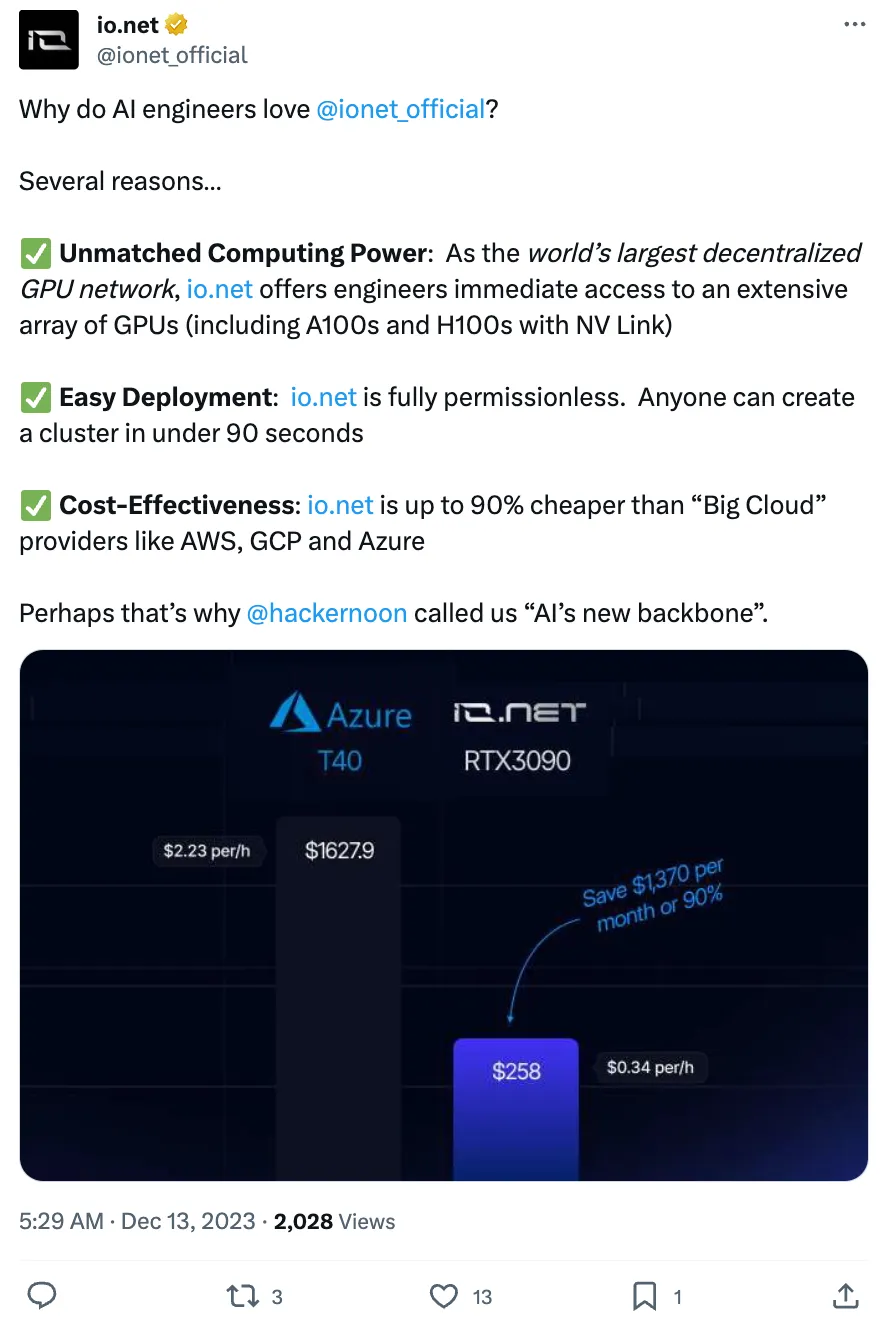
How to Choose Between Competitors and io.net?
-
Traditional competitors might argue that io.net lacks specific features like automated deployment, CI/CD, API protection—features they’ve spent years developing.
-
Ahmad pointed out that io.net has already built these features within the ML (machine learning) community for training and inference purposes. He added that while there may be some gaps in currently available functionality, the overall experience offered by io.net surpasses that of traditional providers.
-
Ahmad said that with their platform, users can easily access a broad supply of GPUs across 45 countries. With just one click to deploy, setup completes within 10 seconds.
-
In contrast, traditional methods using AWS or other providers often involve begging for GPU access by submitting presentations and LinkedIn profiles. Ahmad shared how, as a developer, he was frustrated when asked to provide promotional materials and LinkedIn information just to use a GPU.
-
io.net aims to empower engineers by simplifying the process and eliminating unnecessary requirements. io.net offers a supportive community on Discord where engineers can get help from others who have deployed alongside them.
-
Ahmad added that by engaging with the community and providing support, they aim to create a better overall user experience for engineers. This approach aligns with the needs and mindset of today’s generation of developers, who value simplicity and accessibility.
-
He also noted the emergence of a startup-driven market where companies are willing to spend heavily on computing resources. This generation is building innovative solutions, and serving their specific needs and workflows is crucial. The io.net platform aims to shift market dynamics through on-demand supply.
What is a GPU Cluster?
-
io.net’s technology enables clustering 50,000 to 70,000 GPUs into a single cluster. This clustering capability distinguishes io.net from competitors who typically offer individual GPU instances. io.net’s built network infrastructure enables efficient communication between clustered GPUs. With sufficient resources, users could potentially build large language models via the platform.
-
The product targets developers building on specific infrastructure, particularly clients with financial resources but struggling with costs. The io.net team recognizes the importance of alignment with customers. The product has already been demonstrated to well-known companies such as OpenAI, Instacart, and Uber.
-
Ahmad expressed confidence in the scale and revenue potential for targeted clients. He expects substantial capital inflows into the io.net network as more startups join. Transactions can be made using traditional payment methods like Visa, without requiring users to understand anything about crypto. The goal is to attract customers booking GPUs long-term (e.g., six months) to maximize revenue.
-
Additionally, Ahmad envisions a network where funding flows exceed token issuance. Tory views competitors as potential suppliers rather than direct rivals. He claims they hold unique advantages in serving enterprise AI customers. All transactions within io.net incur a network fee ranging from 5% to 10%.
In conclusion, io.net is not only an example of technological innovation but also a paradigm of blockchain applied to real-world challenges. As its team continues to push boundaries, we look forward to seeing more projects like io.net emerge, bringing greater possibilities to our Web3 world.
Join TechFlow official community to stay tuned
Telegram:https://t.me/TechFlowDaily
X (Twitter):https://x.com/TechFlowPost
X (Twitter) EN:https://x.com/BlockFlow_News
 Revelo Intel