IO.NET 2024 Summit Keynote: From Vision to Reality — How io.net Is Transforming AI, Computing, and Cryptocurrency?
TechFlow Selected TechFlow Selected
IO.NET 2024 Summit Keynote: From Vision to Reality — How io.net Is Transforming AI, Computing, and Cryptocurrency?
io.net announced three major breakthroughs that will completely transform the future of AI, computing, and cryptography.
 Navigating Web3 tides with focused insights
Compiled & Translated: TechFlow
Participants: Ahmed Shadid, Founder & CEO of io.net; Tory Green, Founder & COO of io.net; Aline Almeida, Senior VP of Engineering at io.net; Mahar Jilani, Chief Experience Officer at io.net; Gauvrav Sharma, CTO of io.net; Basen Oubah, Co-Founder & CoS of io.net; Hashim Alnabulsi, Managing Partner of IO.VENTURES
Guests: Avery Ching, Co-Founder & CTO of Aptos Labs; Toly Yakovenko, Co-Founder of Solana; Lily Liu, President of Solana Foundation; Hidde Hoogland, CEO of DCENT
Podcast Source: io.net
Original Title: IO Summit 2024 Keynote
Release Date: June 4, 2024
Key Takeaways
-
At the 2024 IO Summit, io.net announced three major breakthroughs: launching the world’s largest AI computing network, IOG (Internet of GPUs), and showcasing collaborations with Aptos and Solana. These innovations will fundamentally reshape the future of AI, computing, and crypto.
-
Ahmed Shadid, Founder & CEO of io.net, shared the latest achievements of io.net during the summit, emphasizing the importance of computational power and presenting a bold vision: making access to GPU computing as seamless as accessing the internet. io.net is building a compute-centric ecosystem that provides tools and services for large-scale construction, training, and deployment of machine learning models on-chain.
-
As key partners, Aptos and Solana offer high-performance blockchain infrastructure and decentralized computing capabilities, enabling io.net to scale its AI computing network globally. Through decentralized cloud computing solutions, io.net bridges the current supply-demand gap in computing resources, delivering lower-cost, higher-performance computing services.
-
Additionally, io.net launched Project BC8—the world’s first fully decentralized end-to-end machine learning model—trained and inferred using io.net’s IOG infrastructure. Its investment arm, IO.VENTURES, is also advancing machine learning startups by providing GPU computing in exchange for equity and token allocations.
io.net: Three Breakthroughs Disrupting the AI Computing Industry
-
Ahmed Shadid, Founder & CEO of io.net, opened the summit by introducing io.net’s mission and vision, expressing excitement about the team's accomplishments. He emphasized that io.net brings together top engineers worldwide to push technological boundaries into uncharted territory. Together, they are poised to disrupt the AI computing industry, announcing three breakthroughs set to transform AI, computing, and cryptocurrency.
-
In today’s digital world, computing power is the lifeblood driving technological progress—powering AI that transforms lives, reshaping industries, and empowering innovators to create worlds we haven’t yet imagined.
-
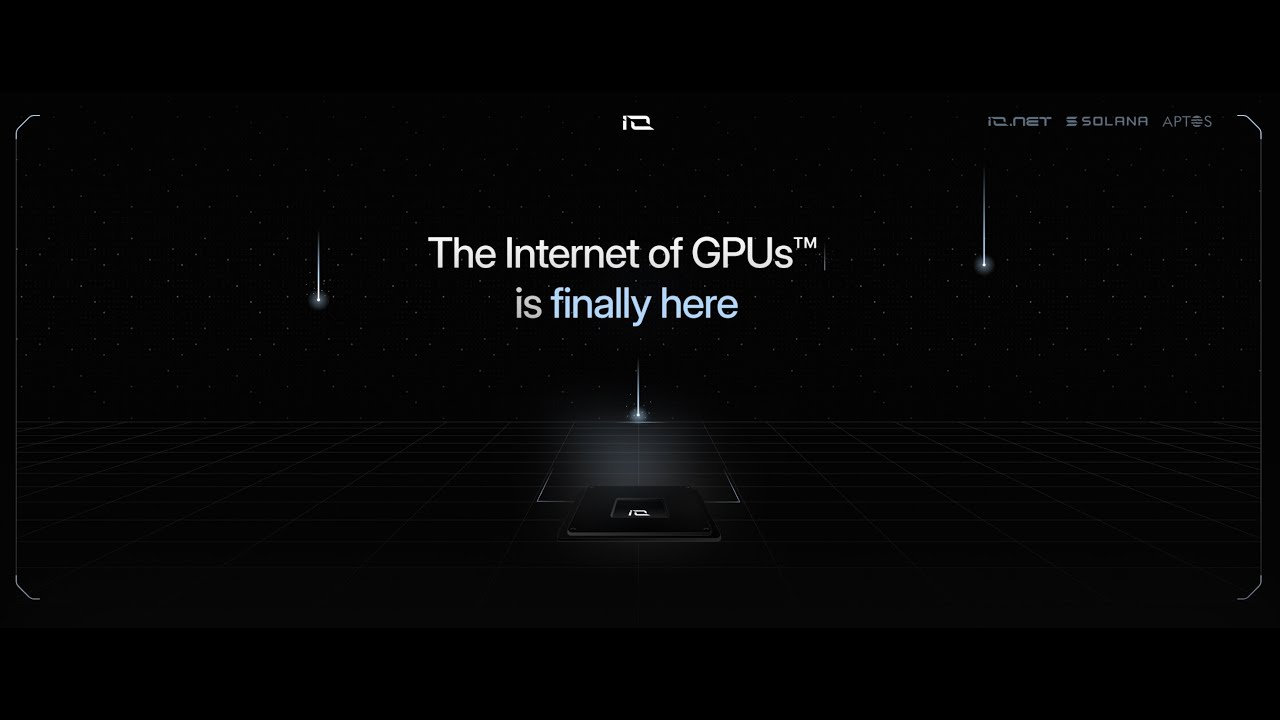
Ahmed posed a simple yet profound question: What if accessing GPU computing were as seamless as accessing the internet? This is the genesis of Internet of GPUs (IOG). IOG is the world’s largest AI computing network, and Ahmed believes the world needs fair, democratic, and permissionless access to AI computing.
-
He further noted that in today’s digital age, computing power is not just an asset or commodity—it’s digital oil. China now spends more on semiconductors than crude oil, underscoring the critical importance of digital infrastructure. Currently, computing consumes 70% of startup funding.
-
io.net is building a compute-centric ecosystem offering tools and services for large-scale on-chain development, training, and deployment of machine learning models—all powered by Aptos and Solana. Users can deploy models in real time for inference or efficiently train and fine-tune models. In short, Io represents the currency of computing power—just as the dollar standardizes transactions, Io coin unlocks global computing resources. io.net aims to become the universal medium of exchange for large AI startups and enterprises.
-
Ahmed also highlighted that approximately 90% of global computing resources sit idle across consumer devices, data centers, and crypto mining farms. io.net aims to harness this unused capacity, unlocking massive economic potential.
Aptos and io.net Partnership: Advancing the Convergence of AI and Blockchain
-
Avery Ching, Co-Founder & CTO of Aptos Labs, outlined the collaborative vision between Aptos and io.net, emphasizing the potential of treating computing power as currency—creating new ways to interact with AI products and services. The Aptos network is the ideal partner for io.net. Built on the Move language, Aptos offers a more secure, faster, and higher-performance blockchain infrastructure, allowing io.net to focus on innovation rather than blockchain maintenance.
-
Aptos has demonstrated the ability to process over 25,000 transactions per second and handled 2 billion transactions in a single day—13 times more than Visa. Aptos plans to scale beyond 1 million TPS. With this parallel architecture, Aptos is a trusted partner for io.net to scale its IR products in the future.
-
Aptos and io.net both recognize that the future of AI will inevitably intersect with Web3 and decentralization. Open access and decentralized ownership of content are essential components of future AI. Decentralized physical infrastructure networks like io.net are laying the foundation for globally accessible AI products and services. Both parties are committed to setting new standards for responsible AI.
-
Aptos and io.net are collaborating on linear data use cases, such as Proof of Compute, and exploring how blockchains can provide transparent, immutable records for AI-generated assets. This partnership accelerates innovation at the intersection of AI and Web3, and Avery expressed enthusiasm about co-building the future with io.net.
Leading a New Era of AI Computing via Decentralized Cloud
-
Tory pointed out that current computing demand is 2.5 times supply, and AI computing demand doubles every 3.4 months—widening the gap continuously.
-
He argued that traditional cloud computing can no longer meet this demand—but this also presents immense opportunity. The combined market cap of the three major centralized cloud providers (Amazon, Google, Microsoft) exceeds $7 trillion, much of which stems from AI growth. Demand is so high that last year, China imported more chips than oil. Computing is dubbed “new oil,” and costs are steep—for example, Chad GPT’s daily operating cost exceeds $700,000. With OpenAI launching Sora, its text-to-video platform, these costs will only rise.
-
Tory noted that despite continuous AI innovation, computing resources remain insufficient. io.net fills this void with a novel solution: decentralized cloud computing. io.net’s infrastructure is valued at over $3.5 billion, hosting more enterprise-grade GPU clusters than Amazon AWS, Google Cloud, and Microsoft Azure combined. It offers on-demand computing at a fraction of traditional cloud costs, aiming to deliver AI to the world better, faster, and cheaper.
-
Ahmed stated that io.net’s success is made possible by support from tech and Web3 leaders. io.net is backed by Hack VC, Multicoin Capital, 6MV, OKX Ventures, Aptos Labs, Solana Ventures, M13, and prominent figures including Solana co-founder Anatoly, Aptos founders Mo and Avery, Yat Siu of Animoca Brands, and Sebastian (co-founder of The Sandbox). Additionally, senior executives from leading global GPU manufacturers support io.net. With this elite list of VCs and angel investors, io.net raised over $40 million in an oversubscribed Series A round, accelerating its mission and execution. Within its first 10 months, io.net became a unicorn—and this is just the beginning.
Solana and io.net: Building a Decentralized Future for AI Computing
-
Anatoly, Co-Founder of Solana and CEO of Solana Labs, reflected on the collaboration history between the Solana ecosystem and io.net.
-
Anatoly mentioned that io.net won the Solana Grizzlython hackathon and showcased their MVP at Solana Breakpoint. io.net chose Solana as a partner due to its speed, low cost, and scalability. Solana processes tens of millions of transactions daily at sub-cent fees, with over 1.5 million active addresses.
-
Anatoly emphasized that AI is one of the fastest-growing sectors, and io.net needs a powerful blockchain partner to support its expansion. Solana’s scalability and Solana Pay’s seamless payment functionality will help io.net succeed globally.
-
Lily, President of the Solana Foundation, noted that in the fast-evolving Web3 world, finding a platform that not only supports but accelerates growth is crucial for pioneers like io.net. Solana is more than a blockchain—it’s a launchpad for cutting-edge applications and rapidly growing companies, home to strong projects like Orca, Jupiter, Mediora, and Backpack. Solana offers unmatched support, ensuring builders have the tools needed for success from day one.
-
Lily added that the Solana Foundation collaborates closely with teams like io.net through events, hackathons, and direct support to drive innovation. io.net actively participates in multiple Solana programs and works closely with partners like Colosseum to build the world’s largest decentralized AI computing network, redefining the status quo and democratizing AI.
Achieving Sustainable AI via Decentralized Computing Networks
-
Ahmed emphasized that io.net is the world’s largest AI computing network and treats computing as currency—making sustainability critical. io.net fosters a healthy ecosystem by rewarding IO workers who contribute computing power, enabling AI developers to access computing seamlessly and affordably while incentivizing them to build new models and lead technological frontiers. This network now belongs to everyone, protected by IOG Cortex—a hyper-cluster defense system deployed on every IO worker node.
-
Ahmed likened io.net’s network to an ant colony, where all worker nodes coordinate like ants, completing tasks nonstop. The IOG framework enables engineers to use open-source computing—meaning Python code running on your laptop can automatically execute across the GPU internet. This network can serve over 100 million users with ultra-low latency, coordinating tasks across thousands of GPU clusters in 139 countries, creating a cloud service for ML model inference.
-
io.net leverages ray.io as its core open-source technology—without which many AI-based products like ChatGPT, Uber, and Instacart wouldn’t exist. io.net has elevated this technology, building the world’s most advanced, scalable, and secure distributed computing framework.
io.net: Enhancing AI Application Deployment and Training Efficiency via IOG
-
Aline Almeida, Senior VP of Engineering at io.net, introduced how the io.net platform distributes AI and Python applications across a broad GPU network, enhanced by IOG (Internet of GPUs).
-
io.net forked Ray to better run in decentralized networks and improve user experience for application libraries. IOG introduced backend customization for optimal integration with io.net’s unique network, including dedicated Outer Scalar and Io Cloud supporting graph and scheduling algorithms. io.net also improved dashboards, providing developers with Io-specific operational metrics and geographic node details.
-
IOG simplifies AI application distribution through direct interfaces with Io Cloud and code templates, making AI scaling feasible not only for big tech engineers but also for AI creators worldwide. io.net clusters can scale to thousands of GPUs, offering robust computing power—from confidential computing and zero-knowledge jobs to AI model training and tuning—supporting decentralized agents and enabling low-latency model inference. This is an open-source journey where global collaboration will shape the future of decentralized AI.
-
Aline demonstrated using the IUG package to train a computer vision classification model and tune hyperparameters to improve accuracy. By connecting to an IOG supercluster with 1,000 GPUs, io.net completes 1,000 training runs with different configurations in one hour—instead of 41 days. This showcases the power of distributed computing: faster speeds and 90% lower costs.
-
Finally, Aline announced that the IOG SDK Python package will be publicly released next quarter, inviting interested users to join the waitlist for the beta version.
io.net: Redefining User Experience in AI Cloud Computing
-
Mahar Jilani, Chief Experience Officer at io.net, shared how io.net leads the future of Web3 through innovative design, building the world’s largest AI computing network. He stressed that technology alone doesn’t shape the future—people do—and design is the bridge between people and technology. io.net is committed to exceptional user experience, enabling engineers to easily deploy the world’s most advanced clusters.
-
io.net’s Io Cloud platform hosts 100x more GPUs than major crypto market players, nearly matching Google Cloud, Amazon AWS, and Microsoft Azure. Engineers can deploy a 20,000-GPU cluster in 90 seconds, offering end-to-end solutions from model training to inference.
-
Mahar demonstrated how to deploy clusters using Io Cloud. Engineers can choose powerful options like Ray, Mega Ray, and Kubernetes, select GPU models and connection speeds as needed. io.net also supports Apple-chip clusters, enabling millions of Apple device owners to contribute computing power and earn rewards. The entire process is simple and fast, requiring no KYC—users just make selections, and io.net handles the rest.
-
io.net’s cloud services are up to 80% cheaper than major market players, delivering identical performance, quality, and reliability—significantly reducing costs.
io.net: Transforming GPUs into Digital Assets for Global AI Computing
-
Gauvrav Sharma, CTO of io.net, introduced io.net’s revolutionary platform aimed at democratizing GPU computing as a global standard. io.net’s IOG (Internet of GPUs) platform allows GPU owners to connect their devices to the network, turning GPUs into valuable assets generating steady income streams.
-
Whether large data centers, mining farms, or individual miners, anyone with underutilized GPUs can join io.net and become part of the digital oil powering the AI revolution. io.net breaks traditional barriers through Web3’s revolutionary principles, empowering users globally. Gauvrav compared io.net’s GPU network to an ant colony, where each GPU is maximized like an ant—anyone, anywhere, can join this worker community.
-
Gauvrav demonstrated how to connect and monitor devices. Users follow an intuitive flow: connect new devices, select OS (Mac, Linux, or Windows) and device type (GPU or CPU), run scripts to download and install Docker and drivers, then execute Docker commands to connect. On the device page, users monitor activity and reputation scores (driven by uptime). On the earnings and rewards page, they track and withdraw accumulated earnings. Users link their Solana wallets to io.net to claim rewards and view computation tasks and earnings history.
BC8: Leading a New Era of 3D Content Creation via Decentralized AI
-
Basen Oubah introduced BC8—the world’s first fully decentralized end-to-end machine learning model, trained and inferred using io.net’s IOG (Internet of GPUs) infrastructure. BC8 exemplifies decentralized AI, using Aptos as the payment rail to handle inference computation fees, model owner royalties, and proof of compute records, generating 500,000 images and 2 million transactions daily.
-
BC8 supports third-party model integration, hosted on io.net’s decentralized cloud. BC8 began with a Stable Diffusion-powered model trained on a 10TB dataset, setting a new benchmark for text-to-image realism, adopted by tens of thousands of community members to generate character avatars for social media.
-
BC8’s latest innovation is text-to-3D-model generation, compatible with AAA game engines like Unreal Engine 5, Unity Engine, CRI Engine, and Frostbite—opening infinite possibilities for creators. Users simply visit the BC8 AI website, upload an image or enter a prompt, and generate a 3D model in seconds, optionally upgrading quality.
-
In the future metaverse, whether gamers seeking new weapon skins or Blender designers imagining unique shapes, BC8 meets and exceeds these needs. BC8 is a community-driven platform leveling the playing field for content creation and truly shaping the digital future. Basen added that Aptos AV will further detail their collaboration.
Aptos: The Blockchain Backbone Powering Decentralized AI and Gaming
-
Avery Ching explained how io.net deploys its generative AI product BC8 on the Aptos blockchain. Every inference transaction is recorded on Aptos, enabling seamless payments and proof of compute records. Since launch, BC8 has processed nearly 500,000 transactions daily, showcasing Aptos’ advantages in speed and scale. BC8 is just the beginning—future machine learning models will generate high-quality 3D models and AAA game assets, redefining game development.
-
The Aptos blockchain provides instant, secure, and scalable proof of compute behind the scenes. Avery emphasized this is just one of many use cases Aptos supports, with hundreds more to come. The Aptos ecosystem will offer tools and services for building, training, and deploying machine learning models on-chain, supporting payments for hundreds of thousands of on-chain models, making Aptos the backbone of the Internet of GPUs. Each product will be powered by its native Aptos token, driving growth and adoption of all on-chain AI products.
io.net’s Physical Infrastructure: Etch Data Centers
-
Hidde Hoogland introduced Etch data centers, part of the world’s largest distributed GPU computing network. She took us on a tour of server rooms capable of housing up to six cold aisle containment units, totaling 120 racks. Etch data centers primarily utilize GPU computing power leased via the Web3 and io.net platforms.
-
The data center has a 2-megawatt redundant power connection, with each cold aisle unit powered via busbars beneath raised floors. Perforated floor tiles between racks allow fresh air to reach GPUs. These clusters are packed with GPUs leased through the io.net platform, serving clients while generating revenue.
-
Hidde also showed the battery backup room, which sustains operations for at least two hours during grid outages. These battery systems are charged by the data center’s solar roof, providing sufficient summer energy to achieve net-zero operation.
io.net’s Investment Arm: IO.VENTURES Driving AI Startup Growth
-
Hashim Alnabulsi, Managing Partner of IO.VENTURES, introduced IO.VENTURES as io.net’s investment arm, dedicated to advancing machine learning startups. AI startups typically spend over 80% of raised funds on computing—even small projects can burn over $500,000 monthly, severely hindering AI progress. io.net offers a better solution.
-
IO.VENTURES proposes providing startups with GPU computing in exchange for equity and token allocations—a more economical alternative to traditional venture capital that returns significant value to GPU suppliers. As io.net decentralizes AI computing, IO.VENTURES aims to grow the Io economy by investing in fast-scaling AI and ML startups.
-
Hashim revealed a bolder plan: creating the IO.VENTURES Mega GPU Fund. Unlike traditional funds relying on a few limited partners, IO.VENTURES accesses the entire io.net network, unlocking $3.5 billion in computing power. This grassroots movement connects the world’s idle GPU supply with innovators, unleashing infinite potential while democratizing AI.
-
IO.VENTURES aims to expand globally through decentralized investment, focusing on projects challenging the status quo—especially those aligned with its vision to transform industries. Hashim called on the world’s boldest AI talent to join this transformative journey. IO.VENTURES plans to collaborate with global partners—including accelerators, research institutions, large enterprises, and progressive public-sector initiatives—to build an unprecedented supportive ecosystem.
-
The future for IO.VENTURES is both challenging and exciting—they look forward to meaningful collaborations with groundbreaking projects, embarking on this transformative journey together.
io.net: Turning the Dream of a New AI Era into Reality
-
Ahmed Shadid expressed his excitement about io.net turning dreams into reality. Just months ago, io.net was just a dream—today, it’s real and growing faster than anyone expected.
-
Today’s launch announced several major product releases: IO Coin, IO Cloud, IO Worker, and most importantly, the Internet of GPUs (IOG)—empowering all of us to build and create a better world. Ahmed also previewed the upcoming IOG Python framework, to be released later this year.
-
He called on everyone to join this revolution—visit io.net now and help change the world.
Join TechFlow official community to stay tuned
Telegram:https://t.me/TechFlowDaily
X (Twitter):https://x.com/TechFlowPost
X (Twitter) EN:https://x.com/BlockFlow_News
 深潮TechFlow