








Numerous favorable developments emerge—could Mask Network be on the verge of a new surge?
TechFlow Selected TechFlow Selected
Numerous favorable developments emerge—could Mask Network be on the verge of a new surge?
The Mask Network ecosystem is once again seeing a series of market tailwinds, which could also serve as driving forces for the continued upward momentum of the $Mask token.
 Navigating Web3 tides with focused insights
Under the new ideology of the Web3 world, value is being redistributed. As the most critical SocialFi infrastructure today, protocol layers will prioritize providing more robust foundational support for application layers, making all resources increasingly modular, foundational, and decentralized. This composability is precisely one of Web3's social advantages—through open-stack services, upper-layer applications can further compete for external resources by leveraging the composability offered by underlying infrastructures. With continuous improvements in the protocol layer, a new wave of SocialFi applications is poised for explosive growth. Focusing on the SocialFi sector, the protocol layer will remain the primary narrative direction for this space over the long term.
In this new market cycle, Mask Network remains one of the most promising projects within the social protocol layer. As a programmable social protocol, it seamlessly integrates blockchain technology into mainstream social media platforms we use daily, aiming to build a bridge for users to access decentralized applications (DApps) effortlessly. This integration ensures Mask Network maintains a competitive edge in the protocol race—not only lowering technical barriers so non-technical users can easily engage with decentralized services, but also introducing a layer of privacy protection into social communications. Through encrypted messaging features, Mask Network enhances communication security and confidentiality among users—an unprecedented feature in traditional social media platforms.
Since launching to the market in 2021, the $MASK token has delivered notable surprises. Although it experienced a brief lull during the previous bear market, $MASK began a sustained rally starting in the second half of last year. Bolstered by ongoing ecosystem expansion and favorable bull market conditions, the token has surged over 100% from its prior lows. Currently, the Mask Network ecosystem is witnessing a series of positive developments, which could serve as key catalysts driving further upward momentum for the $MASK token.
Potential Mining Boom
On March 18, Mask Network announced a mining initiative—launching a staking program to reward its community and $MASK token holders.
Under this plan, users who stake their $MASK tokens may receive additional token airdrops as incentives from core partners and rapidly growing projects within the ecosystem (specific rules have not yet been disclosed). As a programmable protocol layer, Mask Network has already attracted numerous high-quality development teams through its Social Ecosystem Grants program—now in its third phase—covering areas such as Web3 social, autonomous worlds, and public goods.
On another front, Mask Network founder Suji Yan is actively expanding his social ecosystem. Recently, Pawoo—the Mastodon-based social app formerly operated by Pixiv—was transferred from Pixiv Inc. to The Social Coop Limited, a company registered in the Cayman Islands where Suji Yan serves as chairman of the board.
As a result, three of the four largest Mastodon instances globally—including the two most popular in Japan—are now maintained by companies managed by Suji Yan: pawoo.net, mstdn.jp, and mastodon.cloud (the latter two operated by Sujitech LLC, which also develops and runs Mask Network and the Twidere client). This expanded footprint is expected to bring massive user inflows to Mask Network while further fueling the prosperity of its application ecosystem.
This may also mean that Mask Network could offer multiple high-quality airdrops over time to stakers, boosting participation incentives for $MASK holders and reducing circulating supply—a potentially significant tailwind for $MASK’s market performance.
Hong Kong Hype Revives Interest in Mask Network
Following the implementation of Hong Kong's pro-crypto policies last year, the "Hong Kong narrative" has become one of the hottest themes in the crypto industry. A prime example is Conflux Network, widely seen as one of the biggest beneficiaries of Hong Kong's Web3 boom. Beyond securing strategic partnerships, its $CFX token has achieved remarkable price and market cap gains, sustaining strong investor attention. Mask Network, also rooted in Hong Kong, appears significantly undervalued in this market cycle—especially when compared to peers. Against the backdrop of a bull market, $MASK could deliver fresh surprises.
Celebrity Influence Fuels New Wave of SocialFi
-
A Project Endorsed by Ethereum Founder Vitalik
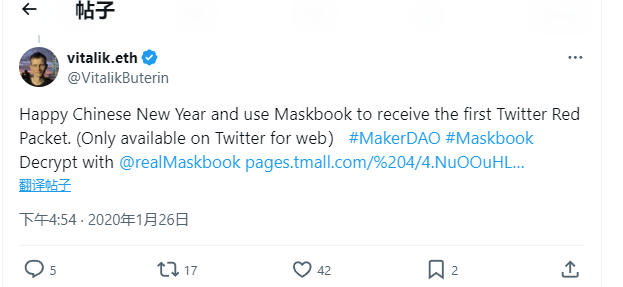
In fact, Ethereum co-founder Vitalik Buterin is highly optimistic about the SocialFi sector and frequently engages in discussions with Mask Network founder Suji Yan on industry trends and technological development. Both share a strong vision for SocialFi’s future and are committed to advancing the field long-term. Mask Network has earned Vitalik’s strong support—he has praised its products multiple times, including publicly endorsing Mask’s red envelope feature back in 2020 when it was just getting started.
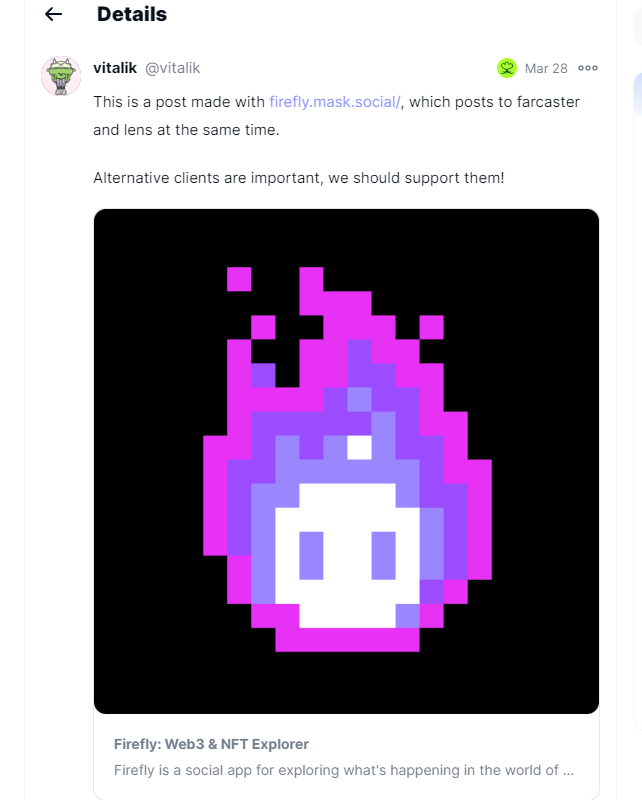
Recently, Mask Network launched firefly.land—a social aggregation protocol built on its own infrastructure. As a Web3 social aggregator, Firefly allows users to connect with all their friends across Twitter, Lens, Farcaster, NFT communities, and other Web3 platforms through a single entry point (users simply log in via supported social accounts). Upon launch, the product once again gained Vitalik’s endorsement.
For instance, Farcaster—a red-hot social platform valued at $1 billion—is highly regarded by Vitalik. Yet he frequently uses Firefly, a product under Mask Network, as his preferred gateway. Compared to others, Firefly offers a superior user experience and undergoes extremely rapid product iteration. Vitalik often publicly praises firefly.land on social media, significantly boosting its visibility and credibility.
Currently, users from Farcaster, Twitter, and other platforms are logging into firefly.land for aggregated social interactions—and using the app may even qualify them for future airdrops.
-
New Catalysts from U.S. Election Outlook
In recent financial and tech news, former U.S. President Donald Trump partnered with a SPAC company to take his social media platform Truth Social public, drawing widespread market attention. The merger was executed through Digital World Acquisition Corp. (DWAC), aiming to bring Truth Social into the public spotlight.
Launched by Trump Media & Technology Group (TMTG), Truth Social aims to provide an alternative social platform emphasizing free speech—particularly after Trump was banned from mainstream platforms like Facebook and Twitter. Built on the Fediverse’s decentralized social networking stack, the platform enables users to create accounts, post content, and interact socially without relying on a centralized authority. It emphasizes decentralized personal data protection, contains no built-in ads or complex recommendation algorithms, and operates via a network of independently hosted servers—offering users a space for open expression and idea sharing.
While commercially weak—Truth Social generated only around $3.4 million in revenue during the first nine months of 2023, with losses reaching $49 million, and had approximately one million users—its decentralized ethos combined with Trump’s vast supporter base have ensured continued attention and backing. This support helped Trump raise nearly $3.5 billion, funding potential political campaigns ahead.
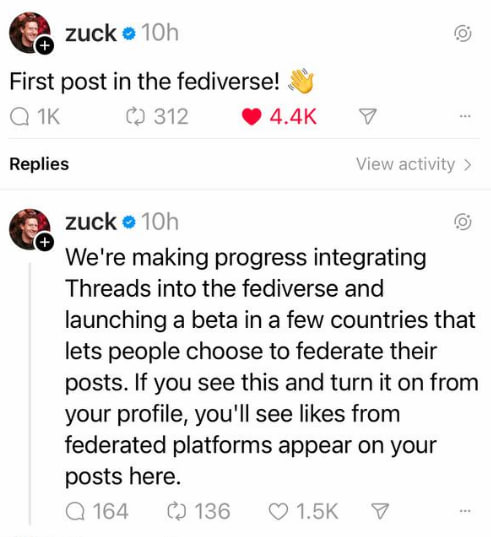
Fediverse, the key backend technology behind Truth Social, has drawn interest not only from Trump but also from Meta CEO Mark Zuckerberg, who has begun posting on Threads within the Fediverse and expressing optimism toward cryptocurrencies. In reality, Fediverse encompasses not just social media services like Truth Social, but also microblogs, blogs, video hosting, and various online social platforms. Users can follow and interact across different services using a single account. Moreover, through Fediverse nodes, global communities can independently develop and maintain this decentralized network, ensuring greater user control over data and communications. Zuckerberg’s engagement signals growing recognition that decentralized social media may represent the next evolution of online interaction. Mask Network and its founder Suji Yan are strong supporters of Fediverse and are well-positioned to provide future technical support to Truth Social.
Furthermore, Mask Network stands to benefit significantly should Trump win the upcoming election. Previously, Mask Network brought on Terry Branstad, a prominent Republican politician and two-time governor of Iowa, as a strategic advisor. He served as U.S. Ambassador to China from 2017 to 2020 under President Trump and remains a key figure within the Republican Party. If Trump returns to the White House, Branstad is likely to assume a major role again—potentially unlocking significant opportunities and influence for Mask Network’s growth.
Indeed, whether it’s Farcaster valued at $1 billion or Lens at $450 million, these are merely appetizers—the ultimate goal is the full-scale flourishing of the entire SocialFi sector. As the new market cycle unfolds, the SocialFi space stands on the brink of explosion. Comparing Animoca Brands’ early bet on Axie Infinity, once Mask Network successfully brings SocialFi narrative users into its ecosystem through its three leading social products,
Suji Yan could surpass Animoca Brands founder Yat Siu to become the king of the social赛道.
Join TechFlow official community to stay tuned
Telegram:https://t.me/TechFlowDaily
X (Twitter):https://x.com/TechFlowPost
X (Twitter) EN:https://x.com/BlockFlow_News






