Interview with Arweave Core Contributor and everVision CEO: On the Future Division of Roles Among Ethereum, Bitcoin, and Arweave
TechFlow Selected TechFlow Selected
Interview with Arweave Core Contributor and everVision CEO: On the Future Division of Roles Among Ethereum, Bitcoin, and Arweave
The content requiring permanent storage is essentially any information that needs to reach consensus.
 Navigating Web3 tides with focused insights
Authors: Sunny, Bella & Zolo, TechFlow
Guest: outprog.ar, CEO of everVision
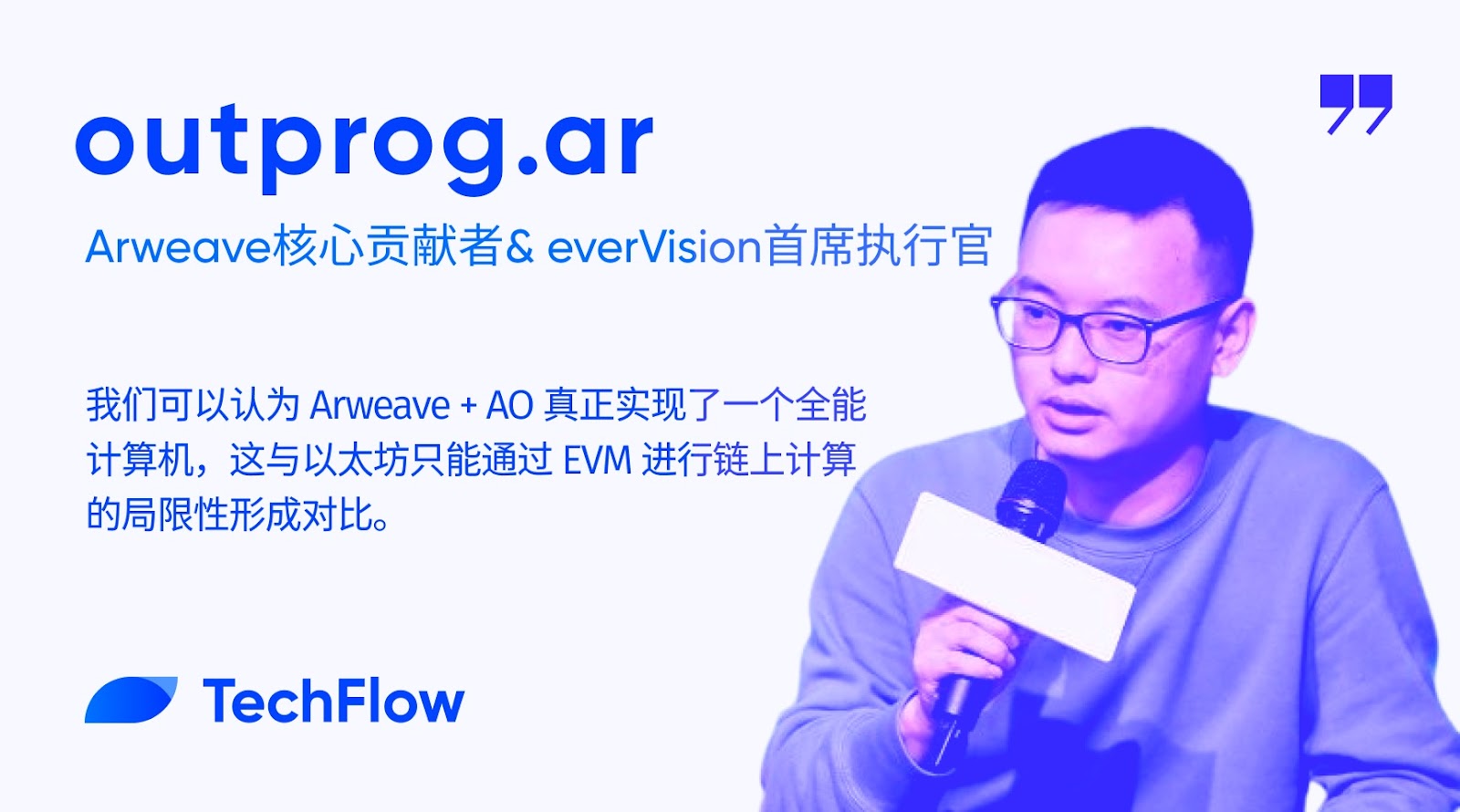
"We can say that Arweave + AO truly realizes an omnipotent computer, in contrast to Ethereum's limitation of only being able to perform on-chain computation via the EVM."
— outprog.ar, CEO of everVision
"A large crowd gathered."
That’s exactly how I felt after speaking with Professor Xiong Wei (@outprog_ar).
Web3 builder events are always dazzling. After attending many conferences, I often feel like time has been wasted. Although I meet new people and encounter fresh concepts and technologies at various summits and hackathons, it's hard for individuals to derive constructive insights—such as what the blockchain industry’s overall structure really looks like. Web3 seems no different across networks; every blockchain appears to be competing homogeneously, doing the same things.
The recent Ethereum Dencun upgrade is a hot topic. People are discussing "How different is Ethereum from other public blockchains after the Dencun upgrade?" But few may offer answers close to reality.
In the overly labeled crypto Twitter (CT) space, there’s almost an illusion: Bitcoin could build Web3, Ethereum can do everything—DeFi, AI, social, DePIN—and Near is the abstraction layer for all chains, while Doge could even build a “city network.” Readers lacking critical thinking skills (including myself) often finish reading a pile of information without understanding what’s actually happening, so they simply immerse themselves in CT’s atmosphere.
Professor Xiong Wei is an early contributor to Arweave and has proposed several concepts within the network, including the “Storage-based Consensus Paradigm” (SCP). This theory emerged from critical thinking about differences between blockchains.
"We believe that from Bitcoin’s UTXO model, data must reflect its chronological relationship.
By contrast, Ethereum maintains a global state ledger, meaning we can know the current state of the ledger even without access to historical records.
In emphasizing decentralization, Arweave focuses more on the process rather than the outcome itself.
The content requiring permanent storage is essentially any information needing consensus."
Arweave is a blockchain-based permanent storage platform. Perhaps after reading Professor Xiong’s explanation of the differences between Ethereum, Bitcoin, and Arweave, you’ll gain a clearer understanding of this industry, better grasp the distinctions in underlying technical roles among networks, and more easily browse and identify information on CT.
everVision is a product born from the technological inspiration of Arweave. At the end of this interview, we will provide a detailed explanation and introduction of its core products.
We hope that after reading this, you'll develop a more critical understanding of our industry.
Below is the conversation between TechFlow and Professor Xiong Wei (outprog.ar). The dialogue has been refined using GPT for grammar and clarity, and may differ slightly from the original version.
Joining Arweave and Founding everVision: "I realized that the complex systems and work I did at banks could be solved in just 200 lines of code on Bitcoin or Ethereum"
TechFlow: First, I’d like to learn about your background. Why did you choose to focus on the Arweave community instead of other blockchain networks? Also, as CEO of everVision, I’m curious to hear the full story of how you transitioned from participating in the Arweave community to founding your own Web3 company.
outprog:
I initially worked in a traditional bank for five years. I was living in Tianjin, and my life was very stable. Around 2017, however, I discovered blockchain, which had a huge impact on me.
I realized that the complex systems and tasks I performed at the bank could be accomplished in just 200 lines of code on Bitcoin or Ethereum.
So I decided to fully commit to the blockchain industry, applied to blockchain companies nationwide, and eventually joined one. I then moved to Hangzhou with my family.
My transformation stemmed from seeing the revolutionary potential of blockchain as a new industry. I joined imToken and began deeply studying and researching DeFi, possibly becoming one of the earliest authors to write about Uniswap and Compound. When Uniswap first launched, I excitedly wrote about its mechanics. Many people came to me then, discussing ideas around entrepreneurship and building DeFi applications.
Later, I became increasingly aware of industry pain points, especially how ordinary users found the field difficult to use. So I transitioned from imToken to Arweave, hoping to solve these problems by adopting a different technical paradigm.
My ultimate goal is to enable everyone to use blockchain to reorganize production and consumption relationships in a decentralized way.
Another motivation for starting up came during DeFi Summer, when financial pressure was relatively low. My co-founder Xiao Jie and I began our project, both of us extremely excited about Arweave’s model. We coded together and created everPay. Initially, we didn’t plan to raise funds, but after launching the product and publishing an article on ChainNews, we attracted attention from investment firms like IOSG and started considering fundraising. This motivated us to pursue long-term development and dive deeper into the Arweave ecosystem.
Through three years working at imToken, I observed that many users found blockchain very difficult to use.
-
First, a major barrier is managing recovery phrases and private keys—many users lose them and cannot recover their assets.
-
Second, Ethereum’s high fees make transactions frustrating. On our DEX product, users might pay $5 in gas fees to swap just $10 worth of assets, which feels confusing and unacceptable. Our experience at a blockchain wallet company made us realize these issues are far too unfriendly for average users.
In July 2020, during DeFi Summer, I learned about Arweave through a friend and met Zeng Mi and Miao Shu at Star Pool in Hangzhou, who were senior employees at Star Pool and early members of the Etherfans community. Through them, I became interested in the Arweave project. As a storage blockchain, Arweave’s storage cost is much lower compared to Ethereum.
So we started thinking about whether Arweave could be used as a computer hard drive or storage device for future applications.
Our computation doesn’t necessarily need to happen on-chain—it can occur off-chain. But since Arweave’s storage is immutable and traceable, even off-chain computations can achieve a certain level of consensus and verifiability.
Based on this idea, we believed that with a storage blockchain like Arweave, future application experiences could closely resemble those of Web2.
Starting from July 2020, I’ve been deeply researching Arweave and exploring whether we could build products on it that lower user barriers. Our product, everPay, aims to simplify wallet operations and achieve zero gas fees using Arweave. We also hope to eliminate the need for recovery phrases in the future, allowing users to operate using Web2 standard key protocols like FIDO. Our core goal is to make blockchain easy for ordinary users to use.
everPay can be understood as a service similar to Alipay, offering an experience close to Alipay, while all ledger records are stored in a decentralized manner on Arweave. Such an Alipay is still somewhat centralized, but because the ledger is public, anyone can verify its records. For users, this is already sufficient.
Over the past year, I have developed a theory called SCP (Storage-based Consensus Paradigm), with the full English name Storage-based Consensus Paradigm.
The core idea of this theory is that as long as storage is immutable and traceable, computations built upon it are trustworthy and decentralized.
In October 2020, I left imToken and founded everVision in November. Since then, we have focused on developing everPay, a payment network product based on Arweave.
From Arweave to AO: The Pioneer of Modular Blockchains
TechFlow: I see. When you mentioned that Arweave was previously not sufficiently decentralized, were you referring to the lack of transparency and general awareness around off-chain computation?
outprog:
Actually, the reason for incomplete decentralization back then was our roll-up mechanism—the Sequencer. In everPay, the Sequencer was singular, meaning all transactions had to go through our gateway before being uploaded to Arweave. That was why decentralization wasn’t complete at the time.
Of course, this issue has now been resolved by Arweave’s AO.
TechFlow: Could you first explain what AO is?
outprog:
After I introduced the SCP (Storage-based Consensus Paradigm), all applications on Arweave adopted this model. Whether developing smart contracts, network drives, or gateways providing storage services, everyone uses off-chain computing resources, treating Arweave solely as a network hard drive. Over these two years, many SCP-based applications have emerged.
However, we faced a challenge: inter-application communication was extremely difficult, especially when aiming for interoperability between different apps. I should add that SCP is similar to inscriptions—it actually predates inscriptions. The difference is that we write data to Arweave, while inscriptions are written to Bitcoin. Both inscriptions and SCP apps face severe communication difficulties. To verify data from another node, I’d need to run the entire node’s data to achieve interoperability and communication.
AO was originally designed to solve this inter-app communication problem.
Last July, in Berlin, Germany, I and a representative from WARP, as SCP app developers, discussed trust issues between our two apps with Sam (Arweave Founder). We designed a messaging protocol then, which can be seen as the precursor to the AO system. This system aimed to resolve communication challenges.
At the end of last year, Sam redesigned the system entirely, creating today’s AO system, which has recently been implemented. We found that AO not only solves communication between SCP apps but also functions as a global, hybrid, super-parallel computer. Our existing SCP apps—like everPay and WARP—will be transformed into threads or processes within this supercomputer, enabling communication and trusted computation across the system.
Additionally, although AO was initially designed for communication, it actually enables the creation of a fully decentralized distributed computing network. Within this network, users, bots, or programs can request other threads to perform computations—as if multiple computing units provide processing power to a program.
Therefore, we can say AO truly realizes an omnipotent computer, contrasting sharply with Ethereum’s limitation of only performing on-chain computation via the EVM.
Under the AO framework, all computing resources are decentralized and global. We can outsource computational tasks to any computing unit or partial computing resource.
Data Storage Methods Define the Future Roles of Arweave, Bitcoin, and Ethereum
TechFlow: Based on this explanation, Arweave combined with AO opens new possibilities for distributed computing, allowing not just data storage but also computation. You previously mentioned comparisons with Ethereum. Technically, what exactly distinguishes Arweave+AO from Ethereum?
outprog: First, the main difference is that Ethereum integrates disk (storage) and computation together, meaning Ethereum’s virtual machine (EVM) contains both the computing unit (CPU) and storage. Of course, recent ConsenSys upgrades may have trimmed some storage aspects, but that’s another topic.
As for Arweave and AO, they were designed separately from the start. When Sam originally designed Arweave, he didn’t consider any computational functionality at all.
Our goal was simply to create a fully decentralized, global storage hard drive.
AO evolved later, influenced by SCP, as a completely new system where the two layers have entirely separate responsibilities. AO handles virtually no permanent or block-level storage management, while Arweave does not handle any computation.
Using widely known terminology in the blockchain industry, this model is essentially modular blockchain architecture.
Although the concept of modular blockchains may originate from the Ethereum ecosystem, Arweave never explicitly proposed modular blockchains. Yet, from the perspective of SCP’s architecture, our design can be seen as the ultimate form of modular blockchains.
TechFlow: So are you suggesting that as Ethereum completes its Dencun Upgrade and implements sharding technology under “Ethereum 2.0,” it will increasingly move toward separating storage and computation, making its state gradually resemble Arweave’s?
outprog:
When studying Ethereum in 2020, we noticed plans for a 2.0 version with 64 shards and a beacon chain. If developed further, its structure would become quite similar to Arweave’s model.
But based on recent developments, especially Ethereum’s Danksharding upgrade, it will actually prune historical data.
Therefore, Ethereum may no longer retain permanent data storage in the future. From this upgrade, Ethereum, Arweave, and even Bitcoin, are heading down entirely different paths.
TechFlow: I find your point about Ethereum potentially not storing data permanently very interesting. As a member of the Arweave developer community, what’s your view on permanent data storage? Specifically, what kind of data needs to be permanently stored?
outprog:
We believe that from Bitcoin’s UTXO model, data must reflect its chronological relationship.
In contrast, Ethereum maintains a global state ledger, allowing us to know the current state even without historical records.
In emphasizing decentralization, Arweave focuses more on the process rather than the outcome itself.
The content requiring permanent storage is essentially any information needing consensus. For example, if we develop a decentralized social app, user-generated content on the app, or whether such content could become tradable assets in the future, needs to be permanently preserved because it involves transactional and consensus requirements.
On Ethereum, certain content might eventually get lost, as Ethereum primarily records the latest ledger state.
Thus, for applications like decentralized finance (DeFi), discarding some data may be feasible since the focus is mainly on the current settlement state.
But for social, gaming, and other decentralized applications, preserving historical data becomes crucial because such data may hold value in the future.
By using the Arweave + AO model, we can make every sentence or data point tradable.
Similarly, in artificial intelligence, the raw data used to train AI models and completed work should be permanently saved to enable future revenue distribution. Without these credentials, profit-sharing becomes impossible; without proof, platforms like TikTok, Facebook, and Twitter remain the sole beneficiaries. They control the collection of user data and capture the generated value.
To ensure value directly benefits users, users must possess verifiable credentials at the data generation stage, which requires consensus and permanent data storage.
TechFlow: Therefore, from an application standpoint, Ethereum may primarily serve the DeFi domain, while Arweave supports broader use cases such as AI and social. Regarding Bitcoin, with increasing use as inscription data storage, do you think Bitcoin will transcend its role as pure value storage?
outprog:
Inscriptions are mostly driven by Chinese developers. They aren’t nearly as popular in Western countries—that’s the first point. Second, Bitcoin’s native storage is extremely expensive, making it very difficult to store full processes. I think Bitcoin inscriptions will just have a speculative wave and then fade away.
Moreover, Bitcoin itself doesn’t need any extra features—it is gold.
Gold has almost no industrial use except as jewelry. So Bitcoin’s value will remain the highest, with the strongest consensus. I don’t think inscriptions will bring much to Bitcoin, though they might attract some attention or create a bubble leveraging Bitcoin’s strong consensus.
TechFlow: Indeed, storing 1 GB of data on Ethereum could cost around $30 million, and it would be even more expensive on Bitcoin. You previously mentioned on Twitter that Arweave has the potential to become Ethereum’s “killer.” We’ve discussed differing roles among these three systems: Bitcoin may anchor digital currency, Arweave may anchor the application layer, and Ethereum may anchor the future financial sector. If discussing “killers” or competition, you seem to have a compelling argument.
outprog:
Actually, my tweet didn’t mean Arweave is Ethereum’s “killer.” What I meant was that in computing, Ethereum’s final form might resemble Arweave’s initial sharded design. The discussion about “Ethereum killer” actually originated from a community event discussion.
So these are two different things: I publicly discussed Ethereum’s future development in computing, which is based on technical considerations.
I strongly agree with this three-party division of labor, and I believe Ethereum is undoubtedly strongest in verification and financial applications, especially DeFi. Meanwhile, Arweave is better suited for social media and decentralized gaming applications.
So the term “killer” is more of a label created by the community for marketing purposes—to grab attention—not the emphasis I intended.
The Storage Consensus Paradigm Driving Arweave’s Evolution: Turing Machine, von Neumann Architecture, and the Ethereum Virtual Machine
TechFlow: Let’s move away from media-overhyped topics and return to discussing SCP (Storage-based Consensus Paradigm). As the founder of the SCP concept, could you elaborate further? I’m particularly interested in the context behind your idea—your personal reflections, humanistic perspectives, and technically, what SCP actually is.
outprog:
This might lean technical. As computer science graduates, we all learned about the Turing Machine in our first class.
The Turing Machine is a fundamental computational model, essentially consisting of an infinite tape and a state machine. The state machine marks dots on the tape, each representing 0 or 1. As long as the state machine keeps marking, this simple system can perform any computation.
When I learned about Arweave, I immediately thought of the Turing Machine and the concept of computation. If we compare the Turing Machine’s tape to Arweave, it means our state machine—and thus the computer itself—is trustworthy, because every mark recorded on the blockchain forms consensus and is tamper-proof.
This model allows us to step back from today’s more complex computer architectures—like the EVM or the von Neumann architecture used in daily computing—and return to the simplicity of the Turing Machine. The von Neumann architecture adds displays, input/output devices, hard drives, memory, and CPUs, making computers more engineering-friendly and forming the structure of modern computers.
But at its core, they all rely on the basic combination of tape and state machine.
So after learning about Arweave, I realized our blockchain computation doesn’t need to depend on von Neumann or EVM architectures. We just need to treat it as a storage unit, while the computing unit can reside on personal devices like smartphones or PCs.
Back in July 2020, when I first learned about Arweave, we envisioned a future: computing devices would merely be computation terminals, with all programs downloadable from Arweave or other blockchains. All messages and communications we send would go through storage blockchains like Arweave.
Eventually, Arweave would become a global hard drive, and every device—my Mac or your PC—would act as a computation terminal for data on this drive. This model closely resembles the Turing Machine—all devices need only read and write data to the blockchain.
Thus, all devices can achieve trustless and decentralized interaction, because the storage drive itself is decentralized.
When Does Combining AI and Blockchain Make Sense?
TechFlow: Currently, we’re seeing some AI projects within the Ethereum ecosystem that are EVM-compatible and aim to decentralize computing resource allocation. What’s your view on these attempts to coordinate decentralized computing resources for AI projects within the Ethereum ecosystem?
outprog:
First, based on our own investment fund experience, when OpenAI first emerged, many AI projects appeared, but we didn’t invest in any. Later, we noticed the founders of these projects actually shifted to other ventures.
This is anecdotal: we found many Web3-focused AI projects are merely trying to ride the hype of AI and crypto to promote themselves, hoping to generate buzz or build an ecosystem, but many of these visions are practically unachievable.
Regarding your question about AI projects in the Ethereum ecosystem—especially those claiming Ethereum compatibility and focusing on decentralized computing resource allocation—and your thoughts on optimizing computing resource distribution and coordination within Ethereum, my view is that most investors, including rational and well-known ones, may remain skeptical of such integrations.
Investors like Zhu Xiaohu may have previously shared similar views. From my perspective as a technical professional, these are mostly conceptual and not practical; there’s no real necessity to tightly couple AI with cryptocurrency.
TechFlow: Do you have any criteria for identifying successful cases of combining AI and blockchain?
outprog:
I believe for AI applications in decentralized domains, the entire industry chain must be decentralized—from data generation to data consumption.
Currently, many AI projects may use Ethereum or other EVM-compatible blockchains to handle distributed data generation and training—for example, having 100 or 1,000 users participate in training and recording some processes on Ethereum. However, these projects often overlook the data consumption side—users cannot consume AI services via Ethereum due to prohibitively high on-chain payment costs.
This creates a disconnect between production and consumption—even if consensus data is produced, consumers cannot utilize this data within smart contracts to enable value flow throughout the supply chain. I believe this is a major challenge. But if we shift to Arweave or off-chain computation models, or use a permanent storage hard drive, everyone’s work and training—including algorithms—can form consensus on this drive. Consumers can directly invoke these computing units to obtain results or AI outputs, achieving seamless integration across the entire chain.
Therefore, I believe realizing such a model requires not only moving computation off-chain but also leveraging storage like Arweave as consensus infrastructure. The correctness and quality of data that AI relies on are crucial, and this high-value data needs to be permanently preserved.
Only by rebuilding from the data layer to finally involve the consumer side can we form a complete closed loop.
TechFlow: For people less familiar with technology, what exactly is the difference between on-chain computation and off-chain computation?
outprog:
For those unfamiliar with blockchain, they may not know what on-chain computation means. In fact, computation itself doesn’t inherently distinguish between on-chain and off-chain.
The concept of on-chain computation was primarily introduced by Ethereum or Ethereum-like models. But once we move beyond this concept—especially in contexts like Arweave or Web2 applications—everyone becomes a distributor of computation units, and the distinction between on-chain and off-chain disappears.
Ultimately, nodes require off-chain or real-world physical devices to perform computation. Simply put, truly decentralized servers don’t exist—because all Ethereum nodes actually run on AWS, and miners still rely on centralized resources.
This decentralization is actually an abstract concept, not a physical reality. Therefore, we can’t say decentralized servers exist—only decentralized ledgers like Ethereum and decentralized storage exist. Decentralized servers don’t physically exist. I hope this clarifies my point.
Indeed, we can talk about decentralized ledger technology, but just as with Bitcoin nodes, it doesn’t mean physically decentralized Bitcoin nodes exist. Node operation still depends on centralized infrastructure.
Arweave, Filecoin, and Attracting Users and Developers
TechFlow: Regarding Arweave, given its goal of becoming a global storage hard drive, perhaps we shouldn’t simply call it decentralized storage but rather a global storage solution. How does it differ from Filecoin?
outprog:
Filecoin aims to replace traditional AWS or cloud storage services by building a decentralized market using blockchain—a sort of order-book-style marketplace allowing users to trade data storage resources in a decentralized way. In contrast, Arweave’s storage aligns more with Bitcoin’s philosophy, offering immutable, undeletable decentralized data storage. That’s the main difference.
Many AI projects today, especially those in the Ethereum ecosystem, may use Ethereum, EVM, or other blockchain technologies to distribute and train data. However, these projects often neglect the data consumption layer because consuming data via Ethereum is too costly.
When discussing decentralized social apps, many existing Ethereum-based applications aren’t fully on-chain. They may rely on Layer 2 solutions. For example, Lens Protocol stores all its data on Arweave, enabling years of social app data to be permanently preserved.
Ultimately, the full-stack technical solution provided by Arweave and AO allows developers to quickly build and deploy applications in a decentralized, low-cost environment. This is highly attractive to developers. By comparison, building the same app on Ethereum may require significant funding and time. We believe many such apps will explode on AO in the future.
TechFlow: Although I’m not deeply familiar with technical details, from an outside view, this field seems somewhat politicized—requiring wise positioning to attract a large enough ecosystem and user base. How should we empower developers to attract more users?
outprog:
From two perspectives, capital in the blockchain ecosystem is unlikely to massively buy Ethereum purely for value storage. Despite Ethereum’s large developer and user base, this alone isn’t enough to attract big money or so-called “old money” to invest at scale.
Second, for developers, transitioning from Ethereum to the AO ecosystem may still be difficult now, given Ethereum’s massive developer community. We faced similar struggles promoting SCP and off-chain computation models over the past few years.
However, key changes are emerging—such as Arweave founder Sam beginning to emphasize the importance of the computation layer. Arweave should elevate its position in the supply chain, not just as a storage layer but also offering computation. Only when the supply chain narrative is reset or restructured can we attract developers.
Developers join for two reasons: first, because substantial funding and ecosystem support signal traffic potential.
Second, some developers genuinely want to build apps and discover that using Ethereum, EVM, or Solana still fails to meet their needs, naturally driving them toward the Arweave ecosystem.
Returning to AI—if Sam himself recognizes the computation layer and begins promoting it, corresponding capital may follow. If this hadn’t been emphasized earlier, investors might only see Arweave as a storage solution, limiting its narrative scope. Potentially, capital could enter the Arweave ecosystem more effectively in the future, helping developers.
The second point is almost indisputable. Just as developers won’t return to Bitcoin to build smart contracts on Ethereum, even though you can write smart contracts in Lua or other languages on Arweave, developers won’t return to a platform that can’t meet their social app or gaming needs.
everVision: Building Web3 Stripe = everPay and Arweave #1 DEX = PermaSwap
TechFlow: Shifting back to your own projects at everVision, you mentioned two products: everPay and PermaSwap. You previously described everPay as a Web3 version of Alipay. Could you detail everPay’s relationship with Arweave and AO? What advantages does
Join TechFlow official community to stay tuned
Telegram:https://t.me/TechFlowDaily
X (Twitter):https://x.com/TechFlowPost
X (Twitter) EN:https://x.com/BlockFlow_News
 深潮TechFlow