








AO Airdrop Weakness and Ecosystem Stagnation: Has Arweave's Newly Promoted "Decentralized Computing" Narrative Failed?
TechFlow Selected TechFlow Selected
AO Airdrop Weakness and Ecosystem Stagnation: Has Arweave's Newly Promoted "Decentralized Computing" Narrative Failed?
Was Arweave and AO's "silence" caused by an ecosystem decline, or is it another gem overlooked by the market?
 Navigating Web3 tides with focused insights
Author: Frank, PANews
On February 11, Arweave, a veteran decentralized storage protocol, launched its decentralized computing platform AO with an official announcement stating that the first mainnet token minting had been completed and new tokens would be minted daily at 6:20 PM Eastern Time. Unlike Story and Solayer, which conducted simultaneous airdrops, AO's launch seemingly failed to generate much buzz on social media. However, in terms of vision, AO is closely tied to today’s hottest topic—AI—and Arweave, as a mature decentralized storage infrastructure, could offer substantial support at the network level.
Given these factors, the silence surrounding Arweave and AO—a once high-profile project—raises the question: Is this decline due to ecosystem deterioration, or is it another gem overlooked by the market?
Low Airdrop Expectations Lead to Weak Market Enthusiasm
One possible reason AO was overlooked is that the token issuance did not create significant market anticipation. According to official information, the total supply of AO tokens is 21 million, adopting a halving mechanism similar to Bitcoin. In the initial reward distribution, 36% was allocated to AR holders and 64% incentivized cross-chain asset bridging (e.g., DAI, stETH). Data from February 12 shows that 3.214 million AO tokens have already been minted.
As of February 11, 2025, AR's circulating supply was 65.65 million. Based on this ratio, the current issuance ratio between AR and AO stands at 20.78:1. LBank and MEXC have already started pre-market trading, but the two exchanges show a significant price gap. LBank’s pre-market price is around $92, while MEXC’s is only about $35—more than double the difference. However, in terms of trading volume, LBank’s 24-hour pre-market volume reached $1.97 million, higher than MEXC’s. Thus, LBank’s price may better reflect market expectations. At the higher pre-market price of $92, AO’s circulating market cap is approximately $290 million.
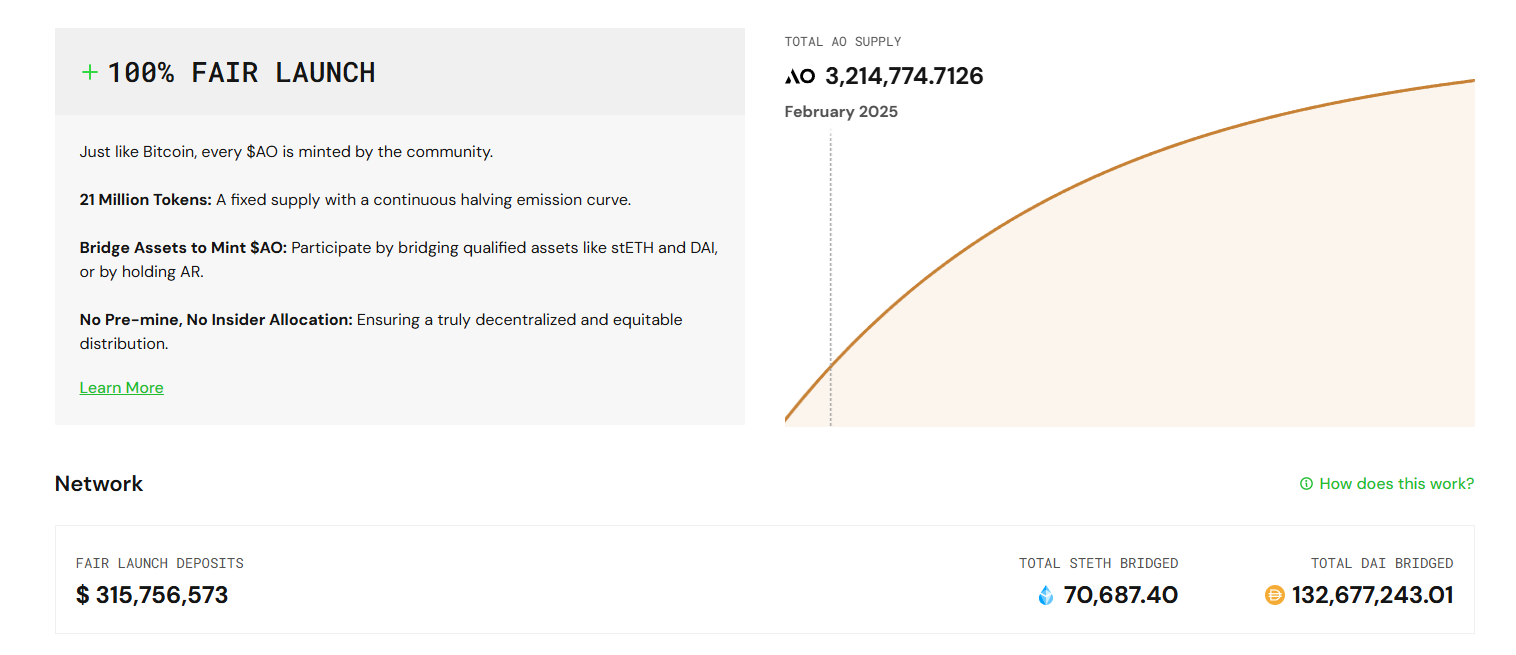
According to prior official data, each AR token holder might receive approximately 0.016 AO tokens. At the $92 pre-market price, AR holders could receive AO worth about $14.72 per AR over the coming months—exceeding the current value of a single AR token. However, considering AR’s steep decline over the past several months—from its May 2024 peak of $49.55 down to $9.52 on February 11, a drop of over 80%—holders during this period would need AO to open at around $500 to offset their losses.
As of February 11, AR had a total of 211,000 holder addresses. Based on this, each address could receive roughly 4.44 AO tokens, worth about $409 (though this is an estimate and actual amounts depend on airdrop rules). Official data shows that the top 100 AO holder addresses collectively hold 2.21 million tokens, accounting for about 70%, indicating concentrated holdings among large holders. In terms of overall airdrop scale, if the $92 pre-market price holds, the airdrop value reaches $290 million. If the price remains around $35, the airdrop value drops to just $110 million. Considering AR’s continuous decline, it’s no surprise that market enthusiasm remains low.
Network Activity Shows Some Increase, But Remains Low Overall
In reality, Arweave’s overall network activity has never been particularly high. For example, on February 11, Arweave’s daily active addresses numbered 3,366. While this figure is relatively high compared to historical levels—prior to 2023, daily active addresses were generally around 1,000, rising to the 2,000 range in 2024—in 2025, possibly due to AO airdrop expectations, daily active addresses have consistently exceeded 3,000, peaking above 5,000 on one day.
Additionally, as a decentralized storage network, data upload volume may be one of the most important indicators of activity. On-chain data shows that since the end of 2023, Arweave’s daily data upload volume has steadily increased, rising from an average of over 100GB per day to over 400GB. Although the peak still falls short of the record 2.02TB uploaded in a single day in 2022, upload volumes have shown a stable upward trend.
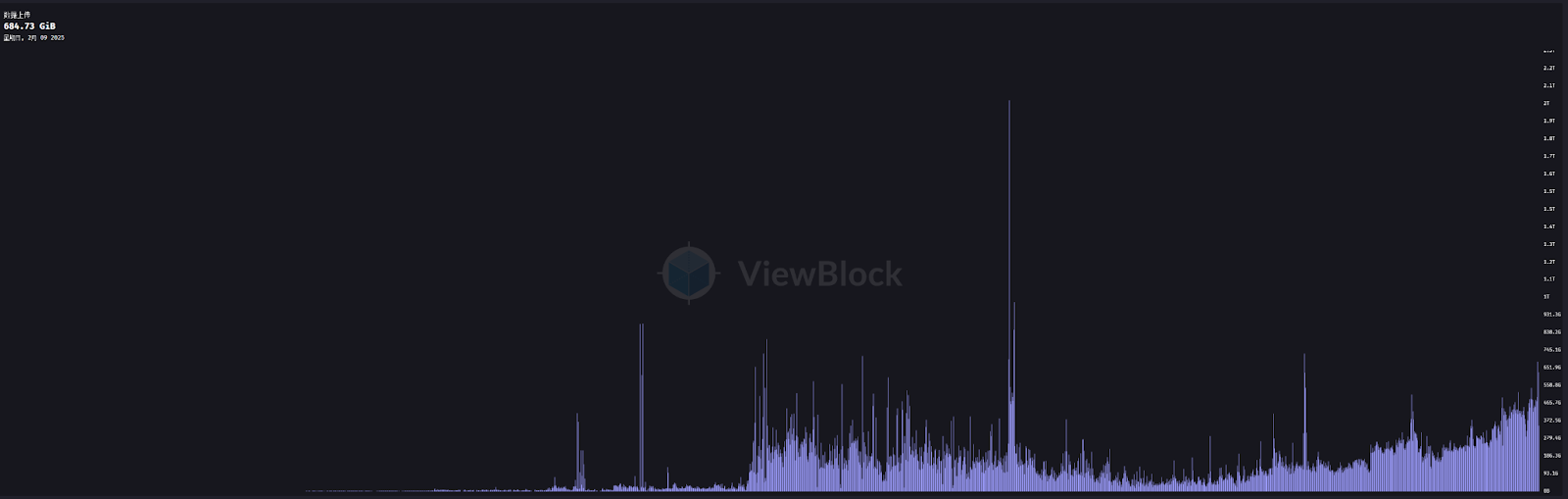
In terms of network activity, ArDrive is the most active application on the Arweave network, responsible for uploading about 90% of daily data. ArDrive is a permanent storage application on the Arweave network that allows users to permanently archive their files with full censorship resistance. In 2022, ArDrive raised $17.2 million in seed funding. Aside from ArDrive, another ecosystem project, Irys, contributes about 10% of uploads.
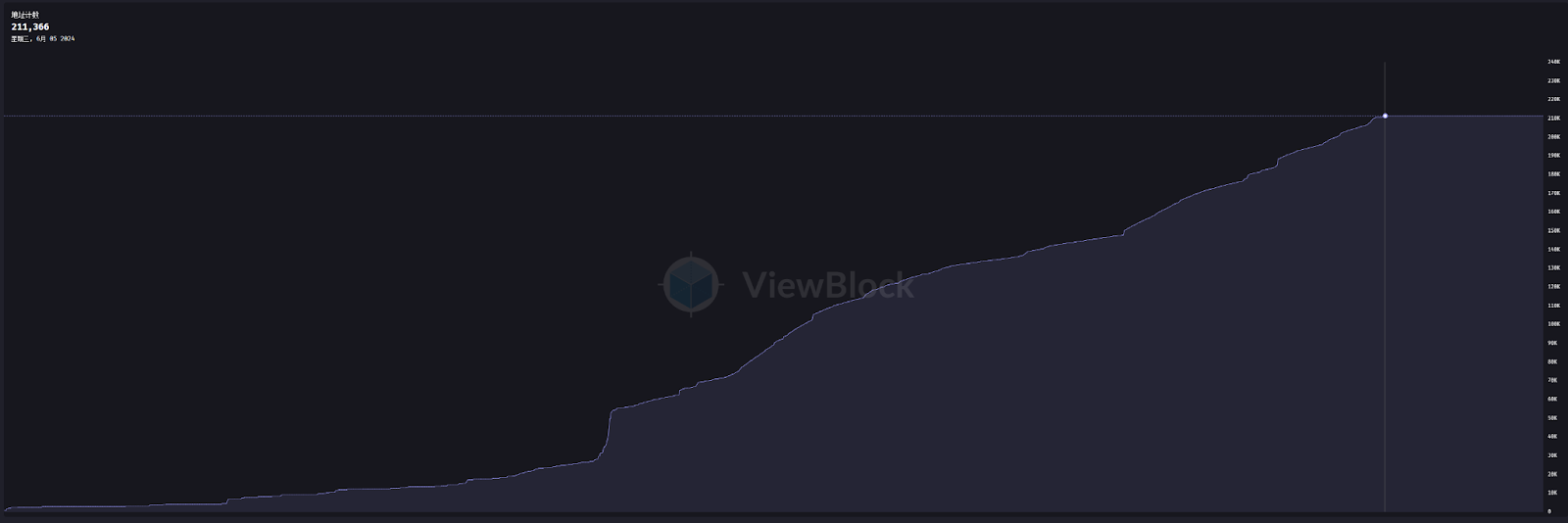
Another odd data phenomenon within the Arweave ecosystem is that since June 1, 2024, the total number of Arweave addresses has stopped growing and remains fixed at 211,366. It is unclear whether user growth in the ecosystem has completely stalled or if there is an issue with browser data maintenance. Like AO’s lukewarm reception, these minor bugs have gone largely unnoticed and undiscussed.
AO Ecosystem Remains in Very Early Stages
According to official data, AO network’s current TVL is approximately $315 million—down significantly from $700 million during the testnet phase. This suggests that user enthusiasm for staking incentives on the AO network post-launch has been relatively low.

In terms of ecosystem projects, several key initiatives are still in early development stages. For example, AOX, the primary cross-chain bridge on the AO network, announced on February 11 that its trading volume surpassed $8 million and its TVL exceeded $3 million. Another project, FusionFi, announced that its settlement volume surpassed $10 million.
From a social media engagement perspective, the following projects within the AO ecosystem are already operational:
Marketverse AI: AI agent project
StarGrid Battle Tactics: On-chain game
Decent.land: EVM virtual machine
AOX: Cross-chain bridge
FusionFi Protocol: AgentFi
Permaswap: DEX
Astro Labs: Liquidity provider and issuer of stablecoin USDA
RedStone Oracles: Oracle project
Overall, the AO network remains a nascent product. There is currently no dedicated browser, no official ecosystem map, and no clear public announcement regarding when AO will officially begin trading. Even after a year-long testnet phase, the ecosystem still appears to be in a raw, unfinished state. As such, the public may simply not know how to engage with or evaluate AO.
From another perspective, perhaps AO’s innovative technical vision was the primary reason for earlier market interest. But judging from the results delivered at mainnet launch, it appears more like a half-completed exam—only partially addressing token mechanism design. The core narrative of unlocking AI potential and achieving performance upgrades through permanent storage has yet to yield tangible results. For AO, success ultimately depends on translating technological vision into real-world applications—not merely relying on token incentives.
Join TechFlow official community to stay tuned
Telegram:https://t.me/TechFlowDaily
X (Twitter):https://x.com/TechFlowPost
X (Twitter) EN:https://x.com/BlockFlow_News
 PANews


