Arweave — The Breakthrough in Web3.0 Storage
TechFlow Selected TechFlow Selected
Arweave — The Breakthrough in Web3.0 Storage
Among the various components of the Web3 hardware stack, decentralized storage is arguably the most powerful.
 Navigating Web3 tides with focused insights
Authors: Nicole Cheng (Investment Manager of OFR), Mstone (Analyst of OFR)
Advisor: JX (Partner of OFR)
At the beginning of the new year, Ryan Selkis wrote in Messari's 2022 report: "Among various components of the Web3 hardware stack, decentralized storage is arguably the strongest." Compared to short-term services provided by IPFS and Sia, the report recognizes Arweave as a key player in long-term blockchain storage. So how exactly does Arweave take on the critical role in the storage sector?
Permanent Storage
Arweave is a blockweave network designed to achieve decentralized, permanent data storage. Its one-time payment, lifetime access model eliminates the need for users to repeatedly renew subscriptions. Arweave promises at least 200 years of data storage, and with annual declines in storage costs, this goal becomes increasingly achievable.
Why Do We Need Permanent Storage?
Even before Web3.0, the importance of permanent data storage had already been recognized. Can users still access a URL from ten years ago or retrieve data stored on centralized servers today? In the crypto world, multi-million-dollar NFT artworks stored on traditional centralized servers inevitably face significant risks.
The internet relying on centralized storage is fragile and fragmented—on one hand, data grows exponentially; on the other, old data frequently disappears or gets stolen. Over the past 20 years, 98.4% of web links have suffered from link rot, resulting in the familiar “404 Not Found” error. Viewed over a longer timeline, data permanence on blockchains represents a novel value proposition, and achieving permanent storage will be an exciting revolution in the evolution of the internet and the Web3.0 era.
How Can Arweave Achieve Permanent Storage?
Arweave leverages the BlockWeave data structure and the SPoRA consensus mechanism to provide a novel solution to permanent storage. The weave-like architecture of Blockweave offers inherent sharding properties and high scalability, while the SPoRA consensus ensures miners are sufficiently incentivized to store rare data, thereby enabling true data permanence.
How Do Miners Achieve Permanent Storage?
The SPoRA consensus mechanism can be understood as a combination of three concepts:
-
1. PoW (Proof of Work)
-
2. PoA (Proof of Access)
-
3. Data access speed
Block production on Arweave requires participation from a randomly selected prior block (recall block), which forms the basis of the Proof of Access (PoA) mechanism. Additionally, to prevent all miners from storing identical data and thus making it impossible to determine block-writing rights, PoW is introduced to ensure that the miner who computes the random number fastest gains the right to write blocks. However, if many miners choose low-cost regions to run nodes in order to reduce expenses, this geographic centralization could degrade data access speeds for certain users. Therefore, data access speed also factors into miner rewards.
Under the PoA mechanism, another feature implicitly encourages miners to store data: the probability of being selected to recall any given block is uniform. This means miners storing rarer blocks have higher chances of competing for rewards, encouraging uniform distribution of all data across the Arweave network.
While miners’ subjective willingness supports permanent storage, could objective data loss compromise its feasibility? For instance, what if a particular block happens to not be stored by any miner and is permanently lost?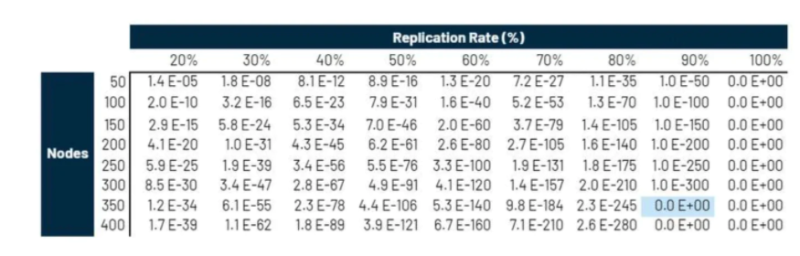
Taking the example above with a replication rate of 50% and 100 nodes, we see that even when miners store only half of all data, the probability of losing a block is already extremely small. In reality, however, the Arweave network has over 1,000 nodes and achieves replication rates up to 90%. Thus, the probability of permanent data loss is negligible.
Moreover, storage cost is another crucial factor sustaining Arweave’s permanent storage model. While people are accustomed to rising prices across most areas of life, data storage is one of the few domains moving in the opposite direction. Over the past 50 years, data storage costs have declined by more than 30.5% annually on average. Arweave’s economic model for permanent storage operates under a highly conservative assumption: it assumes storage costs will decrease by only 0.5% per year. The initial fee paid by users covers 200 years of storage. If actual storage costs decline faster than 0.5% per year, the effective storage duration will extend accordingly.
Additionally, Arweave has established an endowment fund—86% of every storage fee paid by users goes into this fund. Over time, these funds appreciate in value, similar to interest earned in a bank account. The fund is designed to disburse payments as needed to ensure miner rewards remain above storage costs, preserving the economic sustainability of the network.
In Arweave’s recent hard fork update, v2.5 directly benefited users by nearly halving the AR cost of storing data on the permaweb. This upgrade enables gradual transition from SSD to HDD storage, significantly reducing initial storage expenses.
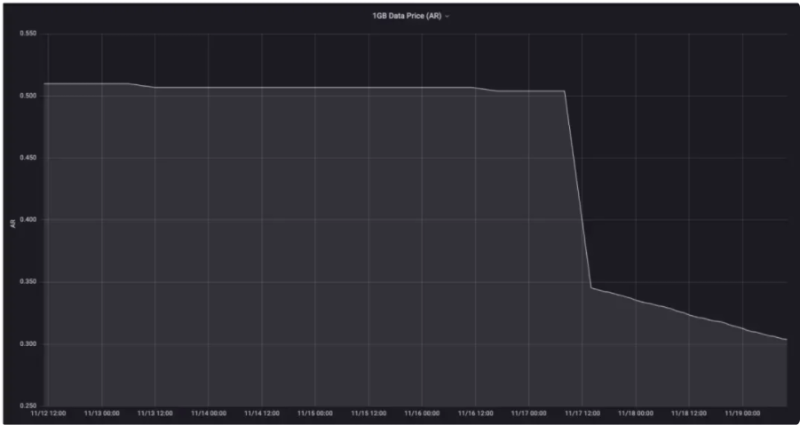
Source: Ardrive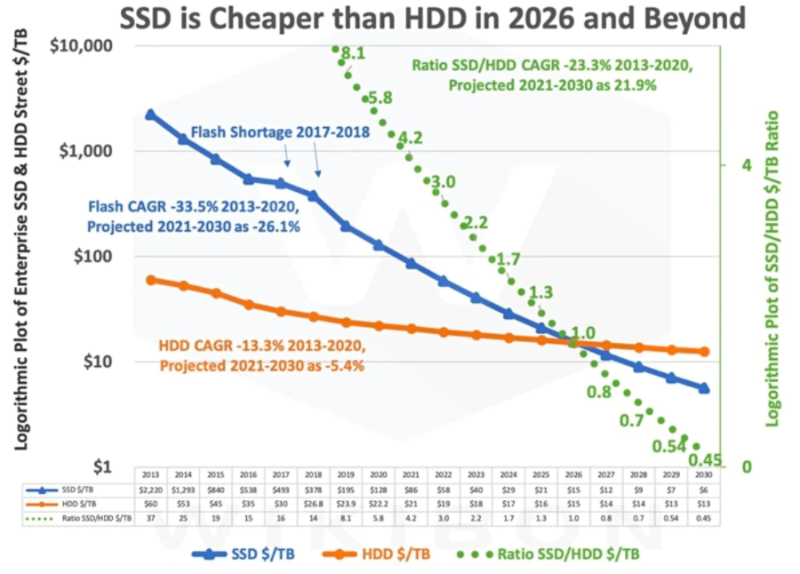
Source: Wikibon, 2021
Arweave Ecosystem
From a purely quantitative standpoint, Arweave reached a peak transaction volume of just 600M three years after launch, whereas Solana and Avalanche achieved similar levels within their first year.
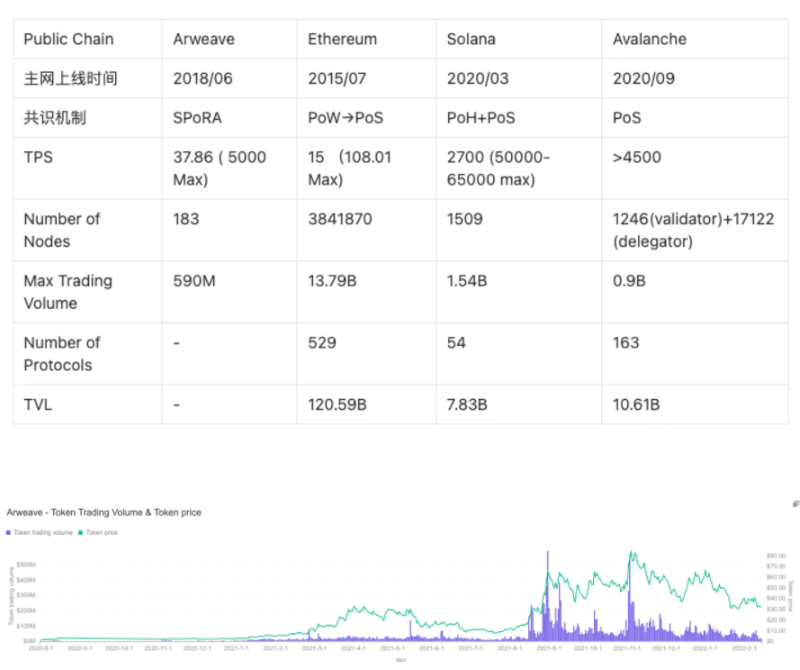
Source: Coin Market Cap
Looking back at the development history of public blockchains, we observe a common pattern: growth tends to be top-down. Application-layer success drives infrastructure development, creating a virtuous cycle. Uniswap and OpenSea—the two largest consumers of Ethereum gas—significantly boosted Ethereum’s transaction volume and active addresses, jointly fueling its bull market. DEXs like Serum and Raydium propelled early adoption of Solana; GameFi drove BSC activity; and unique DeFi protocols such as Anchor and Mirror brought capital inflow and momentum to Terra.
In contrast, although Arweave has nurtured several promising applications, none have yet emerged as dominant ecosystem pillars akin to those mentioned above. Below is a list of current Arweave-based projects categorized by infrastructure and application layers:
-
Bundlr: To understand Bundlr, one must first grasp Arweave’s new technology—Bundles. Bundles enhance Arweave’s scalability by compressing arbitrary amounts of data off-chain into single blocks processable by L1. This innovation allows Arweave’s transaction capacity to scale linearly. Users can now upload large volumes of data without worrying about failed transactions—a common issue on other chains where lower-paying transactions may get dropped when competing with higher-fee ones.
In its first month, Bundlr processed over 10 million transactions, compared to Arweave’s native one million. As Bundlr scales, the network will handle orders-of-magnitude more data. Currently, around 70% of transactions on Arweave involve bundled data.
-
RedStone (Middleware): An oracle solution built on Arweave, RedStone aims to become the Chainlink of Web3 by uploading verified data onto Arweave (via staked tokens). Anyone can retrieve accurate data from the chain. All applications built using SCP perform off-chain computation. When using the oracle, users directly read data stored on the blockchain, guaranteed correct through RedStone’s economic design.
-
Kyve Network (Application/Middleware Layer): Leveraging Arweave’s storage capabilities, KYVE provides structured data storage, validation, and access services for different blockchains, enabling cross-chain data archiving. Data uploaders fetch data from source chains and store it on Arweave, while validators use incentive and penalty mechanisms to ensure data integrity and reliability, supporting downstream applications. Once stored, users can query data via KYVE’s interface or directly access it on Arweave. With KYVE’s verification and Arweave’s permanence, data supplied to downstream users remains complete and trustworthy.
-
ArDrive: As a user-friendly front-end application for Arweave, ArDrive dramatically simplifies interaction with the network. Before ArDrive, users had to interact with Arweave via CLI (command-line interface) to store content. Now, they can upload files with just a few clicks.
-
AR I/O: A companion product developed by the same team behind ArDrive, AR I/O acts as an information hub. Content uploaded via ArDrive first passes through AR I/O before reaching the Arweave network—and vice versa. AR I/O significantly enhances user efficiency and experience when using ArDrive.
-
everPay (Middleware): A trustless, gas-free, on-chain payment settlement protocol built on Arweave, allowing instant token transfers between Ethereum and Arweave. everPay aims to offer everyone a credible, decentralized payment app and provide developers with an SDK to easily build DEXs.
-
Pianity (Application Layer): An NFT minting and trading platform utilizing a novel NFT standard built on Arweave, solving the problem of off-chain metadata storage. Minting an NFT involves sending a transaction to an NFT contract on Arweave, simultaneously storing the audio file on-chain. This enables low-cost, on-chain storage while reducing trust overhead during NFT trades. Users no longer need to understand complex concepts like metadata or storage methods, achieving true “what you see is what you get” transactions and fully trustless exchange.
Clearly, as an infrastructure-level protocol, Arweave’s narrative, logic, and value foundation differ significantly from other public blockchains. Consequently, unlike most chains that grow top-down, Arweave has spent the past three-plus years primarily building foundational infrastructure, carving out a unique bottom-up development path. Today, its ecosystem hosts over 400 projects—nearly double the count from last year. Under the Web3.0 paradigm, many native dApps will naturally prefer on-chain storage. As core infrastructure matures, more application-layer projects will emerge, bringing incremental users and capital into the Arweave ecosystem.
By offering unique permanent storage, Arweave has emerged as a leader in the storage domain. Users achieve permanent data storage with a single payment and lifetime access. Meanwhile, leveraging its storage foundation, Arweave continues evolving toward a synergistic environment integrating SmartWeave contracts and the Permaweb. Yet, in future explorations of Web3, data ownership—a pivotal feature—will require more than just permanence. Additional innovations will be essential for Arweave to continue advancing its vision.
To conclude, here are several promising application scenarios we believe in:
-
NFT metadata storage—the most widely adopted use case so far—and demand will further increase with the rise of audio-visual NFTs.
-
Similar to Kyve Network, backing up other public chains’ data on Arweave, permanently preserving historical blockchain records, and providing easy-to-use interfaces for retrieval—effectively serving as Layer 0 for public blockchains.
-
Storage of Web3.0 tech stacks and code—for example, Uniswap and Compound have already hosted their frontend applications on Arweave.
-
Decentralized social platforms capable of hosting vast amounts of data, for which Arweave’s inherent high scalability makes it a natural fit.
Join TechFlow official community to stay tuned
Telegram:https://t.me/TechFlowDaily
X (Twitter):https://x.com/TechFlowPost
X (Twitter) EN:https://x.com/BlockFlow_News
 Old Fashion Research