Web2 is no longer secure: How can tech professionals step into the new era of AI + Web3?
TechFlow Selected TechFlow Selected
Web2 is no longer secure: How can tech professionals step into the new era of AI + Web3?
We start from insecurity and ultimately find ourselves in structures of certainty.
 Navigating Web3 tides with focused insights
Author: Keegan Xiaogang
1. Current Reality: Anxiety and Crisis Among Web2 Technologists
I've noticed an increasing number of people adding me to consult on how to transition into Web3.
They include fresh graduates, engineers with three to five years of experience, and mid-career technologists like myself who have worked for over a decade and are beginning to feel uncertain about their professional prospects.
Their questions are almost identical:
-
"Is there still opportunity in Web3?"
-
"Am I too late to start learning now?"
-
"Most realistically—how can newcomers find jobs in Web3?"
This anxiety is not accidental. Over the past decade, Web2 built a "world of certainty" for technologists—stable positions, predictable career paths, and platform-driven windfalls. But after 2024, this certainty is rapidly collapsing. The structural turning point in the internet industry has arrived, and the wave of AI is making this shift increasingly irreversible.
1. The End of the Technology Dividend
Global growth in the internet industry is slowing down. In the first half of 2025, tech companies worldwide announced nearly 94,000 layoffs, hitting a three-year high (Observer, 2025.07). This is no longer a cyclical adjustment but a fundamental shift in industry logic.
Microsoft’s actions are particularly telling:
In July 2025, Microsoft announced around 9,000 layoffs, approximately 4% of its global workforce; just two months earlier in May, it had completed another round of over 6,000 layoffs. At the same time, the company explicitly required employees to “use AI tools” and incorporated AI usage into performance evaluations.
This means even the most stable and resource-rich tech giants are actively “optimizing human resources with AI.” The sense of job security cultivated under the Web2 model is being systematically eroded.
2. The Substitution Effect of AI
The rise of AI is not merely an upgrade of efficiency tools—it is redefining what “technical work” itself means. According to Stack Overflow's 2025 Global Developer Survey, 52% of programmers now use AI tools (such as Copilot, ChatGPT, Claude, etc.) daily, with 18% stating that AI has significantly changed their job responsibilities.
In other words, AI has become an integral part of the development process, not an optional add-on.
A product that once required a team of 10 can now be delivered by just 3 people with AI assistance.
The competitive focus of technical roles is shifting from “who writes better code” to “who collaborates more effectively with AI.” For traditional Web2 technologists, this represents a silent “middle-layer collapse”: AI-native engineers are rising, while purely execution-based roles are becoming marginalized.
3. The Double-Edged Sword of Platform Dependency
Web2’s prosperity was built on “platform ecosystems.” Technologists relied on systems like App Store, Google, WeChat, and TikTok—but this dependency also meant personal output lacked autonomy and asset value. Data from SensorTower shows that Apple’s App Store policy changes at the end of 2024 caused a sharp income drop for about 12% of independent developers globally, abruptly cutting off primary revenue streams for many small and medium-sized teams.
This risk is widespread within the Web2 framework:
-
Changes in platform rules can directly impact livelihoods;
-
Creators’ data and works belong to the platform;
-
Account or service suspension could mean starting from zero.
Under such a structure, no matter how hard individuals work, it's difficult to build transferable, accumulative assets.
4. Restructuring of Skills and Income
LinkedIn’s “Future of Skills 2025” report identifies AI, blockchain, and data analysis as the fastest-growing skill areas, while growth in traditional web frontend skills has dropped to just 0.3%. Meanwhile, according to Levels.fyi data from late 2024, average salaries for FAANG engineers declined by about 8%, whereas AI/LLM-related roles rose逆势 by over 20%.
This indicates that technological dividends are shifting from “platform development” to new domains centered on “intelligent systems + decentralized technologies.” Skill migration is no longer a bonus—it's a survival necessity.
5. Shaking the Foundation of Security
These data points collectively reveal a reality:
-
Organizational stability in Web2 is gone;
-
Job skill boundaries are blurred by AI;
-
Income and growth paths are decoupling from platform logic.
An increasing number of engineers, designers, and product managers are asking the same questions:
-
"Can my skills still hold long-term value?"
-
"If I don’t rely on platforms, does my output still exist?"
The source of security is shifting from “companies and platforms” to “an individual’s capacity for self-evolution.”
🧩 This is the core logic behind the loss of security in Web2:
Certainty has moved from external organizations to internal individual structures.
The next generation of technologists must rebuild their own certainty at the intersection of AI and Web3.
2. Turning Point: The Convergence of AI and Web3
If the last internet wave (Web2) connected people together, this new wave (AI + Web3) is restructuring the agents of connection—from “platform-centric” to “autonomous agents and individuals.”
1. The Intersection of Technology Cycles
The emergence of AI and Web3 is not coincidental—it marks the convergence of two exponential curves.
-
AI Curve: Generative intelligence, represented by LLMs (large language models), is achieving “cognitive automation.”
-
Web3 Curve: Decentralized infrastructure, represented by blockchain, is enabling “value automation.”
Where these two curves intersect, a new era interface emerges:
Intelligent individuals can own identity, assets, and agency on-chain.
McKinsey estimates in “The Economic Potential of Generative AI” (2025) that AI could contribute $4–7 trillion annually to the global economy; meanwhile, Electric Capital’s 2025 Developer Report shows over 23,000 monthly active developers continue building in Web3. This suggests both ecosystems, though progressing at different paces, are entering a phase of practical application and convergence.
2. AI: From Tool to Agent
The period 2023–2025 marks the critical phase of AI “personification.” From early tools like ChatGPT and Claude to today’s coding- and agent-focused platforms such as Cursor, Claude Code, and Codex, we’ve witnessed AI evolve from a “support assistant” to an “autonomous executing agent.”
AI is no longer just helping write code—it can make decisions and execute tasks autonomously:
-
It can automatically write and deploy smart contracts;
-
Interact with on-chain protocols to execute transactions and manage assets;
-
Even self-learn and optimize based on yield models.
This evolution gives rise to a new concept—the AI-native Builder:
Individuals scale productivity via AI and solidify outputs through on-chain protocols.
This means the future “developer” will no longer be a single engineer, but a hybrid of “human + intelligent agent.”
3. Web3: From Speculative Narrative to Structural Infrastructure
Concurrently with AI, Web3 is transitioning from speculative hype to foundational infrastructure. Where attention once focused on token prices, it’s now shifting toward “protocol-layer capabilities”—the underlying systems that can sustainably support the digital economy.
Today, the industry’s real focus centers on several key directions:
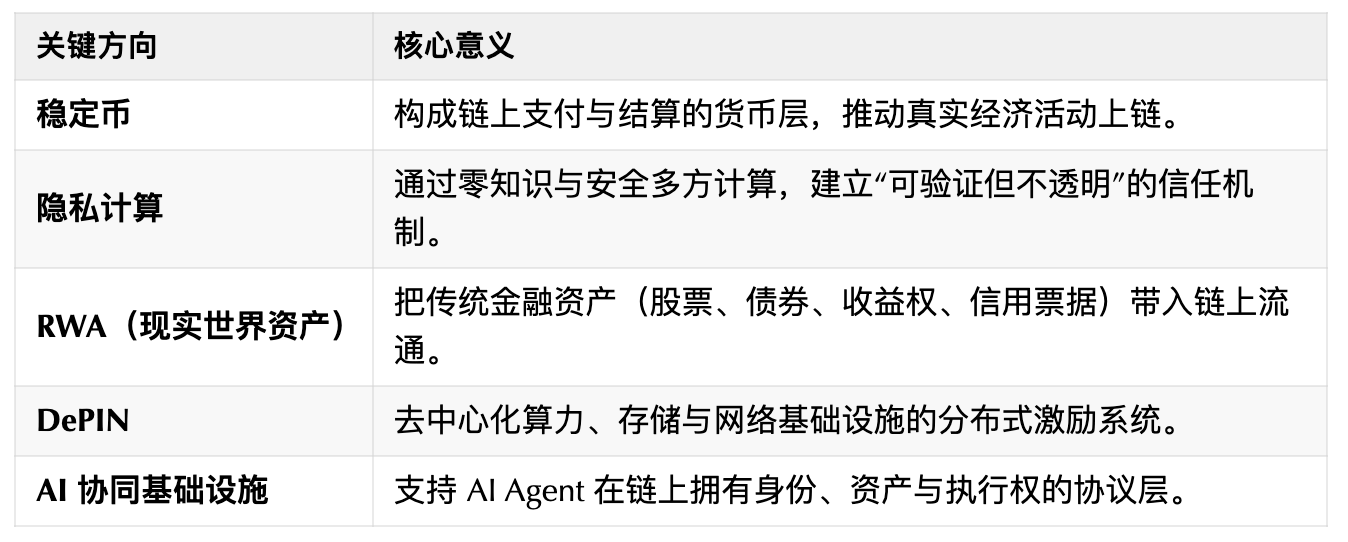
Together, these trends show:
Web3 is no longer just a stage for financial innovation, but evolving into the trusted execution layer (Trust Layer) of the next-generation internet—a foundation enabling free collaboration between AI, individuals, and the real economy under trust mechanisms.
4. What Happens When AI Meets Web3?
We are witnessing a new system architecture emerge: AI-generated content + Web3 settlement + individual ownership. This structure enables transformation across three levels:
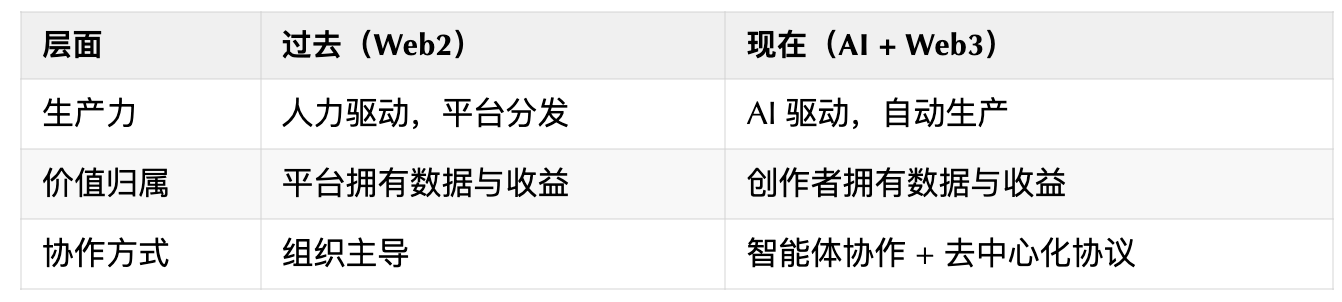
In short, AI makes “production” more efficient, while Web3 makes “results” more sustainable. Together, they drive a key trend—the rise of the individual economy.
AI can give one person hundredfold productivity; Web3 allows that output to be owned, monetized, and reused. This is the underlying logic behind the rise of “one-person labs” and even “one-person companies.”
5. Structural Opportunity: From Platform Dividends to Protocol Dividends
Historically, every technological cycle shift involves a rewrite of production relationships. From PC to internet, from mobile to platform economies, the center of gravity for dividends keeps moving. Now, the dividend is shifting from “platform dividends” to “protocol dividends”:
-
Platform Dividend: Relying on giants, profiting from traffic;
-
Protocol Dividend: Building open systems, participating in value distribution.
In this process, individuals who leverage AI to build products and use Web3 to establish ownership will become the next generation of “micro production nodes.” Whether developers, designers, or independent creators, everyone has a chance to find new certainty here.
6. The New Era’s Challenge
When we say “AI + Web3 is a turning point,” it’s not an abstract slogan but a tangible structural shift:
-
Fundamental change in production tools (AI);
-
Fundamental change in value systems (Web3);
-
And a shift in the technologist’s role—from “passive executor” to “active creator.”
This isn’t just a skill upgrade—it’s a paradigm shift.
🧭 This is what the convergence of AI + Web3 represents:
AI redefines productivity; Web3 redefines ownership.
When productivity and ownership converge at the individual level, a new era for technologists begins.
3. Way Forward: From Technical Job to Individual Node
As technological dividends fade and platform certainty collapses, a natural question arises:
"So how should I transform?"
In the age of AI + Web3 convergence, the path forward for technologists is no longer about “switching jobs,” but reconstructing their production structure—from passively participating in platforms to actively becoming an “individual node.”
1. From Job Mindset to System Mindset
In the Web2 era, a technologist’s value was tied to their “job”: writing code, designing architecture, running projects. But AI automates tasks, and Web3 opens up value distribution.
The new competitive logic is not how many tasks you can complete, but how many systems you can build.
A system could be:
-
An automated development pipeline (AI + DevOps)
-
A smart contract protocol (Web3 application layer)
-
A knowledge or tool product (Notion templates, Agents, API services)
These systems don’t depend on platforms—they are self-sustaining loops driven by individuals, assisted by AI, and secured by protocols.
This was precisely the starting point when I built BlockETF and BlockLever at Soluno Lab: making each project a standalone, asset-accumulating, reusable system unit.
Technologists must shift from “doing tasks” to “building machines,” letting systems work for them.
2. Phase One: Upgrading Productivity with AI
In any transformation journey, the first step is mastering the AI tool stack. It determines whether you have the foundation for “hundredfold productivity.”
-
Cognitive Layer: ChatGPT, Claude, Perplexity—for thinking, analysis, decision-making, and writing;
-
Coding & Development Layer: Cursor, Claude Code, Codex—for code generation, debugging, documentation, and testing;
-
Creative & Expression Layer: Midjourney, Runway, Figma AI, ElevenLabs—for visual and multimodal creation.
My own workflow is essentially a microcosm of this system. While building BlockETF and BlockLever, I use Claude Code daily to analyze and generate complex contract logic. My writing is polished with ChatGPT. AI hasn’t replaced me—it’s freed me to focus more on architecture and creation.
Mastery of these tools isn’t about showing off—it’s about embedding AI into your personal workflow: writing specs → generating code → automated testing → documentation → publishing. Once achieved, you’re no longer an “executor,” but an “AI orchestrator.”
3. Phase Two: Web3 Technology and Assetization Thinking
Once you can efficiently produce using AI, the next step is ensuring your output is owned, monetized, and sustainable. This is where Web3 thinking comes in.
-
Learning Level: Master smart contracts (Solidity), EVM logic, wallet interaction, on-chain deployment;
-
Product Level: Understand token models, protocol mechanisms, oracles, and governance systems;
-
Mindset Level: Recognize that “your code, models, and content” can all become asset units (Asset Units).
Technologists are no longer just developers, but asset issuers, protocol designers, and node operators. AI enables efficient creation; Web3 enables ownership and monetization. Together, they form the prototype of a “personal sustainable system.”
4. Phase Three: Individual Productization and Branding
When you can produce, claim ownership, and create feedback loops, you enter phase three: individual productization. This means no longer relying on jobs, but building your own “micro ecosystem.”
Typical paths include:
-
Personal brand products: technical blogs, courses, consulting, SaaS tools;
-
On-chain product projects: micro-protocols, NFT series, AI Agent-as-a-Service;
-
Community economy experiments: solo-company DAOs, tokenized memberships, revenue-sharing models.
At this stage, competitiveness isn’t about how many skills you know, but whether you can crystallize your knowledge, algorithms, and experience into a “reusable structure.”
The individual is the node; the node is the brand. Once you have your own protocols, codebase, product matrix, and user network, you no longer need a “company” to define your worth.
5. Establishing New Certainty From Within
In the Web2 era, certainty came from organizations; in the AI + Web3 era, it comes from structurally coherent individual systems.
AI gives you “leverage on productivity”; Web3 gives you “leverage on value distribution.” When combined, you gain the ability to survive, create, and accumulate in any environment.
This is the true meaning of moving from “job” to “node”:
You are no longer just a part of the system—you are its creator.
🧩 Summary
The AI + Web3 wave won’t eliminate everyone, but it will leave behind those lacking systematic self-upgrading capability. For those willing to learn, practice, and build, this era is actually the best of times.
“You don’t need to join a big company to change the world. You can use AI + Web3 to become a small company yourself.”
4. Path: A Roadmap from 0 to 1
Understanding the trend is one thing; completing the transformation is another. Transitioning from a Web2 technical role into the AI + Web3 era doesn’t require starting over—it’s about gradually reconstructing skills and mindset through iterative steps.
A realistic and feasible path follows three stages: Tooling → Protocolization → Productization.
1. Stage One: Tooling—Reconstructing Productivity with AI
Goal: Integrate AI into your workflow.
Key Actions:
-
Use ChatGPT / Claude / Perplexity as a “cognitive assistant” in thinking, structuring, and writing;
-
Integrate Cursor / Claude Code / Codex into your development environment, reshaping your development flow (spec → code → test → docs);
-
I involve AI in my workflow daily—from auto-generating test scripts and updating documentation to assisting in code refactoring and deployment. For me, AI is no longer just a tool, but part of my R&D system.
Success Metric:
When you can use AI tools to complete 80% of work previously requiring human collaboration, you’ve formed the prototype of an “AI-native individual.”
2. Stage Two: Protocolization—Learning Web3 Structure and Value Logic
Goal: Understand and build systems that are ownable, settleable, and composable.
Key Actions:
-
Learn smart contract languages like Solidity / Rust / Move;
-
Familiarize yourself with on-chain components: wallets (EVM / EIP standards), liquidity protocols (Uniswap / PancakeSwap), oracles (Chainlink / Pyth), indexing services (The Graph / SubQuery);
-
Experiment on-chain with minimal viable products (MVPs), such as BlockETF (on-chain index protocol) or BlockLever (leveraged lending protocol) built at Soluno Lab—start from core functionality, validate contract logic and economic models first;
-
Learn how to interact with frontends via Subgraph, API, and complete DApp workflows.
Success Metric:
When you can independently launch an on-chain project and understand its incentive structure, you’ve acquired the foundational skills of a “Web3-native Builder.”
3. Stage Three: Productization—Building Your Own “Individual System”
Goal: Turn personal capabilities into reusable, tradable, and sustainable products.
Key Actions:
-
Consolidate your AI + Web3 experiments into reusable modules—open-source libraries, smart contract templates, educational content, automation tools;
-
Distribute and validate via GitHub / Mirror / X (Twitter) and local channels;
-
Build a “personal asset structure”: project docs, code repos, protocol deployment records, content systems;
-
Attempt to close the revenue loop: courses, consulting, tool subscriptions, on-chain revenue sharing.
Success Metric:
When your system continues creating value even when you’re offline, you’ve completed the transition from “job” to “node.”
4. Key Mindset: Gradual Evolution, Not a Single Leap
Transformation is not a one-time event but a continuous evolutionary process. The real risk isn’t “not being able to learn,” but “staying stuck in the old paradigm.”
You don’t need to master all new technologies at once, but you must stay on a trajectory of continuous iteration.
Treat every learning session, experiment, and output as part of building your “individual system.” As tools evolve, your structure will upgrade automatically.
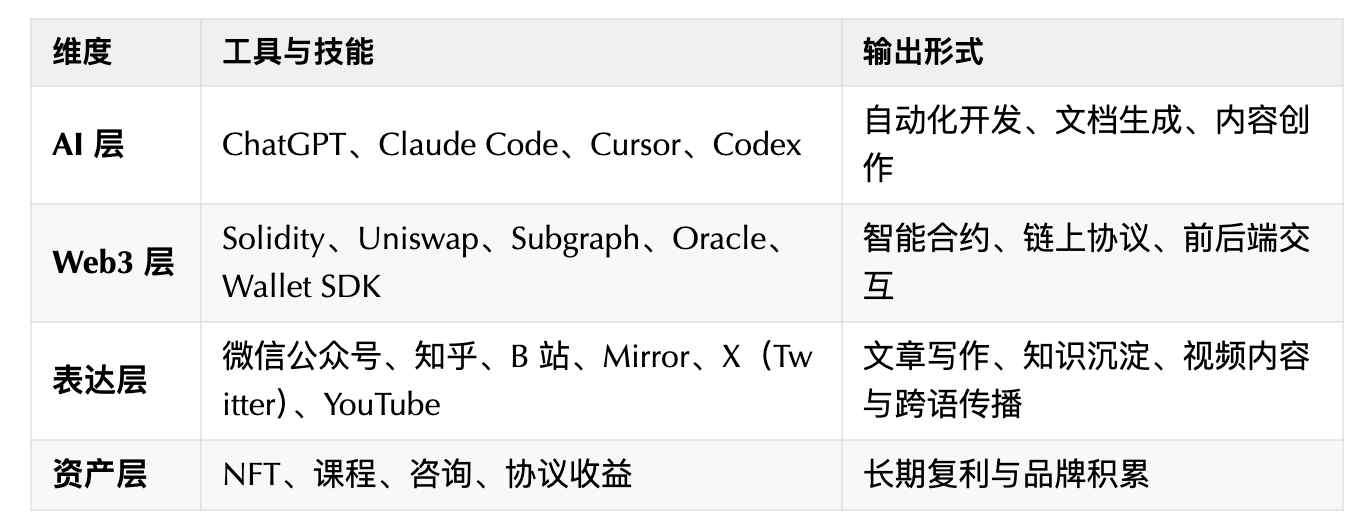
5. From Skill Tree to Ecosystem Map
Traditional skill trees are vertical: junior → mid-level → senior. But the AI + Web3 skill map is networked: cognition, tools, protocols, content, and community interconnect.
This means your learning path should be multidimensional and parallel:
🧭 Summary
Transitioning from Web2 to AI + Web3 isn’t about escaping the old world, but reconstructing your position in the new one. AI gives you the “efficiency lever,” Web3 the “ownership lever,” and productization the “compounding lever.”
The real way forward isn’t finding a new job, but building a personal system capable of self-evolution.
5. Conclusion: From “Insecurity” to “New Certainty”
Looking back over recent years, we’ve witnessed massive shifts in the tech world. AI brought a leap in efficiency, Web3 reshaped value distribution, and the Web2 order—jobs, platforms, companies—is losing its certainty.
This insecurity is something nearly every technologist feels. You might be wondering:
-
"Can I still keep up?"
-
"Will my work still be needed?"
But the truth is, real certainty has never resided in the external world. It has always depended on whether you possess the ability to create independently and evolve continuously.
1. Certainty Comes from Structure, Not Position
In the AI + Web3 era, an individual’s structure determines their certainty. AI allows one person to do what once required a whole team; Web3 allows you to own, share profits, and accumulate long-term assets. When these two capabilities converge in one person, you no longer depend on platforms—you become an individual node with a complete economic cycle.
This isn’t idealism—it’s a real trend. More and more people are using AI and on-chain tools to build their own micro systems: some build products, others content or protocols. Their common trait is clear:
They no longer seek certainty externally, but create it internally through systems.
2. The Greatest Opportunity for Technologists Is Redefining Themselves
From Web2 to AI + Web3, the core of this transformation isn’t “changing lanes,” but “reconstructing the self”:
-
From job role to system builder;
-
From task execution to mechanism creation;
-
From organizational dependence to independent node.
This shift is exactly the path I’ve been practicing in Soluno Lab. BlockETF and BlockLever aren’t endpoints, but iterations of a systematized individual. They’ve shown me that one person can build complex systems, launch projects, and grow compounding ecosystems. This is our “new certainty.”
3. The Future Belongs to Those With Structure
The future no longer belongs to the hardest workers, but to those who can build systems. AI will keep amplifying your leverage, Web3 will keep solidifying your results, and your mission is to continuously upgrade this “personal system”—making it more automated, open, and sustainable.
While others worry about “job security,” you’re already creating security through your own system.
Security no longer comes from employers, markets, or platforms, but from your ability to self-evolve.
AI + Web3 isn’t a flood—it’s a toolkit. Real certainty lies in whether you dare to use them to build your own world.
🧭 Afterword
Writing this isn’t about painting a future vision—it’s documenting a reality already unfolding. AI is already part of our daily lives, and Web3’s infrastructure is steadily maturing.
When the boundaries of an era are redrawn, the best response for technologists isn’t fear, but creation.
We begin from insecurity, and ultimately find ourselves in structures of certainty.
Join TechFlow official community to stay tuned
Telegram:https://t.me/TechFlowDaily
X (Twitter):https://x.com/TechFlowPost
X (Twitter) EN:https://x.com/BlockFlow_News