A Look at the Parallel EVM Four: Monad, Sei V2, Neon, and Eclipse
TechFlow Selected TechFlow Selected
A Look at the Parallel EVM Four: Monad, Sei V2, Neon, and Eclipse
This article will delve into the design of these networks, their advantages and disadvantages, and explore the future development of these parallel blockchains.
 Navigating Web3 tides with focused insights
Author: Lukasinho, GCR Research Team
Translation: Luffy, Foresight News
Parallel transaction execution is a promising blockchain scaling technique and a necessary condition for achieving widespread blockchain adoption without sacrificing user experience or fragmenting liquidity. Solana and its virtual machine (SVM) pioneered an approach based on parallel execution rather than purely sequential processing. This method is more complex compared to the dominant Ethereum Virtual Machine (EVM). Recently, several promising projects have emerged aiming to overcome this complexity, enabling developers to build applications with Solana-like performance within the familiar EVM environment.
In this article, we will examine Monad, Sei V2, Neon EVM, and Eclipse—promising projects dedicated to such parallel EVM solutions. We will delve into their network designs, analyze their strengths and weaknesses, and explore the future of these parallel blockchains.
The Promise of Parallel EVMs
Undoubtedly, Ethereum is the most widely adopted smart contract blockchain, boasting the strongest community and ecosystem. However, despite relentless efforts toward scalability, Ethereum's transition from sharding to Rollups has made layer-1 scalability particularly challenging. While a Rollup-centric roadmap can address scalability, it is not without drawbacks. Liquidity fragmentation and poor user experience caused by interacting across numerous different blockchains remain significant hurdles to overcome.
What if the Ethereum we know reached 10,000 TPS or higher in a parallel universe? Monad, Sei, Neon, and Eclipse are fully EVM-compatible blockchains leveraging parallel execution to achieve scalability.

Source: twitter.com/SeiNetwork
Monad
Monad is a high-performance EVM blockchain designed to significantly enhance scalability and transaction speed through parallel execution. It optimizes four key areas to become a high-performance blockchain.
Monad BFT
Monad BFT is the consensus protocol used by the Monad blockchain to achieve agreement on transaction ordering. It allows many nodes in the network to securely agree on the sequence of transactions, even if some nodes are dishonest or offline. Monad BFT operates via a leader-based two-phase commit, collecting threshold signatures from 2f+1 validators, which are aggregated into a single signature using pairing-based cryptography. Compared to individual signatures, this improves efficiency, scalability, and reduces storage requirements.
Deferred Execution
Monad separates consensus and execution to improve performance. The consensus layer involves nodes agreeing on transaction order without executing them. The execution layer consists of nodes that independently execute ordered transactions to update state. By decoupling consensus and execution, Monad achieves faster consensus through larger transaction batches. With one-second slot finality and execution latency under one second, it ensures consistency while achieving high throughput on a single shard. This architecture decouples consensus and execution to optimize both transaction ordering and processing.
Parallel Execution
Monad enables parallel execution of transactions within a block to increase efficiency. It uses an optimistic approach, starting execution of new transactions before prior executions complete. To handle incorrect results, Monad tracks inputs/outputs and re-executes inconsistent transactions. A static code parser predicts dependencies to avoid invalid parallelism and falls back to a simpler mode when uncertain. This parallel execution increases throughput while reducing the likelihood of transaction failures.
Monad DB
Monad performs asynchronous I/O (input/output operations) to enable parallel transaction execution—unlike traditional systems that must wait for I/O results before processing the next transaction. With asynchronous I/O, the CPU can process other transactions without waiting for specific I/O outcomes. Monad DB leverages advanced Linux kernel features to achieve efficient asynchronous disk operations, eliminating the limitations of synchronous I/O. Traditional Ethereum databases lack support for asynchronous I/O, but Monad DB is built specifically to take full advantage of it. This asynchronous approach dramatically improves transaction processing efficiency while maintaining Ethereum compatibility.
Sei
Sei V2 is a major upgrade to the Sei Network, aiming to become the first fully parallelized EVM. This upgrade will equip Sei with the following capabilities:
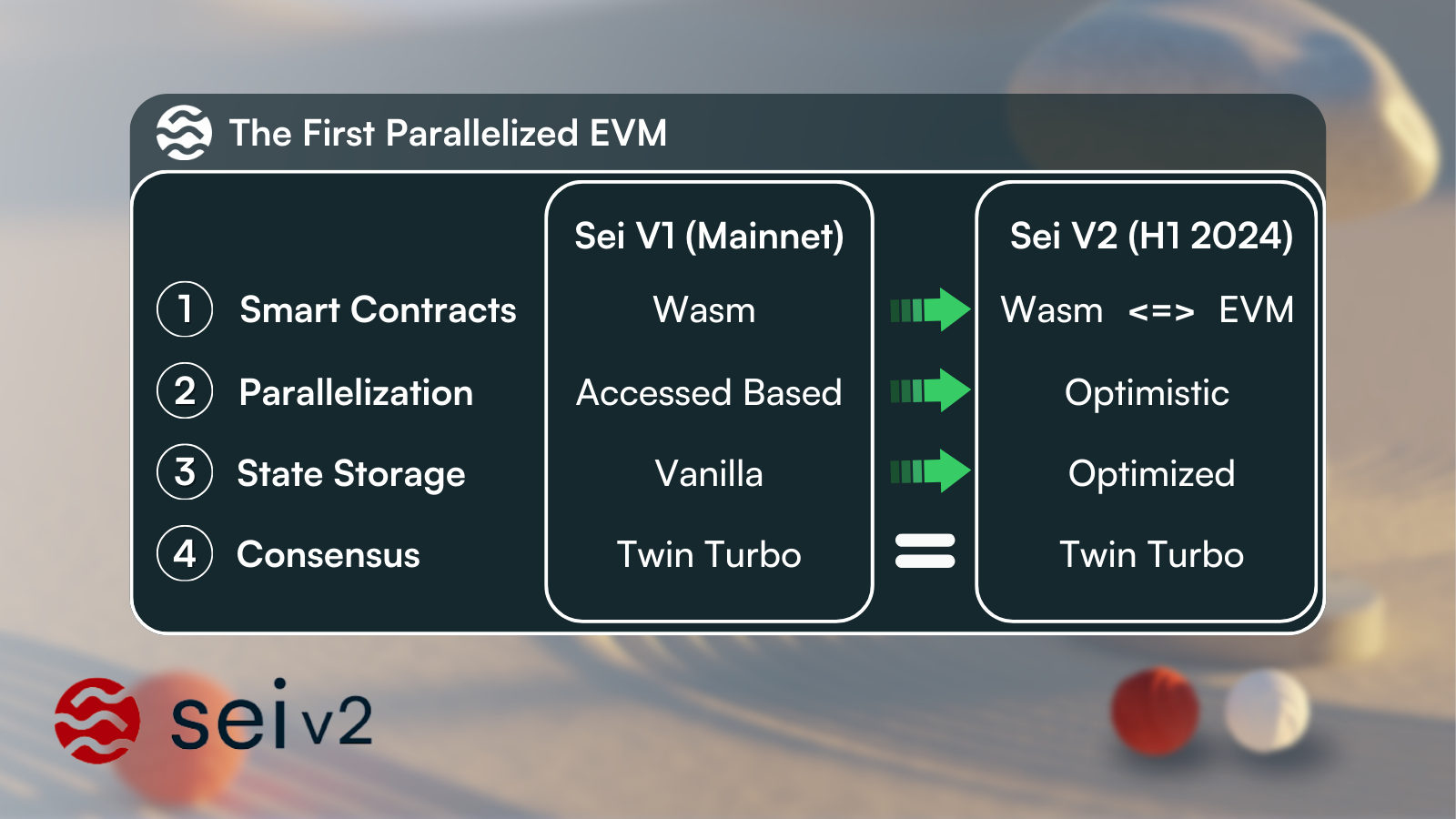
Backward-Compatible EVM Smart Contracts
Developers can directly port audited smart contracts from other EVM-compatible chains to Sei without modifying any code. Sei nodes will import Geth (the Go implementation of the Ethereum Virtual Machine), which will handle EVM transactions. Any resulting updates—including state changes or calls to non-EVM-related contracts—will be routed through special interfaces created by Sei for EVM integration. This is a significant upgrade as it simplifies migrating existing smart contracts from blockchains like Ethereum to Sei.
Optimistic Parallelization
Like Monad, Sei V2 will use optimistic parallelization. This allows the blockchain to execute transactions simultaneously without requiring developers to define dependencies. When conflicts occur, the blockchain tracks the storage locations accessed by each transaction and re-runs conflicting transactions sequentially. This process continues recursively until all unresolved conflicts are resolved.
Sei DB
Sei DB is a new dual-component data structure designed to optimize storage and prevent blockchain bloat. It separates state storage from state commitment, moving away from the traditional single IAVL tree design. Compared to a single tree, this dual structure reduces latency and disk usage while improving multi-threaded read/write performance.
Neon EVM
Neon EVM is a fully EVM-compatible solution built on the Solana blockchain. It runs as a smart contract within Solana, allowing developers to deploy Ethereum DApps without any reconfiguration.
Neon EVM enables Solidity- and Vyper-based DApps to leverage Solana’s network advantages: low fees, high transaction speed, and parallel transaction execution.
This means creating Solana-compatible contracts using developer-familiar Ethereum ecosystem tools. Neon EVM makes key Ethereum DApp tools compatible with Solana, including Vyper, Solidity, and MetaMask. The solution allows any Ethereum application to run on Solana with minimal reconfiguration, including Uniswap, SushiSwap, 0x, and MakerDAO.
Eclipse
Eclipse is the next-generation Optimistic Layer 2 solution on Ethereum, powered by the Solana Virtual Machine (SVM). By integrating Ethereum’s settlement capabilities with SVM’s high performance and parallel execution, Eclipse Mainnet combines speed, scalability, and security. It uses Ethereum for settlement and ETH as the gas token, enhancing transaction throughput while ensuring compatibility and security.
Eclipse aims to solve Ethereum’s scalability challenges by leveraging Celestia for data availability and RISC Zero for zero-knowledge proofs, targeting greater transaction capacity without compromising security or decentralization. That said, the Eclipse team will continue monitoring Ethereum’s EIP-4844 upgrade and consider migrating to Ethereum’s data availability layer in the future, further enhancing Eclipse’s security.
SVM and its Sealevel runtime support parallel transaction execution. Like Sei V2 and Monad, transactions that do not involve overlapping states can be executed in parallel rather than sequentially.
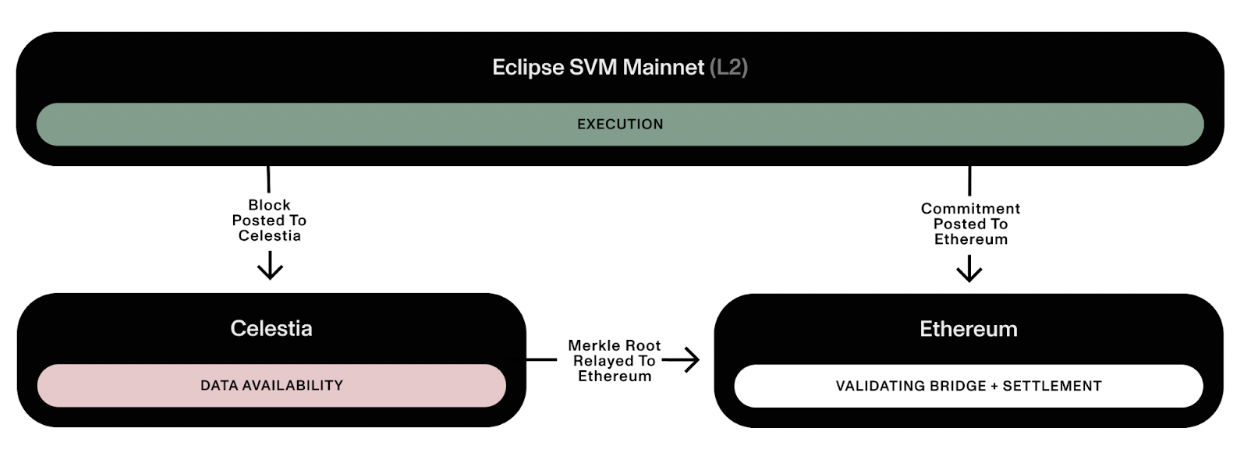
Source: Eclipse.builders
To achieve EVM compatibility, Eclipse will integrate Neon EVM. This brings full EVM compatibility to the Eclipse mainnet—including Ethereum bytecode and Ethereum JSON-RPC. Since each Neon EVM instance has its own local fee market, applications can gain all the benefits of app-specific chains simply by deploying their contracts, without compromising user experience, security, or liquidity. Thus, beyond functioning as a Layer 2 network, Eclipse also aims to serve as an infrastructure layer for a thriving Layer 3 ecosystem. Trend-setting Layer 2 networks like Arbitrum and Base have recently begun developing Layer 3 solutions themselves. Additionally, the Solang compiler can compile Solidity smart contract code into SVM bytecode, enabling developers to deploy Solidity contracts on Eclipse without needing Neon EVM to launch their own Layer 3.
Comparison
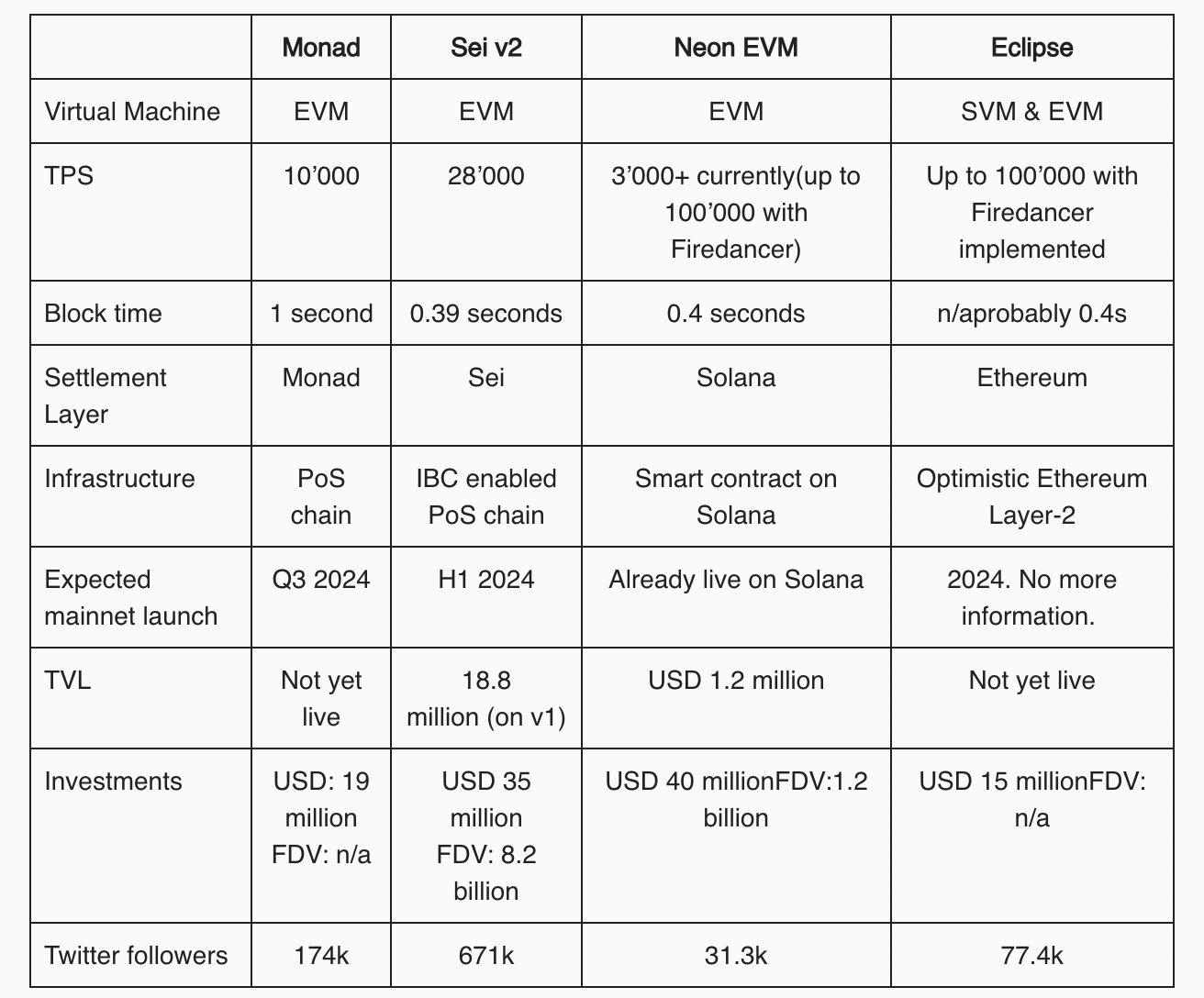
Among the two independent parallel EVM chains, Monad appears to attract more attention. Despite having far fewer followers than Sei, its posts generate significantly more engagement, and recent Twitter Spaces hosted by Monad drew three times as many participants as those hosted by Sei. This suggests Monad has a more passionate and active community. Notably, the Ethereum community seems particularly excited about its upcoming launch, positioning Monad favorably to capture early hype and adoption.
Although Sei’s performance metrics appear superior to Monad’s and it launched earlier, Sei has received less attention. While Sei experienced a strong rebound after announcing its parallelized EVM, it had previously launched as a CosmWASM chain, and its token has been circulating for some time—diminishing its novelty. Sei’s narrative seems weaker than Monad’s, and due to its Cosmos heritage, members of the Ethereum community are less likely to perceive it as part of the Ethereum ecosystem.
Due to Solana’s upcoming Firedancer client, both Neon EVM and Eclipse will offer superior performance compared to Monad and Sei, highlighting the inherent performance limitations of EVM relative to SVM—even when parallelized. Despite this performance edge and an earlier mainnet launch, Neon has struggled to find its market position. At minimum, Neon’s early adoption rate has been deeply disappointing. This may stem from Neon lacking a clear target audience. The Ethereum community remains highly skeptical of Solana due to concerns over reliability, security, and decentralization, making them uninterested in launching applications on Solana. Conversely, the Solana community is satisfied with SVM and sees no need to switch to EVM, leaving Neon EVM in an awkward position where neither community strongly embraces it.
Will Eclipse face a similar fate? As an Ethereum Layer 2, it inherits Ethereum’s security, decentralization, and reliability. However, running the Solana Virtual Machine at the base layer might still invite skepticism from the Ethereum community. By combining the strengths of both Ethereum and Solana, aligning neatly with the trend of modular blockchain architecture, and supporting app-specific Layer 3 rollups, Eclipse appears perfectly positioned within all current Web3 hot narratives. From its design, technology, and performance, Eclipse is well-placed to build a compelling story around its launch. Currently, Eclipse looks highly promising and is gaining strong momentum, actively hiring additional marketing professionals.
Outlook
Competition in the Web3 space is intense, with numerous Layer 1 and Layer 2 solutions vying for attention. Success depends not only on possessing cutting-edge technology but also on crafting compelling narratives, building strong communities, and attracting developers—areas where certain blockchains hold a distinct advantage.
Monad is well-positioned within the emerging parallel EVM narrative. Despite slightly lower performance than Sei, Monad has generated the most buzz and attention. However, crypto narratives fade quickly. Monad will need to leverage this short-term hype to bootstrap its ecosystem effectively.
Beyond competing with each other, these projects must also contend with established players like Ethereum, various Layer 2s, and second-generation blockchains such as Solana, Avalanche, and Polygon—all of which have had more time to develop their communities and ecosystems. The allure of shiny new products, innovative technology, and impressive performance metrics may capture attention when Monad, Sei, and Eclipse launch. Long-term success, however, will depend on whether they can sustain that attention and foster vibrant, self-sustaining ecosystems driven by users and developers.
Join TechFlow official community to stay tuned
Telegram:https://t.me/TechFlowDaily
X (Twitter):https://x.com/TechFlowPost
X (Twitter) EN:https://x.com/BlockFlow_News
 @Globalcoinrsrch