Countdown: 10 hours, 3 minutes — The simplest Dencun upgrade guide you'll ever need
TechFlow Selected TechFlow Selected
Countdown: 10 hours, 3 minutes — The simplest Dencun upgrade guide you'll ever need
A brief summary of the 5 EIPs in the Dencun upgrade.
 Navigating Web3 tides with focused insights
Author: 0xCygaar
Translation: Frank, Foresight News
Editor's note: The Dencun upgrade will activate on the mainnet at 21:55. With only 10 hours remaining until the upgrade, and being the largest fork since The Merge, this article aims to help users understand the key changes of the Dencun upgrade in just three minutes.

First, why is it called "Dencun"?
There are two types of Ethereum clients—execution clients and consensus clients—each with their own set of upgrade names.
For example, there’s the Cancun upgrade for execution clients and the Deneb upgrade for consensus clients. Combined, they form the name "Dencun".
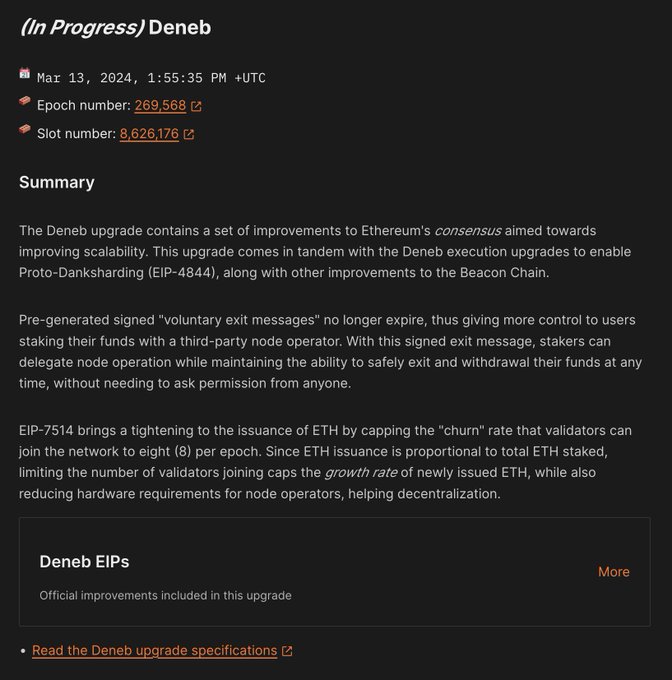
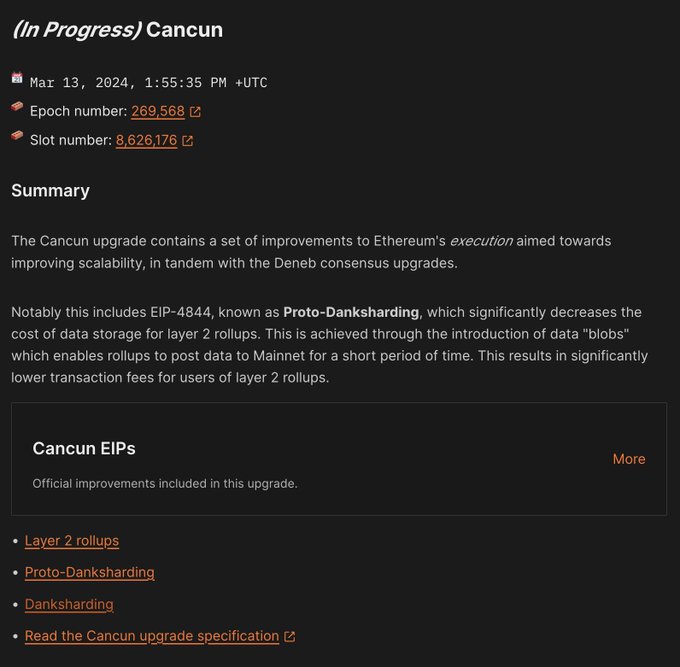
Additionally, the Dencun upgrade includes five EIP proposals.
1. EIP-4844: Ethereum Scaling Solution Proto-Danksharding
This is a major step forward in Ethereum's scalability journey, ongoing for two years, introducing "blobs" as a way for rollups to post transaction data, laying the foundation for future scaling.
Blobs will reduce rollup costs by 10–50 times (exact figure TBD), as rollups will no longer directly post data onto Ethereum blocks. Moreover, since rollup data will no longer compete for regular block space, costs for other L1 transactions should also decrease.
2. EIP-1153: Transient Storage
This change has long been requested by application developers, particularly Uniswap, adding a new type of storage within the EVM.
Previously, data could either be stored short-term (cheap, in memory) or long-term (expensive). EIP-1153 introduces a new transient storage option.
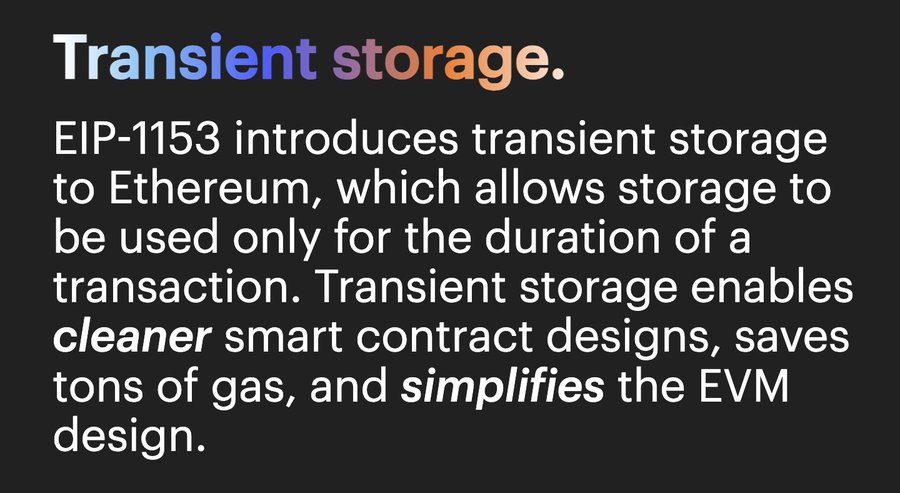
This storage type persists throughout a transaction but disappears afterward, making reentrancy protection cheaper, unlocking new smart contract designs without increasing state bloat.
Many applications and contracts, including Uniswap V4, are expected to use these opcodes.
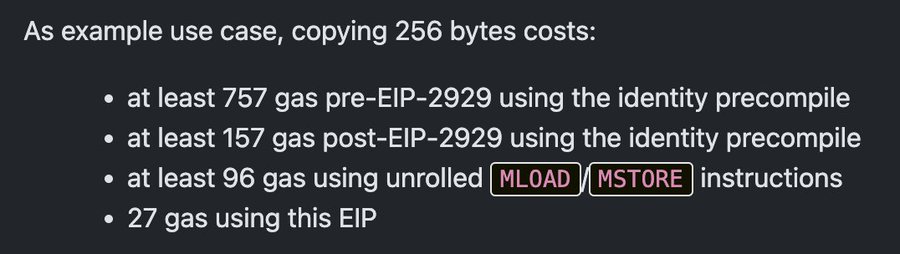
3. EIP-5656: MCOPY Opcode
This opcode has been widely requested by application developers because nearly every contract performs memory copying, which currently requires significant gas.
The MCOPY opcode simplifies the process and reduces costs, making smart contracts more efficient.
4. EIP-6780: SELFDESTRUCT Opcode
The SELFDESTRUCT opcode was originally designed to reward developers who remove state from the chain. However, it has caused more problems than benefits. Therefore, EIP-6780 restricts the functionality of the SELFDESTRUCT opcode to specific scenarios.
5. EIP-7044 / 7055: Staking Improvements
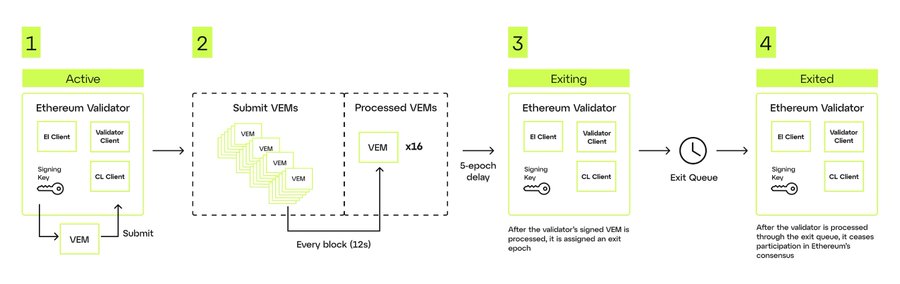
EIP-7044 makes validator withdrawals easier by making pre-signed exit messages indefinitely valid.
EIP-7045 extends the window during which validators can submit attestations, speeding up block finality (LMD-GHOST will be faster).
Overall, EIP-4844 is by far the most significant change in this hard fork, drastically reducing costs and improving user experience. Transient storage and MCOPY will further reduce costs, especially on L1.
Best wishes to the core developers and hoping for a smooth upgrade.
Join TechFlow official community to stay tuned
Telegram:https://t.me/TechFlowDaily
X (Twitter):https://x.com/TechFlowPost
X (Twitter) EN:https://x.com/BlockFlow_News
 @0xCygaar




![In-depth Analysis of Trade[XYZ]: How Were 92 Markets and 98% HIP-3 Trading Volume Established?](https://upload.techflowpost.com/upload/images/20260716/20260716061117965147.jpeg?x-oss-process=image/resize,p_50/quality,q_80)