On-chain lending moves toward modularity: 3 new protocols to watch
TechFlow Selected TechFlow Selected
On-chain lending moves toward modularity: 3 new protocols to watch
This article discusses multiple projects in the lending space, including Ajna, Morpho, and Euler.
 Navigating Web3 tides with focused insights
Author: AARON XIE
Translated by: TechFlow
Introduction: The Dawn of Permissionless On-Chain Lending
The story of permissionless on-chain lending platforms begins with Rari Capital and its Fuse platform. Launched in the first half of 2021, shortly after the DeFi summer boom that marked explosive growth in decentralized finance, Fuse quickly gained attention. Developed by Rari Capital, the platform revolutionized the DeFi space by enabling users to create and manage their own permissionless lending pools—aligning perfectly with the emerging trend of yield optimization.
During its rise, Rari Capital adopted the (9,9) narrative popularized by Olympus DAO—a strategy aimed at leveraging OHM yields. Its merger with Fei Protocol further amplified growth and community building during this period. In November 2021, the integration between Rari Capital and Fei Protocol centered around a specific vision: creating a comprehensive DeFi platform combining Rari’s lending protocols with Fei’s stablecoin mechanism.
However, everything collapsed dramatically in April 2022 when Fuse fell victim to a reentrancy attack, resulting in staggering losses estimated at approximately $80 million. This incident triggered intense scrutiny of Rari Capital's security practices and raised broader concerns about the vulnerability of DeFi platforms to such attacks. In the aftermath, Tribe DAO—the governing body formed post-merger—faced difficult decisions. Pressured by the hack and subsequent challenges, Tribe DAO and Rari Capital ultimately shut down later that year. This closure marked a pivotal moment in the DeFi landscape, highlighting how even the most innovative platforms remain vulnerable to security threats and underscoring the importance of secure, robust protocols within decentralized finance.
Revival of Permissionless Lending
Following the April 2022 Rari Capital hack and the major Euler exploit in 2023—which resulted in $200 million in losses—the DeFi industry faced persistent skepticism regarding security. Euler, known for its innovative permissionless lending protocol allowing borrowing and lending across various crypto assets, became another stark reminder of vulnerabilities within the DeFi ecosystem. These significant security breaches intensified industry-wide pessimism, raising serious questions about the safety and reliability of decentralized financial platforms.
Yet starting from mid-July with Ajna’s launch, the second half of 2023 quietly ushered in a revival in DeFi lending. This resurgence continued with Morpho Blue’s release on October 10, 2023. What sets these emerging protocols apart in the renewed DeFi lending landscape is a shift in narrative—from purely "permissionless" to distinctly "modular." Platforms like Ajna and Morpho Blue began emphasizing their “modular” nature rather than focusing solely on unrestricted access offered by permissionless systems. This approach positions them as foundational technologies upon which third-party developers can build and customize lending use cases. The shift toward modularity highlights flexibility and adaptability, encouraging innovation and specialization in lending solutions. Alongside this modular narrative comes an increased emphasis on security. For example, Ajna differentiates itself through oracle-free design, eliminating reliance on external price feeds and thereby reducing potential attack vectors. Morpho Blue introduces the concept of “permissionless risk management,” delegating responsibility to third parties who select loan markets offering the best risk-adjusted returns.
Current Landscape: Return of DeFi Liquidity
Entering 2024, the broader cryptocurrency and DeFi sectors have experienced a noticeable upswing. This recovery is often attributed to novel token distribution mechanisms—a theory championed by Multicoin’s Tushar. His thesis posits that every crypto bull market is catalyzed by innovative token distribution methods. In the current cycle, the concept of “points” has emerged as a key driver, with platforms like Eigenlayer leading through its restaking ecosystem. This model has not only reignited interest but also reshaped market dynamics. Meanwhile, the diversity of on-chain asset types continues to expand, deepening the overall DeFi ecosystem.
That said, as both institutions and “degens” alike seek on-chain leverage, it becomes imperative to ensure we have the necessary lending systems and infrastructure in place. While established protocols like Compound and Aave have facilitated billions in transactions, their limited capacity to support diverse collateral types necessitates the emergence of new on-chain lending platforms. Over the past one to two years, the sector has seen the rise of new lending protocols such as Morpho, Ajna, and Euler, each competing for a share of the on-chain lending market. Additionally, we’ve observed growth in NFT lending protocols like Metastreet and Blur. This article aims to explore the narratives and functionalities of these projects, providing readers with deeper insights into their differences and contributions.
Morpho Protocol
Origins of Morpho
The origin story of Morpho and the decision to develop Morpho Blue stem from the protocol’s initial success and a deep understanding of limitations within the DeFi lending space. Launched by Paul Frambot and his team at Morpho Labs, Morpho rapidly rose to prominence as Ethereum’s third-largest lending platform, amassing over $1 billion in deposits within a year. This impressive growth was driven by the Morpho Optimizer, which operated atop existing protocols like Compound and Aave to enhance interest rate efficiency. However, Morpho’s scalability eventually hit constraints imposed by the design of these underlying lending pools.
These insights led to a fundamental rethinking of decentralized lending from the ground up. Drawing on extensive experience, the Morpho team recognized the need to move beyond existing models to achieve new levels of autonomy and efficiency in DeFi lending. This evolution gave birth to Morpho Blue—an initiative designed to address several critical issues in DeFi lending:
-
Trust assumptions: The protocol reduces trust assumptions by enabling more decentralized and dynamic risk management, addressing the problem of numerous risk parameters requiring constant monitoring and adjustment—one of the primary sources of security vulnerabilities.
-
Scalability and efficiency: By moving away from DAO-style governance, Morpho Blue aims to improve scalability and efficiency, tackling inherent issues of capital efficiency and interest rate optimization present in current decentralized lending models.
-
Decentralized risk management: Morpho Blue focuses on permissionless risk management, introducing a more transparent and effective way to handle risk within lending platforms.
The development of Morpho Blue represents a significant shift toward building opinionated and trust-minimized primitive functions in DeFi. This transition enables the potential for abstraction layers to be built atop these primitives, establishing a more resilient, efficient, and open DeFi ecosystem at its core.
Analysis of Morpho Blue (and MetaMorpho) Protocol
The Morpho protocol consists of two distinct layers: Morpho Blue and MetaMorpho, each serving unique roles within the ecosystem.
Morpho Blue allows anyone to deploy and manage their own lending markets without permission. A key feature of each Morpho Blue market is its simplicity and specificity: it supports only one collateral asset and one loan asset, along with a defined loan-to-value ratio (LTV) and a designated oracle price feed. This framework ensures each market remains simple and focused, making it accessible to a wide range of users. Morpho Blue also features minimalist governance with a clean and efficient codebase of just 650 lines of Solidity, enhancing its security and reliability. Additionally, Morpho Blue includes a fee switch managed by $MORPHO token holders, adding a layer of community-driven oversight to the protocol.
On the other hand, MetaMorpho introduces the concept of lending vaults managed by third-party “risk experts.” At this layer, lenders deposit funds into vaults, while vault managers are responsible for allocating this liquidity across various Morpho Blue markets. This approach enables more complex and dynamic fund management, leveraging professional expertise to optimize returns and manage risk. The core innovation of MetaMorpho lies in its product positioning and developer-friendliness. It creates a platform where third-party developers can build atop Morpho Blue’s infrastructure, adding another layer of diversity and innovation to the Morpho ecosystem.
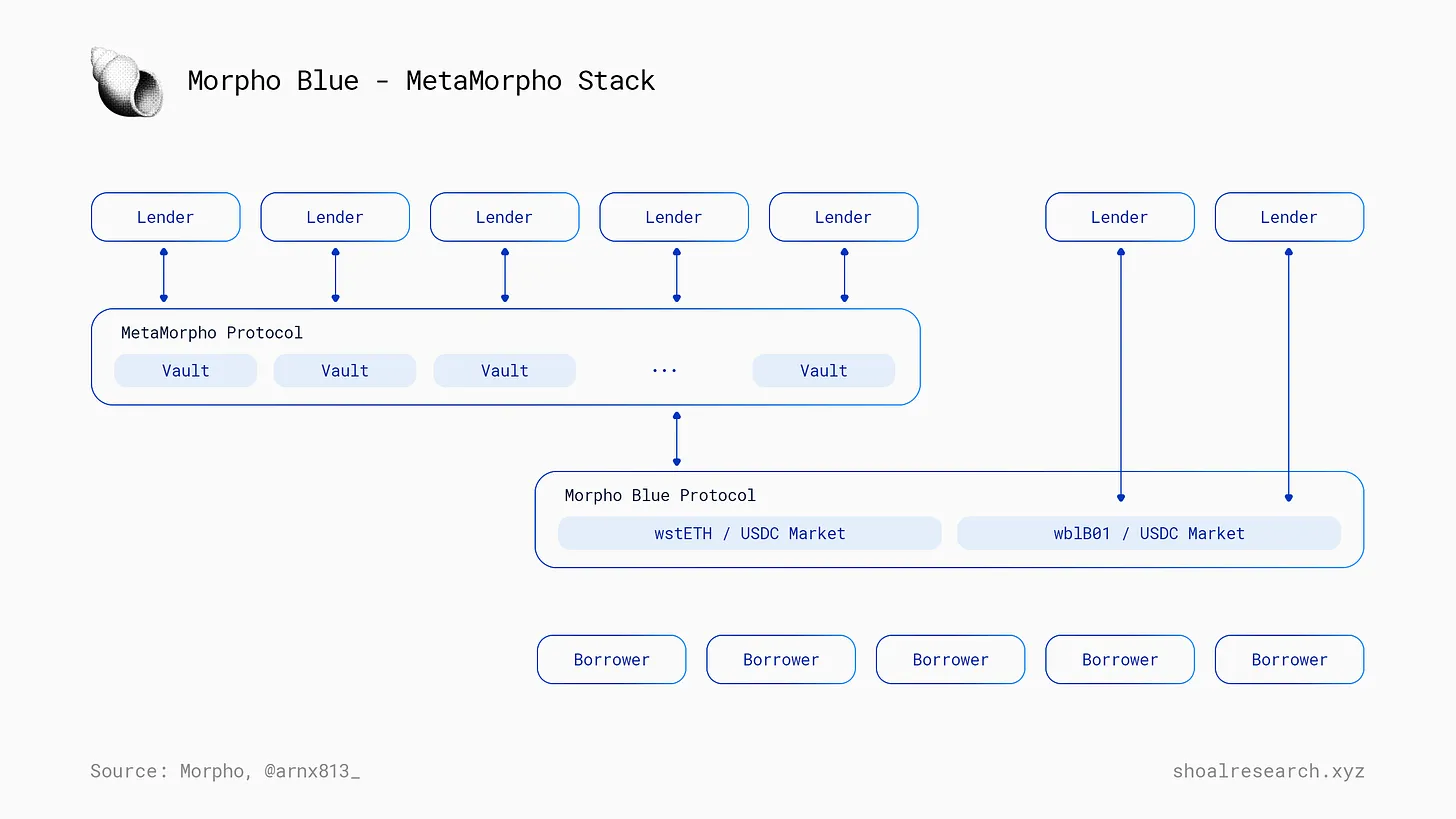
Case Study: Steakhouse Financial
Led by Sebventures, Steakhouse Financial exemplifies effective utilization within the Morpho Blue ecosystem. This crypto-native DAO offering financial consulting services has made notable strides in the DeFi space, drawing attention for its innovative lending approach. Since January 3, Steakhouse Financial has been managing a USDC MetaMorpho vault with a total value locked (TVL) of $12.8 million, primarily focused on stETH and wBTC. Looking ahead, Steakhouse Financial has expressed interest in supporting real-world assets (RWA) as collateral.
Four Key Roles in the Morpho Ecosystem
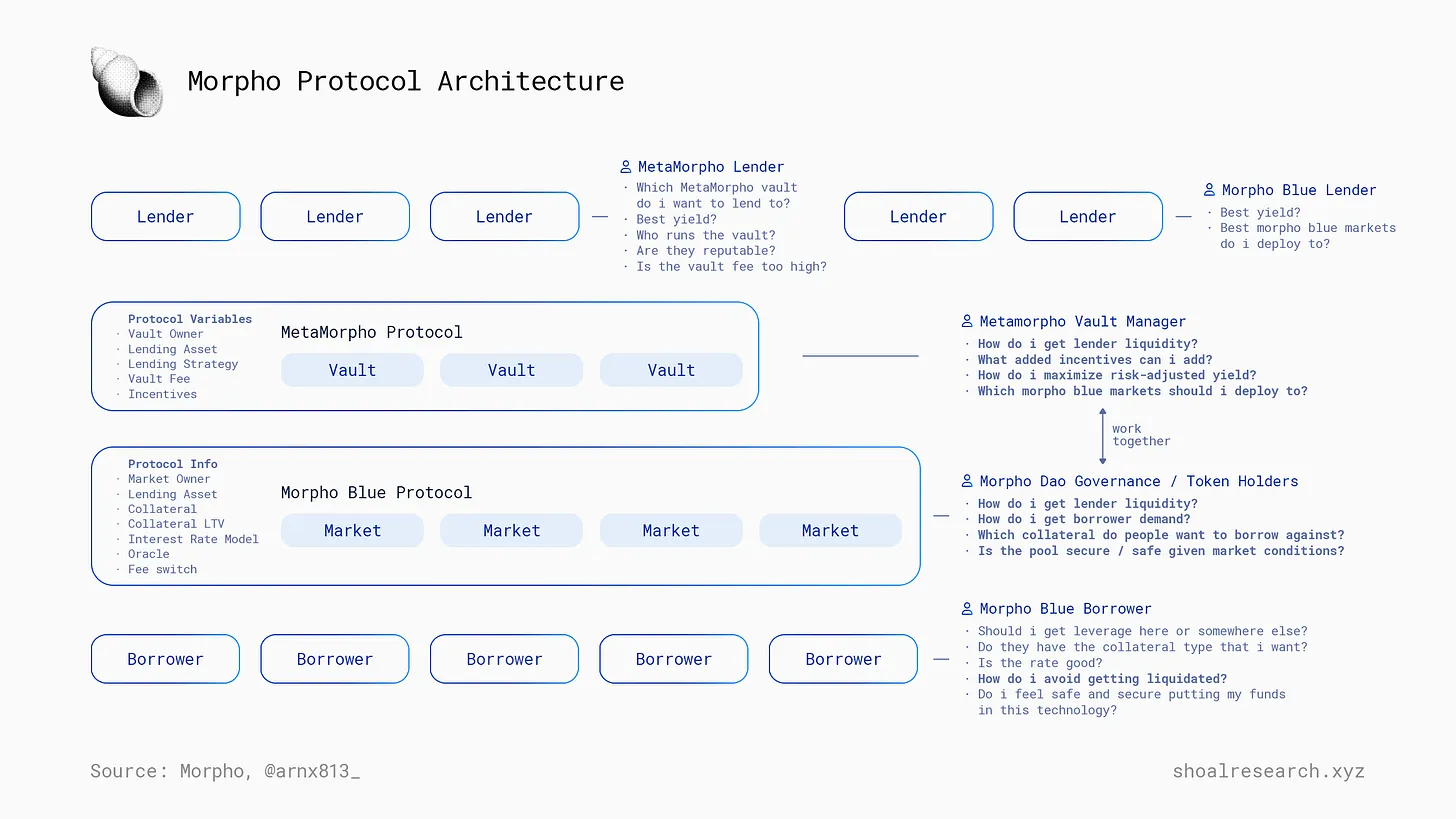
Given current developments, there are four main roles within the Morpho ecosystem: MetaMorpho lenders, Morpho Blue lenders, borrowers, MetaMorpho vault managers, and Morpho governance / Morpho Labs.
Below is a diagram illustrating the full Morpho protocol architecture, annotated with participants and their objectives/thought processes.
Morpho’s Growth
Morpho stands out through a combination of strong branding and exceptional business development execution. While other lending projects have emerged—including Ajna, Midas, Frax Lend, and Silo Finance—Morpho leads in total value locked. Although fundamentally permissionless, the protocol abstracts complexity via a curated, permissioned Morpho UI. This carefully designed interface reflects the team’s commitment to maintaining brand integrity and trust, showcasing only top-tier lending markets and partners. This nuanced strategy—marketing the appeal of a permissionless protocol while effectively linking its front-end to reputable entities—positions Morpho Blue as a benchmark of quality and reliability in the DeFi space, even amid perceptions of risk and instability.
Building on this, Morpho has invested heavily in end-user experience. The team developed a clean and intuitive UI/UX that simplifies interactions for both end-users and lending operators—a rarity among many DeFi lending protocols, which often still feel clunky. Furthermore, the creation of abstraction layers like MetaMorpho enhances usability. Morpho Blue’s balanced strategy—bridging permissionless innovation with a permissioned, brand-centric front-end—is impressive. This approach not only underscores the platform’s adaptability and flexibility but also positions Morpho as a leader in fostering specialized and secure lending solutions within DeFi.
What is Morpho doing well? Areas for Improvement?
Strengths include:
-
Strong personal brands of team members (e.g., Paul and Merlin), boosting credibility and visibility.
-
Effective ecosystem building through selling simplicity, developing abstraction layers like MetaMorpho, securing partnerships with third-party lending operators such as Steakhouse, B Protocol, Block Analitica, and Re7, and locking in token incentives (e.g., stETH).
-
Its Optimizer product enjoys strong existing traction and brand recognition, providing significant leverage for Morpho Blue’s success.
Area for improvement: Unit economics for third-party risk managers need refinement. For instance, Block Analitica generates $70,000 in revenue from $45 million in assets under management, excluding engineering, legal, and risk management costs.
Ajna: Oracle-Free Markets
Origins of Ajna
Ajna was founded by several former MakerDAO team members who identified scalability and risk issues in previous-generation lending protocols. Oracle dependency and governance were both limiting factors and major sources of risk. The key insight was to outsource oracle functionality to lenders and liquidators themselves. Their vision was to create a “lending Uniswap”—an immutable protocol capable of scaling to support nearly any asset, including long-tail tokens and NFTs. This original and innovative design emerged from over two years of development, including more than ten code audits.
Ajna Finance’s origin story closely aligns with the broader 2023 DeFi ecosystem’s desire for greater security and robustness. This point is emphasized in Dan Elitzer’s article on the need for oracle-free protocols in DeFi (read here). Elitzer, founder of Nascent VC and a well-known figure in the DeFi community, outlined the ongoing security challenges plaguing DeFi and the billions lost to hacks, stressing the necessity of a fundamental rethinking of DeFi protocol design and security.
In this context, the Ajna protocol emerged as a compelling solution. Launched in mid-July 2023, Ajna’s design philosophy aligns with Elitzer’s vision for DeFi: a protocol operating with zero dependencies—and therefore zero trust requirements—including no governance, upgradability, or oracles. This approach minimizes theoretical attack surfaces and inherent risks within the protocol.
Ajna Protocol Analysis
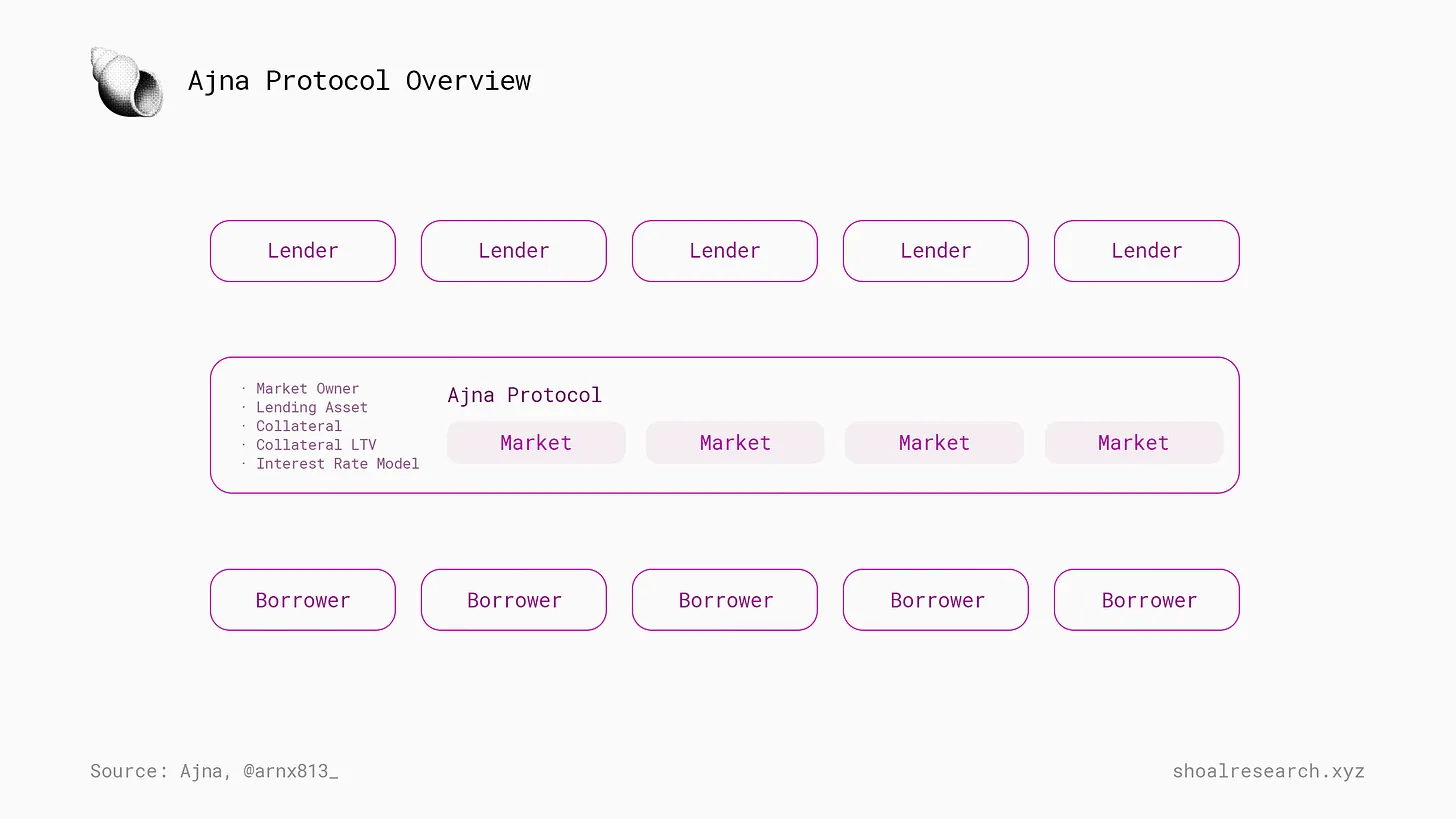
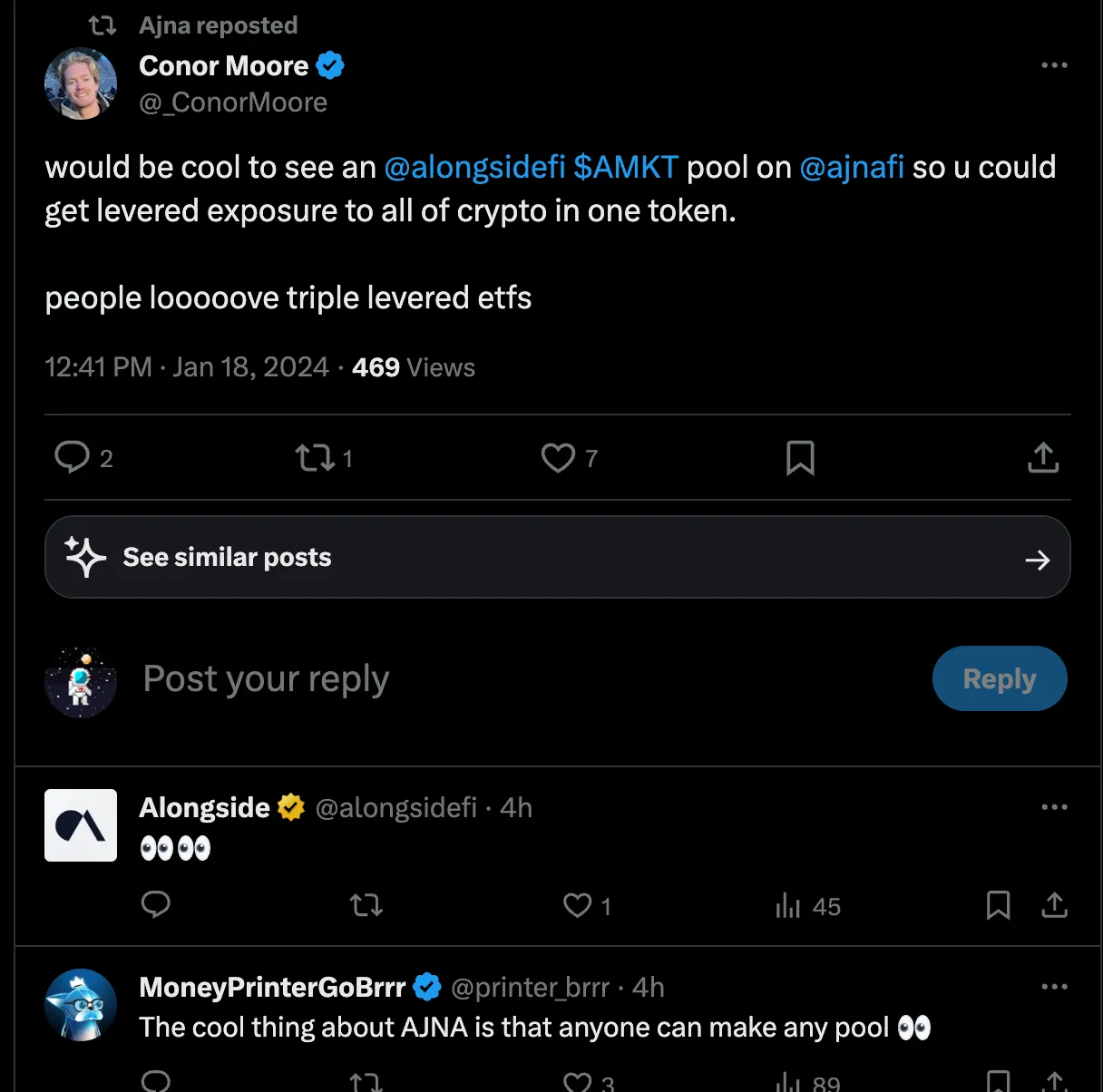
Within the DeFi lending landscape, Ajna distinguishes itself through a unique approach to lending. It is a non-custodial, permissionless system that requires neither oracles nor governance, ensuring a high degree of decentralization and autonomy. Ajna enables the creation of markets with specific collateral and loan assets, streamlining the process and improving user accessibility. The platform supports a wide range of assets, including both fungible and non-fungible tokens, expanding the scope of collateral types beyond what is typically seen in DeFi. Ajna facilitates use cases such as NFT lending and short-selling markets without being constrained by common platform limitations.
Three Participants in the Ajna Ecosystem
Given current developments, there are three main roles in the Ajna ecosystem: Ajna lenders, Ajna borrowers, and Ajna governance / token holders.
Ajna’s Growth
After suffering a major security breach in the second half of 2023, Ajna took a clear hit to its security-focused branding. Following a restart, the project pursued full decentralization, severing all ties with centralized lab companies. Today, Ajna operates as a fully decentralized DAO and protocol.
Restarting a DeFi protocol is difficult and never ideal. Despite setbacks, Ajna returned with a re-audited protocol and two clear value propositions: full decentralization and oracle-free operation. Ajna’s strategy now relies entirely on native DeFi branding.
Now, key long-term questions remain:
-
What unique lending use cases does Ajna unlock that differentiate it from Morpho and other competitors?
-
How effective is decentralized DAO coordination as Ajna executes its growth and business development strategies?
Euler: Rising from the Shadows
Origins of Euler
Euler Protocol’s emergence as a next-generation DeFi lending platform marks a significant evolution from first-generation protocols like Compound and Aave. As a decentralized service, Euler addresses a key gap in the DeFi market: the lack of support for non-mainstream tokens in lending services. Recognizing unmet demand for lending long-tail crypto assets, Euler provides a permissionless platform capable of listing nearly any token, provided it pairs with WETH on Uniswap v3.
The Euler protocol stands out in the DeFi lending space through several key innovations:
-
It employs a unique risk assessment methodology considering both collateral and borrow factors, improving accuracy in risk evaluation.
-
Euler integrates Uniswap v3’s decentralized TWAP oracle for asset valuation, reinforcing its permissionless ethos by supporting diverse asset listings.
-
Additionally, the protocol introduced a MEV-resistant liquidation mechanism and a reactive interest rate model that automatically adjusts to market conditions.
-
Coupled with the implementation of sub-accounts for user convenience, these features make Euler a sophisticated and flexible platform in DeFi lending.
Unfortunately, on March 13, 2023, Euler Finance suffered one of the largest DeFi hacks in history. A flash loan attack that day resulted in losses exceeding $195 million, triggering a chain reaction affecting numerous DeFi protocols. Beyond Euler, at least 11 other protocols incurred losses due to the attack.
Post-Hack: Euler V2
After a year of silence, Euler launched its v2 on February 22, 2024. Euler v2 is a modular lending platform composed primarily of two components: the Euler Vault Kit (EVK) and the Ethereum Vault Connector (EVC). EVK enables developers to create customized lending vaults—it can be described as a vault development toolkit that simplifies building vaults using Euler’s technical framework. EVC is an interoperability protocol allowing vault creators to link their vaults together, enabling developers to efficiently connect vaults for information sharing and interaction. Together, these technologies serve as foundational lending infrastructure.
Euler vaults will come in two primary types:
-
Core: Managed lending markets similar to Euler v1, governed by the DAO.
-
Edge: Permissionless lending markets with greater parameter flexibility. Pooled lending experiences, rather than 1:1 structures like Morpho Blue or Ajna.
Euler’s Brand Strategy
Like Ajna and Morpho, Euler strongly advocates the “modular” lending narrative, aiming to build a permissionless base-layer lending protocol for third-party use. However, Euler differs significantly in its public-facing marketing and branding strategy. Unlike Morpho, which takes a highly abstracted and simplified approach, Euler leans into its rich feature set as a core technical and branding advantage. Key features highlighted include advanced risk management tools such as sub-accounts, PnL simulators, limit order types, and a new liquidation mechanism (“fee flow”), among others.
Who is Euler’s End User, and What is Their Final Product?
Euler offers a powerful and novel feature set surpassing Morpho Blue (e.g., sub-accounts, fee flows, PnL simulators, etc.). A critical question remains: Is Euler selling its lending infrastructure to third-party lending operators, or is it building its own lending markets? These represent two distinct opportunities with different customer bases. If Euler competes with Morpho to attract third-party lending operators, how easy is it to build abstractions on Euler v2? Euler missed the conceptual equivalent of MetaMorpho’s “pool manager” abstraction primitive, yet appears to aim to replicate what Morpho did with third-party pool operators.
Is Charging a 1% Protocol Fee at Launch a Good Idea?
At launch, Euler enforces a mandatory minimum 1% protocol fee derived from vault managers. This could pose a significant psychological barrier, as fees may hinder growth during early stages. In contrast, Morpho uses a licensing model tied to fee mechanisms: if fees are charged, the code becomes open-source (and thus freely forkable).
Conclusion
Compared to more novel aspects of DeFi—such as liquid staking and restaking—the lending sector appears mature. One might question where innovation lies and what the future holds for one of DeFi’s more established verticals. Yet, it is fair and reasonable to argue that lending is one of the few areas in DeFi that has achieved genuine product-market fit and largely avoided Ponzi-like economics. Given this, innovation will almost inevitably follow where product-market fit exists. Thus, if the past is any indicator of the future, DeFi lending is certain to undergo further evolution and advancement in the coming cycles.
In this article, we examined multiple projects in the lending space, including Ajna, Morpho, and Euler. A central theme across all three lending projects is not just permissionless market creation, but doing so in a user-friendly, human-centered manner. Yes, prior to these protocols, individuals could technically launch their own lending pools or protocols—but the process was far from user-friendly. In the next DeFi lending cycle, our focus should extend beyond the permissionless aspect—which seems to be the obvious direction of protocol trends—and equally emphasize user experience. Companies like Summer.fi are already pioneering new lending experiences (and broader DeFi interfaces) to simplify user interactions. As integrations grow, their streamlined experience—simpler than accessing various protocol creators’ frontends directly—is likely to gain increasing traction. With rising interest in intent-based protocols, intent-based lending or borrowing (akin to how Morpho aggregates across Aave and Compound) may emerge as the next narrative: simply input what you want to borrow, and this new paradigm will find the optimal, risk-adjusted opportunity.
To some extent, creating markets in a permissionless way will also become simpler. Currently, Morpho collaborates with three sophisticated groups (B Protocol, Block Analitica, and Steakhouse Finance) to operate its new permissionless markets. But soon, this too will become more user-friendly—just as the permissionless lending experience itself has become accessible to any user. The ability for any user to create markets will enable a Cambrian explosion of innovation in lending markets—from new collateral types (like LRTs, RWAs) to structured products targeting novel yield opportunities.
Join TechFlow official community to stay tuned
Telegram:https://t.me/TechFlowDaily
X (Twitter):https://x.com/TechFlowPost
X (Twitter) EN:https://x.com/BlockFlow_News
 @Shoalresearch