Atomicals and DMINT Overview: Revolutionizing Asset Management and Exploring NFT Innovation on Bitcoin
TechFlow Selected TechFlow Selected
Atomicals and DMINT Overview: Revolutionizing Asset Management and Exploring NFT Innovation on Bitcoin
The Atomicals protocol brings greater flexibility, decentralization, and fairness to the Bitcoin ecosystem.
 Navigating Web3 tides with focused insights
Author: HAMSTER
With OKX Web3 Wallet announcing the upcoming integration of Atomicals inscriptions and NFTs, the value of the Atomicals ecosystem is experiencing a resurgence. But what exactly is the Atomicals protocol? How does ARC-20 innovate and compare against standards like BRC-20 and SRC-20? What makes DMINT—a key upgrade to the Atomicals protocol—so unique? And why is it drawing significant attention from major exchanges?
Atomicals: A Revolution in Bitcoin Asset Management

Built on the Bitcoin blockchain, the Atomicals protocol introduces the ARC20 token standard, aiming to simplify asset management without relying on external entities. This standard supports two minting methods—decentralized and direct—enhancing flexibility and configurability in asset management while ensuring seamless compatibility with the Bitcoin blockchain. Each ARC20 token is backed by one Satoshi (the smallest unit of Bitcoin), a design choice that elegantly secures the token’s intrinsic value.
Minting Methods:
-
Decentralized Minting: Implemented via the Atomicals CLI, this method allows users to set specific parameters such as reward per mint, total allowed mints, and starting block height. It enables community-driven projects to gradually issue tokens. The inclusion of an optional Bitwork mining prefix forces minters to perform proof-of-work (PoW), mirroring Bitcoin’s own mining mechanism, thereby enhancing decentralization and fairness.
-
Direct Minting: Allows the creation of a single output containing the full supply, where each Satoshi represents one token unit. This requires the creator to commit a quantity of Bitcoin equal to the intended supply, increasing credibility and reducing the risk of fraud. This approach suits teams or companies seeking full control over initial distribution and future use of their tokens.
Comparison with Other Protocols:
The BRC-20 standard, inspired by Ethereum's ERC-20, enables the creation of fungible tokens (FTs) on the Bitcoin blockchain. While BRC-20 successfully introduced the concept of token issuance on Bitcoin, it has faced criticism for potential centralization risks and reliance on off-chain indexing platforms.
SRC-20 tokens, introduced through the STAMPS protocol, offer a different data embedding approach, similar to Ethereum’s ERC-1155 standard, allowing multiple token types to be stored within a single transaction on Bitcoin. By storing tokens in spendable data transactions—rather than witness data like Ordinals—it provides stronger immutability and security guarantees.
Compared to both, the Atomicals protocol delivers significant improvements in design and implementation. Focusing specifically on fungible tokens (ARC20), it leverages Bitcoin’s UTXO model to enable decentralized creation and management of complex digital objects and token systems. Atomicals simplifies the process of creating "digital objects" on Bitcoin by introducing technical innovations such as using individual Satoshis as token units, exclusively using Taproot addresses during asset creation and updates, and avoiding on-chain data recording during transfers. These enhancements expand Bitcoin’s functionality and support broader application scenarios.
In summary, the Atomicals protocol brings greater flexibility, decentralization, and fairness to the Bitcoin ecosystem through its innovative use of the UTXO model and tokenization techniques. These optimizations not only broaden Bitcoin’s utility but also open new possibilities for asset management and digital object creation on the network.
DMINT: Innovating BTC NFT Creation
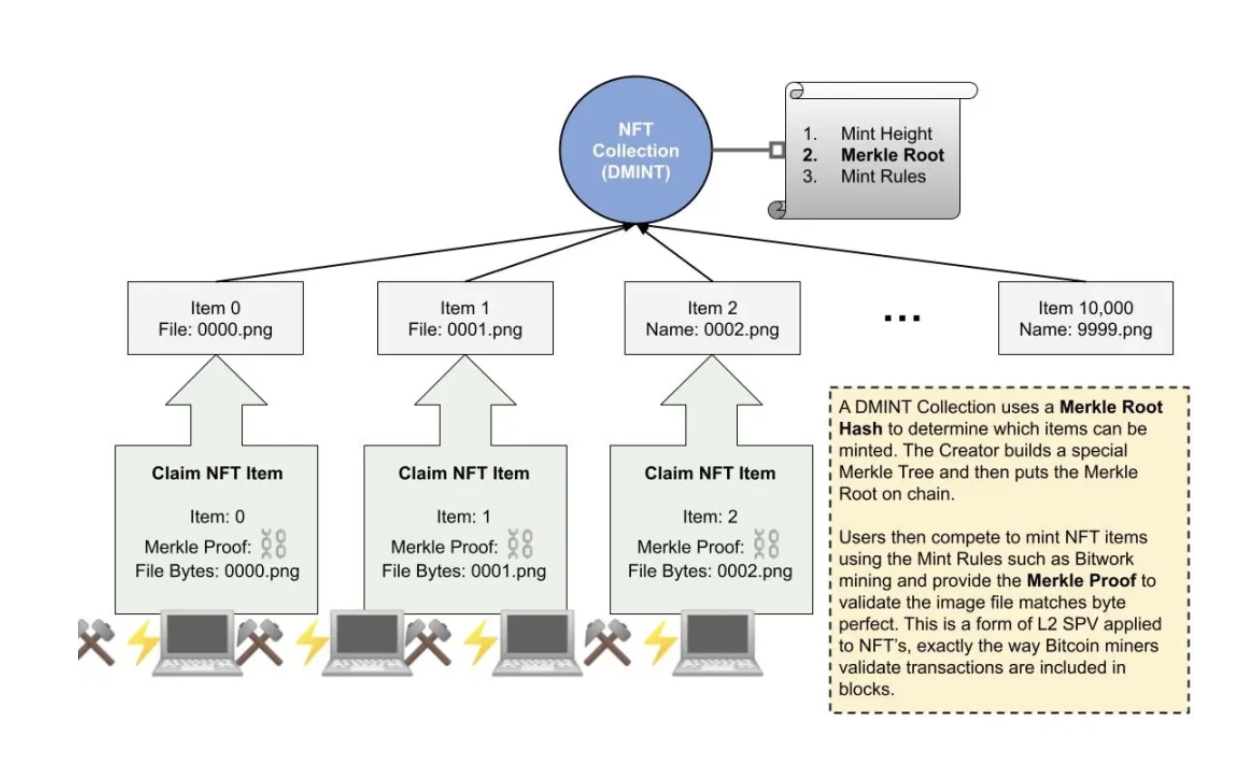
Atomicals’ NFT technology is powered by DMINT, a decentralized minting process that allows project owners to register their NFT collections as containers on-chain. The process consists of four main steps: preparing collection data, configuring the container, validating NFT items, and minting the NFTs. It emphasizes thorough preparation before any on-chain activity, including gathering NFT data, setting up DMINT configurations and metadata, and using command-line tools to create dedicated wallets to isolate container operations. Minting both containers and NFTs requires gas fees. The system also supports advanced features such as custom mint payment rules, enabling collection creators to require payments to designated addresses before users can claim an NFT.
As a pivotal update to the Atomicals protocol, DMINT introduces a decentralized minting mechanism for NFT collections on Bitcoin. Its innovation lies in an automated “first-come, first-served” minting flow that eliminates centralized mechanisms like whitelists, ensuring fair access. With DMINT, Atomicals enhances the security and uniqueness of NFTs while offering flexible management options, empowering users to fully control their NFT collections directly on the Bitcoin blockchain. This not only gives creators customizable tools to meet diverse creative needs but also provides efficient on-chain solutions for minting, transferring, and updating digital assets—greatly increasing the versatility of both static and dynamic digital assets.
DMINT employs an efficient method for minting NFTs on the Bitcoin network by transmitting only the hash of the NFT image instead of the image itself, significantly reducing operational costs. A hash is a cryptographic function that maps data of any size to a fixed-size value—known as a hash value, hash code, digest, or simply hash. By leveraging hashing, DMINT enables verification of data ownership or integrity without revealing the original content, thus improving both security and efficiency.
Additionally, the Bitwork mining mechanism introduced by DMINT grants every CPU an equal one-time chance to mint, effectively preventing large-scale automated minting and eliminating competitive gas fee bidding. Designed using regular expressions, Bitwork allows developers to define specific mining conditions, ensuring fairness and accessibility. For instance, creators can set particular patterns along with corresponding Bitwork codes to control who may participate and how, guaranteeing transparency and equity in the minting process.
In conclusion, DMINT and its underlying Bitwork mining mechanism leverage cryptographic hashing to ensure secure, unique, fair, and low-cost NFT minting within the Bitcoin ecosystem. Together, they represent an innovative and efficient solution for NFT creation on the Bitcoin network.
Conclusion
The integration of Atomicals and DMINT technologies unlocks new use cases and development opportunities on the Bitcoin blockchain, particularly in the creation, transfer, update, and storage of digital objects. This advancement benefits not only NFT creators and collectors but also highlights Bitcoin’s adaptability and untapped potential, delivering innovative solutions to decentralized finance and digital asset representation.
Join TechFlow official community to stay tuned
Telegram:https://t.me/TechFlowDaily
X (Twitter):https://x.com/TechFlowPost
X (Twitter) EN:https://x.com/BlockFlow_News
 @ChainFeedsxyz