What Happened to the Atomicals Protocol, Which Has Been in a Doldrums for Months?
TechFlow Selected TechFlow Selected
What Happened to the Atomicals Protocol, Which Has Been in a Doldrums for Months?
Among the top 100 Bitcoin ATOM holding addresses today, only 6 belong to Mint. Whether it's "turnover" or "reshuffling," the liquid supply of ATOM has undergone significant changes.
 Navigating Web3 tides with focused insights
By Jaleel, BlockBeats
Over the past few months, Bitcoin has repeatedly hit new all-time highs. Within the Bitcoin ecosystem, BRC20's ORDI and SRC's STAMP have also reached record highs, drawing significant attention. In contrast, ATOM—the flagship token of the highly "halal" Atomicals protocol—has remained under a dark cloud, with its price continuously declining and community sentiment souring.
Despite ATOM being listed on Unisat and OKX Web3 Wallet, as well as exchanges like Gate and Bitget, its price has been on a downward trajectory since peaking at $16 in December last year. At the time of writing, one ATOM trades at $6.478, meaning a single token costs $6,483. Compared to its high of $16, ATOM has dropped by 62% over the past four months.
What exactly has changed within the Atomicals ecosystem? How is the development of AVM progressing? After in-depth conversations with several developers and enthusiasts in the Atomicals community, BlockBeats brings you this report.
The Ceiling of Atomicals
In the early days of Atomicals, almost no one discussed AVM.
Until earlier this year, Arthur, the creator of the Atomicals protocol, was focused on developing the "splitting" feature. We observed that ATOM’s price often rose alongside progress on splitting functionality. It's clear that early holders had high expectations for this feature. Ideally, once ATOM could be split, trading volume and address count would surge, accelerating listings on major exchanges.
However, before splitting, ATOM’s liquidity resembled expensive NFTs or luxury real estate—largely unaffordable for average users. Even now, a single ATOM costs over six thousand dollars, and there are only about two thousand holding addresses.
Although platforms such as Gate, Bitget, and OKX Web3 Wallet have listed ATOM in recent months, top-tier exchanges like Binance and OKX still haven’t added it. Judging from both trading volume and holder address growth, these leading exchanges appear to lack urgency in listing ATOM.
The Shortest Path May Be the Longest
Given how critical splitting is, why hasn't it launched yet—and why has development shifted toward AVM instead?
Wizz Wallet, the earliest wallet in the Atomicals ecosystem and currently the most widely used among the community, maintains frequent private communication with protocol author Arthur. Brutoshi, CEO of Wizz Wallet, told BlockBeats that most of the code for splitting has already been deployed on the testnet—but implementation is now effectively paused.
As for why development pivoted to AVM while delaying splitting, Brutoshi offered his insight: “Before AVM, implementing splitting would require writing extensive logic directly into the indexer. While technically feasible, this approach would hard-code a massive amount of complex code, requiring ongoing maintenance, testing, and promotion. Wallets and marketplaces would need extra effort to support it—all very inelegant.”
Every blockchain or protocol carries its own identity. For the Atomicals ecosystem, keywords include elegance, simplicity, minimalism, and purity.
Both approaches are viable. From the perspective of delivering immediate benefits to holders, launching splitting independently might be the fastest solution. But for Arthur’s vision of the Atomicals ecosystem, it’s not optimal. The path that appears shortest may actually be the longest.
Arthur didn’t shift focus to AVM because splitting was impossible—he did so in pursuit of a more elegant and streamlined solution. The benefit is clear: efforts across the ecosystem aren’t wasted solving just one narrow problem, but instead contribute to broader, reusable infrastructure.
“AVM is programmable, with its own scripting language. With it, splitting can be achieved with just a snippet of code,” Brutoshi added. Indeed, once AVM is live, splitting becomes a natural byproduct.
While AVM promises great potential, during these long, quiet months, holders who prioritized liquidity or failed to manage their positions properly chose to exit early. In crypto, where liquidity reigns supreme, time is measured exponentially—and investors tend to be especially impatient.
“The early whales who minted ATOM were clearly identifiable—mostly technically savvy individuals who understand code. Most of them have already sold,” said Crypto Philanthropist, an active member and enthusiast in the Atomicals community, sharing his observations with BlockBeats after prolonged monitoring.
What Can AVM Actually Do?
Amid widespread community debate, AVM is widely recognized as representing the ceiling of the entire Atomicals ecosystem. So what exactly can this ceiling-defining AVM achieve?
On December 13, 2023, Arthur, the creator of the Atomicals Protocol, accepted an invitation from Ordinal Revolution Podcast to share updates on the protocol and his views on the Bitcoin ecosystem—in an anonymous voice-only format.
During the interview, Arthur briefly introduced the Atomicals Virtual Machine (AVM). As a Turing-complete virtual machine, AVM can execute various computational instructions required for complex blockchain applications, enabling developers to build smart contract programs on Bitcoin and create unprecedented user experiences.
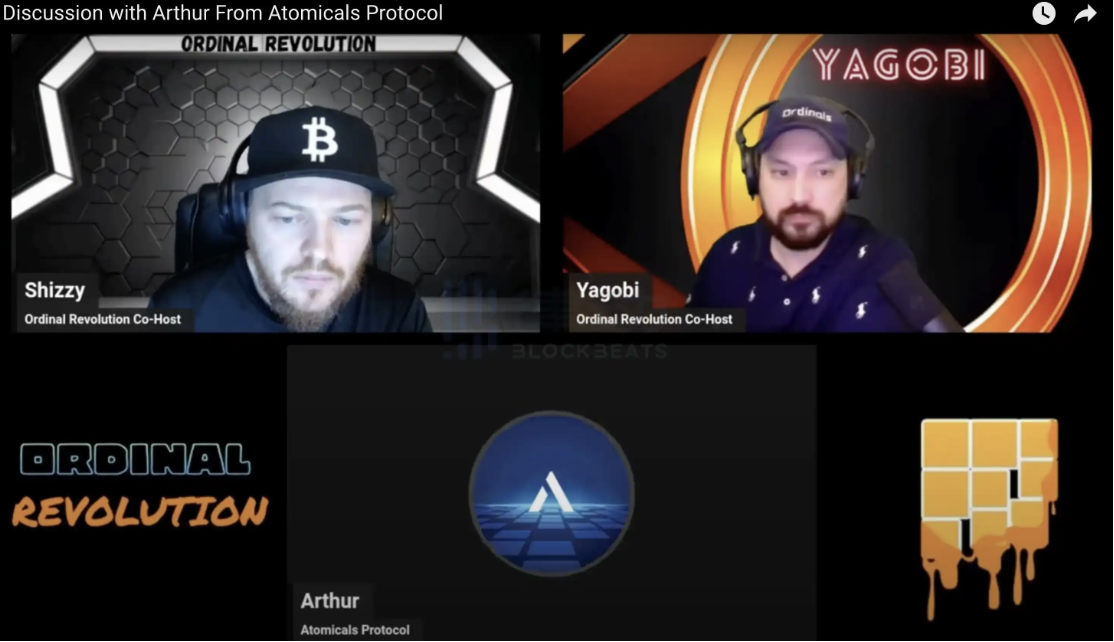
Screenshot from the podcast session
“With AVM, many possibilities open up—including resolving previous technical debt in much more elegant ways,” said Brutoshi.
So what specific possibilities does AVM unlock? According to @PunkOnChain, a prominent Atomicals community advocate on Twitter, key breakthroughs include: an advanced execution environment capable of handling smart contracts and dApps; a custom instruction set designed to boost performance and reduce gas costs; optimized state transitions with parallel processing to improve throughput and scalability; interoperability and cross-chain communication capabilities; and developer-friendly tooling.
For those less familiar with technical concepts, think of AVM as giving Atomicals a smarter brain—a kind of supercomputer able to perform diverse tasks; a specialized toolkit that makes complex operations easier and more efficient; a brilliant manager ensuring everything runs smoothly; a translator enabling seamless communication between Atomicals and other systems; and a practical handbook helping developers quickly learn how to use AVM.
“I have many reasons for being bullish on ATOM, but the most important is that I believe ATOM has limited downside risk while offering infinite upside potential,” said Crypto Philanthropist, echoing his confidence in ATOM to BlockBeats.
In his view, it wouldn't be unreasonable for Atomicals—the second dragon—to capture 10–20% of the market cap of Ordinals—the first dragon. Once AVM is realized, the entire Atomicals ecosystem will expand significantly, potentially matching—or even surpassing—Ordinals in scale. In the long term, the ceiling is limitless. For a protocol like Atomicals that supports both FTs and NFTs, enhanced further by the Realms system allowing users to attach avatars, names, and links to online profiles, the height of the ceiling post-AVM will be formidable.
"Working in Isolation"
Regarding discussions around AVM, we’ve also heard skepticism from some community members about how Arthur plans to implement it—and the most pressing question: when will AVM launch?
From public signals, we’ve gathered some clues. Neeboo, CTO of Wizz Wallet, revealed during a Twitter Space event that the protocol author aims to release the first version of AVM around the time of Bitcoin’s halving—approximately late April.
On March 19, Atomicals enthusiast 0xSea shared insights from a conversation with Arthur: “The alpha version of AVM is coming soon. Timing isn’t certain, but it’s close. This aligns closely with what Neeboo previously hinted at during the Space—that a usable version would arrive before the halving. Once AVM launches, features like staking, lending, and deposits for ARC-20 assets will become easy to support. Based on AVM, ARC-20 tokens can be deposited into smart contracts, similar to how ERC-20 tokens interact with Solidity contracts on Ethereum.”
Whether AVM development qualifies as “working in isolation” is subjective. But it’s undeniable that compared to typical protocol founders, Arthur prefers to remain hidden behind the Atomicals protocol.
Since announcing the start of AVM design work in January, Arthur has not released any official documentation. Although he has gradually shared design ideas on Twitter, the absence of formal docs has left some community members uneasy—especially compared to Casey, who yesterday published the final implementation of Runes on GitHub.
Neeboo noted in early March during a Twitter Space: “We haven’t seen the original design documents or initial code yet.” However, according to Wizz Wallet’s disclosure to BlockBeats, Arthur holds regular meetings with them, maintaining ongoing dialogue with wallet and infrastructure teams.
Each protocol reflects its creator’s personality—shaped deeply by their values and worldview. Everyone who has interacted with Arthur knows he identifies as a scientist and researcher, never intending to profit personally. During meetings with Wizz Wallet, Arthur explicitly stated he has no financial needs in building the Atomicals protocol.
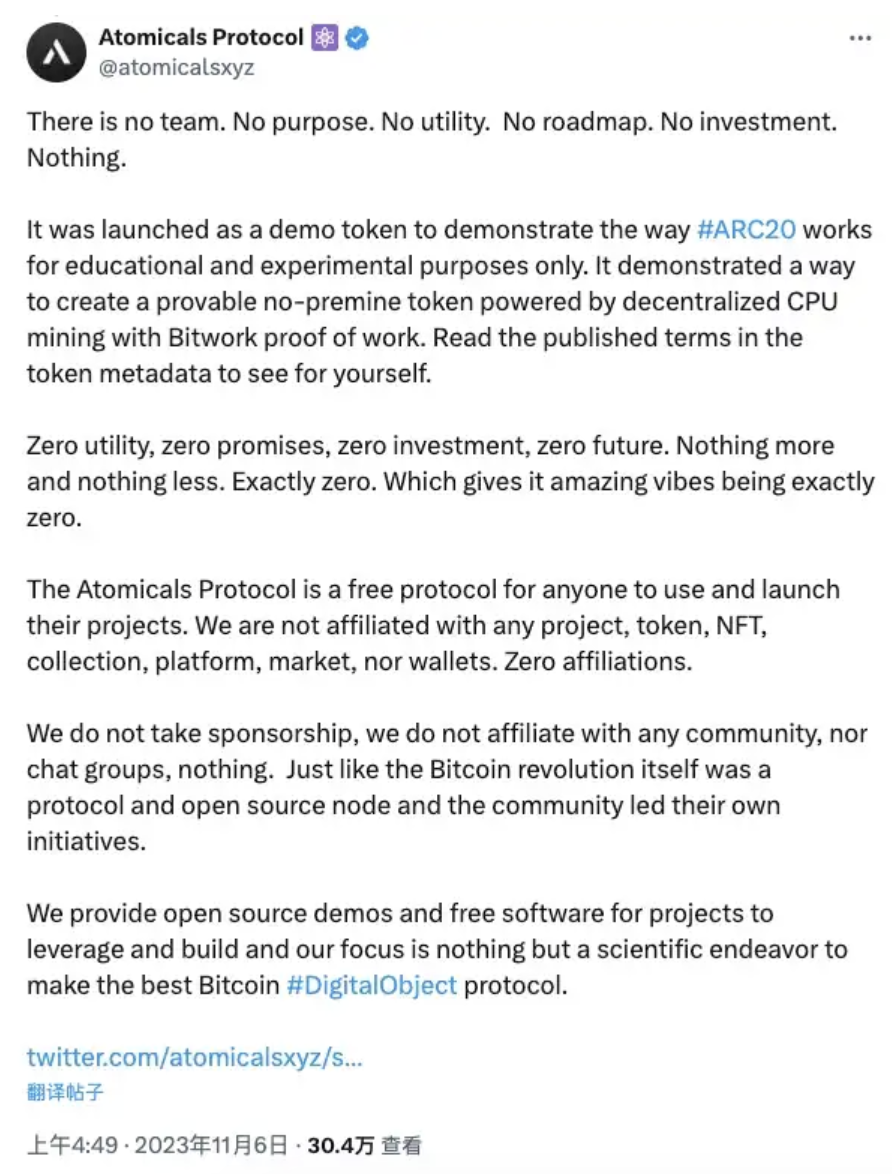
Official statement: Atomicals has no team, no purpose, no utility, no roadmap, no investment—nothing
“Arthur’s mindset and values resemble Satoshi Nakamoto’s,” said Brutoshi. He added: “Once Atomicals and AVM reach stability, he might just disappear. He’s fully prepared for that. From remaining anonymous from day one, to using voice modulators in interviews and audio calls, he places immense value on privacy.”
This explains why many community members trust Arthur unconditionally—not only due to alignment with his character and values, but also because of his proven technical prowess.
“Initially inspired by Ordinals, Arthur wanted to implement domain-like functionality on Ordinals. After experimenting for about two months, he concluded it wasn’t feasible—Ordinals couldn’t support it. So he decided to start fresh, rebuilding the entire protocol from scratch in roughly six months. His technical ability is truly exceptional, and he has deep familiarity with the Bitcoin protocol,” Brutoshi told BlockBeats.
According to Brutoshi, Arthur previously worked on mining pool projects and has a strong affinity for PoW—explaining why the Atomicals protocol pioneered the BitWork token issuance mechanism based on Proof-of-Work.
Returning to criticisms of Atomicals as “working in isolation,” following a recent meeting between Wizz Wallet and Arthur, Arthur seems to have acknowledged this concern. Yesterday, he updated the community on social media about the protocol’s development progress and plans. According to the official Atomicals Protocol Twitter account, the upcoming update aims to allow transfers of token amounts below the 546-satoshi dust limit. This change addresses BTC’s restriction on minimum transfer sizes, originally implemented to prevent “spam attacks” on the Bitcoin blockchain. Because ARC20 uses a colored coin model, it has been constrained by this dust limit, preventing transfers of less than 546 units.
The solution involves partial coloring of UTXOs—without exceeding the total number of units in the UTXO—while preserving the principle of 1 coin ≥ 1 satoshi. This technical fix offers three major advantages: first, it enables sending as little as 1 token unit, directly addressing a key community concern; second, it significantly reduces accidental token burn; third, it enhances flexibility and reliability of smart contracts via the Atomicals Virtual Machine (AVM). Neeboo emphasized that “partial coloring remains part of Arthur’s plan, and will still be implemented through contract capabilities rather than adding rules directly into the indexer.”
This protocol upgrade is expected to be completed within weeks and will coincide with the AVM release. The Atomicals protocol maintains its commitment to 1 token = 1 satoshi (or more). After the update, the open-source developer team will focus on building a testnet version, ensuring sufficient time for industry-wide testing and consensus before stable integration.
Shift in the Battleground of Token Distribution
In his conversation with BlockBeats, Crypto Philanthropist shared investment insights derived from observing token distribution: “Token distribution is the most crucial analytical lens—it determines market direction. Before buying, ask yourself: who will ultimately hold these tokens? The market can only truly take off when tokens flow into stronger hands. If they remain concentrated among early-minting scientists, the project’s prospects are dim.”
To analyze ATOM’s holdings and distribution, BlockBeats examined the wallet addresses of the top 100 ATOM holders on Atomicals Market.
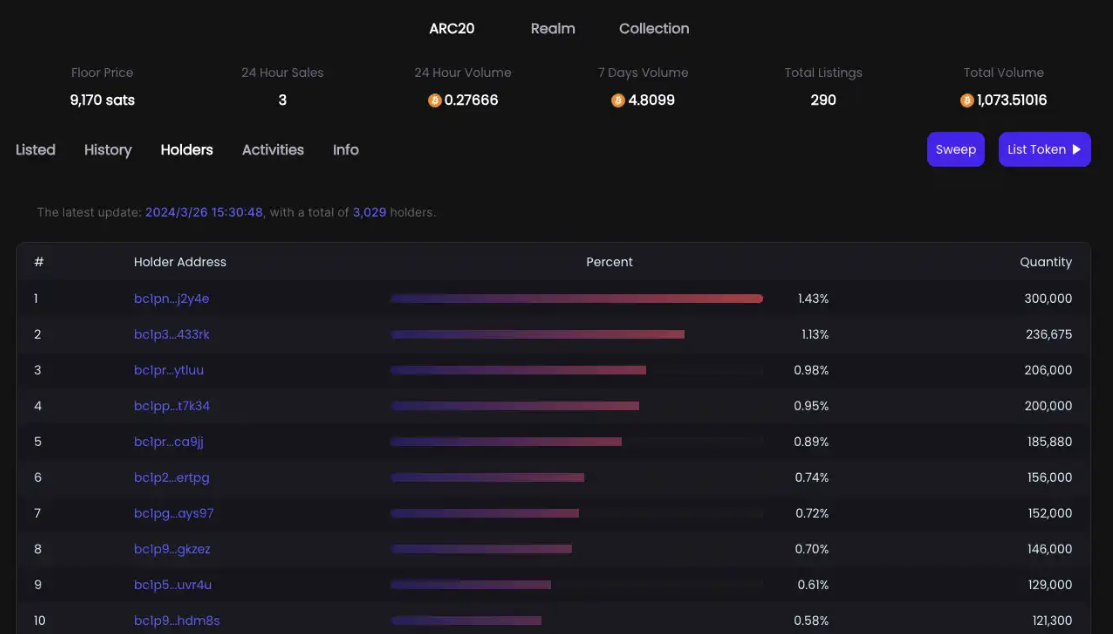
Among the top ten ATOM holders, none are mint-based holders. Among the top twenty, only the #12 address is mint-based. Between ranks 20–30, only #29 is mint-based. From 30–40, there are no mint-based holders. In the 40–50 range, again none. Between 50–60, only #59 is mint-based; between 60–70, only #63 and #65; between 70–80, only #73; from 80–90, none; and among the top 100, only #93 is mint-based.
Out of the top 100 holders, only six acquired ATOM through minting. Mint-based holders have clearly decreased in number, indicating that early participants have significantly reduced or transferred their holdings.
Regardless of whether this is termed “churn” or “shakeout,” ATOM’s liquidity and market influence have clearly shifted—the battleground is moving.
Looking back at ORDI, both price action and community sentiment followed a similar pattern. “From June to September, ORDI was completely dead—absolutely lifeless,” recalled Crypto Philanthropist. At that time, the ORDI community mirrored today’s ATOM community, enduring prolonged periods of pain and pessimism.
After listing on GATE in May 2023, ORDI reached an initial peak of around $25. Over the next four months, however, it entered a prolonged bear phase, bottoming out at $2.86 in September 2023.
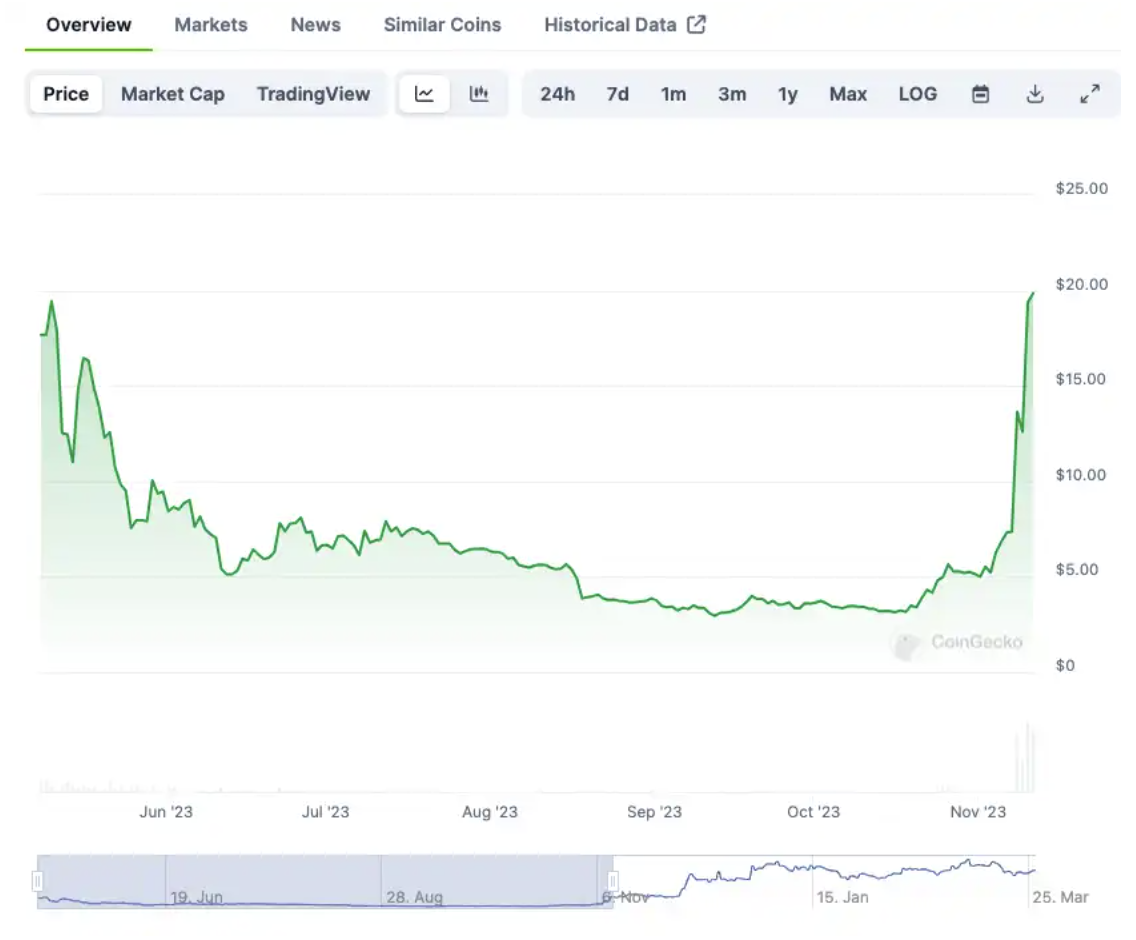
It wasn’t until November 7, 2023, when ORDI listed on Binance, that its price surged past $50. Then, following approval of Bitcoin ETFs in January this year—removing any doubt about the bull market—ORDI peaked again in March 2024 at an all-time high of $96.17. Very few holders who initially minted ORDI managed to hold all the way to $96.17—truly a rare breed. Such a prolonged low-turnover period is entirely normal.
“But precisely because consensus forms and momentum builds during this process, the project can truly take off. Those lacking conviction exit early, selling quickly, which creates space for others to enter. That’s healthy,” said Brutoshi. “Diverse opinions and differing long/short investment decisions are signs of a healthy market. Turnover is a good thing.”
Compared to ORDI’s four-month slump—from $25 down to $2.86, a drop of 88.56%—ATOM’s decline from $16 to $6 represents about 62.5%, a relatively milder fall. Recalling November last year, when inscribing became nearly a “national sport,” with hundreds of inscription projects across chains, only a handful have survived to this day.
“From January to now in March, the protocol author has been researching AVM. Expecting AVM to launch immediately and trigger a price spike is simply unrealistic,” said Crypto Philanthropist. While he suspects some may be suppressing ATOM’s price, he also admits it’s possible ATOM simply hasn’t caught institutional interest yet. “But I’m certain of one thing: market divergence creates opportunity.”
Join TechFlow official community to stay tuned
Telegram:https://t.me/TechFlowDaily
X (Twitter):https://x.com/TechFlowPost
X (Twitter) EN:https://x.com/BlockFlow_News
 BlockBeats