








Understanding Minima: A DePIN-Optimized Blockchain That Runs on Smartphones
TechFlow Selected TechFlow Selected
Understanding Minima: A DePIN-Optimized Blockchain That Runs on Smartphones
What exactly sets Minima's DePIN L1 apart, or is it merely a short-term conceptual hype?
 Navigating Web3 tides with focused insights
Author: David, TechFlow
Among the many current market trends, DePIN certainly holds a prominent position.
According to the DePIN sector report released by Messari earlier this year, smart money is repeatedly betting on the DePIN track, while venture capital funds are raising substantial capital. Meanwhile, new projects related to DePIN continue to emerge.

Narrative acts like a free ride—new projects can go further by hopping on at the right time, while older ones can reinvent themselves and sometimes uncover even greater opportunities.
Starting February 27, Minima—a project launched in March last year—saw its token WMINIMA violently surge after a long period of dormancy. At the time of writing, its 24-hour price increase exceeded 100%, with a market cap reaching $55 million.

Minima’s mission is to build an L1 blockchain specifically designed for DePIN—one that can even run nodes on mobile devices.
Most DePIN projects we've seen typically focus on their own applications while relying on existing blockchains like Solana or Ethereum as their underlying infrastructure. At a time when both DePIN and L1 ecosystems are becoming increasingly competitive, a "dedicated DePIN L1" appears to have found a unique niche—avoiding direct competition with either DePIN apps or major L1 chains.
From the perspective of L1 valuation, a $55 million market cap may not seem high under current market conditions. So, what exactly sets Minima’s DePIN L1 apart? Is this purely short-term hype? Let's analyze its product design and tokenomics before answering.
Quick Understanding of Minima
As shown on Minima’s official website, one of its key selling points is enabling blockchain in the “real world.”
Simply put, most existing L1s are too distant from average users’ everyday devices—running a node usually requires significant hardware investment and technical expertise.

Minima aims to create an L1 blockchain capable of running fully on any mobile or IoT device. Any small personal device—from smartphones to embedded chips such as IoT sensors—can function as a network node.
This aligns perfectly with the etymological meaning of “Minima”—minimalization.
Additionally, the blockchain includes a secure peer-to-peer messaging system called Maxima, enabling decentralized and direct information transmission between nodes.
So what can you do with an L1 where any device can act as a node and communicate directly? The team has outlined four primary use cases:
-
Enterprises: Benefit from deploying lightweight, multi-functional Minima nodes that naturally scale with growing user bases and reduce infrastructure costs;
-
DePIN Networks: Hardware nodes can operate on Minima, allowing rapid value validation during prototyping and easy deployment across the Minima network afterward;
-
Developers: Build decentralized applications (MiniDapps) on top of the L1;
-
Individuals: Run Minima nodes to launch projects, tokenize real-world assets, and participate in block creation and validation.
The most significant value, however, lies in serving the DePIN networks themselves.
At its core, Minima is a solution deployed directly on users' mobile or IoT devices, capable of transmitting tokens and data between any set of nodes. To make an imperfect analogy, DePIN projects could use Minima’s framework as a dedicated “cloud service,” eliminating the need to build their own blockchain—they can simply plug into Minima’s ready-made infrastructure.
Crucially, since this chain is exclusively focused on DePIN, there's no risk of resource congestion caused by competing demands from other public chains—dedicated infrastructure for dedicated purposes.
But here arises another question:
What Are the Concrete Use Cases?
Minima has already applied its technology in industries related to automotive and IoT, demonstrating practical relevance.
For example, using a peer-to-peer network to generate and transfer tokens, you can run Minima-based applications on EV charging stations. The token serves as an access credential to unlock public or private chargers, while owners of private chargers can earn income whenever others use them.
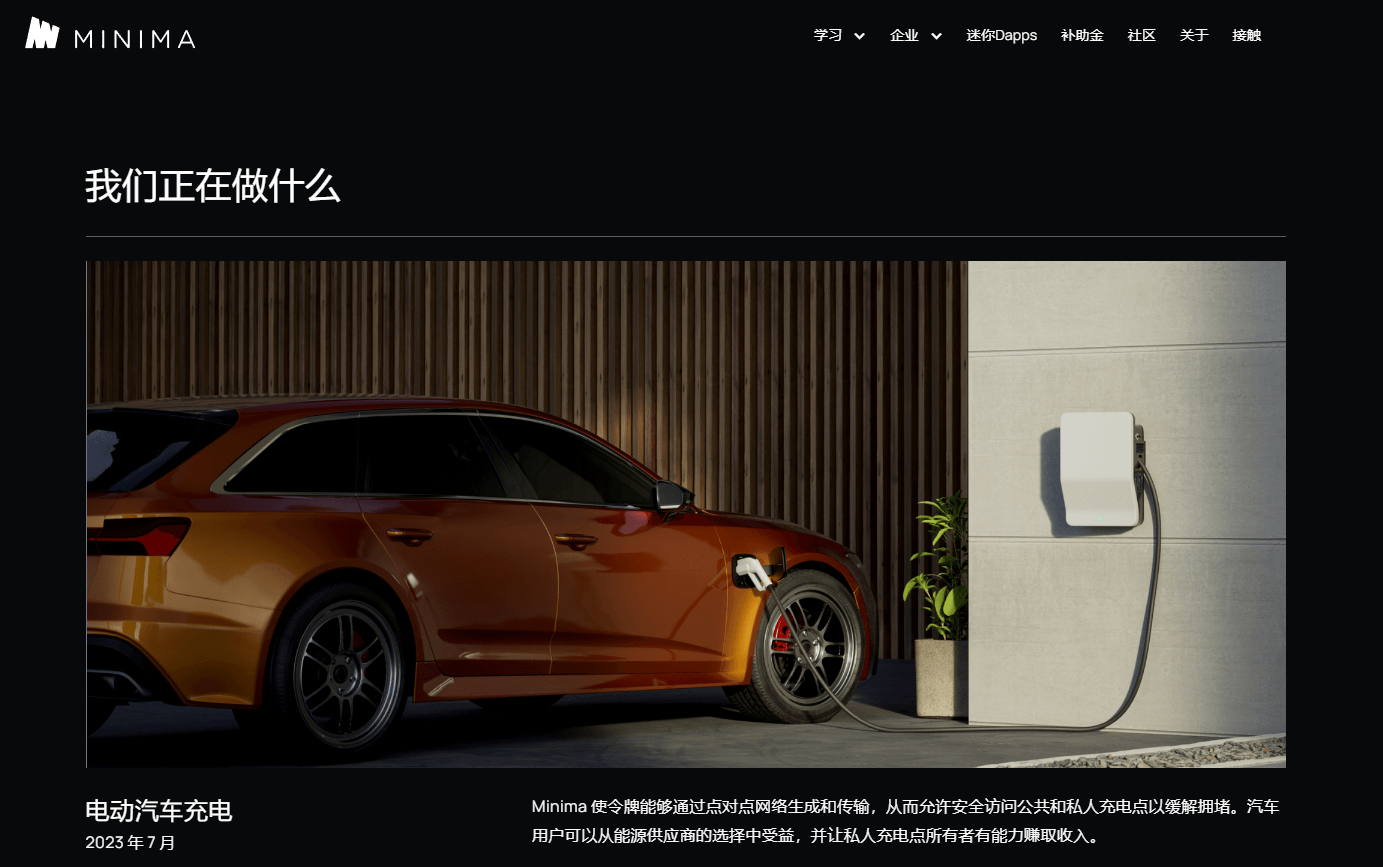
Moreover, Minima has already established partnerships with automakers including Volvo, continuously exploring new vehicle-related scenarios such as vehicle-to-vehicle communication, fuel payments, digital service manuals, and insurance.

On the software side, beyond the automotive industry, Minima can universally run various applications developed by third parties across different compact end devices—essentially functioning as a lightweight operating system.
Once connected to the Minima blockchain, users can access these apps simply by clicking icons on their devices—whether it's real-world industry tools or Web3 wallets and DEXs.

WMINIMA Token Analysis
Regarding tokens, the Minima blockchain features a native token MINIMA, with a hard-capped supply of 1 billion. Of this total, 12.5% is available as wrapped MINIMA (WMINIMA) on the Ethereum blockchain for trading.
Currently, the native MINIMA token has not yet launched; what trades on the market is the WMINIMA wrapped version.
Given that the token underwent TGE (Token Generation Event) back in March last year, its supply gradually enters circulation over time. The table below (first row) shows how WMINIMA supply evolves over time. For full details on the tokenomics model, visit this link:

The MINIMA token serves as a payment medium for application creation and communication costs on the Minima network. It can also serve as the native token for other L1 applications—for instance, being used as collateral in DeFi protocols.
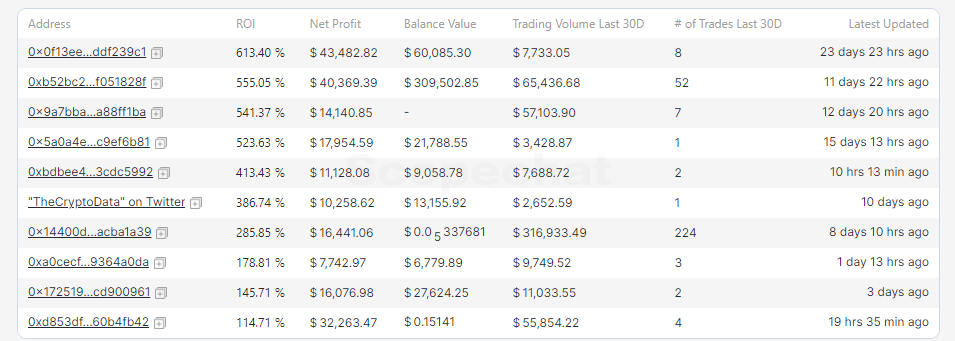
Looking at secondary market data, over the past week, CEX exchanges saw a net outflow of 4,100,539.28 WMINIMA tokens (worth $855,011.91). This suggests investor optimism, with buyers likely transferring tokens to personal wallets for holding (data source: Scopchat).

Notably, analyzing VC holdings and whale addresses reveals that the average withdrawal price for WMINIMA is around $0.2 (current market price at time of writing: $0.4), indicating some investors have already doubled their returns.
Meanwhile, several smart money addresses have achieved returns exceeding 100% on WMINIMA. Considering the trading frequency and behavior patterns of smart money, along with WMINIMA’s current market cap hovering around $50 million, I believe the token is prone to profit-taking and turnover in the short term, potentially leading to sharp volatility.
On the other hand, data from Bubble Map indicates high concentration of WMINIMA token holdings. The top address currently holds nearly half of all tokens, with transactional links to multiple other top-10 addresses. This implies a high degree of centralized control, but also means rapid price surges are possible due to concentrated chip distribution.

Overall, Minima may have successfully carved out a narrative and mental positioning niche—after all, L1s dedicated solely to DePIN remain rare in the market. The project also boasts real-world use cases and actively collaborates with external enterprises.
However, from a demand standpoint, the entire IoT and DePIN space hasn’t yet matured to the point where a specialized DePIN L1 is clearly necessary for communication and accounting. High-performance L1s like Solana already host numerous popular applications. Whether other projects will choose to migrate specifically to Minima remains a test of the team’s ability to tell compelling stories and execute real-world expansion.
Therefore, my suggestion is to view WMINIMA primarily as a low-market-cap player within a mid-to-short-term narrative. Given the aforementioned token distribution structure, WMINIMA might still deliver strong performance. But in the long run, investing in DePIN ecosystems built on Solana would be a more conservative and reliable strategy.
Join TechFlow official community to stay tuned
Telegram:https://t.me/TechFlowDaily
X (Twitter):https://x.com/TechFlowPost
X (Twitter) EN:https://x.com/BlockFlow_News
 深潮TechFlow






