Riding the AI Wave: 3 GPU Mining Projects Even Retail Investors Can Join
TechFlow Selected TechFlow Selected
Riding the AI Wave: 3 GPU Mining Projects Even Retail Investors Can Join
GPU mining offers more opportunities for small players to achieve big returns, reminiscent of early POW chains.
 Navigating Web3 tides with focused insights
Text: dt
Editor: Lisa
Each bull market brings new narratives—favoring the fresh over the old—and this cycle, the most promising narrative is undoubtedly AI. This AI wave has swept from Web2 into Web3, sparking a surge of AI-related projects. Among them, decentralized cloud computing platforms offering shared GPU resources have particularly attracted venture capital interest. By combining blockchain’s traditional hardware mining model with the fusion of DePIN and AI concepts, these projects successfully position decentralized blockchain infrastructure within the heart of the AI boom.
This week, Cryptosnap Dr.DODO will introduce three early-stage decentralized GPU mining and cloud computing projects accessible to retail participants. Let's ride this wave together.
io.net
The first project, io.net, is a Solana-based decentralized DePIN initiative focused on providing GPU computing power for AI and machine learning companies. Founded by Ahmad Shadid, the idea originated in 2020 when he was building a GPU computing network for his machine learning-driven quantitative trading firm, Dark Tick, aiming to reduce costs. After OpenAI launched ChatGPT, Shadid realized this network could serve as large-scale computing infrastructure for AI/ML companies.
io.net aims to build an “internet of GPUs,” addressing the shortage of GPU computing power caused by the AI boom. The platform’s computational capacity supports parallel processing tasks such as model training, batch inference, hyperparameter tuning, and reinforcement learning. It aggregates idle GPU resources from data centers, cryptocurrency miners, and other sources, automatically handling task scheduling, orchestration, and resource scaling. This allows development teams to run compute-intensive workloads across distributed resources without facing the limitations of public cloud services—such as limited availability, high costs, and suboptimal configuration options. Recently, io.net launched a rewards program called "Ignition," running from March 1 to April 28, which awards points based on the number of GPUs users contribute to the network. Details on how to provide computing power can be found in the official documentation. While it hasn't been explicitly confirmed whether these reward points can be exchanged for the platform’s native IO token, CEO Shadid announced that the IO token will launch on April 28.
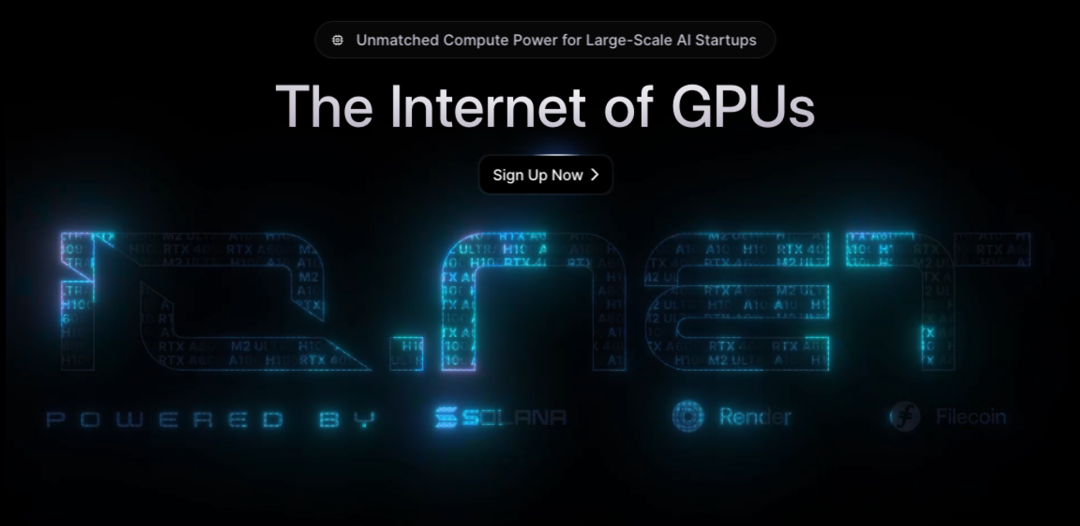
Source: io.net
Gaimin
The second project is another Solana-based DePIN cloud computing initiative—Gaimin—founded by the esports team Gaimin Gladiators. Unlike io.net’s general-purpose decentralized GPU network, Gaimin starts from the gaming sector, aiming to merge cloud computing with a gaming platform. It plans to build a dApp that offers game downloads, login services, and more, while allowing users to rent out their idle GPU power to earn additional rewards. Leveraging the high-performance GPUs commonly owned by gamers, Gaimin aims to construct a decentralized distributed supercomputing platform, gaimin.cloud, which provides data processing services such as video rendering, AI deep learning, and blockchain computation. Last week, Gaimin announced plans for its L2 gaming blockchain—a BNB Chain-based Layer 2 built using opBNB Stack technology in collaboration with Movement Labs utilizing Move language—to achieve over 150k TPS throughput, reduced latency, minimal gas fees, and enhanced Web3 gaming user experiences.
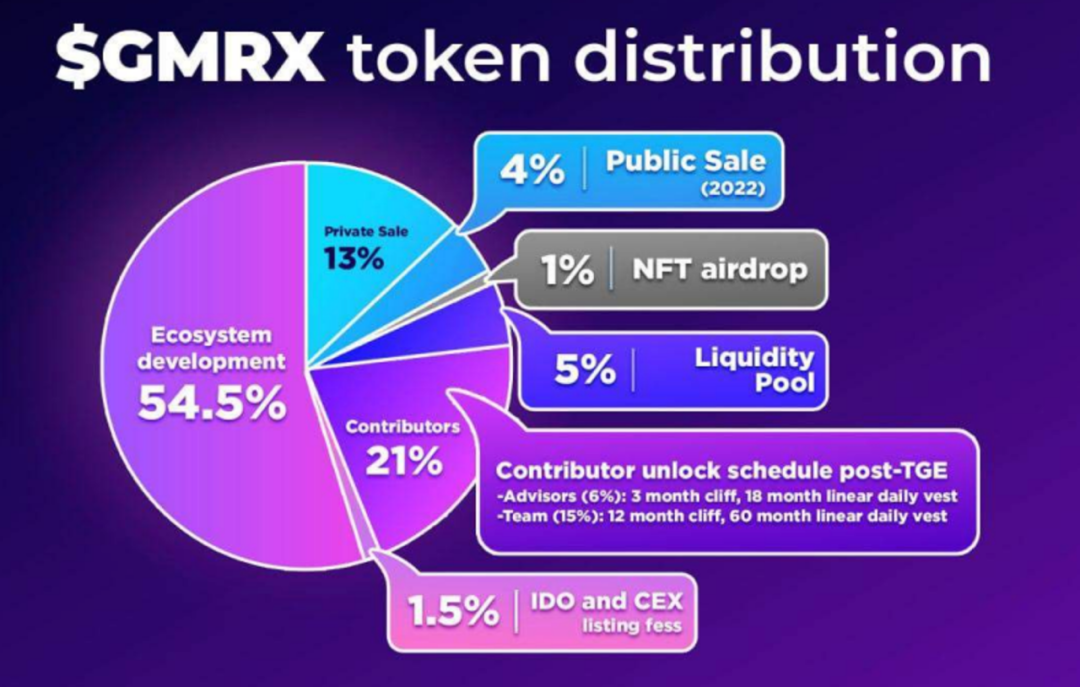
Regarding tokens, players can already start blind mining $GMRX by downloading and installing the Gaimin Windows application—the process is detailed in the official Q&A. The token has not yet launched but is expected to conduct an IDO fundraising round on Seedify around March 21–22. Token distribution is shown in the image below. Additionally, Gaimin has released a Gaimin Gladiators NFT; holders who stake their NFTs on the Gaimin platform will receive $GMRX airdrops.
Heurist
The third project is Heurist. Unlike the previous two, Heurist leans more toward a community-driven initiative. No official team background or funding information has been disclosed, so extra caution regarding security is advised. Heurist is an L2 blockchain built on ZK Stack, designed specifically for hosting and running AI models and inference tasks. Leveraging ZK Stack’s scalability, customizability, security, interoperability, and future-proof architecture, Heurist creates a blockchain optimized for AI model hosting and inference. It enables a decentralized AI infrastructure network where users can access AI inference services—such as text generation and image generation—on a pay-per-use basis. The goal is to allow anyone to contribute resources or models and benefit from an open AI infrastructure, enabling seamless integration of Heurist’s AI capabilities into any application. Retail users can participate in the network in various roles to earn or spend the native $HUE token—for example, miners earn fees and tokens by hosting AI models, model creators receive part of user payments, app developers take a percentage of service fees, and validator nodes are rewarded for verifying data integrity. Currently, Heurist remains at a very early stage. Unlike io.net and Gaimin, it does not function as a GPU rental platform but instead uses users’ GPU power to run specific LLM (large language model) workloads. Heurist is currently running an incentivized testnet, and those interested in accessing its AI model services can apply for API access.

Source: https://www.heurist.ai/
Author’s Viewpoint
For readers with idle GPU computing power and limited capital, I believe participating in GPU mining projects like these is an excellent opportunity. Most current crypto mining models are highly competitive—take Blast or EigenLayer, where staking ETH for potential airdrop rewards favors whales rather than small retail investors. In contrast, GPU mining resembles early proof-of-work chains, offering greater potential for smaller players to achieve outsized returns.
I anticipate that DePIN + AI compute-mining projects like these will only grow in number throughout this year, as everyone wants to ride the AI hype. Readers with modest capital should actively explore such GPU mining opportunities—they might just stumble upon an unexpected windfall.
Join TechFlow official community to stay tuned
Telegram:https://t.me/TechFlowDaily
X (Twitter):https://x.com/TechFlowPost
X (Twitter) EN:https://x.com/BlockFlow_News
 Dr.DODO

![In-depth Analysis of Trade[XYZ]: How Were 92 Markets and 98% HIP-3 Trading Volume Established?](https://upload.techflowpost.com/upload/images/20260716/20260716061117965147.jpeg?x-oss-process=image/resize,p_50/quality,q_80)