
Understanding Lava Network: Building an "Amazon for Crypto Data" – Why It Raised $15 Million in Seed Funding
TechFlow Selected TechFlow Selected
Understanding Lava Network: Building an "Amazon for Crypto Data" – Why It Raised $15 Million in Seed Funding
Lava Network acts as a dynamic P2P marketplace, connecting blockchains and dApps with node providers that offer RPC services and data.
 Navigating Web3 tides with focused insights
Author: Revelo Intel
Compiled by: TechFlow
Introduction
As $BTC approaches all-time highs—and (hopefully) drags altcoins along with it—it's easy to get caught up in price action. But one shouldn't forget the underlying technology and infrastructure that make it all possible. While new user-facing applications continue to emerge, infrastructure projects are also raising funds and executing plans, much like in the previous cycle.
This article focuses on Lava Network, a dynamic P2P marketplace that connects blockchains and dApps with node providers offering RPC services and data access. With the protocol’s recent funding round, upcoming mainnet launch, and points program, this modular data layer is heating up.
Lava Network
Lava Network is a modular data network that provides developers with scalable access to any rollup or blockchain. Recently, the term "modular" has been widely used—what does it mean in Lava’s context? It means enabling any blockchain to access its data network for scaling purposes. Lava is a network of node providers that offer access to data and RPC endpoints, making such resources more easily accessible across various blockchains.
The demand for such a service is already proven, as blockchains have adopted data availability (DA) solutions like EigenDA and Celestia. Lava Network removes intermediaries, allowing blockchains to achieve censorship resistance, transparency, and privacy. Using a decentralized network of nodes is often preferred over relying on a single node or juggling multiple node providers.
Yair Cleper, co-founder of Lava Network, uses Amazon's business model as an analogy to explain how Lava works.
-
Peer-to-peer SDK: Enables direct communication between dApps and multiple providers without intermediaries. Providers are rewarded based on reputation. In this model, dApps are customers, and P2P providers act as Amazon merchants. After transaction settlement, providers are rewarded for their contributions. There are already over 300 large and small providers on the Lava Network.
-
Specs: The “champions” in Lava define RPC APIs for specific chains. They publish these specs to the community, enabling node providers to spin up nodes accordingly. Specs can be seen as products offered directly by Amazon. Champions are those who create specs and define RPC standards for specific and emerging chains.
Just as Amazon hosts many vendors, trust is distributed across multiple providers, ensuring scalability and reliability for the Lava Network. Lava aims to become a one-stop platform for blockchain data access, eliminating the need for developers to source RPC providers individually or index data themselves. Lava enables rapid integration of new chains and APIs based on demand.
Lava Network is designed for flexibility, empowering developers to build wherever they choose. It operates a dynamic marketplace, adding more modules and chains as needed to maintain balance between supply and demand.
Origins of Lava Network
Lava Network was co-founded by Yair Cleper and Gil Binder from Israel, both of whom have experience building multiple startups in Web2. Initially, they aimed to create a multi-chain NFT marketplace but realized running their own nodes for each blockchain was resource-intensive. They then explored using node providers but found limited options for certain chains like Cosmos. Existing providers were either too restrictive or unreliable for their needs. They decided to focus solely on Ethereum, only to face API rate limits and the complexity of managing multiple providers.
Ultimately, the team recognized that the blockchain world is fragmented, complex, and slow when it comes to data access—exactly where Lava Network aims to step in. Lava seeks to simplify the multi-chain landscape by offering a one-stop solution for blockchain data access. With Lava Network, developers can seamlessly reach relevant providers without needing to know which backend provider is being used. The network is built to be modular and flexible, allowing easy integration of new chains as they gain popularity.
Recent Funding of Lava Network
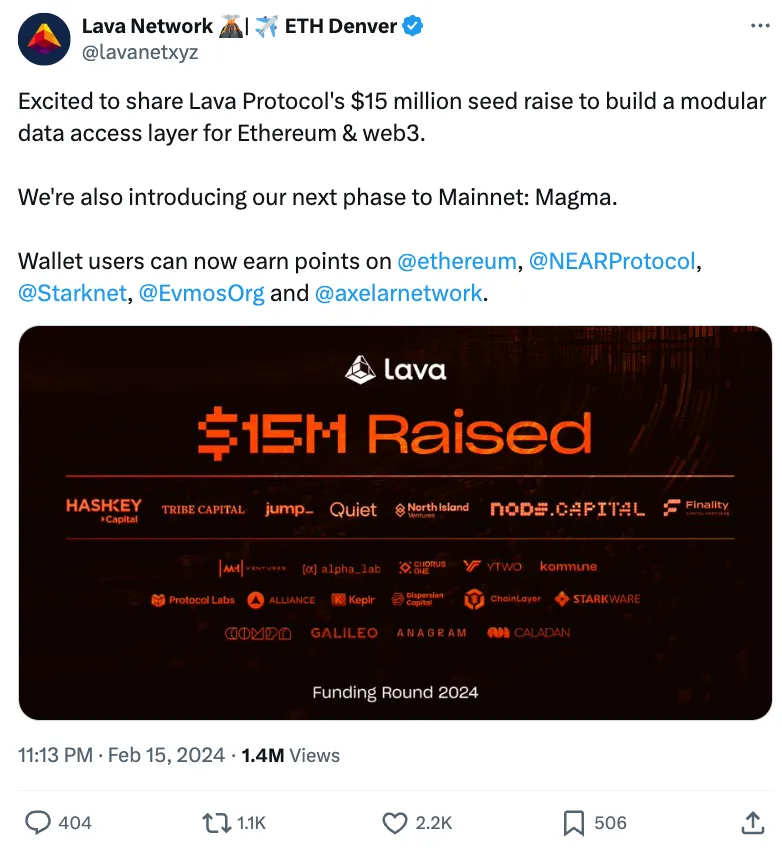
While funding amount alone doesn’t guarantee future success, it signals investor confidence in the product’s potential. Notably, Lava Network recently closed a $15 million seed round. The round was led by Jump Capital, with participation from Hashkey Capital, Tribe Capital, Alliance, Node, North Island, Quiet, Finality, and Dispersion Capital.
Blockdaemon—an investor in Alchemy—as well as ConsenSys (Infura) and QuickNode also joined the round. Validators, ecosystems, and founders from Cosmos, Polkadot, Filecoin, StarkWare, Axelar, NEAR, Celestia, and Celo participated as well.
Lava Network is clearly deeply integrated with the Cosmos community. Dozens of providers from diverse ecosystems have already joined Lava and receive monthly rewards.
Lava Network’s mainnet is scheduled to launch in 2024. Currently, the protocol is focused on expanding its product offerings to non-technical users. Although the product concept may initially be difficult to grasp, the team is actively building communities of non-technical users in regions such as South Korea, Turkey, and Africa. These communities play a crucial role in preparing guides and documentation ahead of the mainnet release.
Lava will soon introduce a points system to encourage participation from non-technical users. This system aims to allow every user to contribute valuable, universally accessible services while serving the public good, bringing real value to Web3.
Join TechFlow official community to stay tuned
Telegram:https://t.me/TechFlowDaily
X (Twitter):https://x.com/TechFlowPost
X (Twitter) EN:https://x.com/BlockFlow_News
 Revelo Intel