MT Capital Research Report: Decentralized Sequencer Sector Breakdown Study
TechFlow Selected TechFlow Selected
MT Capital Research Report: Decentralized Sequencer Sector Breakdown Study
The development of decentralized sequencers heralds potential advancements in blockchain technology regarding network security, censorship resistance, transaction efficiency and cost, as well as ecosystem diversity and interoperability.
 Navigating Web3 tides with focused insights
Author: Xinwei, Severin MT Capital
TL;DR
-
Decentralized sequencers represent an emerging technology aiming to optimize blockchain transaction ordering through decentralization, improving efficiency, reducing costs, and addressing MEV issues. This advancement reflects the blockchain sector’s ongoing pursuit of higher performance and stronger decentralization.
-
Metis’ “in-house” model and Espresso’s “outsourced module” approach illustrate two primary paths for building and maintaining decentralized sequencers. The former emphasizes internal management for security and stability, while the latter offers greater flexibility and openness, promoting technological universality and reducing operational burdens.
-
The evolution of decentralized sequencers signals potential progress in blockchain network security, censorship resistance, transaction efficiency, cost reduction, and ecosystem diversity and interoperability. Further innovations such as batch processing and state channels will enhance L2 platform performance, lower user costs, and foster a more open and interconnected decentralized ecosystem.
-
Despite challenges in technical implementation, network optimization, and governance design, decentralized sequencers play a crucial role in building a more efficient, secure, and open decentralized world. Future developments may focus on researching more efficient consensus mechanisms, scalable architectures, and user-friendly interfaces and tools to meet growing market demands and user expectations.
Introduction to Sequencers
As the name suggests, a sequencer orders originally unordered transaction data on a blockchain into organized blocks for execution. Every L1 blockchain has its own sequencing system, but for L2s, centralized sequencers have become an increasingly serious issue.
While not strictly necessary, L2s can choose to use the L1's sequencer. However, due to cost and speed considerations, operating their own sequencer allows L2s to offer users a cheaper and more convenient experience. An independent L2 sequencer can compress hundreds or thousands of L2 transactions into a single L1 transaction, significantly reducing gas fees. Additionally, users can enjoy fast soft confirmations from the L2 sequencer without being constrained by Ethereum’s transaction throughput. Therefore, running a dedicated sequencer is a natural choice for L2s seeking to improve user interaction.
Current State of Sequencers
Although running a proprietary sequencer enhances user experience, centralization of L2 sequencers has become an undeniable problem. Currently, Ethereum L2s hold over $22 billion in total value locked (TVL), with numerous new L2s emerging—yet nearly all rely on centralized sequencers, where a single operator controls all transaction ordering. Centralized sequencers face multiple issues: theoretically, a single sequencer could exclude user transactions, extract unlimited MEV, suffer from censorship vulnerabilities, and pose single points of failure.
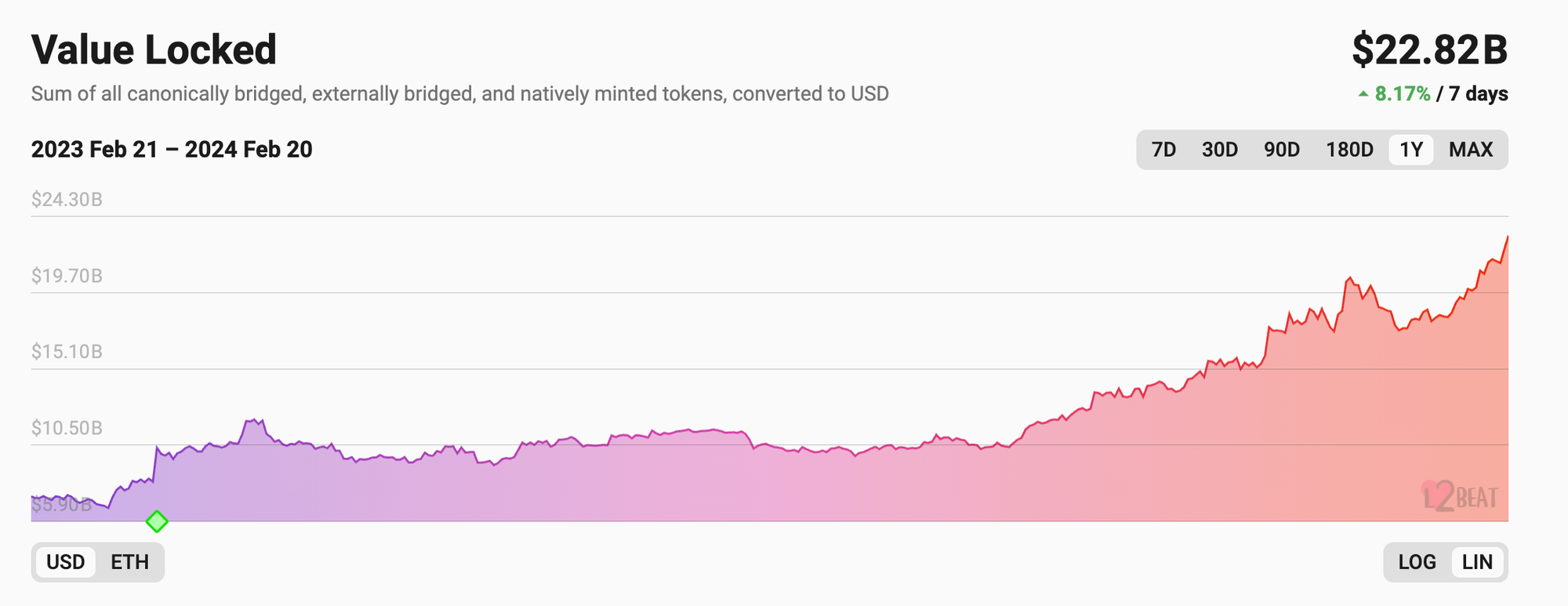
source:https://l2beat.com/scaling/summary
In tackling the complex challenge of MEV, rollups must delicately balance user protection with profitability. This involves preventing harmful MEV practices like frontrunning and sandwich attacks, while also efficiently utilizing block space for revenue generation. Traditionally, rollups have relied on single-operator models using First-In-First-Out (FIFO) ordering to shield users from MEV, but this approach may miss out on revenue opportunities from block space and overlooks economic incentives critical to rollup sustainability and growth. Ensuring strict FIFO compliance and transparent block ordering introduces additional operational complexity. Moreover, leveraging underlying block space for income raises trust concerns—users must trust operators won’t exploit them via sandwich attacks, which could erode transaction integrity and user confidence.
Shared sequencers offer an innovative solution to MEV by introducing a more secure and fair transaction ordering mechanism within blockchain networks, especially beneficial for Ethereum layer-2 solutions like rollups. By dividing rollup block space into a top section reserved for user transactions and a bottom section available for MEV extraction by builders, shared sequencers effectively balance stakeholder interests. Using Practical Verifiable Delay Encryption (PVDE), shared sequencers ensure user transactions remain invisible to malicious actors, thereby preventing frontrunning and sandwich attacks. At the same time, allowing beneficial MEV activities in the lower block space enables rollups to generate revenue while preserving network integrity and user trust. This mechanism not only improves transaction security and fairness but also supports sustainable blockchain development through novel revenue streams. In short, shared sequencers bring positive change to the blockchain ecosystem by uniquely handling MEV, achieving a balance between protecting users and fostering healthy network growth.
Ultimately, the core issue with centralized sequencers lies in excessive power and risk concentration within a single node. Decentralized sequencers composed of multiple nodes effectively address these problems. They ensure robust and effective L2 sequencing while offering additional benefits. For example, Metis-style decentralized sequencers further empower token holders through revenue sharing, while shared sequencers allow L2s to avoid building their own sequencing infrastructure and enable seamless interoperability among L2s using the same service. Long-term trends toward modularity and the rise of L2s will inevitably drive sequencer decentralization, leaving significant room for market expansion in decentralized sequencers.
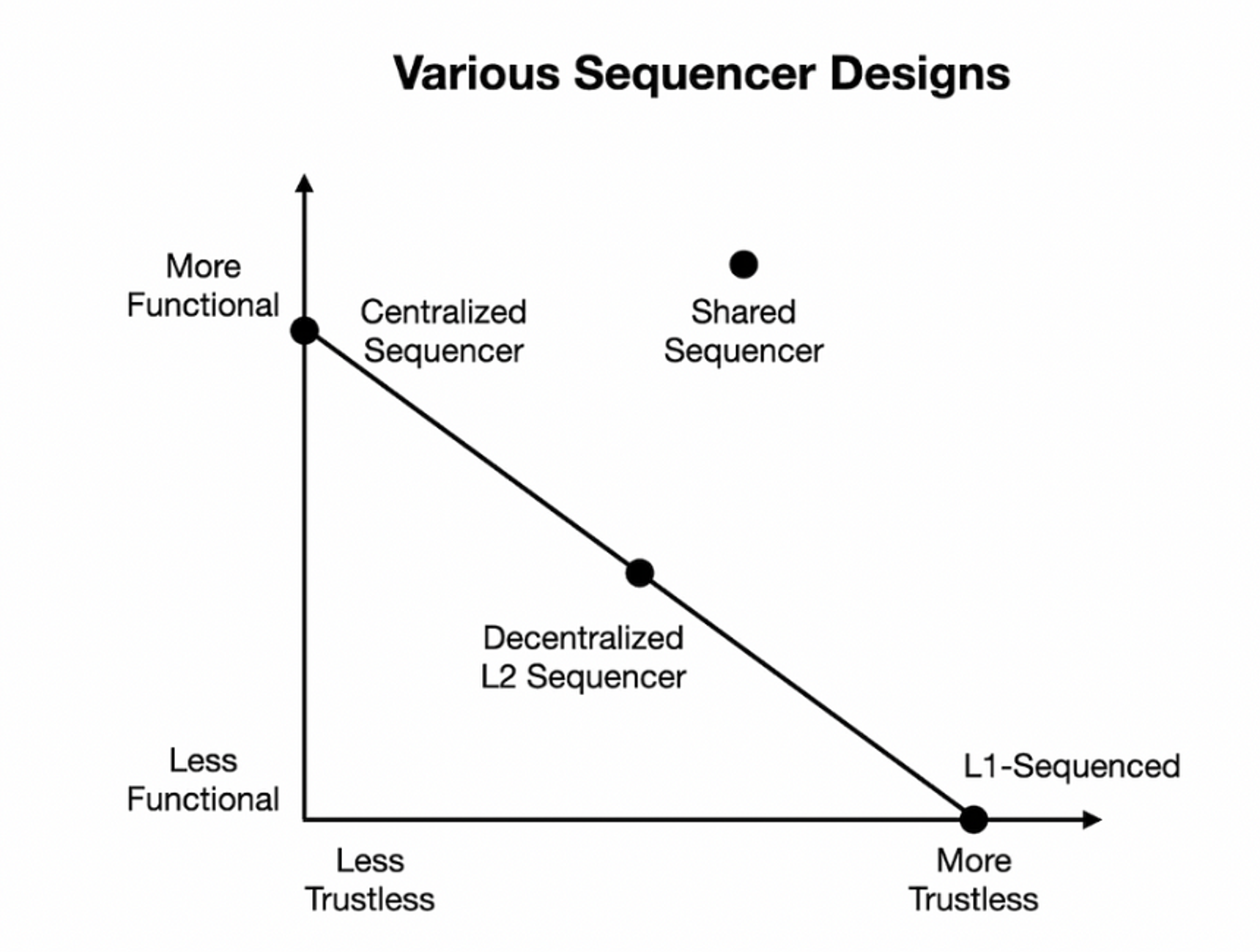
source:https://joncharbonneau.substack.com/p/rollups-arent-real
Decentralized Sequencer Projects
Metis
Elena Sinelnikova, co-founder and CEO of Metis, previously focused on blockchain education and advocacy and co-founded CryptoChicks, an educational nonprofit that has grown into the world’s largest women-led blockchain community with members across 56 countries. Kevin Liu, another co-founder and product lead at Metis, is also the founder and CEO of ZKM and an active researcher in tokenomics, DAOs, DeFi, and blockchain governance.
Metis was one of the first Ethereum L2s to propose and test a decentralized sequencer.
Metis replaced the traditional single sequencer node with a pool of multiple nodes, achieving decentralization through a randomized rotation mechanism.
First, Metis includes an Admin role responsible for managing the decentralized sequencer system, including adding qualified nodes to the Sequencer List whitelist, setting individual node staking caps, and controlling block reward emission rates.
Next, Metis introduced a staking mechanism: any node that stakes 20,000 METIS tokens can join the sequencer pool. Nodes in the pool gain access to the mempool and eligible nodes are authorized to bundle transactions.
Second, Metis implements a PoS-based node rotation mechanism. Block producers are randomly selected based on each node’s stake amount and hash randomness.
Then, a transaction batch must receive signatures from at least two-thirds of the sequencer nodes to be considered valid and submitted to L1. The private keys used for signing are managed by Metis’ PoS consensus layer, which generates, shards, and distributes multi-signature keys when nodes join or leave the network.
Finally, to prevent malicious behavior, Metis introduces verifiers who perform random sampling checks on blocks to verify correct transaction ordering. Malicious nodes face slashing penalties on their staked funds.
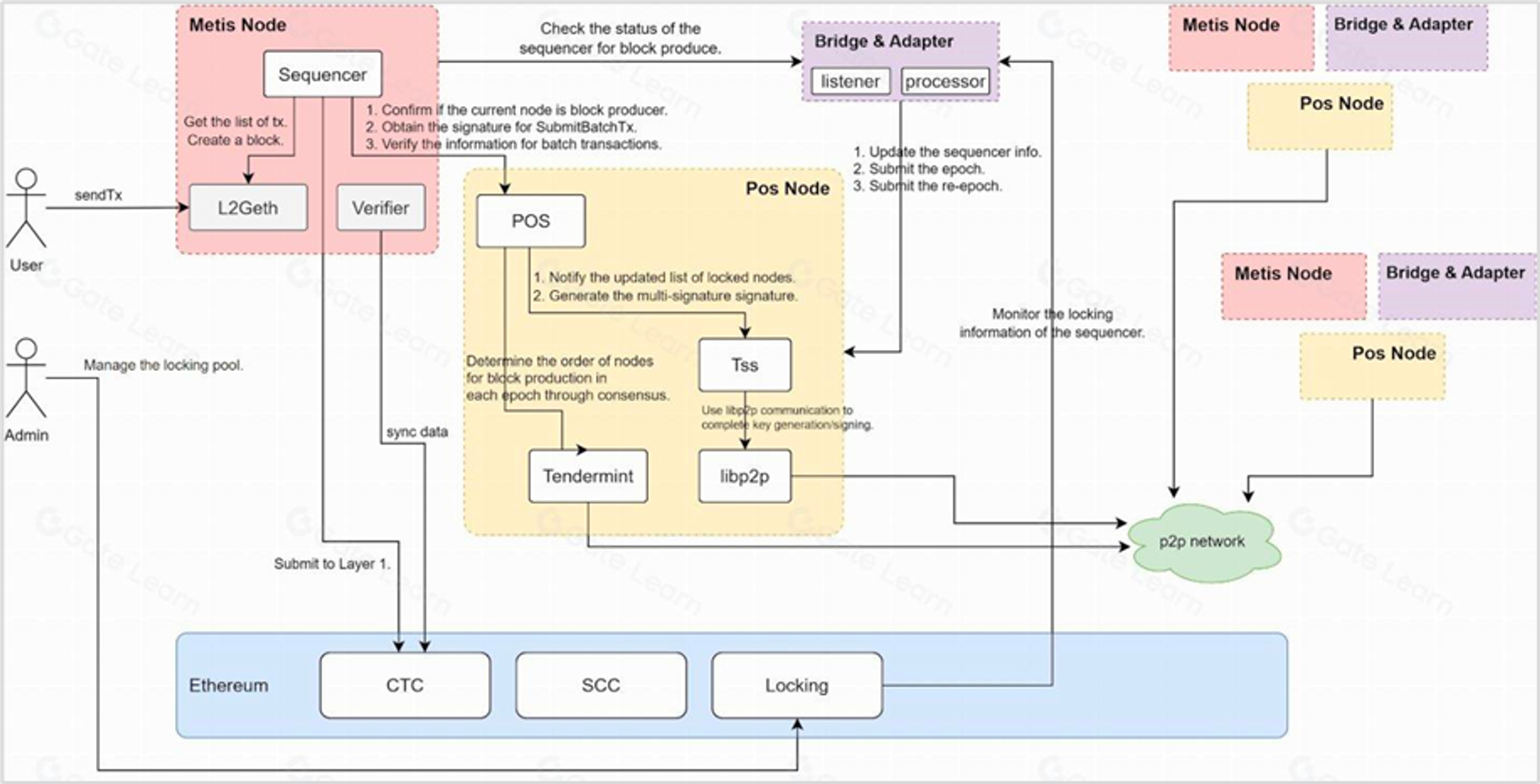
source:https://www.metis.io/decentralized-sequencer
Through this process, Metis has built a decentralized sequencer architecture based on a PoS consensus network. By requiring only 20,000 METIS for node participation, it ensures greater node diversity, mitigating risks of single-point failures, manipulation, and malicious MEV extraction. The node rotation and multi-signature validation mechanisms ensure fair selection and reduce collusion risks, while verifier sampling and slashing further minimize malicious behavior.
To further incentivize participation, Metis introduced additional rewards. Successful block-producing sequencer nodes earn both gas revenue and additional METIS token emissions. This incentive structure could create a positive flywheel effect: increased network activity boosts sequencer income, attracting more users to stake METIS and become nodes. Reduced circulating supply and rising demand increase METIS’ market price, enhancing stakers’ asset value and rewards, thus reinforcing node attraction and creating a self-sustaining cycle.
Metis’ PoS-based decentralized sequencer represents the first attempt by an L2 to implement decentralized sequencing. Its successful deployment may inspire other L2s to pursue sequencer decentralization.
Espresso Systems
Espresso boasts a strong team: co-founders Charles Lu and Ben Fisch are both Ph.D. candidates in Computer Science at Stanford University, and team members have worked at leading Web2 and Web3 firms such as Binance Labs, Coinbase, and Google. Espresso previously raised $23 million in funding from top-tier VCs including Sequoia Capital, Coinbase Ventures, Polychain, and Robot Ventures.
Positioned as middleware between L1 and L2, Espresso decouples sequencing from execution, aiming to become a decentralized shared sequencer network providing sequencing services to various L2s. Similar to modular DA outsourcing, Espresso offers transaction data sequencing as an outsourced service. Like DA layers, Espresso’s sequencing service is chain-agnostic and VM-agnostic, meaning any type of L2 can integrate its service.
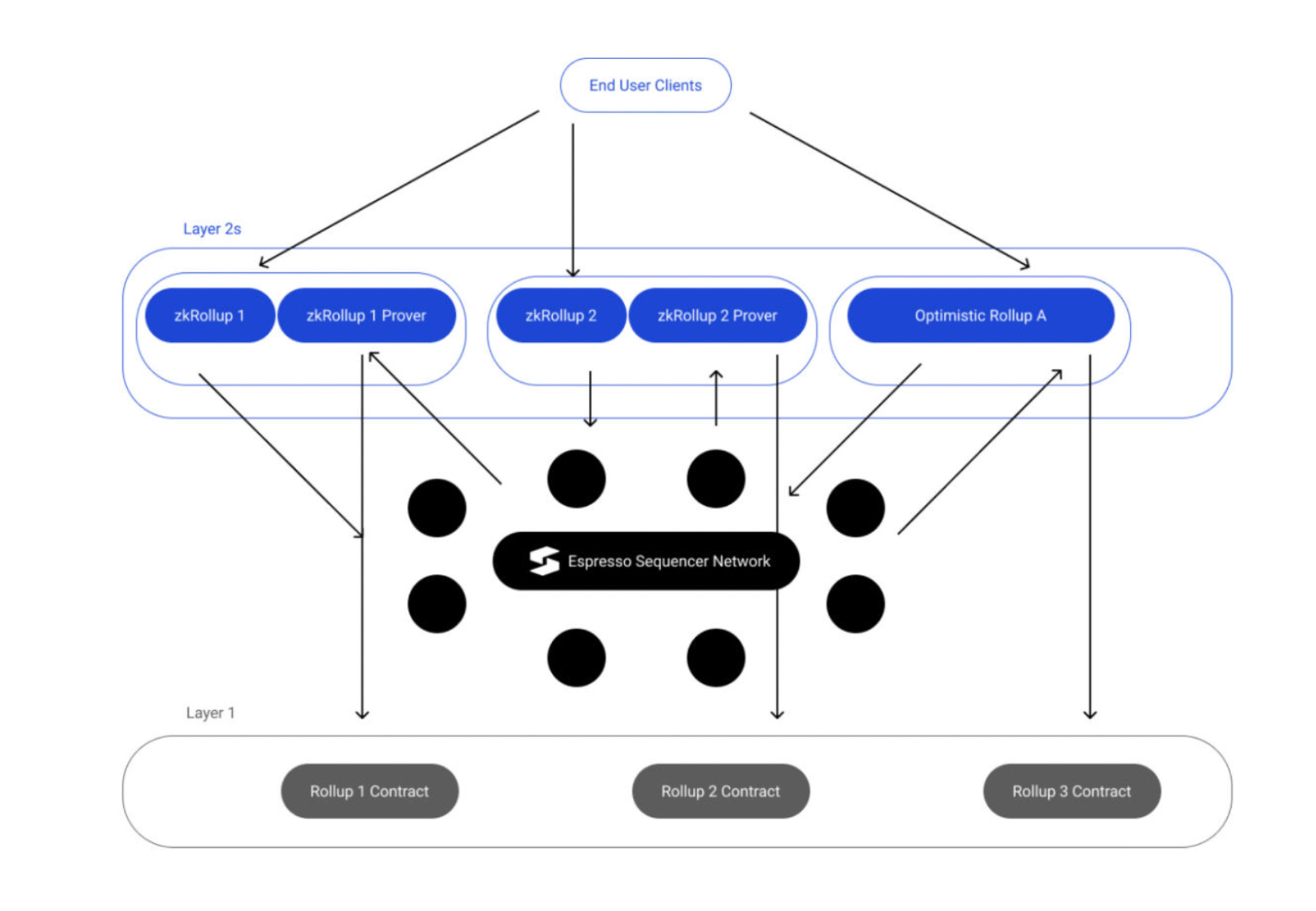
source:https://hackmd.io/@EspressoSystems/EspressoSequencer
Espresso’s core idea is to provide modular sequencer middleware. After users submit transactions via a client, the data along with the L2 identifier is sent to Espresso’s sequencer network. Nodes in the Espresso network (part of the Espresso Hotshot PoS system) order the transactions and broadcast the ordered batches to subscribers (L2 nodes). The L2 then executes the finalized transaction data. Simultaneously, Espresso submits a block commitment containing the transactions to the L1 sequencer contract. Finally, the L2 sends its new state to L1, where the Rollup contract uses Espresso’s block commitment to validate the state update, ensuring correct execution.
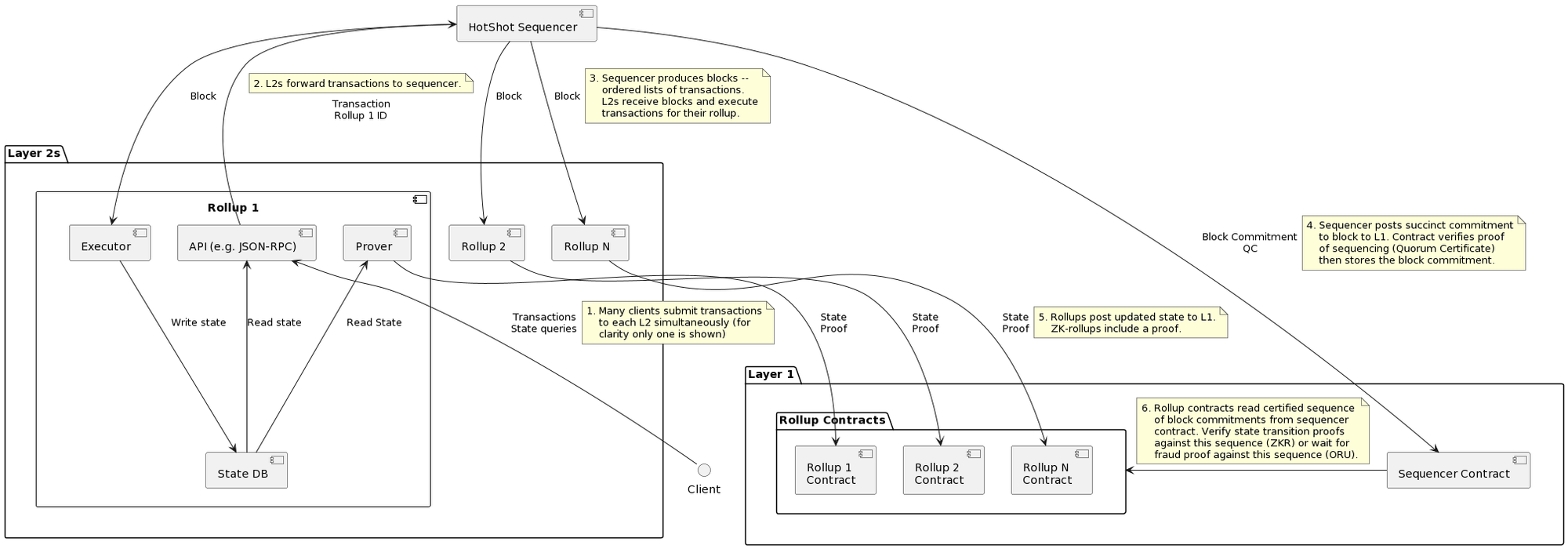
source:https://docs.espressosys.com/sequencer/espresso-sequencer-architecture/system-overview
In the future, Espresso plans to leverage EigenLayer to reuse Ethereum’s existing validator set for sequencing, achieving even higher security.
Overall, Espresso’s decentralized sequencer aligns closely with the concept of modular blockchains. Through sequencing outsourcing and its own PoS network, it creates a decentralized middleware layer between L1 and L2. Its universal service makes it a viable shared sequencer network—any L2 can adopt it. Furthermore, L2s using Espresso as a common sequencer provider gain seamless interoperability.
Astria
Josh Bowen, CEO of Astria, is the main driving force behind the project. Previously working at Edge & Node (behind The Graph) and Celestia Labs, his background gives him deep insight into modularity and decentralization. He has frequently shared valuable perspectives on how shared sequencers help maintain speed and decentralization in the blockchain space. Bowen emphasizes that most application-specific rollups may not need their own sequencers, and cultivating a more decentralized, modular shared sequencer network better serves the goal of building efficient and decentralized blockchain systems. His vision has gained support from institutions like Maven 11, 1kx, Delphi Ventures, and Figment Capital, securing $5.5 million in seed funding.
Like Espresso, Astria aims to build a decentralized shared sequencer network. Astria’s shared sequencer functions as a middleware blockchain with its own decentralized sequencer set, capable of accepting transaction data from multiple L2s. Similarly, Astria supports sequencing requests from any type of L2. Moreover, L2s using Astria benefit from atomic-level interoperability.
Astria’s sequencing workflow is illustrated below.
-
After users submit transactions, the L2 forwards the data to Astria via an API.
-
Astria’s shared sequencer reaches consensus on transaction ordering via its CometBFT PoS network and bundles them into blocks. The network uses CometBFT as its consensus algorithm. During consensus, proposers determine block contents and create commitments specific to each rollup. Other nodes validate and finalize the block.
-
Once ordered, Astria’s Conductor parses the relevant data for each rollup, verifying finality, completeness, correctness, and proper ordering. After verification, Conductor converts the data into transaction lists and passes them to the rollup’s execution engine.
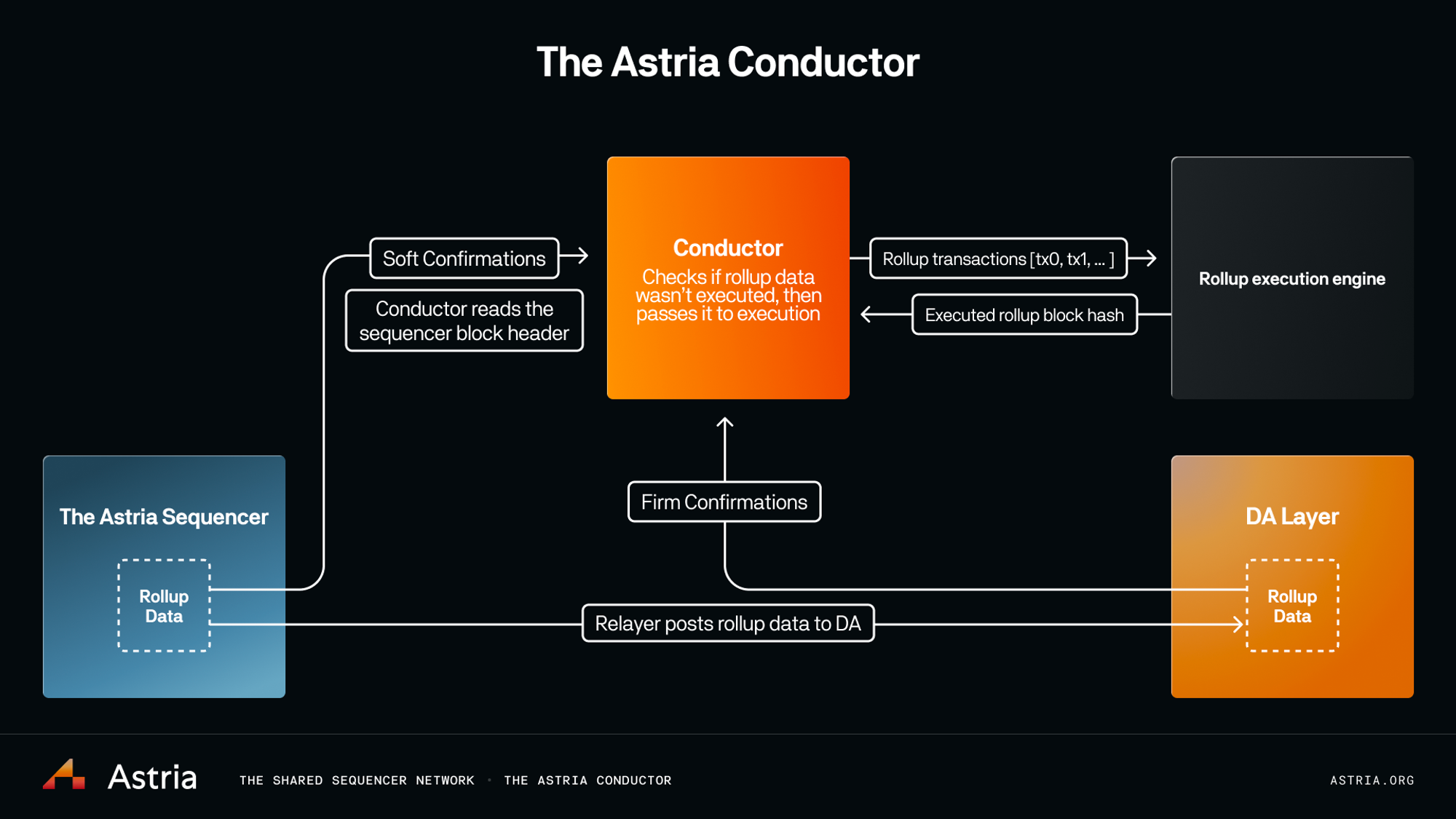
source:https://docs.astria.org/docs/overview/why-decentralized-sequencers/
-
L2s seeking faster user experiences can read soft-commit blocks from Astria for quick confirmation. Alternatively, they can retrieve hard-commit blocks written by Astria via the DA layer.
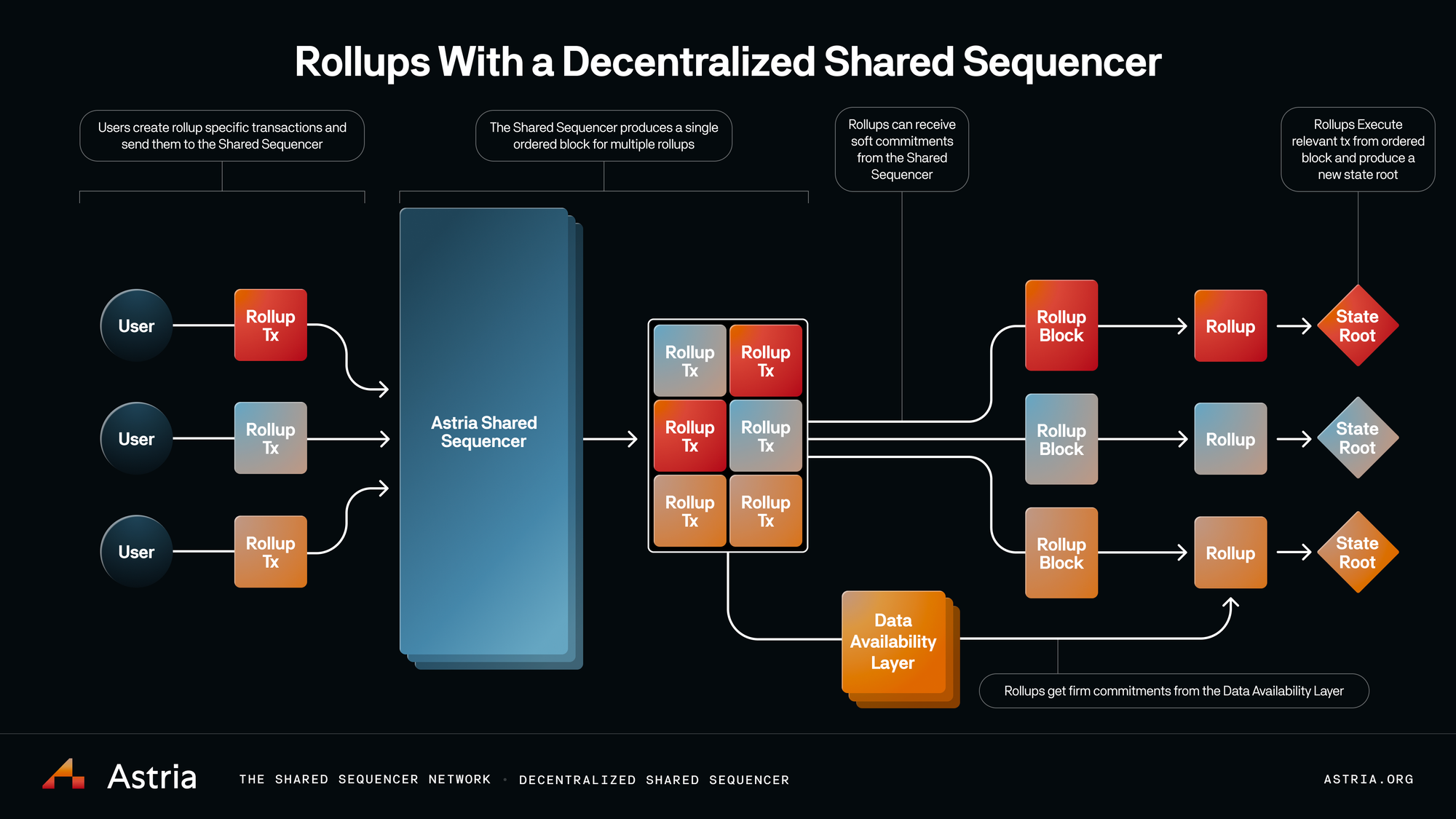
source:https://docs.astria.org/docs/overview/why-decentralized-sequencers/
Astria’s decentralized sequencer network closely resembles Espresso’s solution—both aim to provide decoupled, decentralized sequencing for any L2. Outsourcing sequencing simplifies L2 development and reduces operational costs while enabling atomic composability between L2s.
Radius
Radius focuses on developing a trustless shared sequencing layer to tackle harmful MEV extraction and censorship in blockchain. It has successfully raised $1.7 million in pre-seed funding from investors including Hashed, Superscrypt, Lambdaclass (Ergodic Fund), and Crypto.com.
Radius aims to build a trustless, censorship-resistant shared sequencer network. Compared to Espresso and Astria, Radius’ key differentiator is its ability to significantly reduce harmful MEV through encrypted mempools.
Radius’ overall architecture mirrors mainstream shared sequencer designs. Users submit encrypted transactions and proofs via dApps to the sequencing layer. Sequencers validate the data and proofs before bundling and ordering transactions. Rollups then receive the ordered blocks, execute transactions sequentially, and submit updated states and proofs to the settlement layer.
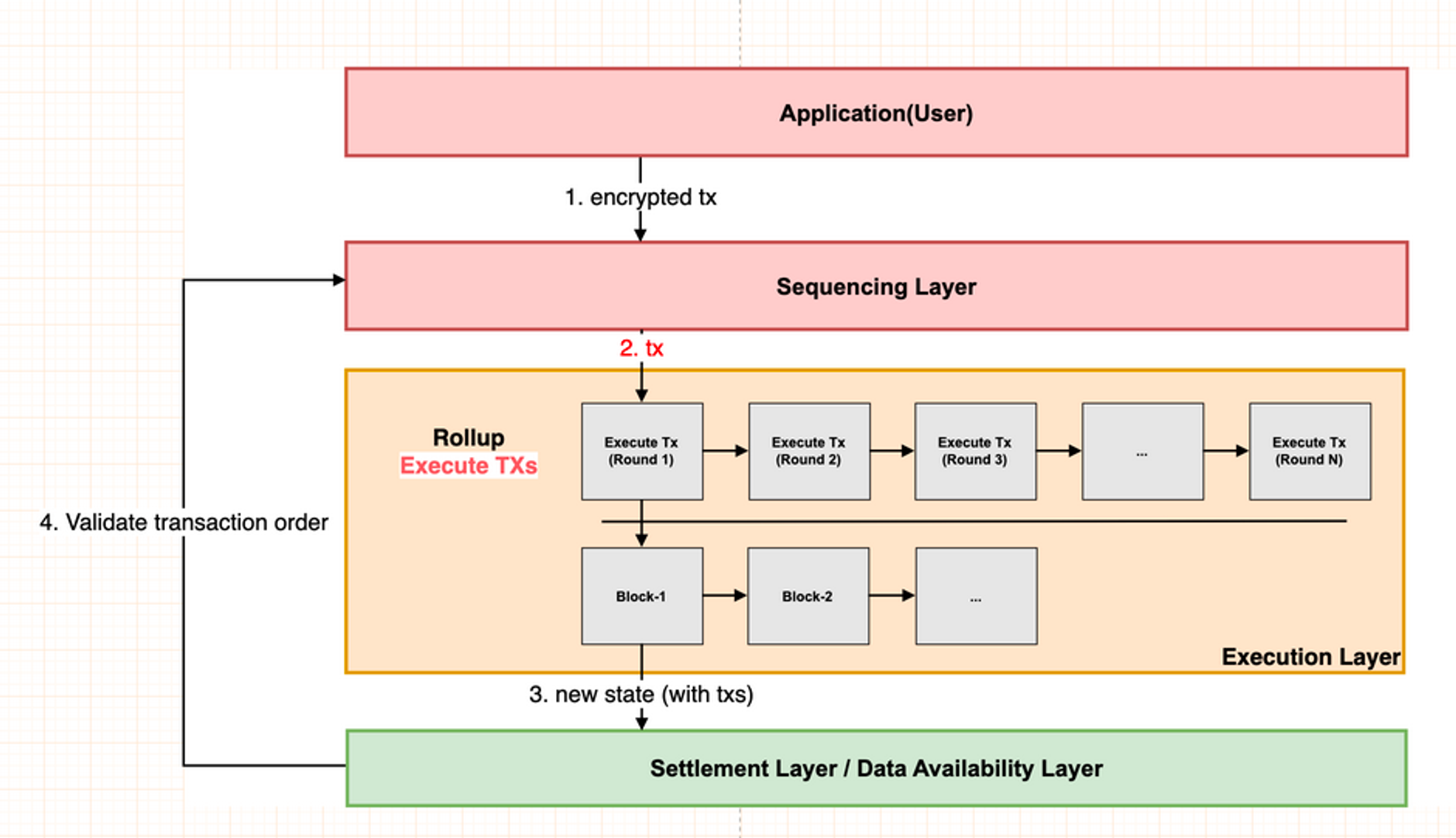
source:https://docs.theradius.xyz/developer/architecture
Notably, Radius employs an encrypted mempool to prevent harmful MEV extraction. User transactions are encrypted before submission to the sequencer network. Since sequencers lack decryption keys, they cannot inspect transaction details and thus cannot manipulate ordering or insert trades for MEV gain.
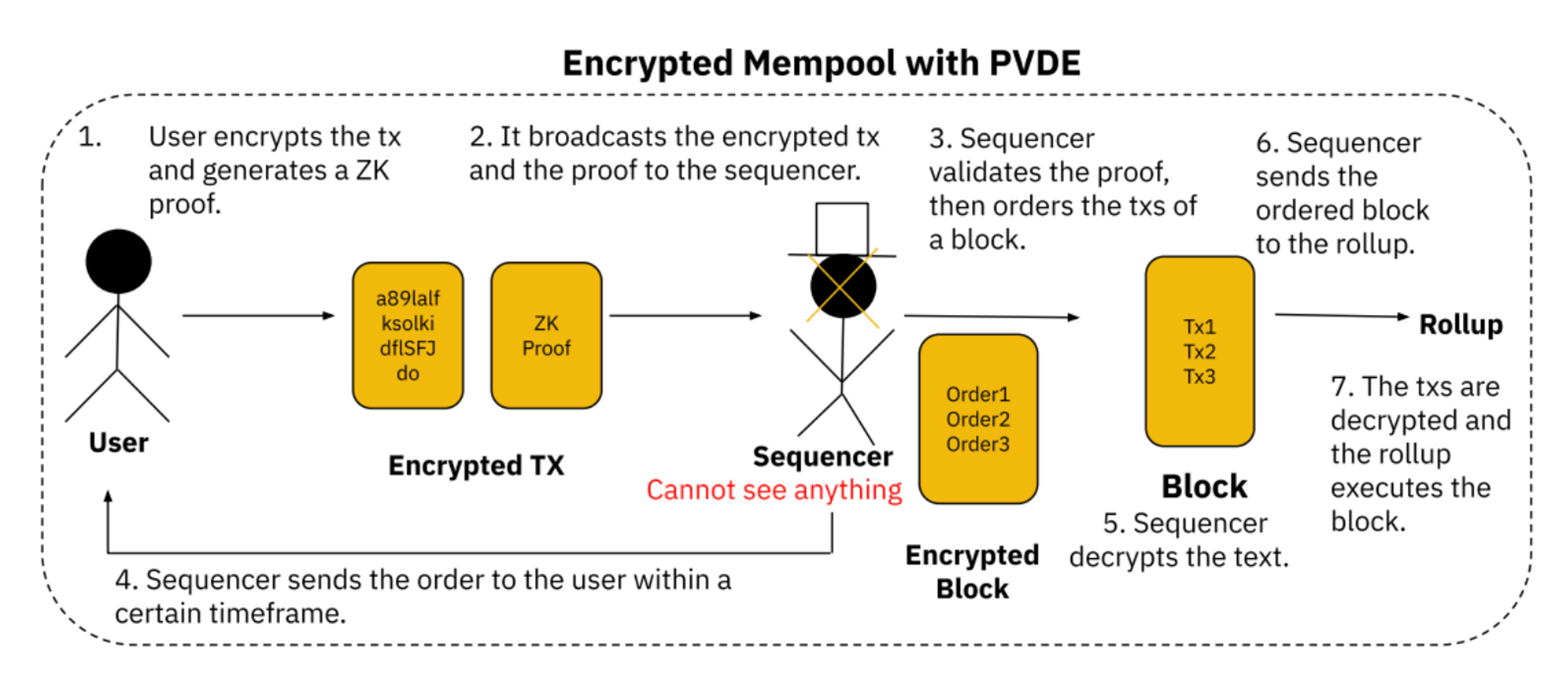
Radius divides block space into top and bottom sections. The top space is reserved for user transactions, protected via encrypted mempool to prevent harmful MEV. The bottom space introduces an auction-based open market where traders can create cross-rollup benign MEV bundles—such as arbitrage and liquidations. Traders submit bundles and bids to the sequencer, which selects the highest bidder to include in the block, maximizing rollup profits and fostering a healthy MEV marketplace.
Compared to Espresso and Astria, Radius offers two key advantages: first, by combining encrypted mempools with split block space, it effectively eliminates harmful MEV while encouraging profitable, benign MEV competition. Second, because no single sequencer node can exploit MEV, there’s less need for complex consensus mechanisms to guarantee ordering correctness—enabling faster finality and greater scalability.
SUAVE (Single Unifying Auction for Value Expression)
The SUAVE proposal comes from Flashbots, a pioneering team dedicated to solving MEV issues in the Ethereum ecosystem. Composed of experts in computer science, mathematics, psychology, and economics, the team currently consists of 28 members with diverse technical skills spanning Python, blockchain, machine learning, and C programming.
Flashbots’ founding team includes Philip Daian and Stephane Gosselin, who left in October 2022 due to disagreements over censorship policies. Another co-founder and top strategist, Alex Obadia, departed in June 2023 for personal reasons. Core member Andrew Miller, known for his research breaking Intel SGX encryption, now leads research on trusted execution environments and SUAVE. He is taking a leave from his assistant professorship at the University of Illinois, where his academic work focuses on electrical and computer engineering. Hasu, Flashbots’ strategy lead, exerts broad influence in the blockchain space, serving as strategic advisor to Lido and research collaborator at Paradigm. Through writing, social media, and podcasts, Hasu actively promotes industry development and education.
SUAVE is a unique decentralized builder and sequencer, distinct from other shared or sequencing layer designs. It aims to provide transaction ordering services for Ethereum and other blockchains but does not embed directly into any chain’s protocol. Users send transactions to SUAVE’s encrypted mempool, and SUAVE’s executor network produces full or partial blocks for chains. These blocks compete with those generated by traditional centralized Ethereum builders and are ultimately selected by Ethereum proposers.
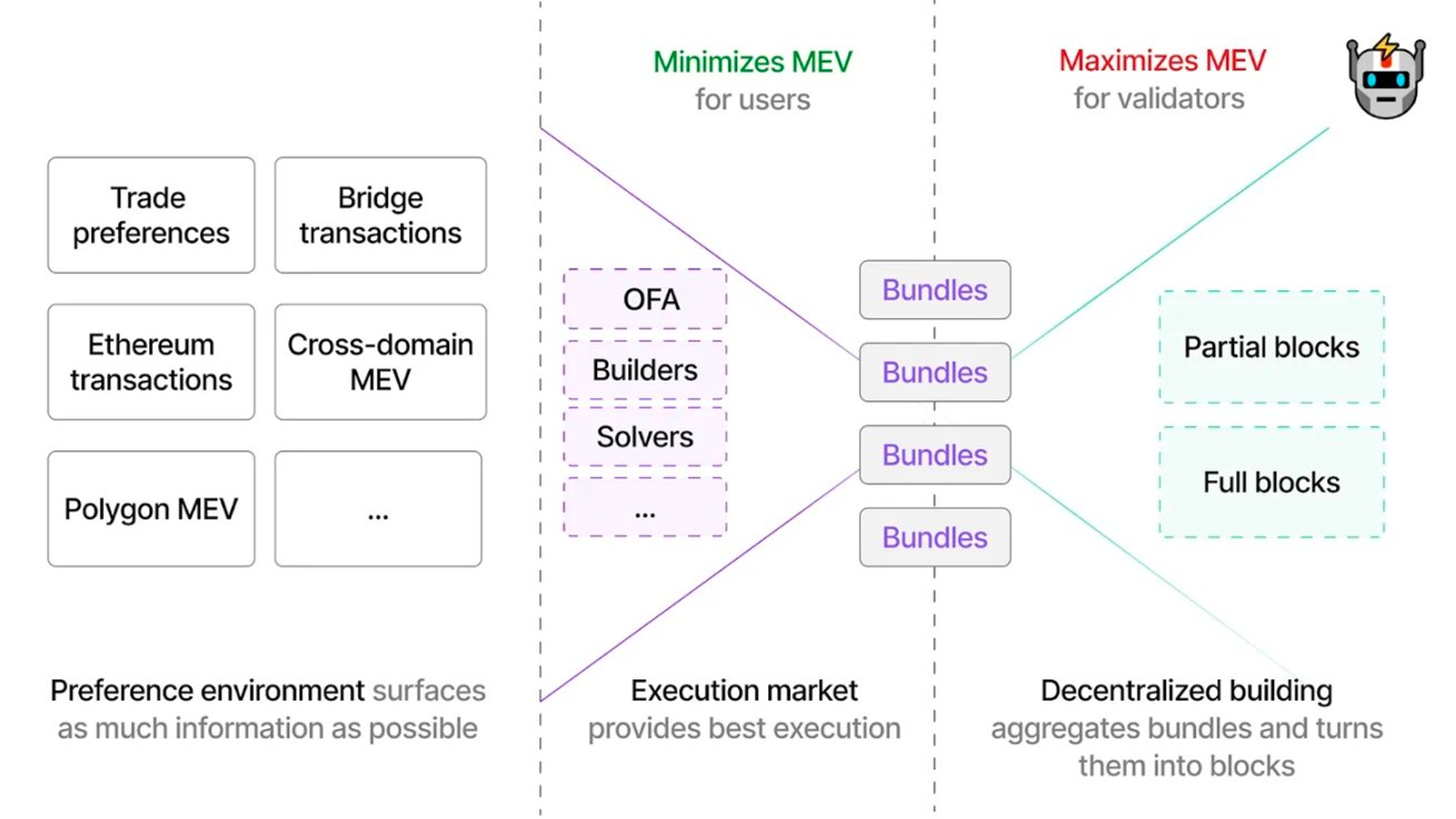
Source:https://foresightnews.pro/article/detail/28930
SUAVE does not replace rollup block selection mechanisms nor alter chain fork-choice rules. Instead, it focuses on delivering profit-maximizing transaction ordering for any chain, typically maintaining full state to simulate outcomes and craft optimal sequences. This design allows SUAVE to collaborate with shared sequencers or MEV-aware builders, enabling services like atomic cross-chain arbitrage—ensuring multiple transactions either execute atomically or are canceled together.
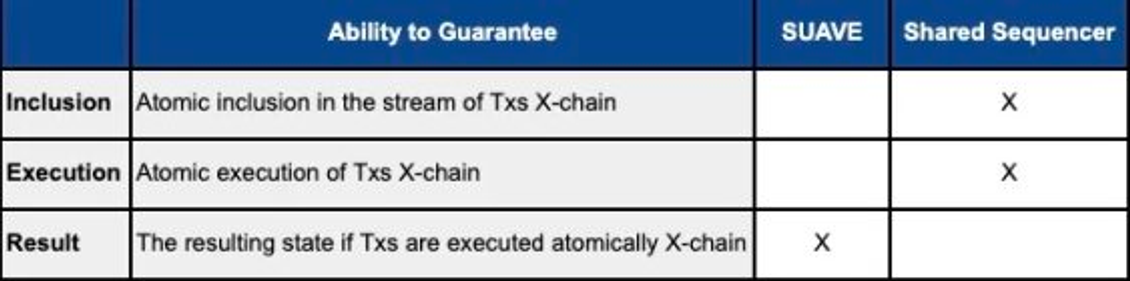
Source:https://foresightnews.pro/article/detail/28930
Long term, rollups may be preferable. Rollups inherit security, censorship resistance, and liveness from L1, whereas SUAVE—a chain specialized in transaction ordering—is not ideal for general users. Its goal is to minimize the need for users to bridge funds to SUAVE, instead focusing on providing an operational platform for searchers and builders. SUAVE aims to deliver optimal transaction ordering rather than fully replacing existing mechanisms. With full-state awareness, it can simulate and construct the best possible transaction sequences.
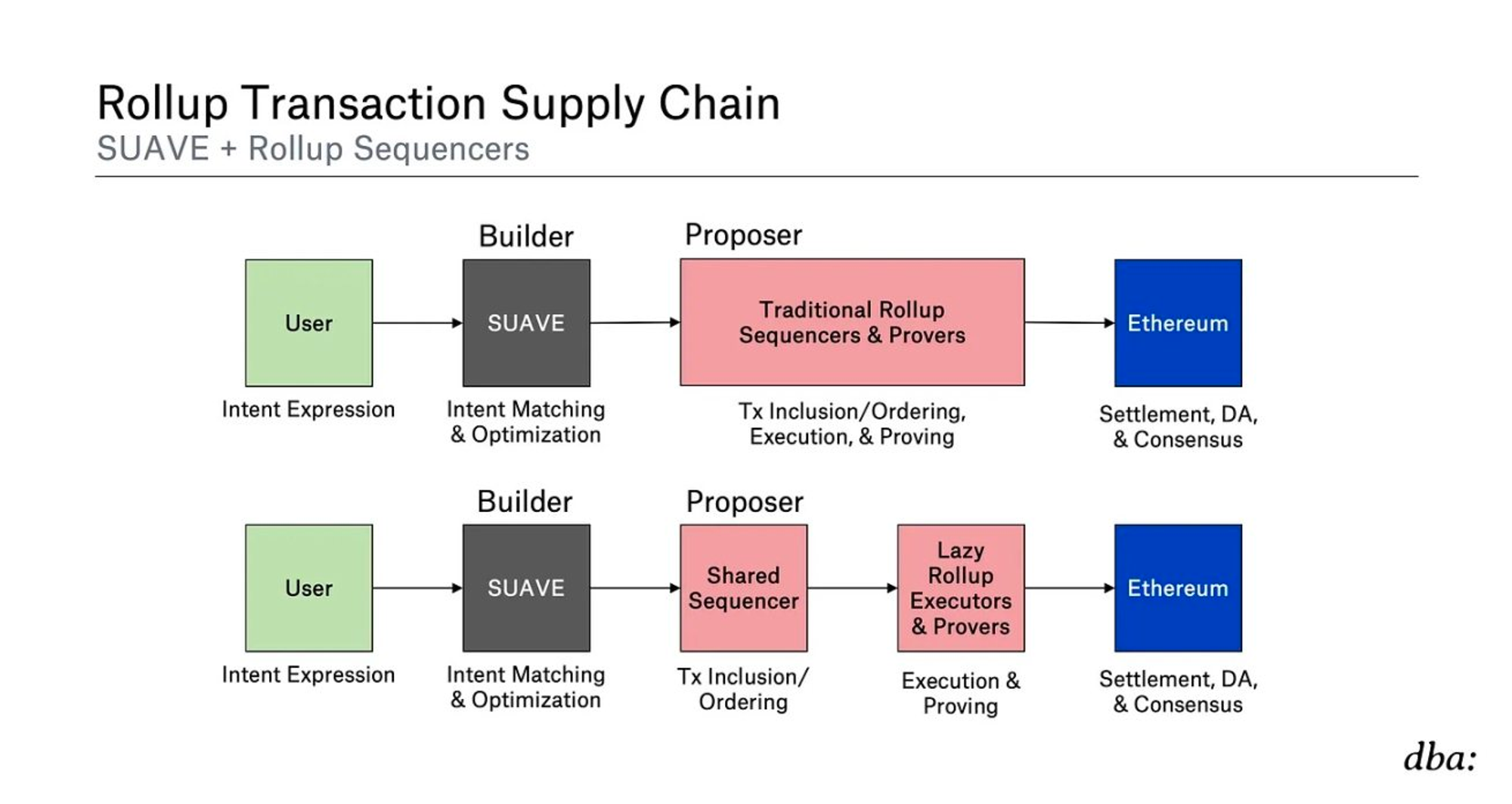
Source:https://foresightnews.pro/article/detail/28930
Regarding MEV mitigation, several mechanisms aim to reduce negative externalities related to transaction ordering and inclusion. For instance, Arbitrum’s time boost mechanism and Flashbots’ proposed FBA-FCFS model both aim to reduce latency competition by allowing users to express preferences for faster inclusion via fee payments.
Arbitrum’s Time Boost Mechanism
The time boost mechanism is a security measure designed to defend against a specific attack known as a "time bandit attack." In such an attack, an adversary attempts to reorganize already confirmed blocks by exploiting previously unknown information (e.g., knowledge of a transaction after the fact) for profit.
Arbitrum defends against this through a unique challenge mechanism: anyone detecting a time bandit attempt can submit a proof of the malicious behavior. This economically disincentivizes attackers by offsetting potential gains, thereby safeguarding network security and fairness.
Flashbots’ FBA-FCFS Model
The FBA-FCFS (First Bid Auction - First Come, First Served) model is a transaction ordering mechanism proposed by Flashbots to address traditional transaction selection and sequencing challenges, particularly in MEV-heavy environments.
- The First Bid Auction (FBA) component allows traders to prioritize their transactions by bidding (typically extra fees paid to miners), similar to an auction where the highest bidder wins priority.
- First Come, First Served (FCFS) ensures that under certain conditions, transactions are processed in submission order, preserving fairness and transparency.
The FBA-FCFS model seeks to balance fairness and efficiency—optimizing resource use through bidding while preventing exclusion of users with limited financial means.
Each mechanism has trade-offs, but they share the common goal of improving transaction processing efficiency and fairness.
By collaborating with rollups and other MEV-aware builders, SUAVE aims to enhance economic security and efficiency in cross-chain operations, while exploring new economic security models and MEV mitigation techniques to improve decentralization in blockchain transaction ordering and execution.
Summary and Outlook
Projects like Metis, Astria, Espresso, Radius, and SUAVE differ in focus but collectively aim to enhance blockchain scalability and transaction efficiency, solve MEV issues, and strengthen decentralization and interoperability.
Metis focuses on optimizing Ethereum’s transaction processing through its Layer 2 solution, lowering costs and improving efficiency to provide a more accessible development platform for developers and enterprises. Astria and Espresso introduce the concept of decentralized shared sequencer networks, supporting transaction processing for multiple L2s—simplifying development and operations while enhancing composability and interoperability. Radius leverages encrypted mempools and block space partitioning to build a trustless, censorship-resistant network that reduces harmful MEV impacts while improving transaction privacy and security. SUAVE addresses MEV’s impact on transaction fairness and transparency through decentralized sequencing, demonstrating a commitment to a more equitable trading environment.
In exploring directions for decentralized sequencers, Metis and Espresso exemplify two contrasting models: the “in-house” model versus the “outsourced module” approach. These reflect differing philosophies on how to build and maintain decentralized sequencers.
Metis’ “in-house” model emphasizes internal control over its decentralized sequencer network to ensure security and stability. This allows direct oversight of nodes and maintains a healthy network via staking and incentives. While enhancing security and reliability, this model places heavy operational responsibilities and resource demands on Metis, potentially limiting flexibility and scalability.
In contrast, Espresso’s “outsourced module” approach offers a more flexible and open solution. By allowing any blockchain project to plug into its service, Espresso promotes technological versatility and reduces individual project overhead. The challenge lies in potential trust dependencies—projects must trust Espresso to handle transactions fairly and securely. Additionally, any disruption or attack on Espresso could impact a wide range of dependent projects.
Metis’ “in-house” and Espresso’s “outsourced” models represent two major paths in decentralized sequencer development. Each has unique strengths and challenges, with the optimal choice depending on a project’s specific needs, resources, and priorities regarding decentralization and security.
The future of decentralized sequencers holds immense potential for advancing blockchain technology—improving network security, censorship resistance, transaction efficiency, cost reduction, and ecosystem diversity and interoperability. As the technology evolves, we can expect safer, more efficient blockchain networks where decentralized sequencing effectively prevents single points of failure and malicious attacks, protecting user assets and data. Innovations like batch processing and state channels will further boost L2 throughput, reduce transaction costs, and enable high-speed, low-latency confirmations—all without compromising security or decentralization.
Moreover, widespread adoption of decentralized sequencers is expected to foster a more diverse and interconnected blockchain ecosystem. Shared sequencer networks like Espresso and Astria will not only serve multiple L2 platforms but also facilitate seamless data and asset flows across chains, contributing to a more open and unified decentralized world. Innovative incentive and token economic models will fairly reward participants, enable decentralized governance and revenue distribution, attract broader participation, and energize communities.
Despite their promising outlook, decentralized sequencers still face challenges in technical implementation, network optimization, and governance design. Future efforts may therefore focus on developing more efficient consensus algorithms, scalable architectures, and user-friendly interfaces and tools to meet growing market demands and user expectations. In sum, as a key driver of blockchain innovation, decentralized sequencers will play a vital role in shaping a more efficient, secure, and open decentralized future.
References
-
https://www.gate.io/learn/articles/the-battle-for-decentralized-sequencers/1049
-
https://ethresear.ch/t/shared-sequencer-for-mev-protection-and-profitable-marketplace/15313
MT Capital
MT Capital is headquartered in Silicon Valley and is a crypto-native fund focused on Web3 and related technologies. With a global team and diverse cultural backgrounds, we possess deep insights into global markets and are able to identify regional investment opportunities. MT Capital’s vision is to become a leading global blockchain investment firm, supporting early-stage technology ventures capable of generating substantial value. Since 2016, our portfolio has spanned infrastructure, L1/L2, DeFi, NFTs, GameFi, and more. We are not just investors—we are strategic partners empowering founding teams.
Website: https://mt.capital/
Twitter: https://twitter.com/mtcap_crypto
Medium: https://medium.com/@MTCapital_US
Join TechFlow official community to stay tuned
Telegram:https://t.me/TechFlowDaily
X (Twitter):https://x.com/TechFlowPost
X (Twitter) EN:https://x.com/BlockFlow_News
 @mtcap_crypto