Deep Dive into API3: Decentralization, Data Flow, and Sustainable Economic Model
TechFlow Selected TechFlow Selected
Deep Dive into API3: Decentralization, Data Flow, and Sustainable Economic Model
API3 has a carefully designed, unique, and powerful token economy model.
 Navigating Web3 tides with focused insights
Written by: @0xmarkyzl
Mentor: @CryptoScott_ETH
LT;DR
-
API3 is an innovative first-party oracle project focused on enabling data providers to run their own oracles, ensuring that first parties deliver data directly to blockchain applications without intermediaries, enhancing data integrity and solving critical trust issues. API3 ensures data quality standards by managing and monitoring data providers, replacing those who fail to meet requirements, thus maintaining data integrity while reducing users' reliance on trust.
-
By deploying first-party oracles and decentralized APIs (dAPIs) using Airnode technology, API3 facilitates a more direct, secure, and efficient connection between data providers and blockchain networks. This mechanism mitigates potential problems associated with traditional third-party oracles, ensuring higher security, transparency, and efficiency, while reducing data transmission costs and potential points of failure.
-
The integration of the OEV Network with ZK-Rollup brings greater competitiveness to API3 and significant advancements to the dApp and oracle sector. By capturing MEV and redistributing value back into the protocol ecosystem, this solution unlocks new value streams for stakeholders, promoting a more balanced and financially sustainable ecosystem.
-
API3 features a carefully designed, unique, and robust token economic model. Its token is fully empowered through deflationary mechanisms such as token burning and one-year lock-up periods for staking rewards to combat inflation, along with dynamic APR incentives to encourage staking. More importantly, its economic model incorporates the protocol's operational and risk factors, creating a self-regulating negative feedback loop. This enables stakeholders and governance participants to quickly reach consensus on long-term development decisions, suppress excessive risk-taking, enhance protocol stability, and ultimately create a positive cycle benefiting all parties in the long term.
-
With its innovative first-party oracle approach, strong emphasis on data reliability and security, fully decentralized DAO governance model, and broader application scope in data provisioning, API3’s future extends beyond merely serving as an intermediate component providing oracle price feeds. It has the potential to become foundational infrastructure for the on-chain ecosystem and diverse dApp developments, enabling real-world ubiquitous APIs to transition onto the blockchain. While setting new standards for the oracle sector, it continuously drives ecosystem innovation.
Introduction
In the evolving Web3.0 ecosystem, decentralized applications (dApps) are experiencing rapid growth, with increasing values highlighting their potential and expanding the need for integrating real-world data, making the decentralized oracle sector one of the most crucial components within the on-chain ecosystem.
However, a major challenge remains: how to seamlessly and securely integrate off-chain data into the blockchain ecosystem. In this context, API3 emerges as a solution to this challenge, aiming to revolutionize the data interface between off-chain and on-chain environments.
1. Project Overview
Launched in December 2020, API3 is a pioneering first-party oracle project aiming to bring APIs—typically customized for centralized applications—into the decentralized world of Web3.0, without imposing significant burdens on API providers or dApp developers.
Unlike traditional third-party oracle networks, API3 focuses on first-party data provision, with its architecture centered around decentralized APIs (dAPIs). Through serverless oracle node technology called Airnode, API3 allows API providers to directly connect their data to dApp projects, eliminating dependence on third-party intermediaries commonly used in traditional oracle networks for data aggregation and forwarding. dAPIs are inherently compatible with blockchain technology, enabling cross-chain integration and offering cross-platform oracle solutions.
API3’s governance model is based on a Decentralized Autonomous Organization (DAO), granting decision-making power to token holders, ensuring a transparent and community-driven ecosystem. We have good reason to expect that API3’s innovative framework has the potential to meet the blockchain industry’s critical demand for decentralized and trustworthy data sources, possibly setting new standards for the oracle sector and on-chain data integration, and building a more interconnected and efficient decentralized future.
1.1 Team Background

Heikki Vanttinen, co-founder of API3, has accumulated extensive professional experience across multiple fields, particularly in blockchain technology and smart contract development. Heikki previously served as founder and CEO of CLC Group, focusing on seamless integration between smart contracts and the real world, demonstrating exceptional capabilities in business development, decentralized application development, and research.
Meanwhile, his entrepreneurial and sales background highlights his leadership and business insight in cross-functional team management, business expansion, and new market development.

Burak Benligiray, co-founder of API3 and head of the core technical team, holds a Ph.D. in Electrical and Electronic Engineering and previously worked as a research assistant at university, engaging in various technological domains. Burak possesses rich experience and outstanding technical abilities in technological innovation and research, demonstrating deep expertise in blockchain technology and smart contracts, committed to building a decentralized and trust-minimized system.
1.2 Funding Situation
According to Crunchbase data, on November 12, 2020, API3 raised a $3 million seed round led by Placeholder. A total of 13 institutions participated in this round, including Pantera Capital, Accomplice, CoinFund, Digital Currency Group, Hashed, and Solidity Ventures.
Additionally, during a public token sale held in December 2020, API3 raised $23 million.
1.3 Key Development Milestones
-
January 29, 2021: Announced partnership with Polkadot Layer 2 protocol Plasm Network to introduce Airnode-supported APIs and data feeds into the Polkadot ecosystem.
-
April 20, 2021: Announced a 10-year collaboration with Open Banking to open up API usage, allowing developers to build applications and services around financial institutions and develop blockchain solutions.
-
June 3, 2021: Partnered with crypto credit data firm Credmark to launch a decentralized risk modeling platform that scores DeFi projects.
-
March 25, 2022: Announced partnership with Ethereum Layer 2 scaling solution Metis to provide Web3 API directories for developers on Metis and deliver price feeds to the Metis ecosystem.
-
May 4, 2022: Announced collaboration with Australian National University to launch a quantum random number generator (QRNG) usable in smart contracts, ensuring unpredictable randomness.
-
January 29, 2024: Announced the launch of the ZK-Rollup platform OEV Network, which enhances DeFi protocol revenue by capturing and utilizing Oracle Extractable Value (OEV), ensuring immediate income for dApps while improving security, transparency, and accountability through on-chain auctions.
2. Project Implementation Mechanism
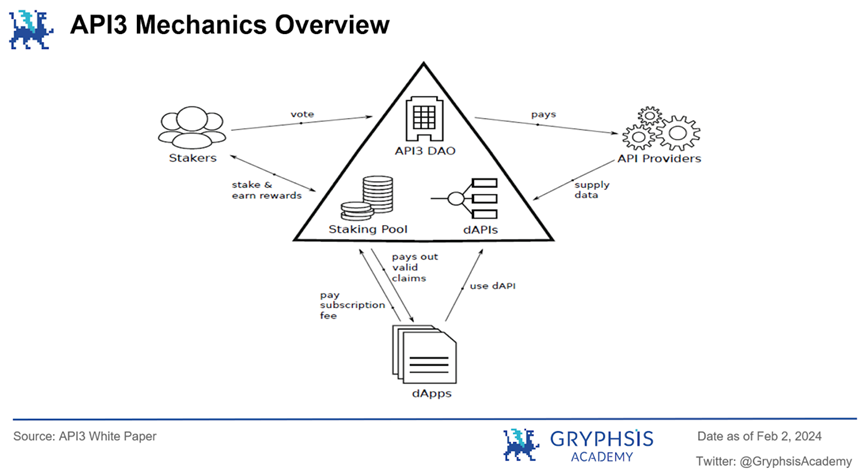
The overall mechanism of API3 is illustrated above. API3 operates as a platform connecting various stakeholders via a Decentralized Autonomous Organization (DAO). API providers earn revenue by supplying data, dApps enjoy data services from dAPIs by paying subscription fees, and if users detect issues with dAPI data, they can submit claims. Token stakers receive rewards and voting rights in the API3 DAO through staking. The specific mechanisms will be detailed below.
2.1 From API to dAPI
In Web 2.0, APIs serve as key bridges for data exchange between digital platforms, enabling seamless communication among software applications and underpinning the functionality of modern digital services in our lives. For example, when booking flights on a travel website, the site typically relies on APIs to retrieve real-time pricing and availability from airline databases.
The concept of dAPI extends traditional API models into the decentralized domain. Unlike conventional APIs relying on centralized servers and third-party intermediaries, dAPIs enable direct data feeds from data providers to users without any intermediary.
API3’s dAPI is built upon Airnode-powered oracles, allowing API providers to directly connect their data sources to blockchain networks so dApps can access real-world data in a trustless and secure manner.
API3 offers two types of data interface services—managed dAPI and self-funded dAPI—for developers to use, catering to different potential use cases. Additionally, API3 uses multi-signature wallets and governance protocols to manage changes to dAPI configurations, balancing flexibility with security.
Managed dAPI aggregates data from multiple first-party oracles, using a median function to provide more reliable and stable data sources, suitable for production environments requiring high data quality and stability. Under the managed dAPI model, users pay API3 for service usage, with fees covering operational and management costs.
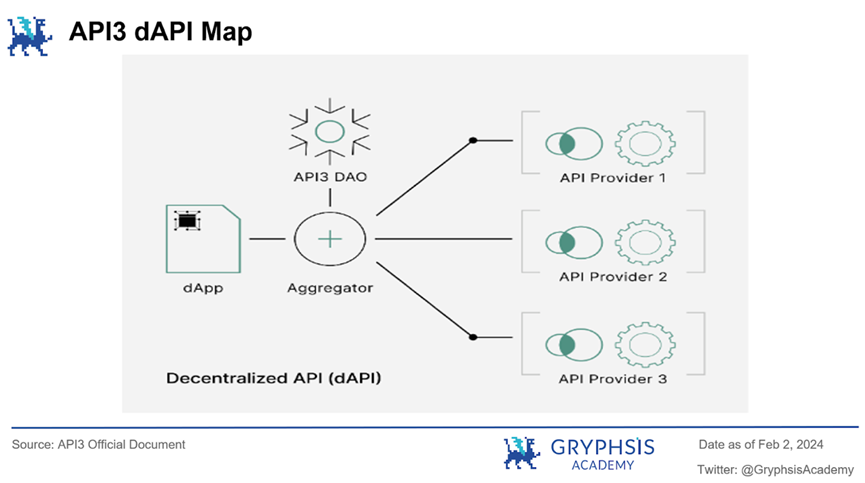
As shown in the diagram, API providers first send data to a single aggregator, which processes and consolidates data from different sources to ensure dApps receive reliable and consistent information. dApps can call dAPIs to obtain processed data and build services upon them. The API3 DAO oversees the entire process through voting and other governance mechanisms, ensuring transparency and security.
On the other hand, self-funded dAPI allows users to bear the costs themselves by sourcing data through a single first-party oracle. This provides developers with greater flexibility and autonomy, enabling them to experiment with and use data interfaces at lower cost, especially suitable for early-stage projects or cost-sensitive applications. In this model, users must fund the operation of the self-funded dAPI, with funds used to cover on-chain transaction fees and ensure timely data updates.
The innovation brought by API3 in the dAPI model may mark a paradigm shift in data consumption patterns in future decentralized environments. This approach not only directly reduces delays, costs, and potential failure points associated with third-party intermediaries, enhancing data security and reliability, but also represents a significant step forward in pursuing fully decentralized and efficient data solutions in Web3.0.
At the same time, the concept of dAPI means API3 is no longer limited to oracle price feed services, but opens up potential decentralized implementations and support for the ubiquitous APIs present in our daily lives.
2.2 API3’s Core Technology – Airnode
Airnode is the core component of API3, enabling API providers to convert their APIs into dAPIs, bridging off-chain APIs and on-chain smart contracts, facilitating seamless flow of real-world data into the blockchain ecosystem.
Specifically, Airnode is a serverless oracle node whose architecture emphasizes decentralization and security. It is both easy for API providers to deploy and maintain, and highly scalable.
Unlike traditional oracles that typically require complex setups and intermediary services, Airnode’s design allows API providers to act directly as first-party oracles without third-party involvement, ensuring data integrity and security are preserved.
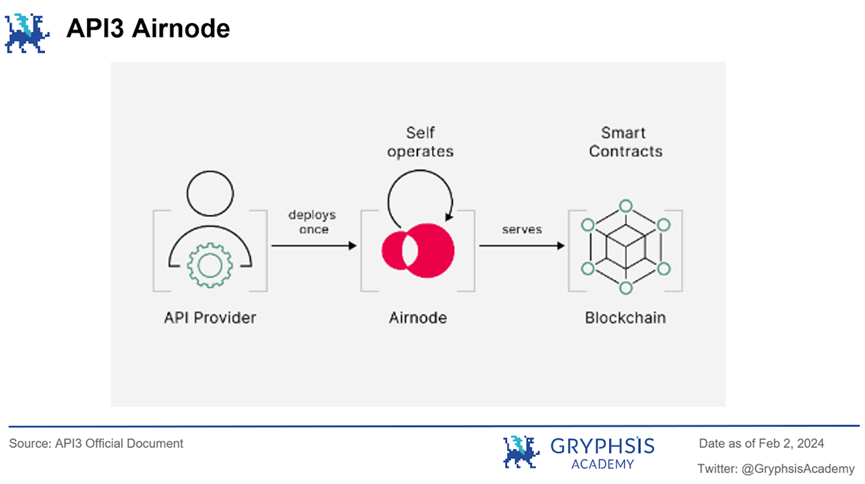
Moreover, another major advantage of Airnode is its simplified API integration process. This allows API providers to set up and operate with minimal blockchain knowledge and cost. This characteristic makes becoming a first-party oracle node simple and frictionless, democratizing blockchain technology usage and encouraging broader participation of data providers in the decentralized data market.
Thus, essentially, Airnode’s design goes beyond being just an oracle solution—it serves as a foundational component for building decentralized, secure, and user-centric data ecosystems. Through Airnode technology, API3 aims to address common challenges faced by traditional oracle services, such as transparency, trust, and efficiency, paving the way for stronger and more reliable dApp development.
2.3 OEV Network Captures Value and Reinvests in the Ecosystem
In the cryptocurrency field, Miner Extractable Value (MEV) has long been an important concept. Since on-chain transactions are not executed instantly, block producers (such as miners or validators) can manipulate transaction ordering, insertion, or replacement to earn additional profits. Oracle Extractable Value (OEV) can be considered a subset of MEV.
Recently, API3 announced the launch of its ZK-Rollup platform, OEV Network—an OEV Network customized using Polygon CDK to capture OEV generated by all dApps using API3, alleviating the widespread value leakage issue in current DeFi operations. Meanwhile, the adoption of rollups makes the entire process transparent and verifiable, making it more decentralized and trustless, thereby strengthening user confidence in participation and usage.
We can understand OEV through an example. Imagine we’re participating in an auction where everyone’s bids are visible, and the auctioneer can choose the order in which bids are considered. This creates an opportunity for the auctioneer to strategically place certain bids to benefit themselves or others, earning extra income.
When oracles update or push data onto the blockchain, depending on when and how this information is used, even minor differences in timing or accuracy could create opportunities for “suppliers” to extract potential value, such as frontrunning, arbitrage, or liquidations.
The OEV Network developed by API3 aims to make this process more systematic and democratic. Operating as a dedicated order-flow auction platform, the OEV Network captures value generated during oracle data updates and redistributes it to DeFi protocols and their users. This process is executed via auctions—highest bidders win the right to update data sources, and the fees they pay are shared with dApps using API3 data sources.
By capturing OEV, API3 introduces a novel revenue stream for dApps, strengthening the economic models of both API providers and dApp projects. Winners must pay an additional 10% fee on top of their bid, with half going to API3 as revenue and the other half distributed to oracle providers. This allocation of captured OEV to API providers incentivizes them to directly participate in building the Web3.0 ecosystem, fostering a fairer and more transparent data ecosystem. Meanwhile, the on-chain auction mechanism for feed rights creates a decentralized and secure environment, promoting fairer data ownership models and mitigating risks associated with centralized data feeds.
Notably, Sandeep Nailwal, co-founder of Polygon, praised API3’s innovative solution for oracle value extraction, calling it a significant breakthrough for the DeFi ecosystem.
Overall, API3’s OEV Network brings major progress to the dApp and oracle sectors, addressing key inefficiencies and unlocking new value streams for participants, potentially creating a more balanced and financially sustainable ecosystem for data providers and users in the future.
3. Protocol Revenue Sources
According to information provided in the whitepaper, API3’s protocol revenue primarily comes from subscription fees paid by dApps, Oracle Extractable Value (OEV), and Service Coverage fees. Protocol revenues are used for purposes including but not limited to supporting ongoing project development, enhancing network security, covering operating expenses, staking rewards, and rewarding potential stakeholders within the ecosystem. API3 governs the project through its DAO and decides resource allocation to ensure sustainability and steady growth.
4. Token Economic Model
4.1 Basic Information
According to Etherscan data, the current maximum supply of $API3 tokens is approximately 128 million, with a circulating supply of about 103 million. The non-circulating portion consists of reward tokens minted for stakers, which will only be unlocked one year after the reward date.
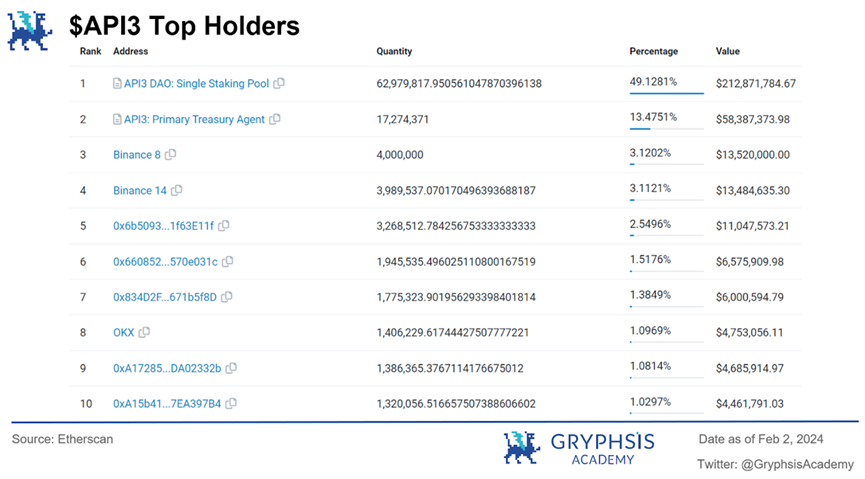
As shown, the largest holder of $API3 tokens is currently the $API3 staking pool, followed by the treasury, together accounting for 62.6% of the total circulating supply. In addition, exchange addresses such as Binance and OKX are also major holders of $API3. Therefore, the actual amount of $API3 freely circulating in the market is relatively small, helping avoid severe sell-off pressure.
Overall, API3 integrates staking, collateralization, and governance in its token economic model. Its goal is to incentivize participation, protect the network, and drive project growth by ensuring token holders can influence the project’s trajectory, effectively manage resources, and participate in ecosystem expansion. By combining these three utilities, API3 builds a healthy token system to achieve truly decentralized governance and operations.
4.2 Staking Mechanism
The staking mechanism is the most crucial component of API3’s token economy, designed to align stakeholder incentives with the project’s long-term success. By staking $API3 tokens, holders receive newly minted tokens (rewarded weekly) as staking rewards and gain voting rights in the API3 DAO. Additionally, staked tokens serve as collateral, which will be used to compensate users in case of dAPI failures.
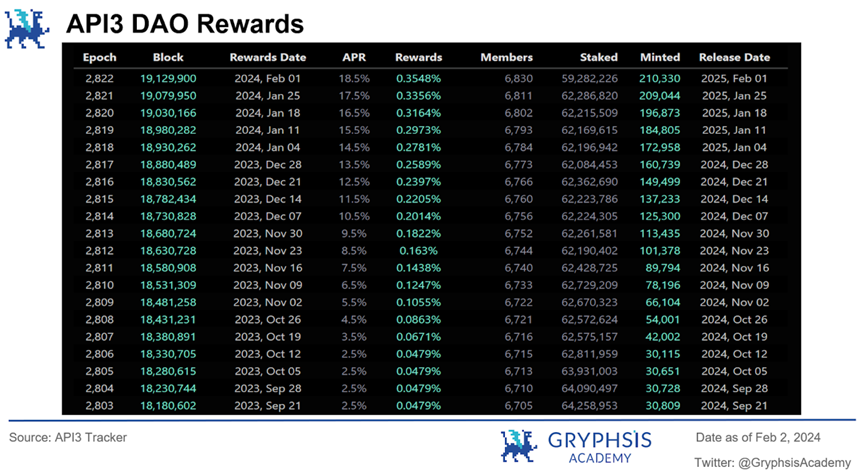
To ensure service continuity, product quality, and sufficient governance decentralization, API3 sets a "staking target," consistently aiming for the quantity of staked tokens to reach a specific percentage of the total token supply.
Currently, API3’s staking target is 64,097,566 tokens, while the actual staked amount has not yet reached this goal. Therefore, as shown, the API3 DAO will increase the APR by 1% at each subsequent reward date to incentivize more holders to stake, until either the staking target is met or the APR reaches 75%.
Since staking rewards are newly minted tokens, this theoretically leads to token inflation. To balance this, API3 designed a deflationary mechanism. First, as shown above, newly minted reward tokens will only unlock one year after the reward date, encouraging participants to hold and stake long-term rather than engage in short-term speculation.
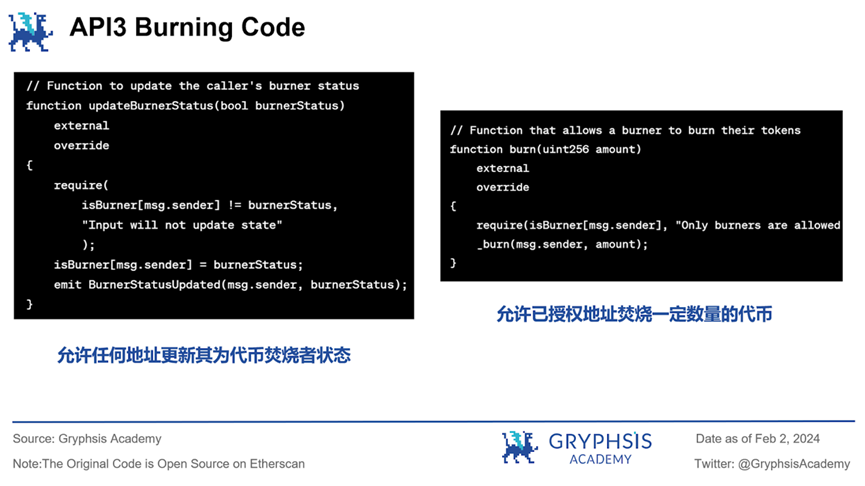
Second, the API3 DAO requires dAPI users to burn or lock a specific amount of $API3 tokens for a certain period to access data services. As shown above, by reviewing API3’s open-source code, we find that any address can independently decide whether to enable or disable its burn permission and can call the Burn function to burn a specified number of tokens.
This method partially offsets inflation caused by newly minted tokens, effectively reducing market supply pressure on $API3, benefiting all token holders and enhancing confidence among long-term investors and participants in staking.
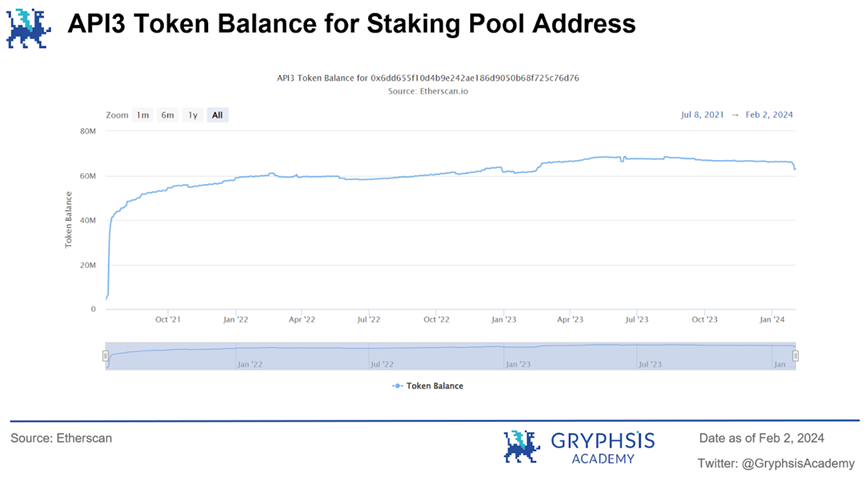
By examining the historical staking behavior of $API3, we observe that since 2021, the quantity of staked tokens has remained very stable, without experiencing dramatic fluctuations. Even during recent sharp increases in the $API3 token price, staking levels have remained largely stable, with no signs of massive sell-offs, indirectly proving the effectiveness of API3’s staking mechanism.
4.3 Collateralization Mechanism
API3’s collateralization mechanism can be viewed as an on-chain oracle service insurance product, achieving quantifiable security manifested in the form of Service Coverage.
The entire process can be summarized in the following key steps:
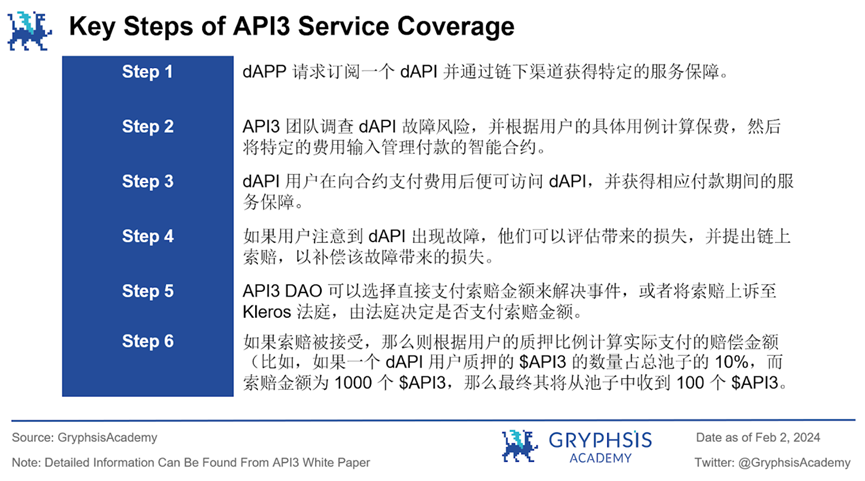
Essentially, this process resembles purchasing an insurance policy, but without requiring any traditional insurance policies. Once the protocol confirms a dAPI malfunction, users will receive compensation from the staking pool. Additionally, API3 supports multiple cryptocurrency types (e.g., ETH), indicating diversification in its services and collateral mechanisms.
More importantly, API3’s collateral model introduces a self-regulating negative feedback loop to prevent system over-expansion and potential self-destructive behaviors. Specifically, as the API3 DAO expands and adds new dAPI users, the risk of dAPI malfunctions triggering payouts also increases due to potential overload.
Therefore, potential payout demands motivate the API3 DAO to avoid excessive load increases during governance, ensuring API3 does not take unnecessary risks for short-term gains. This encourages responsible, stable growth and sustainable development of API3 DAO.
Through this mechanism, dAPI users and other token stakers share aligned incentives, as they all have a common goal of avoiding system failures. Stakers are motivated to monitor and maintain dAPI health due to potential insurance payouts, while users benefit from the system’s stability and reliability.
Moreover, since claimants must stake tokens to file a claim, this raises the cost of claiming, reducing the probability of false or abusive claims. This mechanism prevents abuse by individuals who might exploit the coverage mechanism for personal gain rather than system health.
Ultimately, the negative feedback regulation mechanism helps suppress extreme volatility in token value. In token economics, stability is key to attracting long-term investors and users. By curbing excessive risk and failure rates, this loop helps build confidence in $API3 as a long-term store of value.
4.4 Governance Mechanism
Within the API3 DAO, the only way to obtain governance voting rights is by staking $API3 tokens. Thus, governors bear all risks and rewards of API3. As previously mentioned, if governors do not actively participate, leading to numerous claims, they will suffer losses, and their staked tokens will re-enter the market to be purchased by new governors.
Conversely, if governance is effective, the circulating supply of $API3 in the market will decrease accordingly, potentially driving up token prices due to scarcity, giving governors greater returns. This mechanism allows the API3 DAO to continuously improve and recover from failures, achieving true decentralization.
4.5 Summary of Token Economics
Overall, API3’s token economic model is a carefully designed, sophisticated framework. $API3 tokens are endowed with multiple utilities and demands—staking, collateral, insurance pool, governance voting rights, and accessing dAPI services—not only combating potential inflation through locked reward periods and token burning mechanisms, reducing selling pressure.
More importantly, its economic model deeply integrates $API3 tokens with the project’s operations, risks, and token value (supply), making governance rights not just a trivial option but the most critical tool for participant incentives, maximizing the motivation for token stakers to actively participate in governance to minimize personal loss risks.
Through this mechanism, API3 tightly links the project’s long-term development with stakeholders, ensuring sustained and stable growth while greatly advancing the realization of true decentralization.
5. Sector Market Analysis and Competitive Landscape
In recent years, the oracle sector has experienced significant growth and development due to its unique technical capabilities and broad application scenarios. According to CoinGecko data, the total market capitalization of the oracle sector has now exceeded $13 billion. As an indispensable component of blockchain technology, oracles bridge the information gap between the encrypted world and the real world, providing smart contracts with access to external data.
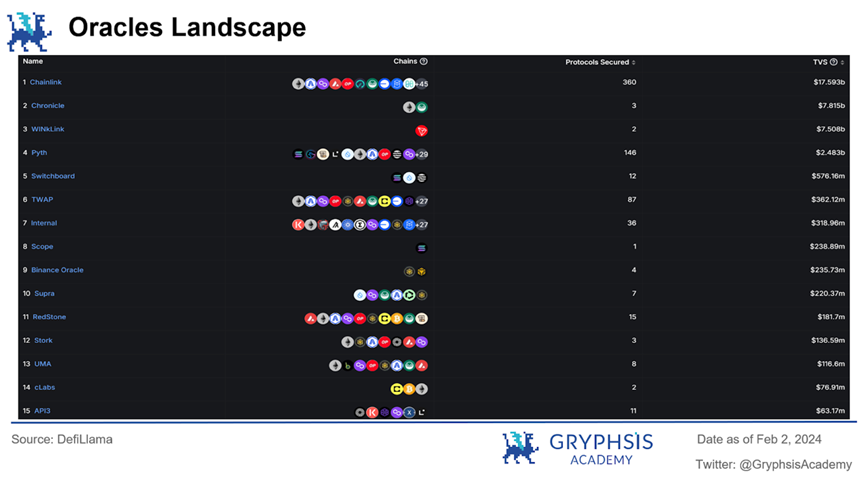
Chainlink has long dominated the oracle sector. According to DefiLlama data, Chainlink currently serves over 50 different networks and 360 protocols, with Total Value Secured (TVS) exceeding $17 billion, and its market cap far surpassing other competitors.
However, this market landscape does not mean there are no challengers or competitors. For instance, API3 positions itself as a first-party oracle solution, emphasizing direct data feeds from data providers to blockchains, aiming to reduce dependencies and potential failure points associated with third-party oracles like Chainlink, offering greater advantages in data accuracy and latency.
5.1 Why Focus on First-Party Oracles?
In August 2020, nine Chainlink node operators were attacked. Since Chainlink nodes operate by responding to smart contract requests, retrieving and verifying real-world data, then feeding it back to smart contracts—a process requiring Ethereum gas fees—attackers exploited this workflow.
Attackers sent large volumes of seemingly valid price feed requests to Chainlink nodes, causing sudden spikes in Ethereum gas fees for node operators. They then minted $Chi tokens—a gas token developed by 1inch at the time—to hedge against gas price fluctuations. After minting, attackers sold these tokens for $ETH, effectively draining $ETH from node wallets, resulting in losses of about 700 $ETH.
Although Chainlink promptly took remedial actions after the incident and continuously improved its protocol to enhance network security and reliability, given the critical importance of oracles to the on-chain ecosystem, oracle-related risks will remain an unavoidable consideration. For example, Mango Markets and Bonq DAO later suffered significant losses due to oracle attacks.
In fact, attackers exploited the mechanisms of third-party oracles to carry out these attacks. In contrast, first-party oracles offer a different solution.
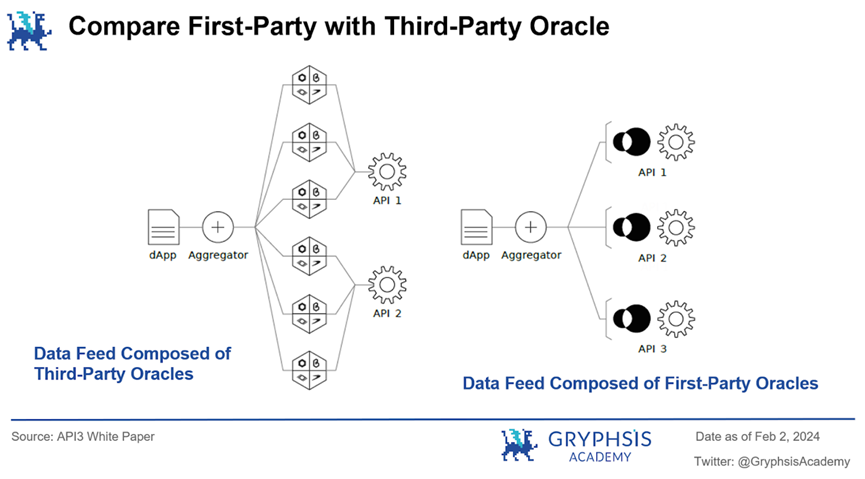
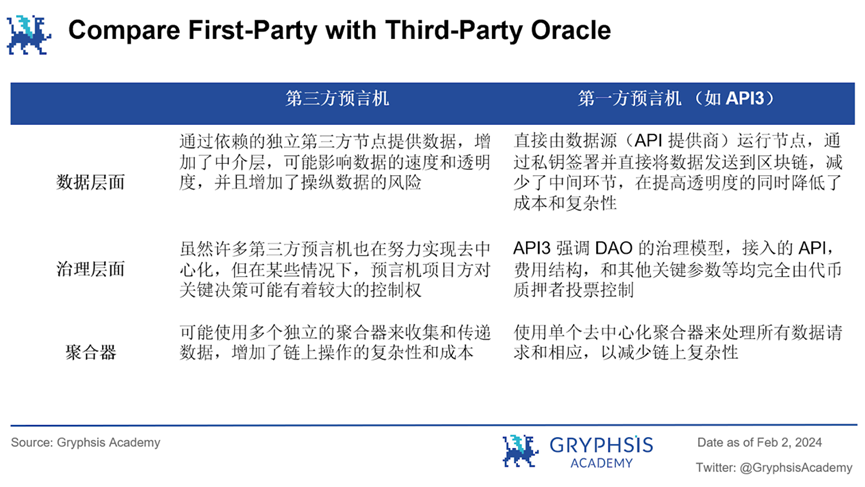
Traditional third-party oracles rely on third-party intermediaries to host oracle nodes, where intermediaries aggregate external data and input it into smart contracts. This mechanism forces data consumers to trust not only data providers but also intermediaries, introducing additional trust layers and potential costs, possibly raising concerns about central points of failure, data manipulation risks, transparency, and trust issues.
For example, to incentivize third-party nodes to provide reliable services, third-party oracles usually require a middleman tax to encourage honest behavior—a cost absent in the first-party oracle model. Furthermore, in some sense, the mechanism of third-party oracles may not be considered truly decentralized.
In contrast, as a first-party oracle, API3 allows API providers to operate oracle nodes themselves, providing a better degree of decentralization in a safer, more reliable, and cost-effective manner.
5.2 Competition Among First-Party Oracles
When discussing first-party oracles, one cannot overlook the recently popular Pyth Network protocol. Next, we will analyze and compare API3 and Pyth Network.
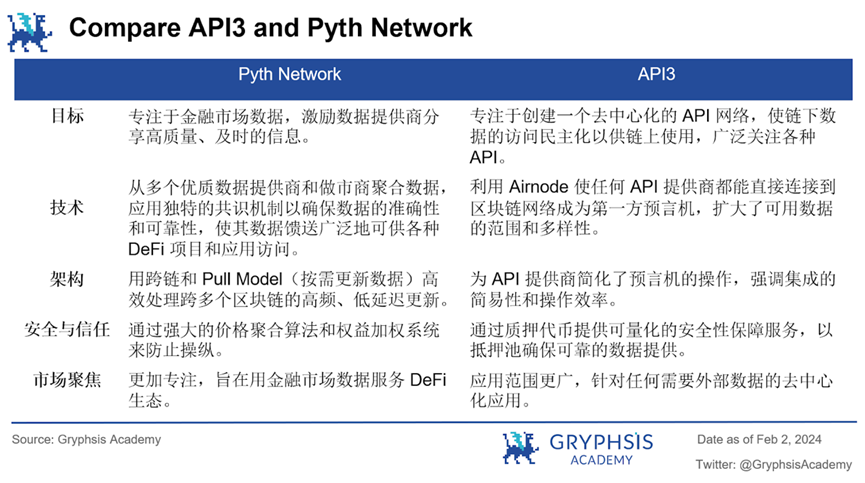
It is clear that both projects make significant contributions to the Web3.0 ecosystem by addressing the critical need for reliable, decentralized data sources. API3’s main advantages include: broader data application scope, fully decentralized DAO governance model, low operational difficulty, cost-effectiveness, high transparency, and a stronger token economic model.
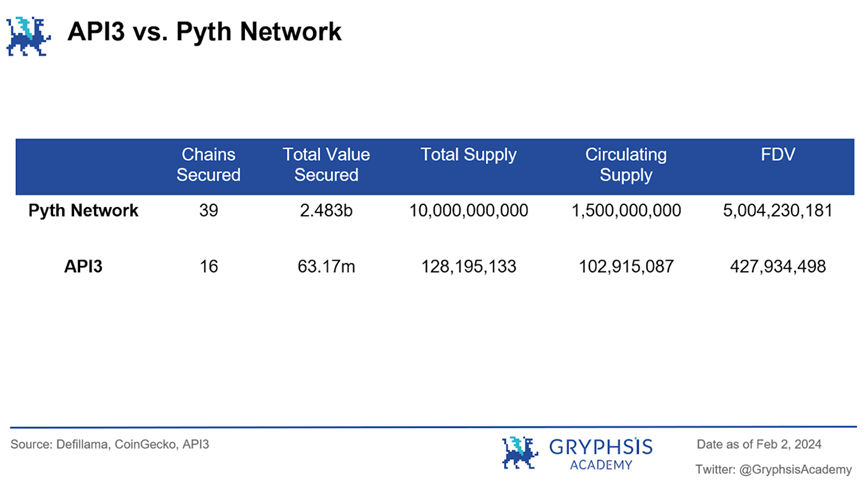
From these data, we can see that Pyth Network currently holds greater advantages in integration depth and coverage. However, this does not mean API3 lacks competitiveness. Fewer integrated protocols give API3 the opportunity to focus on delivering high-quality services and deepen its presence on supported blockchains. As blockchain technology evolves and application scenarios expand, API3 can grow its market share by increasing integrations, protocol support, and value assurance.
Additionally, API3’s smaller current market size may make it more agile, allowing faster adaptation to market changes and user needs, offering greater room for growth and expansion. In the future, we expect API3 to continually elevate its industry standing through innovation and optimization.
Therefore, we still have reasons to be optimistic about API3’s development prospects. Combined with the earlier-introduced OEV Network, when the dAPI architecture integrates with OEV Network and ZK-Rollup and is governed by a fully decentralized DAO, we can envision API3’s future extending beyond serving as an intermediate oracle provider—it may become foundational infrastructure for on-chain ecosystems and dApp development, even holding the potential to disrupt the current market dominated by third-party oracles.
5.3 Risks
Despite API3’s many strengths generating strong expectations, every blockchain project faces inherent risks. API3’s main risks may include:
-
Adoption Rate: API3’s future success heavily depends on adoption by API providers and integration with blockchain projects. If API3 fails to gain sufficient traction or adoption falls short of expectations, it could negatively impact the project’s success and its token value.
-
Provider Attrition: If, for any reason, a large number of API providers cease operations or choose not to adopt API3, this could limit the diversity and quality of available data, potentially affecting the utility of the API3 network.
-
Security Vulnerabilities: Like any blockchain project, API3 may be affected by potential security vulnerabilities in its protocol, smart contracts, or Airnode technology itself. Any security breach or exploit could lead to loss of funds or data and undermine user trust in the platform.
-
Competitive Landscape: The oracle space is highly competitive, with established players like Chainlink already commanding substantial market share. While API3’s concept and design are highly creative, this does not guarantee long-term success, meaning API3 must differentiate itself and prove its value proposition to overcome competitive pressures.
Therefore, beyond its innovative approach and mechanisms, API3’s success will also depend on technical execution, market adoption, competitive differentiation, regulatory environment, and other factors. As with all investments in the cryptocurrency space, thorough understanding of the project’s advantages and risks is essential before making investment decisions.
6. Conclusion
Overall, API3 presents a groundbreaking approach in the oracle space, directly connecting data providers and blockchain networks through first-party oracles and dAPIs, enhancing security, transparency, and efficiency while reducing risks related to data tampering and costs associated with data feeds.
Moreover, API3 boasts a well-designed, powerful token economic model, with its DAO governance model enabling smart contract platforms to leverage dAPIs to build meaningful dApps in a truly decentralized and trust-minimized manner.
Combined with the launch of its OEV Network, we have good reason to expect API3 will be adopted by more blockchain networks and dApp protocols in the future, potentially becoming foundational infrastructure for on-chain ecosystem development and driving innovation in decentralized application development.
Join TechFlow official community to stay tuned
Telegram:https://t.me/TechFlowDaily
X (Twitter):https://x.com/TechFlowPost
X (Twitter) EN:https://x.com/BlockFlow_News
 @gryphsisacademy