








What Is the Potential of Ronin Network, Co-Founded by Axie's Founders and Booming Ecosystem?
TechFlow Selected TechFlow Selected
What Is the Potential of Ronin Network, Co-Founded by Axie's Founders and Booming Ecosystem?
What exactly is Ronin Network, and why is it so favored by investors?
 Navigating Web3 tides with focused insights
Author: Daniel Li
A bull market lasting over two months has driven investors to actively search for potential value opportunities, creating a chance for some established projects to regain momentum. Ronin Network, a veteran blockchain launched in 2021 and tested through bear markets, experienced a revival in early 2024 after a year of sustained development in 2023.
According to BlockBeats data, Ronin Network’s active addresses surged by 3,225% over the past three months, peaking at 693,000 on January 25. During the same period, its native token RON rose over 800%, currently trading at $3.18. So, what exactly is Ronin Network, and why is it gaining such investor attention? As a specialized blockchain platform focused on revolutionizing gaming, what advantages does Ronin Network offer? Let’s explore these questions in this article.
01. From Axie Infinity to Ronin Network
Ronin was developed by Sky Mavis, a tech-focused game studio, and specifically created by Jeffrey Zirlin, a Yale University graduate who worked at Sky Mavis for over four years, and Alexander Leonard Larsen, a blockchain expert and co-founder of Axie Infinity.
Axie Infinity was the flagship GameFi title that drove the previous bull cycle. At its peak, it generated $300 million in monthly revenue, surpassing even Honor of Kings in daily volume, and catalyzed the rise of large gaming guilds like Yield Guild Games (YGG). Its success attracted numerous gamers and developers into the Web3 gaming space, effectively shaping today's GameFi sector. However, as more players joined, Ethereum’s slow settlement speed and high gas fees increasingly raised entry costs. With declining new users and the broader market entering a bear phase, Axie Infinity fell into a death spiral.
To address Axie Infinity’s challenges, Ronin emerged as a long-term scaling solution designed specifically for the game. The concept was introduced by Sky Mavis, the creators of Axie Infinity. Prior to Ronin, Sky Mavis had partnered with the Loom Network. However, Loom’s team aimed to optimize the network as an enterprise-level solution rather than a user-friendly application, which did not align with Sky Mavis’ vision. As a result, the collaboration ended, prompting Sky Mavis to develop its own blockchain—Ronin Network.
As a gaming-optimized EVM-compatible chain, Ronin differs from traditional Ethereum sidechains by aiming to fully resolve key issues such as Ethereum’s high gas fees and slow transaction speeds. It delivers a smoother, seamless gaming experience. Today, Ronin has demonstrated significant potential in the NFT marketplace, processing over $4 billion in transactions while attracting millions of daily active users.
The year 2023 was pivotal for Ronin. In January, Ronin launched Mavis Hub 2, a desktop gaming aggregation platform. In March, it introduced RON staking. April saw the switch to a Delegated Proof-of-Stake (DPoS) mechanism and upgrades to the Ronin Wallet. In May, the NFT marketplace Mavis Market was launched and integrated with Ronin Wallet. In September, the popular game Pixels migrated from Polygon to Ronin Network, signaling further expansion of Ronin’s partner program. In October, Lucas (v2.6.2) upgrades and the Shillin hard fork were deployed on the mainnet. In November, Ronin partnered with South Korean game developer ACT Games, which plans to migrate all its games to the Ronin Network. In December, collaborations were announced with globally recognized studios including Foonie Magus, Directive Games, Bali Games, Tribes Studio, and Bowled.io, significantly expanding Ronin’s gaming ecosystem.
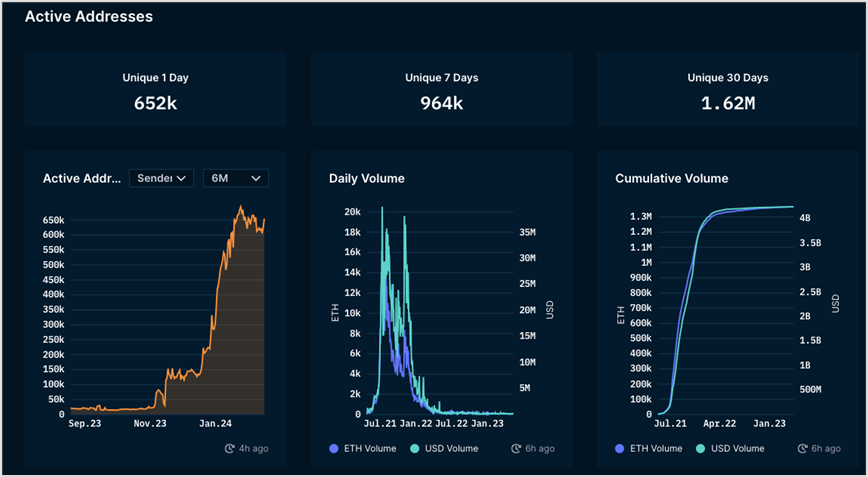
Figure: Ronin Active Address Count
Ronin Network’s steady progress has earned investor trust, particularly due to its close ties with Axie Infinity, which serves as a massive traffic pool providing initial users and momentum. Ronin once surpassed BNB Chain in market share among blockchain games, ranking first with daily active addresses consistently above 600,000. This strong user base has driven RON, Ronin’s native token, to gain over 800% in the past three months. Currently priced at $3.18, RON has nearly recovered to its previous bull market highs—further demonstrating Ronin’s market competitiveness and investor confidence.
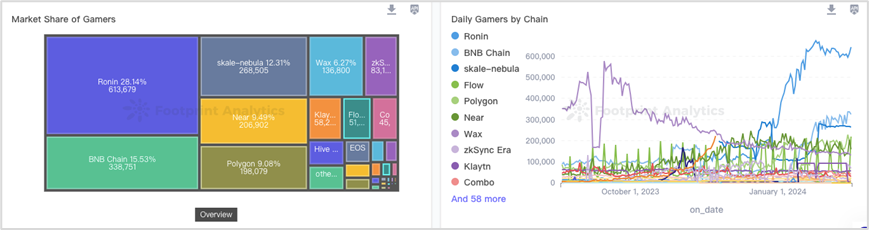
Figure: Ronin’s Share in Blockchain Gaming Market
02. How Ronin Network Works and Its Advantages
Ronin Network is an innovative blockchain platform based on a Delegated Proof-of-Stake (DPoS) consensus mechanism, designed to provide a highly scalable environment for gamers and developers. By leveraging advanced technology and economic models, Ronin successfully addresses Ethereum’s scalability and high transaction cost issues. Below is a detailed explanation of Ronin Network’s operational principles and technical advantages.
Sidechain Architecture
A sidechain is an independent blockchain running parallel to the main chain. Compared to other networks, sidechains are easier to develop and can be optimized for specific use cases. As an Ethereum sidechain, Ronin operates with its own block production mechanism, consensus algorithm, and enables asset interoperability with Ethereum via bridges. This architecture allows Ronin to focus on optimizing gaming experiences while maintaining connectivity with the Ethereum ecosystem. Through the Ronin Bridge, users can transfer ETH and ERC20 assets from Ethereum to Ronin, or move native tokens and NFTs from Ronin back to Ethereum. This interoperability enables gamers to freely transfer assets between chains.
Hybrid Consensus Mechanism
Ronin Network employs a hybrid consensus mechanism combining Proof of Authority (PoA) and Delegated Proof of Stake (DPoS). PoA is a consensus algorithm that uses validator identity as stake to enable fast transactions. DPoS allows token holders to delegate their voting power to elected validators. This hybrid approach combines both methods to maintain high throughput and low confirmation times while enhancing decentralization and security.
Under the PoA mechanism, Ronin is maintained by a set of trusted validator nodes designated by Sky Mavis. These validators package transactions into new blocks and add them to the Ronin blockchain. PoA offers high energy efficiency since it doesn’t require intensive computation, enabling faster transaction speeds and lower fees—improving the gaming experience. However, PoA carries risks such as centralization and single-point failure due to reliance on a few validators. To improve decentralization, Ronin introduced the DPoS mechanism.
With DPoS, RON token holders can delegate their voting rights to candidate validators. Validators receiving more delegated votes have a higher chance of being selected to validate transactions and produce blocks. Users can become candidate validators by staking a certain amount of RON, participating in network validation and governance, and earning a portion of block rewards. This mechanism enhances decentralization and mitigates single-point failure risks.
Highly Scalable Blockchain Platform
Ronin Network is a scalable blockchain platform tailored for gamers and developers, offering several technical advantages that enable it to handle large-scale transactions and deliver exceptional performance:
-
High Throughput: Ronin can process up to 100,000 transactions per second, capable of handling high-volume user interactions and gameplay demands.
-
Low Latency: Advanced technology and optimized network architecture ensure fast transaction confirmations and responsiveness, delivering a seamless user experience.
-
Low Transaction Fees: Compared to Ethereum’s high fees, Ronin offers significantly cheaper transactions, making it more affordable for users to interact.
-
Compatibility: Ronin is EVM-compatible, allowing existing Ethereum developers to easily port their applications and smart contracts to Ronin, expanding the developer community and ecosystem.
RON Token Economic Model
RON is the native token of Ronin Network, serving multiple functions and holding intrinsic value. The RON token economy is designed to promote network growth and community participation, including:
-
Transaction Fee Payment: RON is used to pay transaction fees on the Ronin network, ensuring efficient system operation.
-
Network Security and Staking: Token holders can stake RON to validators, contributing to network security and earning rewards. This incentivizes validators to maintain integrity and encourages holders to participate in governance.
-
Governance Participation: RON grants holders voting rights in network governance, promoting community involvement in key decisions and enhancing ecosystem transparency and consensus.
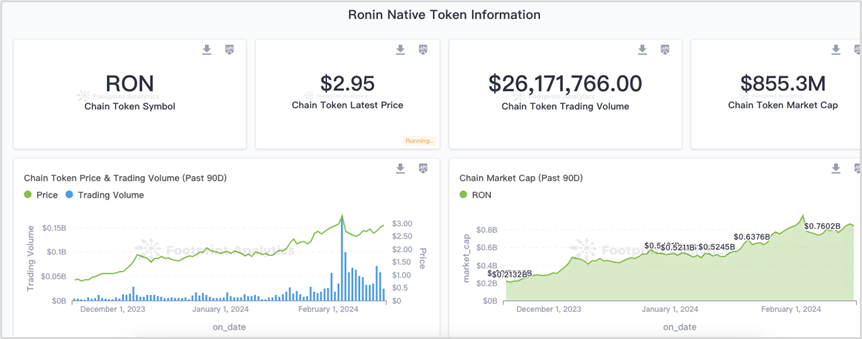
Figure: RON Token Development
Regarding RON token distribution, 30% is allocated to Sky Mavis, partly for employee bonuses and shareholder agreements. Another 30% is reserved for the community to support incentives and development. The ecosystem fund accounts for 15% of total supply, dedicated to initiatives that enhance Ronin Network. The remaining supply will be distributed through staking rewards.
Overall, Ronin Network has successfully built a highly scalable blockchain platform by integrating sidechain architecture, a hybrid consensus mechanism, and a robust token economy. Token holders can earn returns through delegation, participate in governance, and contribute to network security and stability. Ronin’s technical strengths and design make it an ideal choice for the gaming industry and developers, laying a solid foundation for ecosystem growth.
03. Popular Games on Ronin Network
As a blockchain platform focused on transforming gaming, Ronin Network has inspired hope for the future of Web3 gaming among players and developers alike. Leveraging the early success of Axie Infinity, Ronin has now partnered with global studios such as Directive Games, Bali Games, and Tribes Studio, each developing new blockchain games on the platform. Additionally, Ronin’s strong performance has attracted mature, high-quality titles like Pixels, reinforcing its position as a leading blockchain gaming platform.
Axie Infinity
Axie Infinity is the largest game on Ronin, where players can breed, raise, and battle fantasy creatures called Axies. The game pioneered the Play-to-Earn model in 2021 and remains one of the most popular Web3 games globally.
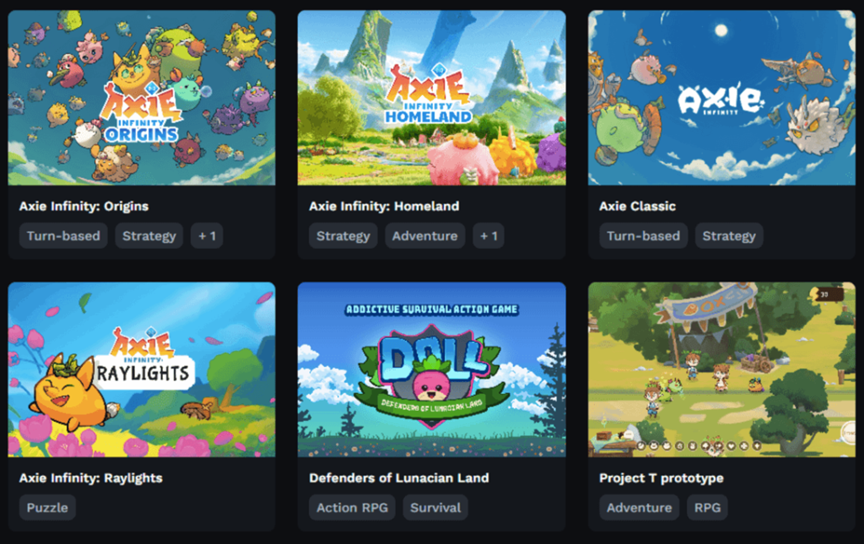
Ronin was originally designed as an Ethereum sidechain specifically for the Axie ecosystem and has since become critical infrastructure for Axie Infinity. With Ronin’s support, Axie Infinity has undergone significant transformation. Recently, Axie introduced AXP (Axie Experience), a new mechanic allowing players to earn points by winning battles in Origins, driving Axie progression and upgrades. The launch of AXP marks a shift from passive characters to organic beings capable of leveling up through accumulation—a mechanism that could become widespread across NFTs and gaming. AXP embodies the AxieCore philosophy, injecting fresh momentum into both Axie Infinity and the broader NFT ecosystem.
Pixels
Pixels is a social, casual, open-world Web3 game and platform launched in 2021. As a pixel-art metaverse farming game, Pixels captures the nostalgic vibe of classic 16-bit RPG adventurers, letting players navigate a pixel-art world, interact, farm land, play mini-games, and earn token rewards. Pixels also allows holders of select NFT profile picture (PFP) collections to use their avatars in-game.
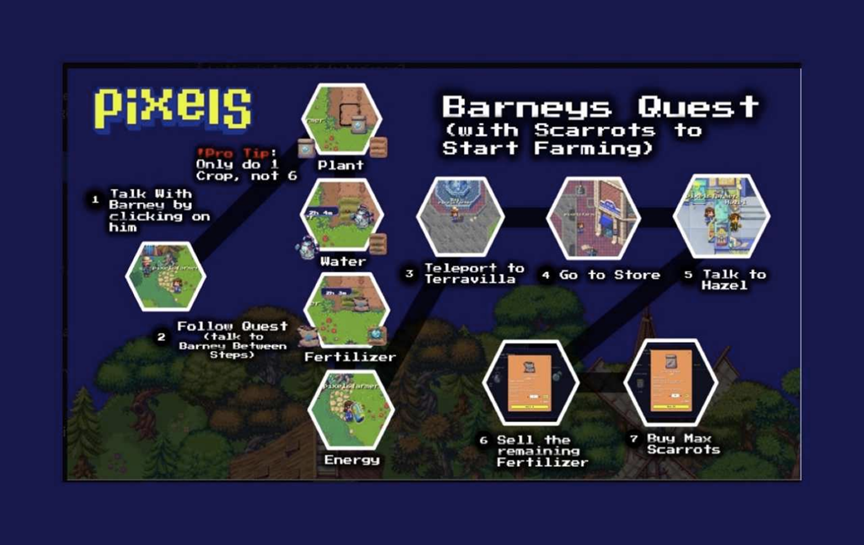
Previously operating on Polygon, Pixels migrated to Ronin Network in 2023. According to Nansen data, Ronin’s active user count surged from around 20,000 in November to 665,000 following the migration, with much of the growth attributed to Pixels. The game has now become another flagship title on Ronin after Axie Infinity.
Currently, Pixels has integrated over 90 Web3 projects into its ecosystem. In funding, as of February 8, 2024, Pixels raised $4.8 million across three private token sales, led by Animoca Brands and PKO Investments, with participation from OpenSea. PIXEL is the native token of Pixels and was recently launched as Binance’s latest IEO project, debuting at $0.04 on February 19. On its first day, it surged over 11,500%, and the price has since surpassed $0.5.
Zoids Wild Arena
Zoids Wild Arena is a TCG (trading card game) developed by renowned South Korean studio ACT Games. Players collect mechanical creature cards from the Zoids series and engage in 1v1 or 3v3 battles. In November 2023, Sky Mavis, Ronin’s developer, partnered with ACT Games to bring all of ACT’s games to the Ronin Network. Zoids Wild Arena is the first game from ACT Games to migrate to Ronin.
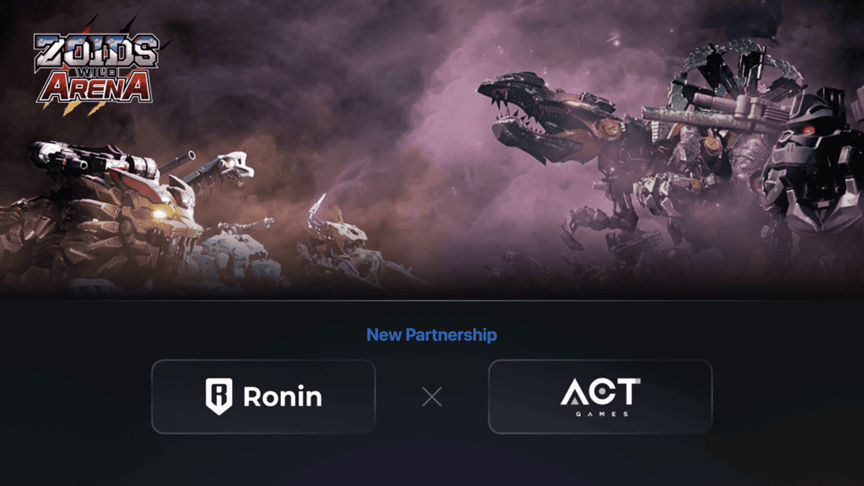
Zoids Wild Arena going live on-chain signifies that the partnership between Sky Mavis and ACT Games has entered a substantive phase. For Ronin, the inclusion of traditional games presents a valuable opportunity. As Sky Mavis CEO and co-founder Trung Nguyen stated, ACT Games has a proven track record in expanding iconic IPs, reaching broader audiences, and increasing player engagement. He added: “This alliance combines our Web3 expertise with nostalgic IPs backed by an existing core fanbase.”
Join TechFlow official community to stay tuned
Telegram:https://t.me/TechFlowDaily
X (Twitter):https://x.com/TechFlowPost
X (Twitter) EN:https://x.com/BlockFlow_News






