








Coinbase Weekly: Will inflation, liquidations, and other factors disrupt the current upward trend?
TechFlow Selected TechFlow Selected
Coinbase Weekly: Will inflation, liquidations, and other factors disrupt the current upward trend?
Bitcoin (and cryptocurrencies more broadly) should remain well supported over the next 3–6 months.
 Navigating Web3 tides with focused insights
Author: Coinbase
Key Takeaways
- U.S. spot Bitcoin ETFs saw massive net inflows in their first month since launch, totaling $3.3 billion.
- We believe Bitcoin (and crypto more broadly) should remain well-supported over the next 3–6 months as more institutional participants turn attention to this new ETF category.
- Ethereum's developments also align with structural market shifts that a spot Ethereum ETF could represent.
Market
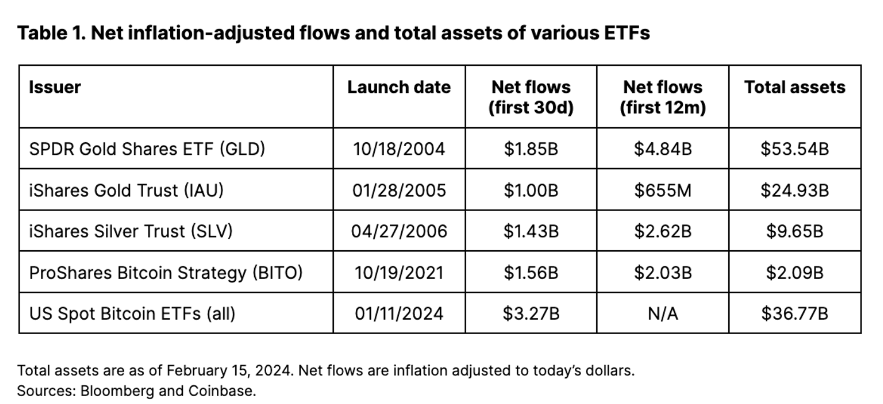
U.S. spot Bitcoin ETFs saw massive net inflows in their first month since launch, totaling $3.3 billion (over $4.2 billion year-to-date). This brings their total assets under management to approximately $36.8 billion. By comparison, prior to ETF approval, our survey of institutional participants showed a median expectation of around $1 billion.
This momentum has helped the total cryptocurrency market cap recover to levels last seen in March 2022. We believe Bitcoin (and crypto more broadly) should remain well-supported over the next 3–6 months as more institutional participants adapt to this new ETF category. At the same time, however, ongoing discussions about global monetary inflation suggest some negative seasonality in March could disrupt this trend.
Looking at the broader ETF market, Bitcoin ETFs surpassed even State Street’s SPDR Gold Shares ETF (GLD)—one of the most successful ETF launches in history—in net inflows during just their first month. GLD attracted $1.8 billion in inflation-adjusted dollars between October 18 and November 18, 2004. In fact, Bloomberg labeled BlackRock’s iShares Bitcoin Trust (IBIT) and Fidelity’s Wise Origin Bitcoin Fund (FBTC) as “among the top 0.1% of all ~5,500 new ETF launches over the past 30 years.”
Although rebalancing flows (from certain funds to others) have begun to stabilize, there are still some sources of technical selling pressure. On February 14, Genesis Global Holdco LLC received permission from the U.S. Bankruptcy Court for the Southern District of New York to repay creditors using holdings including:
- 35.9 million shares of Grayscale Bitcoin Trust (GBTC), worth $1.66 billion as of February 15.
- 8.7 million shares of Grayscale Ethereum Trust (ETHE), worth approximately $209 million.
- 3 million shares of Grayscale Ethereum Classic Trust (ETCG), worth approximately $38 million.
The ruling allows Genesis to either (1) convert these fund shares into BTC, ETH, or ETC on behalf of creditors (e.g., by selling GBTC and purchasing BTC), or (2) directly sell the shares and distribute cash proceeds. Note also that the confirmation hearing for Genesis’s Chapter 11 bankruptcy plan is scheduled for February 26 (9:30 AM ET), where the court will approve, reject, or delay the debt repayment plan. It remains unclear whether additional GBTC outflows not directly used to purchase Bitcoin for creditor repayment will flow into other U.S. spot Bitcoin ETFs. Our view is that much of these funds will likely remain within the crypto ecosystem, resulting in a neutral overall market impact.
Positive Developments in the Ethereum Ecosystem
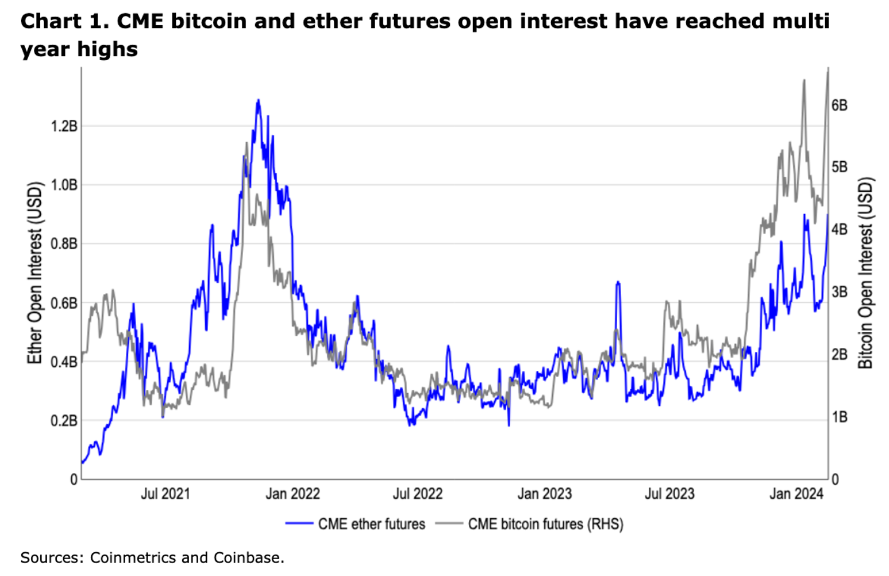
Meanwhile, open interest in CME Bitcoin and Ether futures has rebounded over the past six trading sessions, with the former reaching a record high of $6.3 billion (see Chart 1). Given recent strong performance in crypto and CME Bitcoin futures basis trades nearing 16% (30-day annualized), renewed institutional interest is unsurprising. That said, we believe open interest in ETH futures has room to grow relative to Bitcoin, given a series of major catalysts potentially unfolding for Ethereum over the coming months—including possible U.S. approval of a spot ETF, as discussed in our recent Monthly Outlook.
Recently, Franklin Templeton filed for a spot Ethereum ETF (the eighth applicant), while Ark 21Shares modified its application to allow staking. Given the strong capital inflows into spot Bitcoin ETFs, we expect more issuers to shift focus toward the second-largest cryptocurrency in the coming months. Market participants are watching whether the U.S. Securities and Exchange Commission (SEC) begins actively engaging with applicants, as this could influence perceived approval odds.
Ethereum’s technical progress also aligns with structural market changes a spot Ethereum ETF could represent. First, the majority client risk associated with the Geth client has largely been mitigated. Updated monitoring shows fewer than 50% of nodes now run this software, down significantly from the previous dominance of over 85%. This rapid shift followed early January incidents that caused downtime in Besu and Nethermind clients, raising concerns about Geth centralization risks. Greater client diversity strengthens network resilience and demonstrates Ethereum’s maturity compared to other smart contract platforms.
The network continues making other technical improvements, albeit with some delays. The Dencun upgrade (originally expected in Q4 2023) is now scheduled for March 13, 2024. We believe the successful rollout and adoption of Proto-Danksharding will introduce blob storage and further validate the feasibility of Ethereum’s long-term rollup scalability roadmap. With increasing data availability solutions (such as Celestia and EigenDA) offering alternative options for rollup data publishing, we expect rollup costs to decrease by an order of magnitude by 2024.
Finally, we believe Ethereum’s role as a yield-generating proof-of-stake asset is becoming increasingly important. Thanks to its EIP-1559 burn mechanism, Ethereum continues to exhibit net deflationary supply dynamics, with a 0.5% annualized deflation rate over the past seven days and a total supply reduction of 0.3% since The Merge. Meanwhile, validators have staked approximately 25% of Ethereum’s total supply (around 30 million ETH), consistent with our expectations published a year ago—more than double the amount staked at the time of The Merge in September 2022.
Restaking
In our view, staking-centric protocols—and recently, restaking—are poised to drive a "DeFi renaissance" centered on real yields. EigenLayer, the leading restaking project on Ethereum, enables users to restake deposited ETH to secure other services. After temporarily lifting deposit caps, its total value locked (TVL) surged from $1.1 billion to $4.3 billion—surpassing the combined TVL of Uniswap and Compound across all chains, and approaching Aave and Maker.
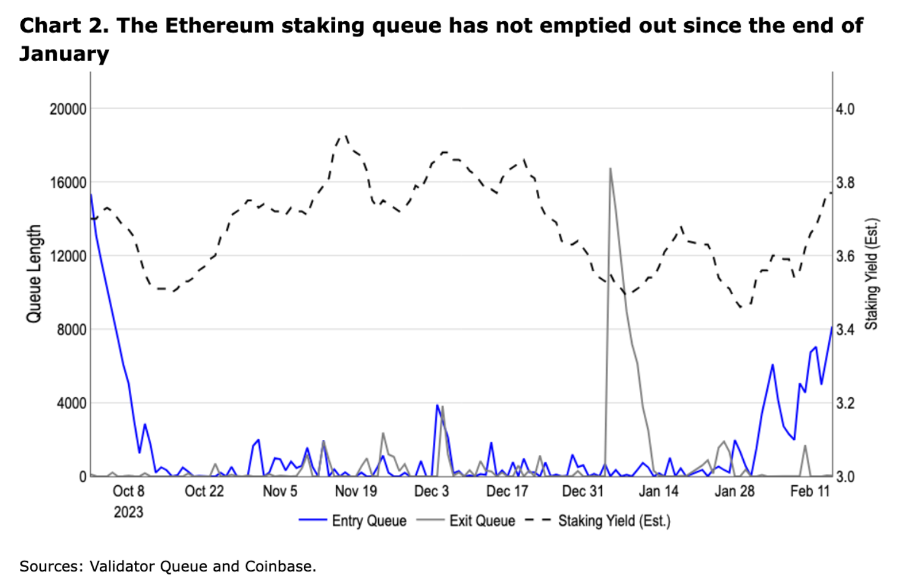
Interest in restaking protocols may be driving increased ETH staking, evidenced by a persistent validator queue that has not cleared since late January (see Figure 2).
Note that EigenLayer has not yet launched any active validation services (AVS) on mainnet. Nonetheless, secondary protocols built atop EigenLayer—offering liquid restaking tokens or various on-chain products—have also seen substantial TVL growth. We believe a yield-attractive restaking ecosystem could become an underappreciated anchor for Ethereum liquidity. While EigenLayer’s mainnet launch date remains unconfirmed, expectations for a Q2 2024 launch could coincide with the potential deadline for Ethereum ETF approvals (possibly late May), further boosting market interest in Ethereum.
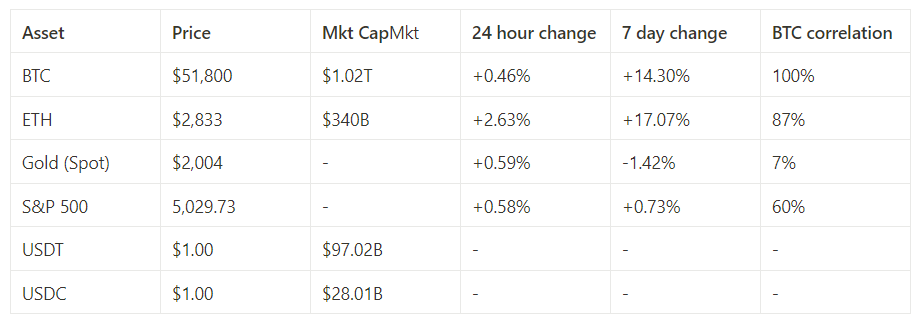
Crypto vs. Traditional Markets Performance
As of 4:00 PM Eastern Time, February 15
Coinbase Exchange and CES Insights
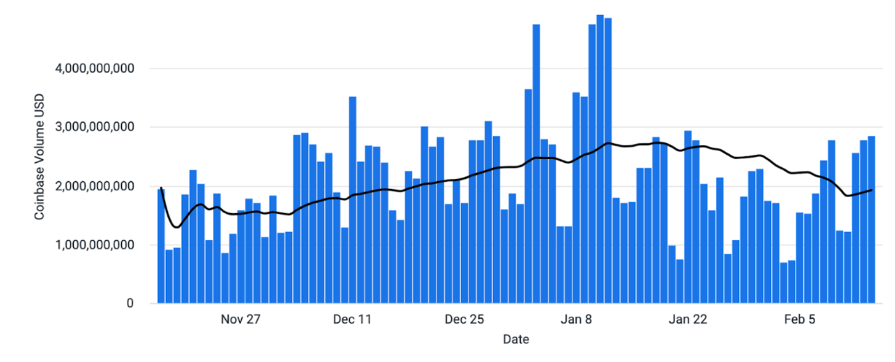
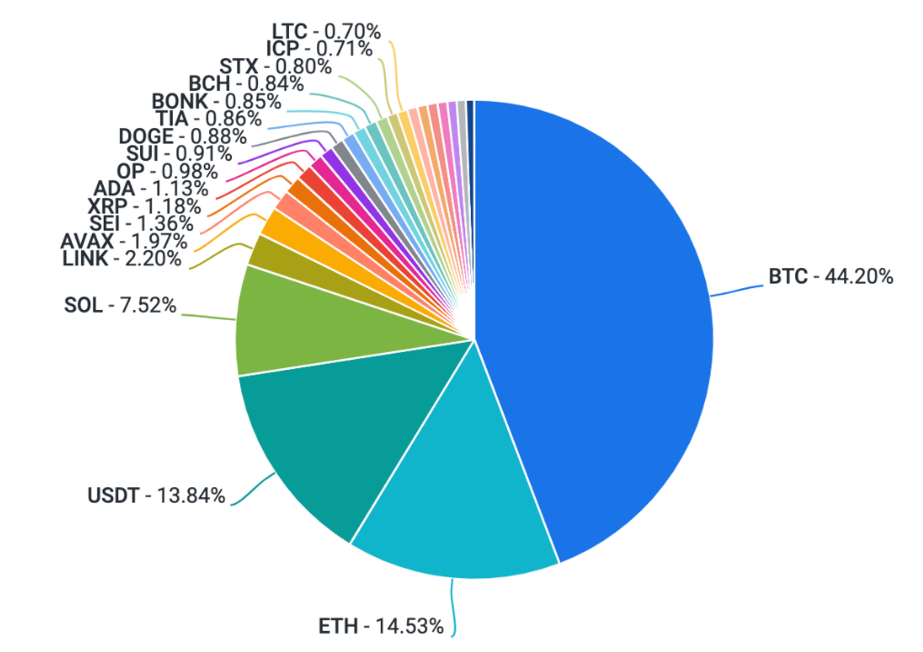
Prices continued rising this week. The absence of large-scale liquidations suggests no oversized leveraged short positions exist in the market, and this liquidity dynamic aligns roughly with client sentiment. It is difficult to find any bearish voices. Crypto-native funds continue pushing altcoins higher, while more traditional market participants add to their BTC positions. While ETH performed well this week, its liquidity remains balanced.
Coinbase Platform Trading Volume (USD)
Coinbase Platform Trading Volume (by Asset)
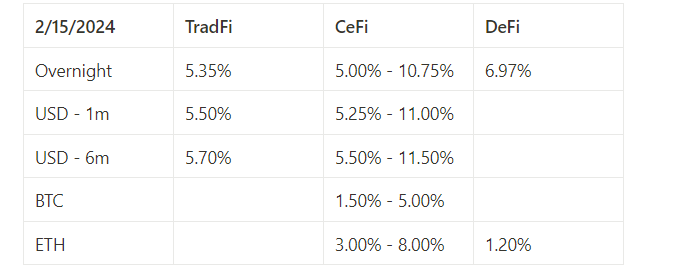
Funding Rates
Notable Crypto News
Institutional
- Genesis approved to sell $1.3 billion worth of GBTC (Bloomberg)
- Coinshares analysts say net inflows into spot Bitcoin ETFs have exceeded $4 billion since launch (The Block)
- Bitcoin ETFs are absorbing BTC at ten times the rate miners produce it (Cointelegraph)
Regulation
- Binance founder Changpeng Zhao’s sentencing delayed to April (The Block)
General
- Starknet Foundation reveals STRK token distribution plan to nearly 1.3 million eligible wallets (The Block)
Coinbase
- California voters support cryptocurrency (Coinbase Blog)
Global View
Europe
Crypto Finance, owned by Deutsche Börse, has obtained four licenses from Germany’s Federal Financial Supervisory Authority (BaFin), enhancing its ability to offer regulated digital asset services in Germany as Deutsche Börse prepares to launch an institutional-grade cryptocurrency exchange. (CoinTelegraph)
Deutsche Börse’s Crypto Finance has secured four licenses from Germany’s Federal Financial Regulatory Authority, strengthening its capacity to provide regulated digital asset services in Germany as part of Deutsche Börse’s plans to launch an institutional crypto exchange. (CoinTelegraph)
Spanish telecom giant Telefonica is partnering with Chainlink Labs to enhance security against SIM card fraud using web3 technology, leveraging the SIM SWAP API to provide additional protection for blockchain transactions. (The Block)
Asia
The Ethiopian government has partnered with a Hong Kong-based data center operator for Bitcoin mining, part of a $250 million initiative to build advanced infrastructure for data mining and AI training in Ethiopia. (CoinTelegraph)
Japan’s financial regulator has urged banks to strengthen protections against fraudulent transactions involving crypto assets. (CoinTelegraph)
South Korean game publisher Com2uS is collaborating with the Oasys blockchain to develop web3 games and expand into the Japanese market, planning to bring franchises like Summoners War: Chronicle onto the blockchain network. (The Block)
South Korea’s Financial Intelligence Unit will intensify oversight of cryptocurrency exchanges, aiming to remove non-compliant platforms from the market starting in 2024. (CoinTelegraph)
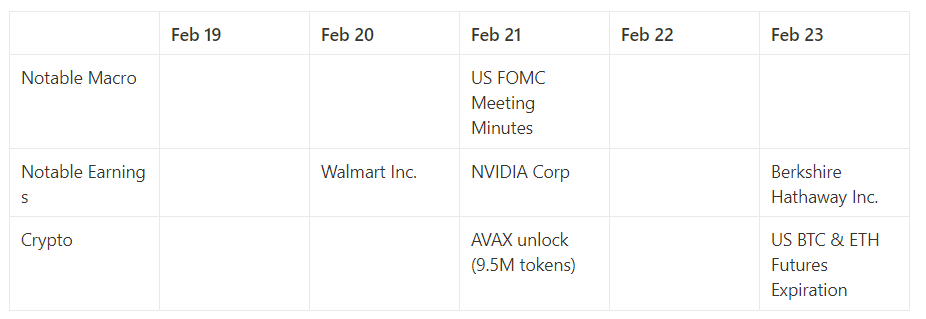
Upcoming Events Next Week
Join TechFlow official community to stay tuned
Telegram:https://t.me/TechFlowDaily
X (Twitter):https://x.com/TechFlowPost
X (Twitter) EN:https://x.com/BlockFlow_News






