In-Depth Analysis of Bitcoin Inscriptions
TechFlow Selected TechFlow Selected
In-Depth Analysis of Bitcoin Inscriptions
This article discusses the past and present of inscriptions. Behind the flourishing of technology, the cryptocurrency user community continuously raises cautious skepticism.
 Navigating Web3 tides with focused insights
Author: Joey Shin, IOSG Ventures
Introduction
Bitcoin has come a long way from its origins as "digital cash" for anonymous transactions. Since the introduction of inscriptions in 2021, Bitcoin has begun exploring new possibilities in programmable money and decentralized finance, exciting pioneers within Web3. By leveraging an expanded scripting language to enable customizable ownership logic and on-chain state, inscriptions promise to usher in a new era where Bitcoin serves as a base settlement layer for downloadable data—be it images, audio, or text. While still in early stages, inscription-based protocols have already demonstrated the potential for Bitcoin to evolve beyond a mere payment tool into a foundational layer for programmable property rights and digital ownership. However, for investors, risks remain around technical implementation, market conditions, and regulatory gray areas.
The History Behind Inscriptions
"Colored BTC"
In Bitcoin’s early days, it was used solely for peer-to-peer transactions and value storage. Starting in 2012, “colored coins” emerged—tagging satoshis to represent real-world assets such as stocks or property. This involved coloring Bitcoin’s unspent transaction outputs (UTXOs) for use in off-chain protocols. However, tracking these special coins proved unsustainable and led to bloating of Bitcoin’s UTXO set. Despite severe capacity constraints, this marked the first attempt at injecting metadata through transaction scripts.
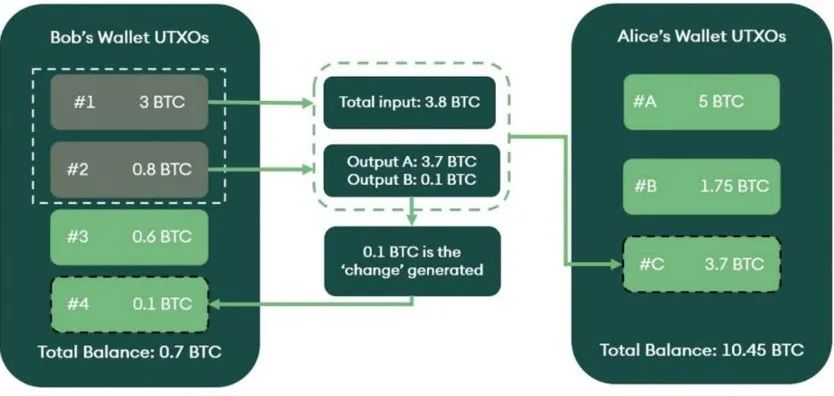
By 2014, due to the need to remove obsolete UTXO data, OP_RETURN outputs were introduced, marking 40 bytes of unspendable script space for arbitrary data. The 2017 SegWit upgrade addressed transaction malleability and block capacity limits by introducing a separate “witness block” with greater storage capacity for metadata. Bitcoin’s witness block also expanded space for embedded data scripts.
The 2021 Taproot upgrade introduced Schnorr signatures and the Merkleized Alternative Script Tree (MAST) data structure, improving efficiency, privacy, and script complexity. Schnorr signatures allow key and signature aggregation in transactions, enabling the network to process more transactions faster and cheaper. Leveraging MAST for data storage allows only executed script branches to be recorded on-chain rather than all possible execution paths, significantly reducing space usage—especially for complex transactions. Crucially, Tapscript modified Bitcoin’s scripting language to read Schnorr signatures, removing previous script size limitations and enabling complex inscription protocols to be directly encoded at Bitcoin’s base layer. After years of incremental improvements toward greater flexibility and capacity, Bitcoin is now poised for a new era of layered digital ownership within the cryptocurrency landscape.
How Inscriptions Work
The Need for Ordinal Protocol
The Ordinal protocol, created by Bitcoin core developer Casey Rodarmor, assigns a sequential number to each satoshi—the smallest unit of Bitcoin. Before the Ordinal protocol, all satoshis were fungible, with no identifiable order or unique metadata. The Ordinal specification provides a method to sequentially number each satoshi based on when it was mined or transferred, giving otherwise indistinguishable units a unique identifier based on their ordinal position.
Under the Ordinal protocol, during Bitcoin transactions, the lowest-numbered available satoshis are spent first. By consistently applying this rule across the blockchain, every existing satoshi since Bitcoin’s inception can be assigned a verifiable sequence and serial number.
Specialized Bitcoin explorers and wallets that follow the Ordinal specification use off-chain indexers to accurately display balances of ordered satoshis, allowing users to locate desired inscription sets. Users can thus precisely identify which ordinal satoshis they control and transfer specific numbered satoshis when needed.
Establishing ordinal sequencing is critical for identifying and tracking custom satoshi-based metadata like inscriptions. Without ordinals, reliably anchoring data to individual satoshis would not be possible. Therefore, Bitcoin inscription protocols heavily depend on centralized off-chain indexers to assign and verify ownership of digital artifacts linked to numbered satoshis.
BRC20—Adding Fuel to the Fire
In March 2023, an anonymous developer using the alias @domodata launched BRC-20 based on the Ordinal protocol, sparking a meme-token-driven speculative frenzy on Bitcoin. BRC20 is a token standard introduced for the Bitcoin blockchain, inspired by Ethereum’s popular ERC20 specification. It enables users to define, mint, track, and transfer customizable token supplies directly on Bitcoin’s base layer, creating tokens other than BTC on the Bitcoin blockchain.
Technically, BRC20 tokens leverage functionalities unlocked by Bitcoin inscriptions and the Ordinal protocol. Creating a BRC20 token involves generating specialized inscription data that defines token parameters and minting rules, which are then etched onto individually numbered satoshis.
A typical BRC20 deployment inscription defines attributes such as token name, total supply, and minting limits per ordinal satoshi. Subsequent inscriptions encode relevant state changes, such as issuing new token supplies or transferring tokens between addresses.
Bitcoin transactions that move these inscribed satoshis effectuate the BRC20 state changes. By tracking inscription history, BRC20-compatible wallets and block explorer software can sort events and compute current ownership balances. Thus, users can issue and exchange user-defined tokens via the underlying Bitcoin ledger.
Unlike Ethereum’s account-based token balance tracking, BRC20 relies on the chronological order of minting and transfer inscriptions sorted via the Ordinal protocol and a centralized off-chain indexer to interpret its rule set; token balance changes are not reflected as native blockchain state updates like in EVM systems. A storage mechanism originally intended for arbitrary data has evolved into an “alternative” ledger system used more traditionally. Technically non-fungible, exchanges are limited to predefined inscription sets. Overall, BRC20 delivers similar token functionality directly on Bitcoin but fails to deliver smart contract capabilities.
Overview of Inscription Technology Development
Impact on Other Projects Across EVM Chains
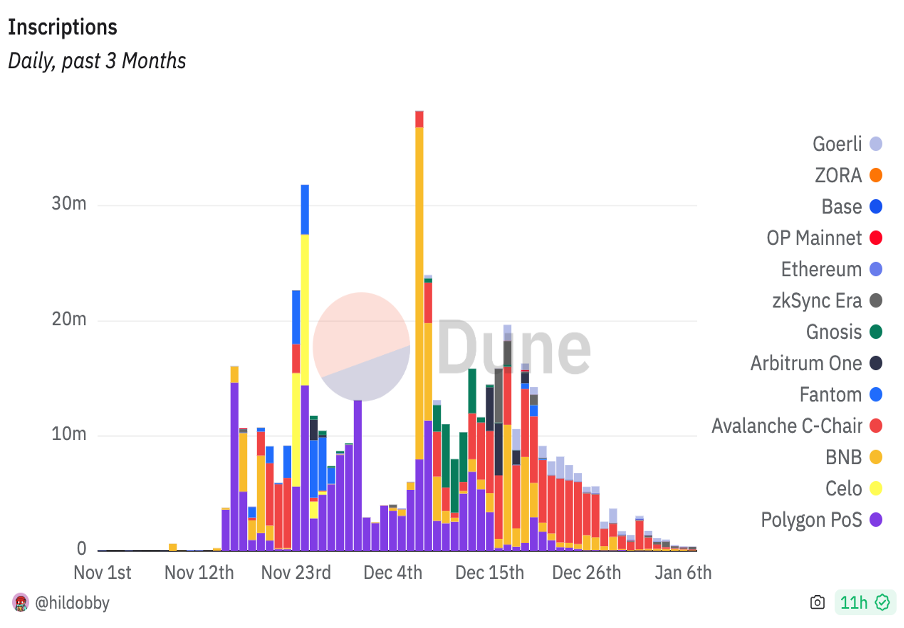
The excitement around Bitcoin inscriptions has prompted other blockchain projects to race to replicate similar features. By encoding data into calldata and relying on external indexers, networks such as Ethereum, Arbitrum, and Avalanche have begun launching inscription-like initiatives.
Compared to Bitcoin Ordinals, costs have decreased because interactions and inscription on other chains are cheaper; however, unlike smart-contract-driven NFTs on Ethereum, such approaches cannot support complex functions like royalty distribution.
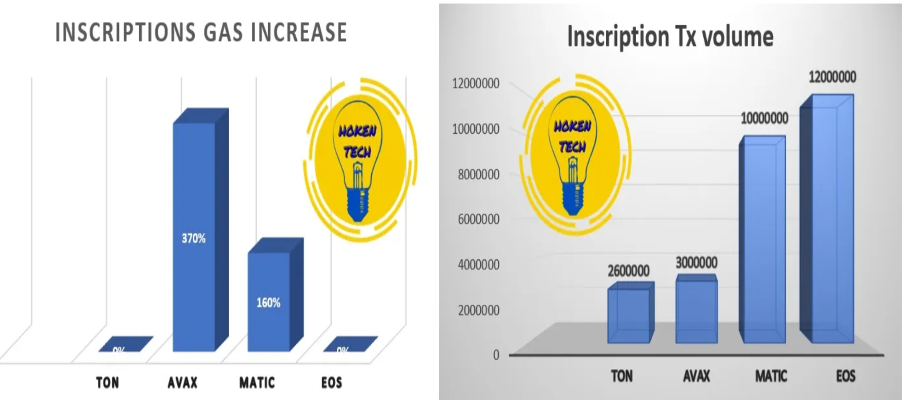
However, short-term spikes in on-chain traffic have placed significant strain on some network infrastructures. Congestion and outages on chains like Avalanche, Polygon, Arbitrum, zKSync, Near, and Cosmos during activity peaks highlight the potential risks of prioritizing speculative demand over sustainable development planning.
Overall Landscape Summary
Ordinals Data Analysis

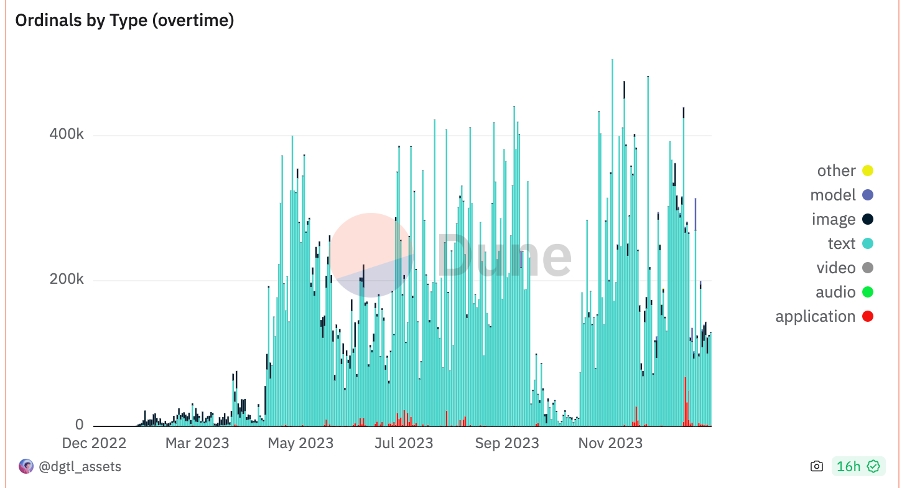
Most inscribed Ordinals are text-based, meaning they represent BRC20 tokens.
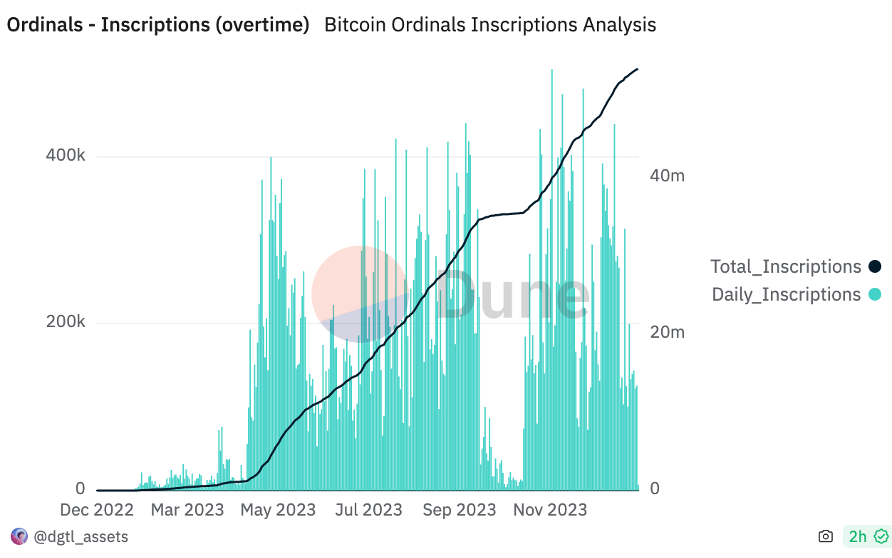
Inscription technology opens up new application scenarios in digital collectibles, tokenization, payments, and self-sovereign identity authentication backed by Bitcoin’s security. At the same time, critics point out that early tools and infrastructure related to inscriptions carry centralization risks in transaction validation, mining, wallets, and software. Additionally, legal regulation of emerging on-chain activities brings uncertainty.
Overall, while Bitcoin inscriptions offer compelling possibilities, sustainable infrastructure and fair governance mechanisms remain crucial as usage increases.
Sustainability Analysis
Trend Review
Looking back at recent precedents offers insights into growth trajectories for emerging innovations like Bitcoin inscriptions. Two prior cryptocurrency trends show clear similarities—the rise and fall of algorithmic stablecoins and the NFT boom of 2021.
Algorithmic stablecoins promised price stability without collateral through complex incentive mechanisms. However, complicated tokenomics confused many users drawn in by speculation rather than utility. Users were primarily attracted by consumer-facing benefits like zero collateral requirements. But as market conditions shifted, projects like TerraUSD failed to maintain their dollar peg during loss of confidence in May 2022.
Similarly, the NFT trend rapidly lost momentum after the hype faded, despite being briefly flooded with attention. Users struggled to find practical uses matching the scale of promotion. Maintaining market share increasingly depended on building real applications before user interest shifted elsewhere.
Unless inscription applications go beyond pure speculative demand, they appear to be heading down a similar path. Integrating inscriptions into solving real needs—such as transparency, credentials, identity verification, and content authentication—seems essential to avoid repeating previous boom-and-bust cycles.
Through continuous community development, sustainable utility can be cultivated while avoiding past mistakes, but technological innovation must be complemented by equitable integration with real-world use cases.
Overall Market Analysis
Beyond infrastructure limitations, Bitcoin inscriptions face barriers to broader adoption. Hype cycles around applications such as NFT collectibles or meme tokens may be intense but prove fleeting, lacking foundational utility and failing to sustain long-term appeal.
The sparse, spiky nature of inscription transactions highlighted earlier also underscores the relative immaturity of current inscription-based products. Critics note that compared to mature Web3 domains like decentralized finance, the quality of these protocols and user experiences is lower. To move beyond niche appeal, accessibility and functionality must improve.
Moreover, questions remain: Do these emerging experiments transcend financial speculation? Projects focused solely on minting tokenized derivatives without practical utility may remain confined to crypto traders and struggle to reach mainstream markets.
Additionally, legal jurisdictions are only beginning to understand crypto-native ownership models, and excessive intervention could stifle innovation.
Overall, Bitcoin inscriptions present compelling potential, but as usage grows, ensuring broad access, durable infrastructure, and fair governance becomes increasingly important.
Technical Deficiency Analysis
Despite technological innovations like Taproot opening new possibilities for inscription-based protocols, scaling the infrastructure for these concepts faces certain limitations.
First, the rapid growth in the number of inscriptions may impact the performance of Bitcoin’s base layer. Adding non-transactional data to the UTXO set ultimately affects storage capacity, bandwidth, and computational demands—particularly for network nodes. Although storage technology has advanced significantly, internet bandwidth development has not kept pace. This could hinder node participation by substantially increasing the time and cost of initial block download (IBD), potentially limiting Bitcoin’s originally appealing scalability and usability.
Furthermore, complex inscription rule sets and scripts, if not rigorously audited, may introduce cybersecurity risks. Attack methods exploiting disguised inscription logic have already appeared in vulnerability databases—inscriptions have recently been listed as a cybersecurity risk in the National Vulnerability Database (NVD). Rigorous auditing and formal verification of inscription architectures are especially critical.
There is also the issue of indexer centralization. Tools provide interfaces to access inscription-based networks. Since BRC20 and the Ordinal protocol do not reflect token balance changes on-chain, they rely on off-chain, centralized indexers—systems dependent on proprietary indexing to decode on-chain transaction data into readable, intuitive formats.
Arguably, BRC20 expanded the capabilities of Bitcoin inscriptions too quickly, compromising reliability, security, and trust in decentralization at this stage. In contrast, focusing on immutable data anchoring presents fewer risks than over-engineered tokenization abstractions reliant on external indexers.
Final Thoughts
The above analysis is not meant to diminish the value of current inscription products. Especially on Bitcoin, they offer more diverse use cases, enriching its culture and ecosystem activity. For EVM chains, inscriptions provide a cheaper, more secure on-chain alternative to existing NFTs, capable of storing any type of data—even code—an attractive option for crypto users.
However, for the overall Bitcoin ecosystem, drawbacks include low sustained appeal, technical immaturity, lack of utility, security threats, and patterns observed in prior trends. These factors make widespread adoption very difficult. They can be used to surpass current NFT standards and attract niche traders—such as through NFTFi or better user engagement incentives (like airdrops)—but are insufficient to become leaders within the crypto ecosystem.
Despite growing pains in both technical and real-world application integration, inscriptions appear poised to unlock Bitcoin’s future potential beyond payments. While inscriptions seem to set a direction for reshaping digital asset ownership structures through tokens, collectibles, and data anchoring, achieving this requires overcoming numerous challenges—including infrastructure limits, legal uncertainty, miner centralization pressures, and risks related to genuine economic utility.
For investors, distinguishing between sustainable platforms and mere "hype" is crucial when making speculative investments in key inscription protocols and services during these early stages. As Bitcoin transitions from initial experimentation toward mature real-world applications in its evolution as a programmable monetary network, we must maintain cautious skepticism and temper blind market enthusiasm.
Join TechFlow official community to stay tuned
Telegram:https://t.me/TechFlowDaily
X (Twitter):https://x.com/TechFlowPost
X (Twitter) EN:https://x.com/BlockFlow_News
 IOSG Ventures