Where does sustainable demand for Celestia come from after completing RaaS integration?
TechFlow Selected TechFlow Selected
Where does sustainable demand for Celestia come from after completing RaaS integration?
Small demand isn't an issue, but cost could be a long-term problem.
 Navigating Web3 tides with focused insights
Written by: @smyyguy
Translated by: Luccy, BlockBeats
Editor's Note: In this article, @smyyguy discusses Celestia’s significant success in integration and marketing, pointing out that a large number of chains launched via RaaS will emerge in the coming months. @smyyguy believes Celestia is an excellent choice for those building rollups, offering multiple options for use. However, he also notes that most rollups built via RaaS won't provide much real user demand. BlockBeats translates the full article as follows:
I’ve spent some time analyzing Celestia data and have a few thoughts on what lies ahead.
Key Takeaways
-
Current demand is extremely low, but that’s not a problem—the team has successfully completed RaaS integrations.
-
Fees could become a long-term issue—where will sustainable demand come from?
-
First-price auctions are inefficient, and Manta is proving why.
Users can access the full dashboard.
Background
Celestia was specifically built to serve as a DA network. Compared to Ethereum mainnet—the current industry leader in DA layers—it reduces rollup data costs by 99.9%.
Users can publish arbitrary data to "blobs" using assigned "namespaces." A blob contains the data and other key information, including the namespace which serves as the blob’s ID. Users can then access the data by querying Celestia’s "blobspace" and filtering for a specific namespace.
Namespaces can be hex-encoded, base64-encoded, or plain text strings. Application developers can directly utilize plain text strings, making it easy to identify which namespace a rollup publishes to.
Current On-chain Activity
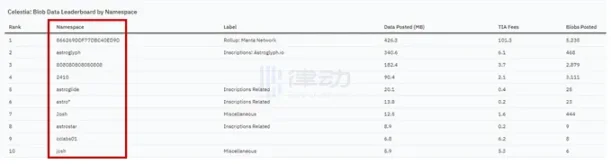
Celestia launched just two months ago. So far, users have published data to a total of 56 namespaces. We observe 3–6 namespaces receiving 30–50 MB of data per day.
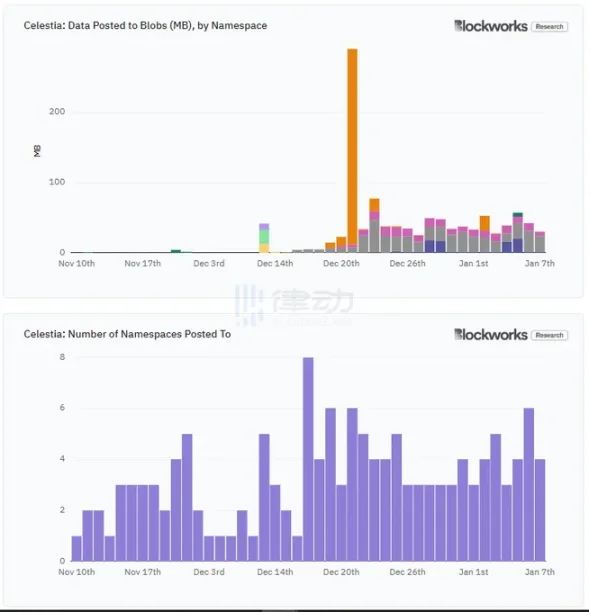
87% of all data posted to Celestia goes to just three namespaces:
@astroglyph_io, an inscription service allowing users to post arbitrary data onto Celestia; @MantaNetwork, an OP Stack rollup launched alongside @Calderaxyz; 808080808080808, an unknown namespace that appears to belong to a rollup.
In contrast, Ethereum mainnet currently hosts around 15 rollups publishing ~700 MB/day, with Arbitrum and OP Mainnet contributing ~120 MB/day and ~80 MB/day respectively. After EIP-4844 launches, Ethereum will initially support up to 5,400 MB/day.
While Ethereum prioritizes scarce block space, Celestia is built on abundant block space. The network has a 15-second block time and 8 MB block size, currently supporting up to 46,080 MB/day. In other words, Celestia is currently utilizing only 0.1% of its data capacity. For a chain created just two months ago, I wouldn’t interpret a 0.1% utilization rate as a worrying sign of weak demand.
Fees
With current data usage at 0.1%, total fees are naturally low. Celestia generates about 5 TIA (~$65) in daily fees. This means users pay between 0.024–0.24 TIA (or $0.31–$3.12) per MB of data published.
Fees are low today, but what about the future? If Celestia achieves full daily data capacity of 46,080 MB at a TIA price of $13, the network would generate approximately $5.2 million in annual fees—65 times more than the current amount of data being posted to Ethereum.
If growth continues, users may be forced into bidding wars, driving fees upward as price tolerance increases. The network could vote to increase block size beyond 8 MB, though this is limited by the number of light nodes and Cosmos SDK bottlenecks.
User Demand
So where will this 65-fold increase in demand come from?
-
High-TPS general-purpose chains?
-
A wave of app-specific rollups?
-
Game-focused chains?
It's hard to say, but even so, fees remain negligible relative to the current valuation. But just because you can't point to today’s sources of demand and definitively say this is what will drive Celestia’s future growth doesn’t mean it won’t happen.
My guess is that gaming + high-TPS rollups will suffice. EIP-4844 doesn’t seem to enable sub-cent transaction L2s, but Celestia does.
IMO, this is a big deal. Clearly, we’ll see a surge of chains leveraging Celestia through RaaS in the coming months. The Celestia team has absolutely nailed their integration and marketing. Anyone building a rollup knows about Celestia—and has the option to use it.
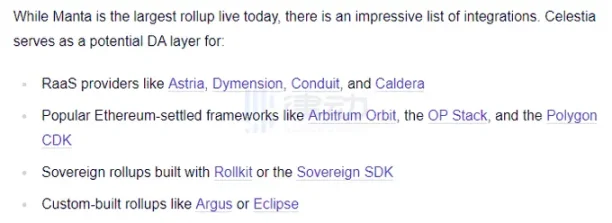
But judging from early trends, most RaaS-built rollups won’t offer users much value. So where will sustainable DA demand come from?
Fee Mechanism
You may also notice variation in the fees users pay to publish data. It’s largely driven by @MantaNetwork, which pays about 10x more than others!
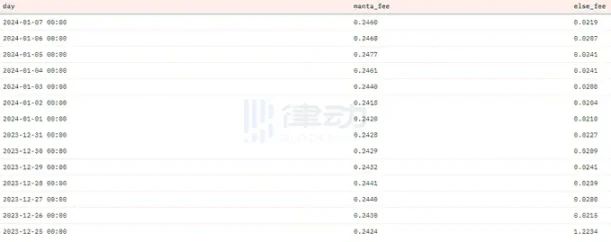
Celestia uses a simple first-price auction fee mechanism, similar to Ethereum pre-EIP-1559. This suboptimal design fails to give users a straightforward way to bid fair inclusion prices, leading to bidding wars and overpayment for block space.
Since Celestia is purpose-built for DA, there are no competing transaction types or high-value DeFi transactions inflating DA posting gas costs, which mitigates most concerns about the fee model.
Once existing data capacity is maxed out, stronger mechanisms can be prioritized.
In summary, I’m excited about what Celestia is doing. They have a strong team, strong vision, and strong product. I’m not worried about low fees today, but I do think they need to keep iterating on this. Integrating with other products might make sense.
Join TechFlow official community to stay tuned
Telegram:https://t.me/TechFlowDaily
X (Twitter):https://x.com/TechFlowPost
X (Twitter) EN:https://x.com/BlockFlow_News
 @smyyguy