Bitcoin Must-Read Guide II: The Past and Present of the UTXO Model
TechFlow Selected TechFlow Selected
Bitcoin Must-Read Guide II: The Past and Present of the UTXO Model
UTXO can not only assist the consensus mechanism in solving the double-spending problem in blockchain, but also endows blockchain with traceability.
 Navigating Web3 tides with focused insights
Author: Echo, BiHelix; Satoshi Labs
Advisor: Hong Shuning
Introduction
"UTXO blockchains lay the foundation and undisputed cornerstone of today's blockchain industry. The UTXO technology reflects Satoshi Nakamoto's core vision for ultimate financial freedom. The UTXO model ensures security, data privacy, and scalability at the heart of financial activities, making it a safer alternative to Ethereum's account model."
Blockchain Principles: Foundations of the UTXO Model
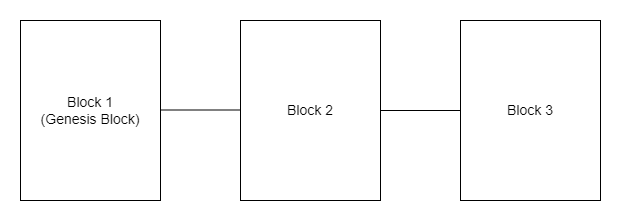
A blockchain is a digital, decentralized, distributed ledger. It uses a peer-to-peer (P2P) network where participants are known as nodes. The ledger stores transaction data. The most critical feature of a blockchain is that blocks are cryptographically linked together.
Blockchain: Cryptographically Linked
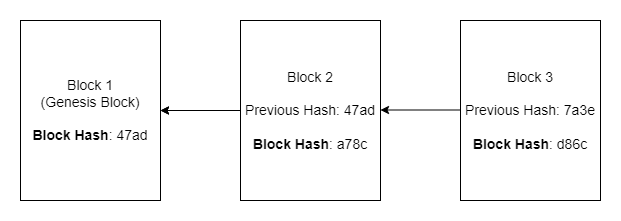
• Except for the first block (called the genesis block), each block in the blockchain contains a field called "previous hash." This is the hash value of the previous block in the chain and forms the basis of blockchain security.
• Factors determining a block's hash. Any change in one of these four factors—even by a single bit—will completely alter the hash due to the avalanche effect. Transactions stored within a block are one of these four factors. This means if a miner selects different transactions while keeping the other four factors identical, the resulting hash will differ.
1. Timestamp
2. Block Number: The sequential number of the current block in the chain.
3. Data: Transactions stored on the block.
4. Nonce
• If an attacker attempts to modify the data in a block, its hash will change. Since the next block contains the hash of the current block, such a change would break the chain. Alternatively, the attacker would have to re-mine all subsequent blocks from that point onward—a scenario possible in a 51% attack.
What Is a “Block”?
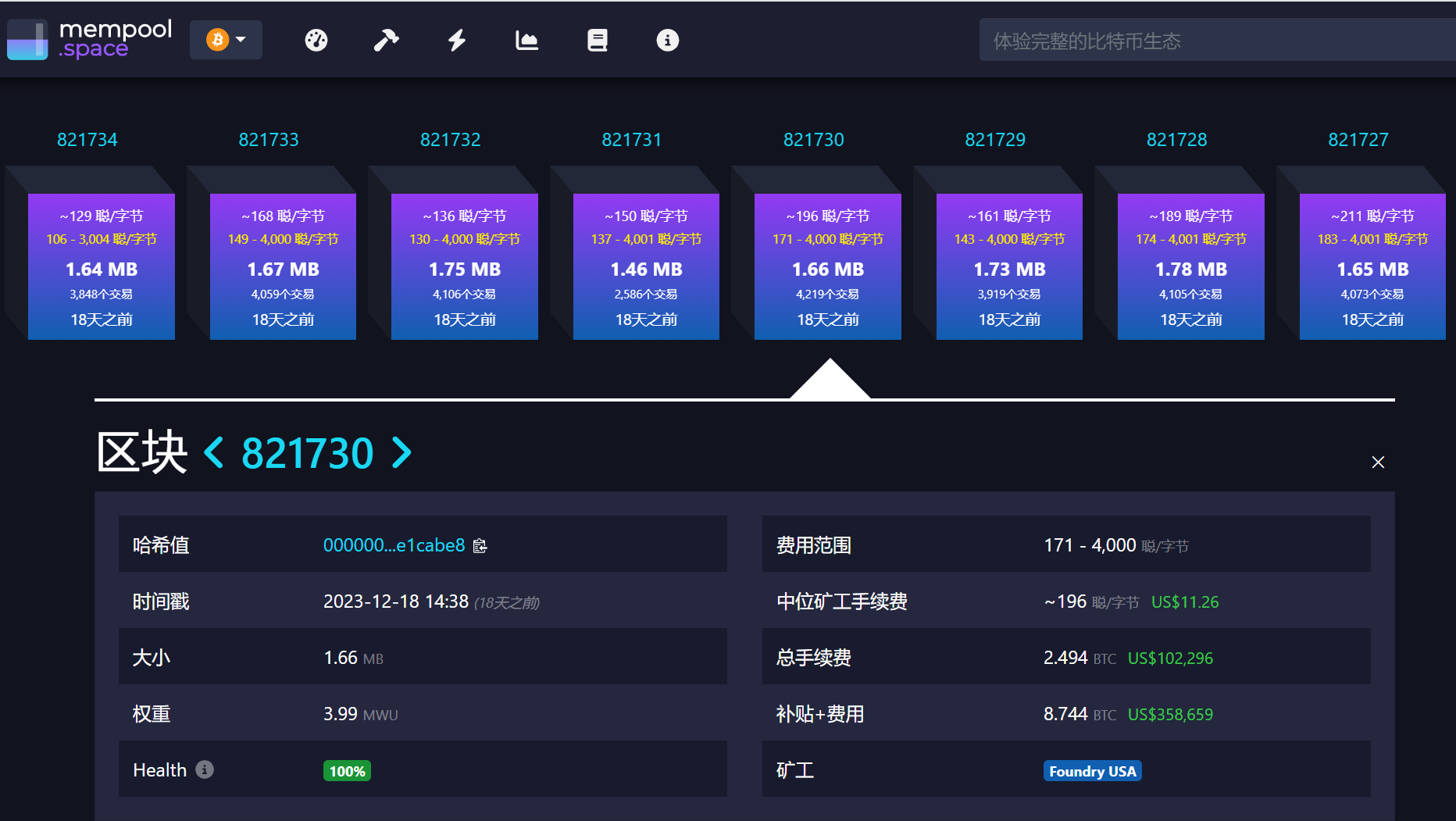
Blocks in a blockchain store transactions. In Bitcoin’s case, a new block is added approximately every 10 minutes, although mining time may vary depending on the difficulty of achieving the target hash.
• When a miner successfully mines a block, it is added to the blockchain. Once added, all transactions within the block transition from unconfirmed to confirmed status.
• For Bitcoin, the number of transactions per block is not fixed, but the average block size is around 1 MB.
• Empty blocks are valid, meaning they can be mined and added to the chain.
Blockchain Transaction Structure
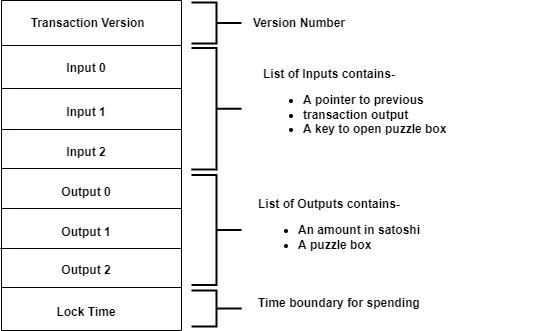
Dissecting a single transaction reveals several distinct structures with different semantics. Below are the components present in a transaction:
1. Transaction Version Number: A version identifier specifying the transaction type to the network. Nodes use this number to determine the rule set for validating the specific transaction.
2. Output: Composed of a cryptographic lock and timestamp.
3. Input: Consists of a pointer and an unlocking key. The pointer references a prior transaction output, and the unlocking key is used to unlock that referenced output. Each time an output is unlocked via an input, it is marked as spent in the blockchain database.
4. Locktime: Specifies whether the transaction can be included immediately or only after a certain time.
UTXOs are all outputs that have not yet been unlocked by any input.
Once an output is unlocked, it is removed from circulation. New outputs replace them. Therefore, the sum of unlocked outputs always equals the total value of newly created outputs.
What Is the UTXO Model?
UTXO is not a cryptocurrency denomination like satoshi for Bitcoin (BTC) or gwei for Ethereum (ETH); however, UTXOs can be measured using these denominations. UTXO stands for Unspent Transaction Output. In Bitcoin, a transaction remains active until another transaction spends that UTXO. When a transaction completes, the unused output is recorded back into the database as an input, which can later be used in another transaction.
When a user initiates a transaction through a wallet, the UTXO containing the transaction information is located, unlocked, and associated with the new owner's details. The user can then reuse these UTXOs in future transactions. As transactions continue, the database accumulates records of ownership changes. Outputs represent portions of cryptocurrency sent to someone but not yet spent. They are recorded in the database as fractional inputs of cryptocurrency.
How Are UTXOs Created?
UTXOs are created by consuming existing UTXOs. Every Bitcoin transaction consists of inputs and outputs. Inputs consume existing UTXOs, while outputs create new UTXOs. When spending Bitcoin, users only see the deducted amount and remaining balance in their wallet. This process resembles paying $0.50 with a $1 bill and receiving change, which is then kept in one's pocket.
Advantages of the UTXO Model
The UTXO model does not include wallets at the protocol level. It operates based on individual transactions grouped into blocks. The UTXO model is a common design among many cryptocurrencies, especially Bitcoin.
• Cryptocurrencies using the UTXO model do not use accounts or balances. Instead, UTXOs transfer between users much like physical cash.
• Each transaction in the UTXO model could theoretically transition the system into a new state, but doing so for every transaction is impractical.
• Network participants must remain synchronized with the current state.
The total set of UTXOs in the blockchain represents a collective dataset, continuously maintained by every Bitcoin node.
• Each transaction consumes elements from this set and creates new ones to be added. Whenever a new block is accepted into the blockchain, the UTXO set is updated, and every Bitcoin node maintains an exact local copy of the UTXO set.
• The complete UTXO set can be summed to calculate the total cryptocurrency supply at any given moment. In valid blockchain transactions, only unspent outputs can fund further transactions. Preventing double-spending and fraud requires ensuring only unspent outputs are eligible for future use.
Differences Between the UTXO Model and Ethereum’s Account Model

Unspent Transaction Outputs are part of the distributed database technology behind Bitcoin and other cryptocurrencies. Bitcoin uses UTXO, but it is not synonymous with UTXO. Furthermore, Ethereum employs an account-based approach with account balances, meaning there are no UTXOs within the Ethereum Virtual Machine.
Technical Significance of UTXO
• Language-Independent Smart Contracts: UTXO-based smart contracts are language-agnostic, enabling unique consensus mechanisms in UTXO systems.
• Support for Decentralized Exchanges and Atomic Swaps: The UTXO model supports atomic swaps, enabling peer-to-peer cryptocurrency exchanges without third-party intermediaries. This atomic swap capability enhances convenience for direct crypto transfers between user wallets.
• Scalability Advantages: Enables facility or parallel transaction processing, reducing computational load on the blockchain network.
• Privacy and Security: Each UTXO transaction uses a new address, making transaction tracking impossible.
• Prevention of Double-Spending: A UTXO can only be spent once—this principle underpins blockchain operation and ensures money cannot be reused.
• Greater Flexibility: Offers more flexibility than fiat currency systems.
• Simpler Parallelization: Allows simpler parallelization of transactions within smart contracts.
The UTXO model is used by many cryptocurrencies because it allows users to track ownership of all parts of the currency. Since anonymity was considered during cryptocurrency design, UTXOs are associated with public addresses visible across the entire network.
Unless a user publicly discloses their address, they cannot be identified by ownership, though the model enables transparency through address visibility.
UTXO Use Case Application—RGB Off-Chain Transfer Scheme
The core idea of the RGB protocol is to invoke the Bitcoin blockchain only when necessary—leveraging proof-of-work and network decentralization solely for protection against double-spending and censorship resistance. All validation work for token transfers is removed from the global consensus layer and moved off-chain, verified exclusively by the recipient's client software.
How It Works:
In a given RGB contract, the genesis tokens belong to a Bitcoin UTXO (either pre-existing or temporarily created). To transfer tokens, you must spend this UTXO. When spending it, the Bitcoin transaction must include an additional output containing a commitment to a message. This message includes the RGB payment details—specifying the inputs, which UTXO the tokens will be sent to, the asset ID, quantity, the spending transaction, and any required auxiliary data.
Conclusion
At its core, UTXO functions as a ledger-style accounting method: using the UTXO model to verify the existence of transaction funds, trace the origin of the transaction, confirm validity, broadcast across the network via consensus, and record on-chain. Throughout this process, UTXO logs all relevant information—including involved account funds, transaction addresses, transferred amounts, and funding sources—enabling full traceability of every transaction back to its source. Precisely because of this characteristic, UTXO, combined with consensus mechanisms, effectively resolves double-spending issues. The security and integrity of transaction information in the RGB protocol are guaranteed through UTXO.
Overall, UTXO not only assists consensus mechanisms in solving blockchain double-spending problems but also imparts traceability to blockchain systems. Based on this, blockchain ensures the authenticity and reliability of every transaction.
Join TechFlow official community to stay tuned
Telegram:https://t.me/TechFlowDaily
X (Twitter):https://x.com/TechFlowPost
X (Twitter) EN:https://x.com/BlockFlow_News
 @BiHelix_