Ethereum 2024 Roadmap Update and Outlook on EIP Improvement Proposals
TechFlow Selected TechFlow Selected
Ethereum 2024 Roadmap Update and Outlook on EIP Improvement Proposals
2024 will be an important year for Ethereum to continue exploring innovation and technological upgrades.
 Navigating Web3 tides with focused insights
Author: Ebunker
Ethereum Roadmap Update
On December 30, 2023, Ethereum co-founder Vitalik Buterin shared the 2024 Ethereum roadmap on the X social network, detailing upcoming upgrades and developments for the Ethereum network. According to a series of charts he listed, Ethereum’s ongoing focus in 2024 includes six major components: The Merge, The Surge, The Scourge, The Verge, The Purge, and The Splurge.
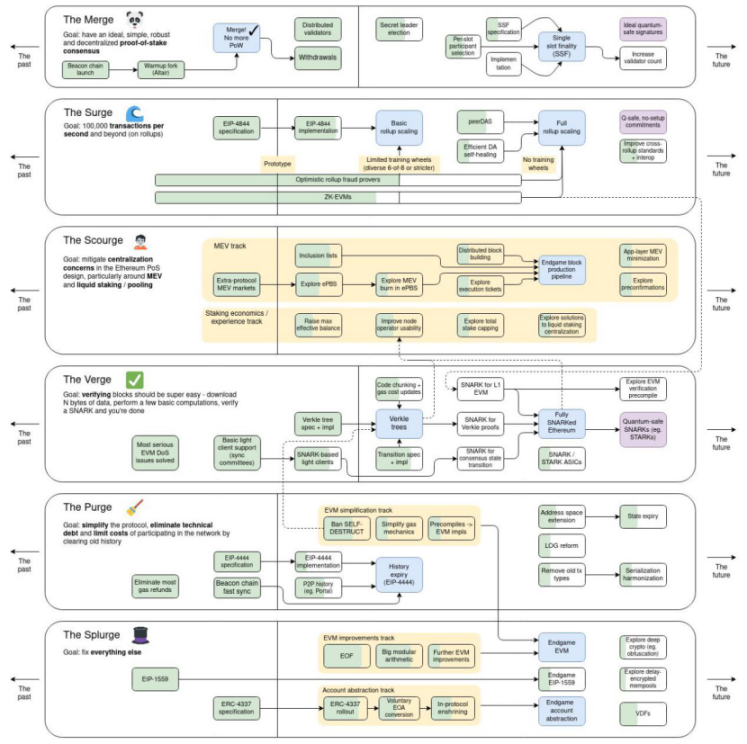
(1) The Merge is highlighted as a key part of the roadmap, aiming to maintain a simple and resilient proof-of-stake (PoS) consensus mechanism. It occurred in September 2022, merging the Ethereum mainnet with the PoS Beacon Chain. Since the Merge, priority has been given to implementing Single Slot Finality (SSF). SSF enables more efficient block validation within Ethereum's consensus mechanism by allowing blocks to be proposed and finalized within the same slot, thereby reducing transaction latency. After Ethereum’s transition from proof-of-work (PoW) to PoS, SSF will serve as a critical solution to address current weaknesses in Ethereum’s consensus system.
(2) The Surge aims to achieve a throughput of 100,000 transactions per second across Ethereum and Layer 2 networks, enhancing blockchain scalability. Cross-rollup standards and interoperability have been emphasized by the Ethereum development team as long-term improvement areas, with significant progress expected this year on EIP-4844 and rollup scalability itself.
(3) The Scourge focuses on mitigating risks associated with Maximum Extractable Value (MEV), liquid staking pools, and rollups, addressing concerns about economic centralization within the Ethereum ecosystem. Vitalik Buterin previously suggested lowering node operation costs to tackle related challenges. Currently, Verkle Trees are ready—verifying blocks will only require downloading a few bytes of data, performing basic computations, and validating succinct non-interactive arguments of knowledge (SNARKs). The network will continue exploring EVM-verified precompiles to achieve a fully SNARKified Ethereum network.
(4) The Verge aims to make block verification easier and more efficient. As on-chain transaction volume continues to grow, this optimization is crucial for maintaining Ethereum’s scalability. The roadmap has removed the item "increase L1 gas limit," allowing gas limits to be raised flexibly, reflecting an adaptive approach to network capacity management.
(5) The Purge aims to simplify the protocol, making it more developer-friendly and accessible. This simplification will eliminate technical debt and reduce network participation costs, expected to improve overall functionality and usability of the Ethereum network.
(6) The Splurge encompasses all other elements critical to Ethereum’s growth, such as ecosystem sustainability and human coordination, reflecting Ethereum’s commitment to nurturing and supporting its vibrant community.
Outlook on EIP Improvement Proposals
Ethereum is set to undergo the Dencun hard fork upgrade in the first quarter of 2024. Core Ethereum developers have already established a timeline for the Dencun upgrade. Barring any major issues, Ethereum’s public testnets will proceed according to the following tentative schedule:
-
Goerli: January 17
-
Sepolia: January 30
-
Holesky: February 7
This will be the last time Goerli is included in the testing plan, as the network is soon to be deprecated. This move is part of the strategy to activate Dencun on the Ethereum mainnet in January 2024, marking a significant advancement in its technical capabilities.
Core developers also discussed the yet-to-be-named Prague/Electra upgrade. The Ethereum community is considering whether to focus on one large core feature (potentially requiring a year of effort) or proceed with multiple smaller upgrades (achievable in the second half of 2024).
Overall, 2024 will be a year of groundbreaking improvement proposals for Ethereum. Below are some key proposals worth watching:
(1) EIP-4844 (Proto-Danksharding)
EIP-4844 is the centerpiece among the many proposals in the Dencun upgrade and the most anticipated by the market. Its primary goal is to reduce gas fees on Layer 2 networks—especially for rollup solutions—without sacrificing decentralization.
The Dencun upgrade will lower data availability costs for all L2s—a highly anticipated development that will further reduce end-user expenses. EIP-4844 is a transformative enhancement proposal expected to reduce rollup gas fees by up to 100x.
(2) ERC-4337, ERC-6900 (Account Abstraction)
Account abstraction is another major improvement proposal, including ERC-4337 and its extension ERC-6900. Centered around the concept of smart accounts, account abstraction significantly impacts the end-user experience by reducing transaction costs and enabling secure social logins. ERCs are a subset of EIPs specifically focused on token standards within the Ethereum ecosystem. They define rules for how tokens operate to ensure interoperability. Unlike EIPs, which modify the core protocol, ERCs typically do not require a hard fork.
ERC-4337 is scheduled for March this year. The concept of account abstraction will bring significant changes and play a pivotal role for end users. It will fundamentally transform how users perceive and interact with crypto wallets, making gasless transactions standard and secure social logins the new norm—essentially reshaping the Ethereum user experience.
Traditionally, Ethereum has two types of accounts: externally owned accounts (EOAs), controlled by private keys, and contract accounts, controlled by code. Account abstraction blurs this distinction, allowing users to create accounts that behave more like smart contracts. This enhances user experience and security, and enables more complex account logic, such as multi-signature wallets or social recovery for lost keys.
ERC-6900 introduces the concept of “delegated transactions.” This standard does not require changes to Ethereum’s mainnet consensus and allows users to delegate representatives to send transactions—for example, approving a set of operations to save time and effort.
(3) EIP-1153 (Transient Storage Opcodes)
EIP-1153 is part of the Dencun upgrade and aims to introduce a new mechanism for handling temporary or transient storage during smart contract execution. Traditional storage operations on Ethereum are permanent and consume gas, which can be inefficient for temporary data that doesn’t need to persist beyond a single transaction. EIP-1153 is an opcode that will allow smart contracts to use transient storage, automatically clearing stored data at the end of a transaction’s execution.
The Uniswap team actively advocated for EIP-1153, hoping for its implementation in the Shanghai upgrade, but failed to gain enough support among core Ethereum developers to reach consensus. The upgrade is expected to play a significant role in enhancing the capabilities and efficiency of the Uniswap V4 protocol.
By enabling transient storage, EIP-1153 can reduce gas costs associated with storing data during contract execution and provide developers with greater flexibility in designing smart contracts. By alleviating the burden of permanent storage and minimizing state bloat, EIP-1153 also contributes to Ethereum’s overall scalability.
(4) EIP-4788 (Beacon Block Root Inclusion)
Imagine Ethereum as a massive library with two main sections: the first is the Ethereum Virtual Machine (EVM), functioning like a reading room where people come to read books (execute smart contracts); the second is the Beacon Chain, acting like the library’s catalog system, tracking all books and their locations (consensus and coordination on the Ethereum network).
Before EIP-4788, these two systems operated relatively independently. The EVM could not directly access the latest catalog and had to rely on indirect methods to learn what was happening on the Beacon Chain. EIP-4788 proposes embedding the Beacon block root (a summary or Merkle root hash of the parent block) into every EVM block. This is equivalent to upgrading an outdated card filing system—inefficient and error-prone—to a real-time, accurate system with direct links to the main database.
In this modern library system, whenever a book is added, moved, or removed (a Beacon Chain update), readers (the EVM) receive instant updates. Readers can trust the latest information they receive, and library operations (such as executing smart contracts) remain tightly synchronized with the overall catalog system (the state of the consensus layer).
This entire process occurs with minimal trust requirements, eliminating the need for external oracles to supply this data and thereby reducing potential points of failure or manipulation. EIP-4788 introduces a protocol-level oracle that broadcasts Ethereum’s consensus state across the entire mainnet. This change is particularly beneficial for liquid staking protocols like Lido, as well as smart contract-based bridges and restaking solutions, as it allows them to directly access critical data such as validator balances and states from the consensus layer—improving both security and operational efficiency.
(5) EIP-5656 (MCOPY Opcode)
The EVM operates using a set of opcodes that dictate various operations. EIP-5656 introduces a new opcode called MCOPY, which optimizes the process of copying data in memory during smart contract execution.
Using existing opcodes under the current EVM architecture is inefficient when copying large segments of data. MCOPY offers a more efficient alternative, expected to reduce gas fees associated with these operations while improving performance. Faster memory operations mean quicker contract execution, giving developers better tools to optimize their smart contracts—especially when dealing with large data structures or complex operations involving memory.
(6) EIP-6780 (Limiting SELFDESTRUCT)
On the Ethereum blockchain, the SELFDESTRUCT opcode allows a smart contract to remove itself from the blockchain. Upon execution, it deletes the contract’s code and state storage, sending any remaining ETH in the contract to a designated address. However, this feature has led to several issues, including complexity in state management and potential security vulnerabilities.
By limiting SELFDESTRUCT, Ethereum can better manage its state size, making the blockchain more stable and predictable. This is crucial for long-term scalability and maintenance, as it will simplify future Ethereum upgrades.
In summary, the 2024 Ethereum roadmap update and key EIP proposals demonstrate Ethereum’s adaptability to industry changes and present a clear vision for enhancing scalability while ensuring robust operation. 2024 is poised to be a pivotal year for Ethereum as it continues to explore innovation and technological advancement.
Join TechFlow official community to stay tuned
Telegram:https://t.me/TechFlowDaily
X (Twitter):https://x.com/TechFlowPost
X (Twitter) EN:https://x.com/BlockFlow_News
 @ebunker_eth