








Hash Global founder KK: Web3 product philosophy and investment practice
TechFlow Selected TechFlow Selected
Hash Global founder KK: Web3 product philosophy and investment practice
One Cat Island may not rival a major Web2 application, but what about ten or a hundred "Cat Islands" uniting to return data ownership to content creators and users?
 Navigating Web3 tides with focused insights
Author: KK, Founder of Hash Global & Cat Island

Hello everyone, I'm KK, founder of Hash Global. We don't just do investments—we also skin in the game by incubating and building products. Our goal is singular: to work with others in the industry to drive Web3 mass adoption.
At the beginning of this year, we predicted that Web3 would achieve mass adoption between 2023 and 2025 in three key areas: Web3 gaming, DePIN, and NFT applications for private traffic management. As a result, we adjusted our investment focus accordingly (see original article on our website: www.hashglobal.io).
Today’s piece shares our product philosophy—it's also a report card of Hash Global’s work over the past year. We sincerely welcome feedback from peers and entrepreneurs, hoping to exchange ideas and grow together!
The core of Web3 technology lies in a major innovation in accounting methods—the last breakthrough being double-entry bookkeeping, which underpinned modern trade and capital markets. Bitcoin's blockchain offers a truly internet-native and digitally-economy-aligned way of record-keeping. Without a revolution in data recording, efficiency-driven competition will push the internet economy toward increasing centralization and oligopoly. To remove platforms and intermediaries, data must be recorded on a public ledger—not within a single tech company’s database.
Product Principle 1: An internet product can only be considered a Web3 product if it records operational data on a public ledger (practical implementation can be phased). This public ledger refers to a tamper-proof, transparent blockchain. Gaming, DePIN, and NFTs are the three application categories most capable of delivering to Web2 users the new experience of owning their own data.
Product Principle 2: We shouldn’t build for Web3’s sake—we must create real monetary value and deliver superior user experiences compared to Web2. Only then does a Web3 product have meaning. Users don’t care about the Web3 narratives or concepts we pitch.
Our envisioned path to Web3 mass adoption unfolds as follows:
-
Enable users to start using Web3 products seamlessly (beyond zero门槛—truly frictionless);
-
Users begin accumulating vast amounts of behavioral data invisibly (e.g., watched a musical twice about meme culture, viewed five shows by Ci Nian, listened to ten episodes of Xian Ning Qi podcast, stayed twenty times at Han Ting, collected idol cards from a favorite star…), all stored on-chain via NFTs as data carriers;
-
Web3 products must immediately and tangibly deliver “benefits” or “convenience” to both B2B and consumer users—something Web2 cannot solve due to its inherent business model limitations.
In China, we're incubating Cat Island, a private traffic management tool serving KOLs and content creators across industries. Because Web2 relies on data monopolies to drive revenue, it cannot offer genuine private traffic tools. Web3 enables co-created, error-free, cross-platform, highly efficient private traffic management.
Take Cat Island as an example: Businesses instantly gain the ability to segment fans based on needs, clearly understand fan profiles and spending power, better monetize their influence, and conduct direct-to-consumer sales—both physical and digital—resulting in real revenue growth or cost reduction.
Meanwhile, end-users discover their fandom journey is now "fairly" recorded—they, as hardcore fans, can secure tickets, easily find like-minded communities, and proudly showcase their collections online. In time, they’ll realize they permanently own their “cultural footprint,” forever tied to their universal identity (phone number) across the web, independent of whether Cat Island itself continues to exist.
- Users gradually discover that logging in with the same ID (phone number) allows them to access their behavioral data across any (Web3) app, visible everywhere. They no longer need to jump through hoops asking App A to verify credentials needed by App B. Their data assets—like concert tickets or collectibles—can be effortlessly resold on secondary markets across platforms.
Once users reach this stage, there’s no going back.
-
Web2 apps that fail to support reading user data stored on Web3 blockchains will see rapid user attrition, as Web3 competitors emerge. Thus, even Web2 apps begin supporting on-chain data access.
-
As more Web3 applications appear online, developer capability strengthens, and infrastructure improves—mass adoption is achieved. People stop talking about Web3; Web2 and Web3 simply become the internet itself.
In the future, internet products won’t be divided into Web3 vs. Web2—many will have Web3 underneath and Web2 on top. This is my third product principle.
Product Principle 4: Web3 infrastructure should be as decentralized as possible, but the degree of decentralization for applications should depend on local market conditions and regulatory requirements. Consortium chains offer less foundational value than public chains—just as intranets cannot surpass the internet—but consortium-based applications today can still surpass many public chain apps in user scale and thus deliver greater value. Public chain infrastructure remains immature, and wallet address usage still has high barriers. If users can trust a Layer3, why not trust open consortium chains? Don’t large-scale apps on Layer2 and Layer3 still require KYC and regulatory compliance?
Recently, I listened to Li Xiang’s product course on Get, and strongly resonated. He said, “Oil and electric aren’t opposing—right now (three years ago), extended-range hybrid was the best choice, letting users first experience the benefits of EVs before full electrification.” Let me rephrase it: “Web2 and Web3 aren’t opposing—right now, Web2.5 is the optimal path (we can’t use blockchain payments domestically; looking forward to digital RMB and e-HKD). First let users experience the benefits of Web3—then comes full Web3 adoption.”
At the Wanxiang Blockchain Summit in September, I delivered a speech titled “Web3 Mass Adoption May First Happen in China.” The threshold for mass adoption is reaching 10% of internet users. I believe we’ll first see over 100 million people in China owning Web3 data assets. Why? Although we currently lack blockchain payments and rely on Web2 payment tools—which isn’t ideal—we possess the world’s best consortium chain infrastructure, NFTs are nationally recognized as a legitimate internet business, we have globally leading telecom providers offering universal IDs, the world’s most advanced internet payment systems, the largest single internet user base, and Hong Kong’s proactive Web3 policies. Together, I believe Greater China—including Hong Kong—will lead the world in achieving Web3 mass adoption.
Guided by these product principles, here’s how we’ve structured our investment strategy in Web3 applications:
- Web3 Gaming. The key difference between Web3 and Web2 games lies in the true public ownership of game assets and rules, enabled by on-chain data and data equity. Only then can games mirror the physical world—becoming expansive and truly inclusive. When one company controls all economic activity, it remains just a game—not a world.
We led the investment in Metacene, incubated by MixMarvel, our gaming track partner. Metacene is an MMORPG ideally suited for Web3 technology with built-in financial capabilities, enabling balanced incentives and ecosystem coordination. Developed by Alan Tan’s team—former president of Shanda Games—he shared that while working on Legend of Mir, he had to compete against私服 (private servers), but now he builds *with* the community. He sees Web3 as unlocking the dream of co-creation and shared prosperity. Isn’t that the essence of Web3? Once data opens up, competition turns into collaboration. Sometimes, one sentence is enough to make an investment decision.
- DePIN. We’ve long believed in blockchain’s potential in IoT. Years ago, we discussed this with government leaders in Wuxi. As a representative city for sensor-based IoT, Wuxi clearly lagged behind Hangzhou during the Web2 and mobile internet boom. The root cause? IoT couldn’t achieve a commercial closed loop like consumer internet. Without trusted data, banks and insurers wouldn’t pay for device operation data. Blockchain solves exactly this problem. Companies like Ant Blockchain and Mobius Tech have already made valuable progress in this space.
On October 30 last year, when the global Web3 industry was at its lowest point, we were thrilled to hear Hong Kong’s Financial Services and Treasury Bureau release its Digital Assets Policy Statement. Inspired by this declaration, the past year has clearly seen a shift—Web3 momentum rising in the East, waning in the West. At the recently concluded Fintech Week, marking the one-year anniversary of the policy, Jimmy Chiang and King Leung from InvestHK highlighted four Web3 applications. We’re proud that Arkreen—a DePIN project incubated and invested in by Hashkey Group and led by Hash Global in its previous round—was among them.
Arkreen is a Trusted Green Energy Data Network. With Arkreen, anyone can generate green certificates and easily purchase them, while individual carbon-neutral actions become publicly visible across the internet. For more details on Arkreen, please read our article on the website: “Building a Green Energy Data Network with Web3 Technology.”
Compared to DePIN, I personally prefer the term IoT 3.0. I believe Hong Kong is the ideal launchpad for a global DePIN ecosystem:
1) Hong Kong leverages the Greater Bay Area and China’s robust hardware production and supply chain. From Bitcoin to Filecoin, Helium, and Arkreen, the biggest mining hardware manufacturers are in China—this is no coincidence;
2) The tokenization aspect of Web3 can be implemented in Hong Kong. Mr. Xiao from Hashkey has already conducted valuable discussions and roadmap planning with Hong Kong regulators;
3) While the West often leads in foundational protocol innovation, Asian teams lead in certain technical and engineering aspects required by DePIN—such as trustworthy on-chain IoT data. Moreover, unlike public chains, DePIN ecosystems are more scenario- and region-specific, without concerns over “protocol orthodoxy”;
4) In talent, Hong Kong benefits from China’s vast pool of software developers and engineers;
5) Hong Kong has historically been a global transshipment hub. DePIN can leverage Web3 organizational models to support the next wave of hardware globalization in the digital economy era.
The immense potential of NFTs in private traffic management and fan economy. We’ve established HG Labs in Hong Kong to incubate two key Web3 products:
-
The first is a Web3 Chinese community club—and a native Web3 IP: Ready Player Club. Ready Player Club consists of 5,000 Ready Player Cats minted on Ethereum. We aim to use NFTs, this groundbreaking technology, to build something akin to a Hong Kong Jockey Club. The West has monkeys and penguins—can the East have cats and little ghosts? We want to build a club for Web3 Chinese worldwide—a place to share resources and support each other. So far, 180 “cat friends” have joined. We welcome all Web3 technologists, developers, policymakers, investors, and Web2 professionals embracing Web3 to join us. Learn how at https://www.readyplayerclub.com/rpcfams. We plan to release the community economics whitepaper on January 1, 2024, and welcome anyone interested in co-building to contact us.
-
RPC is not just a membership club—it will also have its own product: Cat Island. Cat Island is a comprehensive private traffic management platform built using Web3 technology. In Web2, there are no true private traffic management tools. A real solution should aggregate users from various public platforms, provide clear fan profiles, allow fans to actively participate in maintaining and creating private “data sheets,” with unquestionable data accuracy. We’ll give special value to RPC NFTs—e.g., every company running a club on Cat Island will own a Ready Player Cat, acting as a franchise license. We’ll also grant perks from various cultural, entertainment, and sports clubs on Cat Island to RPC members.
We hope Cat Island enables tens of millions of users to start “accumulating” and owning their data and data assets today. The carrier? NFTs—on consortium chains, public chains, or elsewhere. Regardless of chain type, custodianship of data must be separated from app operators. We believe this separation is the most essential trait of a Web3 product.
We’ve spoken with many KOLs. If you rely on traffic-based monetization, we may not be able to help; but if you need private traffic management to directly monetize your influence, we can assist. Public and private traffic operations can coexist—they’re not mutually exclusive.
Recently, I heard a redefinition of PGC and UGC from one of my idols (name withheld without permission). He said PGC means selling directly to fans, while UGC means relying on platform traffic for monetization. PGC demands higher capability but delivers much greater income, free from platform exploitation. Web3 and AI empower more creators to become PGC—and Cat Island is precisely designed to serve such individuals and companies.
We’re already serving clients including musical producers, variety shows, alumni associations, podcasters, chess and card clubs, and welcome conversations with anyone needing private traffic solutions—whether in mainland China, Hong Kong, or elsewhere.
One Cat Island may not rival a major Web2 app—but what about ten, or a hundred “Cat Islands” that return data ownership to creators and users? When Web3 apps unite, users who’ve experienced them won’t want to go back to Web2. That’s why we hope to see more Cat Islands—more is better.
Cat Island’s parent company, HG Labs, is based in Hong Kong, with operations incorporated in Hangzhou. Recently, Hangzhou released the draft of its “Digital Trade Promotion Regulations”—recommended reading, likely to be inspiring.
Finally, reflecting on our past year of practice, we’ve slightly refined our Web3 mass adoption roadmap for your reference.
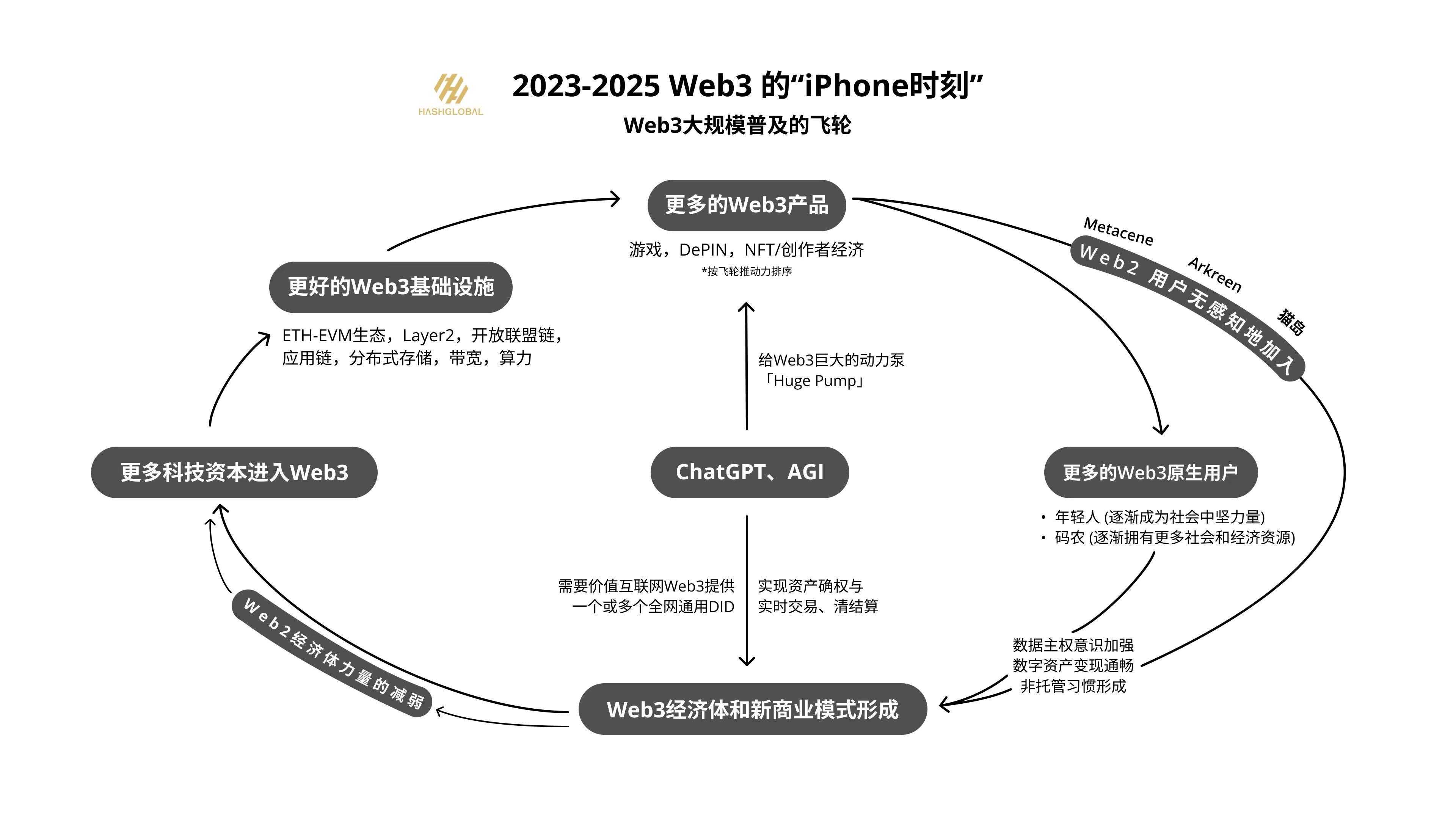
If you align with our product vision and are building products similar to Cat Island, please reach out. We’re also hiring technical developers and business ambassadors for Cat Island. Send project proposals and resumes to [email protected]. For questions or suggestions about this article, or to discuss co-building Ready Player Club or business partnerships with Cat Island, please email us or DM me @longwinsk on Twitter. Thank you!
Join TechFlow official community to stay tuned
Telegram:https://t.me/TechFlowDaily
X (Twitter):https://x.com/TechFlowPost
X (Twitter) EN:https://x.com/BlockFlow_News
 KK
KK






