








The true Web3.0 belongs to the post-2000s
TechFlow Selected TechFlow Selected
The true Web3.0 belongs to the post-2000s
For this generation of young people, Web3 is not a transition—it's their core identity.
 Navigating Web3 tides with focused insights
By Liu Honglin
In the crypto industry, "youth" is no longer just a label—it's a reality.
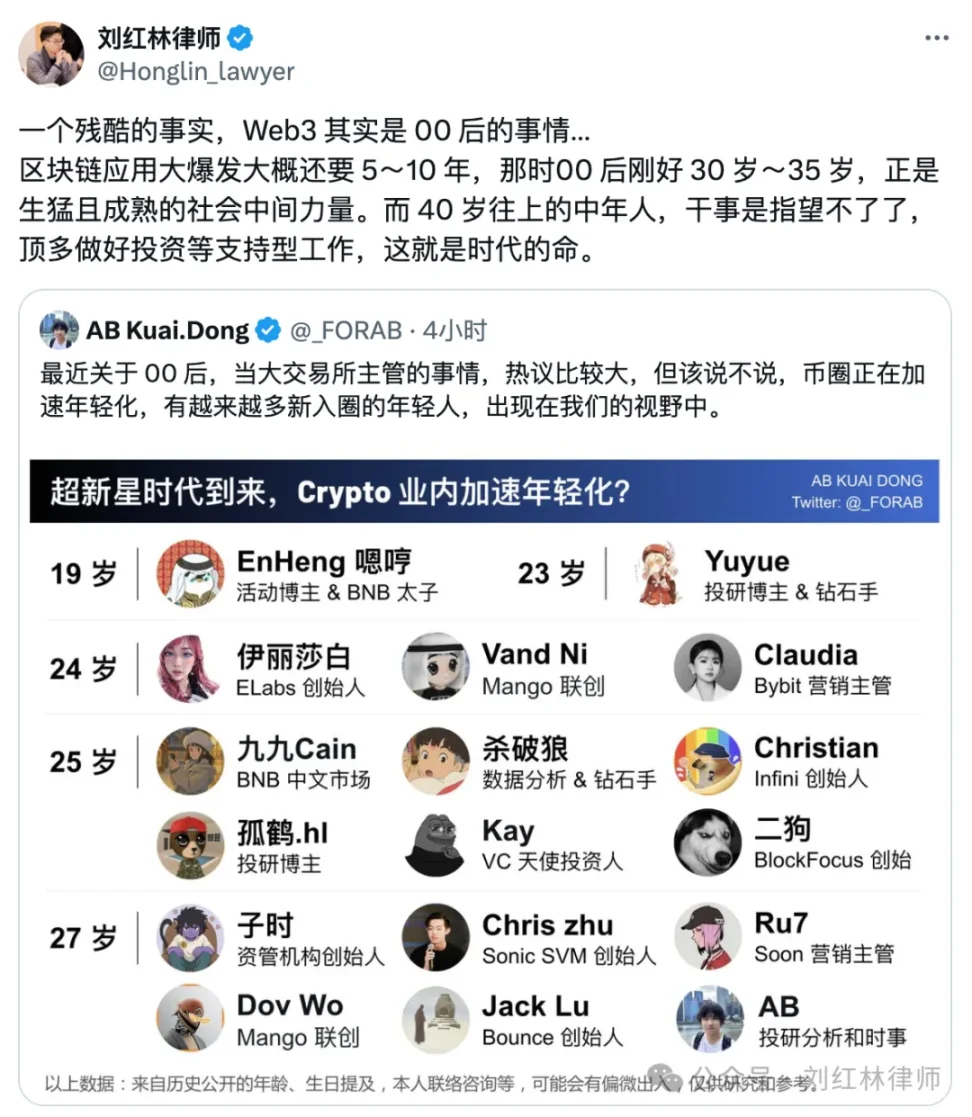
While surfing online, Lawyer Honglin came across a social media post circulating a list titled "Young Faces in Crypto." From BNB and SVM to Infini, from researchers to VCs, from exchange operators to meme community founders—almost everyone on the list was in their twenties. The youngest was 19; none older than 27. They aren't just project ambassadors, but also narrative leaders, community organizers, and even capital allocators.
It left Lawyer Honglin sighing: "A harsh truth—Web3 is actually Gen Z's game..."
Why Are the “Young” Winning This Game?
This isn’t emotional hyperbole, but a sober, logical timeline projection. Given the current sluggish pace of the industry (especially Ethereum-based stablecoin projects), if blockchain ever hopes for a true application boom, optimistically speaking, it will still take another 5–10 years. By then, Gen Z will be 30 to 35—prime age, combining technical strength with resource access, at their most dynamic and mature. What about millennials and Gen X? Most will have passed their peak—physically and mentally. If they still insist on staying active in the field without accepting age, they’ll likely only transition into investors or leverage years of workplace survival tactics—the office politics, the corporate drama—and find fewer and fewer opportunities to lead from the front.
The reason: today’s Web3 is no longer an industry where experience guarantees a seat at the table. It’s about discourse power, community intuition, and information sensitivity—assets rarely held by older generations.
The young people on this list hardly carry labels like "traditional finance" or "big tech internet companies." You could say they lack real-world experience, or you could argue they’re free from path dependency and toxic legacy mindsets. They didn’t migrate from Web2 to Web3—they were born on-chain. For them, Web3 isn’t a career shift; it’s their default profession.
They start investing, becoming KOLs, and building communities as early as college clubs. Their grasp of on-chain game mechanics, marketing tactics, data rhythms, and ecosystem synergies far surpasses that of seasoned veterans. Unburdened by baggage, fluent in native discourse, they dare to speak, experiment, and even rush headfirst into minefields. Their technical ability and market instinct make them truly native "on-chain species."
More importantly, they’ve formed a new system of trust and collaboration—not through apprenticeships or platform funding, but via WeChat circles, Telegram groups, RedBook updates, and ever-evolving meme narratives. Older generations struggle to join, let alone understand, this mode of cooperation.
Older Web3 Practitioners: The Fate of Forced Overtime
If you're a millennial or Gen X Web3 professional, you might already feel drained these past few years: bull runs keep coming, tech narratives evolve from Layer1 to RWA to AI+Crypto—the pace feels relentless, almost desperate.
You may have done many structurally sound things—launched chains, built wallets, formed guilds, managed funds—but looking back, it’s often some 23-year-old graduate student juggling classes and side projects who wins the market with an airdrop bot, token intelligence analysis, or diamond hands community.
It’s not that you’re not working hard—it’s that your rhythm is off. In today’s Web3 world, speed beats scale, traffic outweighs infrastructure, and rhetoric trumps experience. It’s not about right or wrong; the rules have changed.
Crypto development is becoming increasingly modular and productized, reducing reliance on elite developers. Meanwhile, complexity around communities, traffic, and tokenomics keeps rising. Narratives move faster, hype cycles shorten, project lifespans shrink, and operational and strategic gameplay grow more critical.
This means the industry now demands different skills—from "can build" to "can express"; from "technical" to "reactive"; from "accumulate assets" to "generate emotions."
Under these conditions, youth isn’t valuable because labor is cheap, but because they offer shorter feedback loops, less path dependency, and more agile social operations. Their first principle is social networks, not whitepapers.
This isn’t Web3’s distortion—it’s its original form: an experimental industry that prioritizes community-driven momentum and consensus-building above all.
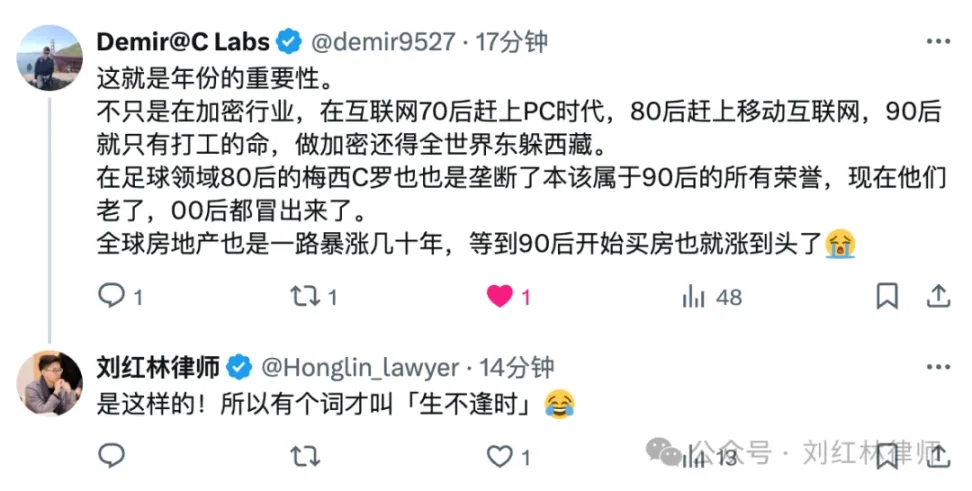
The biggest challenge for middle-aged professionals isn’t lack of ability, but prohibitively high participation costs. You can’t pull all-nighters on Discord anytime, fly three times a week for ecosystem events, or turn your social accounts into extensions of your life. At that point, stepping back becomes inevitable—becoming angel investors, doing research, teaching industry knowledge. That’s exactly what Lawyer Honglin meant by "at best, supporting through investment."
How Should Web3 OGs Pass the Baton?
In 1961, 26-year-old Li Ao wrote "The Elderly and the Baton" in Taipei—an erudite, sharp critique of senior intellectuals who refused to step down, mentor, or pass the torch.
He said: "What young people fear most isn’t that you won’t hand over the baton, but that you’ll wield an outdated one and strike them across the head with it." Spanning six decades, this line still hits home today—for many "old degens" and "industry veterans" in crypto.
His generation wrote about the baton in terms of academic, political, and cultural generational anxiety. Today, when we talk about the "crypto baton," we mean the real transfer of technological话语权, traffic organizing power, and community control. The baton is no longer an abstract ideal or tradition—it’s concrete: nodes, tokens, and influence within industry circles.
Li Ao warned the youth not to overestimate the elderly’s desire to pass on wisdom—many never truly held the baton tightly, and those who do hand something over often give only a hollow stick, emptied by time and coated with superficial polish.
They claim to support the young, yet when it comes to actual resource allocation, project launches, or voting decisions, you realize "support" is just performance—the power remains in their pockets. "You propose, I decide; you operate, I sign off; you charge forward, I reply ‘+1’ in the group." The result? You think you’re relaying, but you’re just working.
So the issue was never about age—it’s whether you genuinely possess the awareness and ability to pass the baton.
Remember, every tech revolution produces a group of "behind-the-scenes players." They don’t seek the spotlight, but they control resources, manage timing, and mitigate risks. Middle-aged professionals don’t need to compete with Gen Z for attention—but they can cut deals with them, allocate resources, and set safety floors. You may not become a 23-year-old content creator, but you can invest in them, incubate them, serve them—become the lever and foundation that amplifies their impact, and proactively become the one who passes the baton.
Truly respected "crypto elders" aren’t those pretending to be young under the spotlight, but those standing behind the stage, enabling the young to run freely. Not talking about "back in my day," but helping them tell "your story now." Not grabbing the next baton, but making sure the next runner can catch it easier, run faster, and avoid detours.
After all, this tide isn’t about confrontation—it’s about symbiosis.
This isn’t a drama of "youth replacing middle age," but a structural shift in the Web3 industry—from technology-led to narrative-led. And the first to sense it, the first to adapt, are precisely this new generation of professionals—"19 when they joined Twitter, 23 when they wrote smart contracts, 25 when they launched projects."
They don’t need us to teach them—we need to learn anew.
This is the mandate of the era.
Join TechFlow official community to stay tuned
Telegram:https://t.me/TechFlowDaily
X (Twitter):https://x.com/TechFlowPost
X (Twitter) EN:https://x.com/BlockFlow_News






