Quick Overview of Particle Network's Full-Chain Account Abstraction: Motivation, Core Components, and Future Roadmap
TechFlow Selected TechFlow Selected
Quick Overview of Particle Network's Full-Chain Account Abstraction: Motivation, Core Components, and Future Roadmap
Particle officially launches its full-chain account abstraction infrastructure.
 Navigating Web3 tides with focused insights
Authors: Peter Pan & Vijay Singh, Particle Network
Translation: Peng SUN, Foresight News
Over the past two months, Particle Network has been making significant moves—from revealing details of its upcoming v2 design featuring ZK and intent-centric capabilities, to outlining its token-centric economic model—gradually unveiling our master plan to onboard the next billion users into Web3.
Recently, Particle's CTO published an article discussing various existing approaches to addressing challenges in the Account Abstraction (AA) space. The article also outlined Particle’s own solution: achieving Omnichain Account Abstraction based on prior frameworks, resolving multiple user experience and robustness issues in AA infrastructure and design. Furthermore, Omnichain AA can address long-standing industry pain points around cross-chain interoperability.
Today, Particle officially launches its Omnichain Account Abstraction infrastructure.
TL;DR
Particle's Omnichain Account Abstraction (Omnichain AA) resolves existing issues in cross-chain transactions and multi-chain account abstraction by decoupling smart account storage and code. It introduces Particle Chain as a central hub for account storage. Within this framework, cross-chain messaging synchronizes storage changes. Omnichain AA also introduces Deployer Contracts for unified address generation and multi-chain storage management, along with cross-chain messaging solutions leveraging existing interoperability protocols to support interactions across different chains. Finally, we propose using the Particle token as a unified gas token to solve inefficiencies in multi-chain gas usage. This design simplifies the management of smart accounts across multiple chains and enhances the efficiency of cross-chain operations.
1. Motivation Behind Omnichain Account Abstraction
As analyzed by our CTO, the current ERC-4337 AA framework is more akin to "transaction flow abstraction," primarily focusing on optimizing the underlying transaction execution process rather than the account itself.
While this approach is important—as it lays the foundation for smart wallet adoption and subsequent protocol-level implementation—it also brings several unique challenges:
-
AA solutions are difficult to integrate, forcing developers to build custom implementations;
-
Poor module compatibility leads to ecosystem fragmentation;
-
Significant barriers between different blockchains make it hard to deliver a consistent, high-quality experience for users and developers, resulting in subpar user experiences.
In response to these challenges, three main approaches have emerged:
-
Biconomy proposes a standardized modular approach where developers build on top of it instead of directly implementing ERC-4337 smart accounts. The proposal includes creating a highly specialized marketplace for different modules that can integrate with smart accounts (e.g., Bundlers, Paymasters).
-
Safe (formerly Gnosis Safe) proposes a similar but fundamentally different method—aiming to create a lightweight smart account protocol as simple as an EOA. On top of this, a module marketplace will emerge where different vendors can build their own implementations while maintaining compatibility.
-
Vitalik Buterin proposed a system using Ethereum or a highly secure zk-rollup as the source chain, deploying Keystore contracts to store users' global keys. In this system, users’ L2 smart contract accounts share the global key stored in the Keystore contract.
The first two methods focus on modularity and compatibility—two essential features of AA—while Vitalik’s approach focuses on bootstrapping AA within a multi-chain ecosystem with multiple L2s and EVM chains. Next, we’ll dive deeper into the multi-chain implications of smart accounts under current frameworks and examine Vitalik’s proposed solution.
2. Multi-chain Challenges of Smart Accounts
The current multi-chain EVM environment forces users to deploy their smart accounts independently on different chains. For each account, information related to account management—including permissions—is stored in the contract’s Storage. Updating this information requires users to initiate transactions across multiple chains, making technical consistency across networks difficult and time-consuming to achieve.
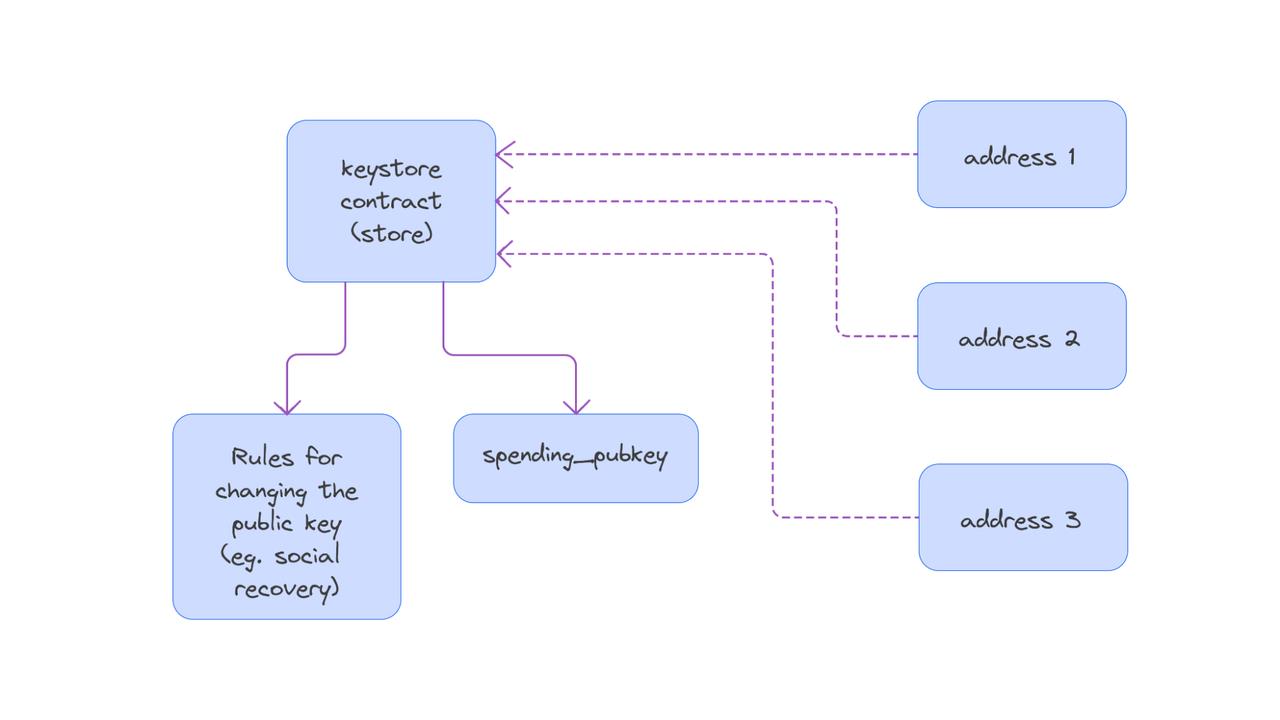
Vitalik Buterin's proposed design
Under the ERC-4337 design, smart accounts use globally unique addresses determined by initCode. Initial administrative rights are encoded in the initCode, meaning if a user deploys a smart account on a new chain after changing admin rights on another chain, they must repeat those changes on the new chain. This adds complexity for both users and wallets.
To illustrate the significance and difficulty of these issues, consider the following scenario:
-
Alice deploys a smart account on Polygon and Arbitrum, with Owner1 as the owner. She routinely rotates owners.
-
Alice changes the owner to Owner2 and forgets the private key for Owner1.
-
Bob sends USDC to Alice’s address via Linea.
-
Alice realizes she needs the private key for Owner1 to initiate any transaction because the initialization initCode depends on Owner1. Unfortunately, she has forgotten it—rendering her assets completely inaccessible.
Vitalik’s solution does address the issue of managing addresses across multiple chains, especially regarding changes in account storage such as ownership transfers and social recovery. However, it comes with significant costs. Beyond non-trivial setup fees, every change to the global key recorded in the Keystore contract on the source chain (e.g., Ethereum mainnet) requires synchronization across all L2/target chain accounts via cross-chain interaction. Given the high cost of interacting with Ethereum and L2s, most users cannot afford this.
Equally important, smart contract accounts behave differently from EOAs, making it difficult for users to maintain the same address across different chains—even if they are EVM-compatible. Therefore, Particle Network builds upon Vitalik’s proposal with several key modifications to minimize impact on users.
3. Particle Network’s Solution
Particle proposes an alternative solution that overcomes the shortcomings of existing multi-chain AA designs and leverages other components of Web3 infrastructure.
Specifically, Particle Network proposes using a dedicated Particle Chain as the omnichain storage database for smart accounts. Through third-party cross-chain messaging solutions (such as LayerZero, CCIP, Axelar, Connext, etc.), changes made by users to account storage will eventually be synchronized with local storage on other chains. Particle Network introduces Cross-chain UserOperations to further abstract the concept of chains and enable seamless cross-chain interactions. It also uses the Particle Network token as a unified gas token to abstract complex gas mechanisms and simplify the use of cross-chain smart accounts. As shown below:
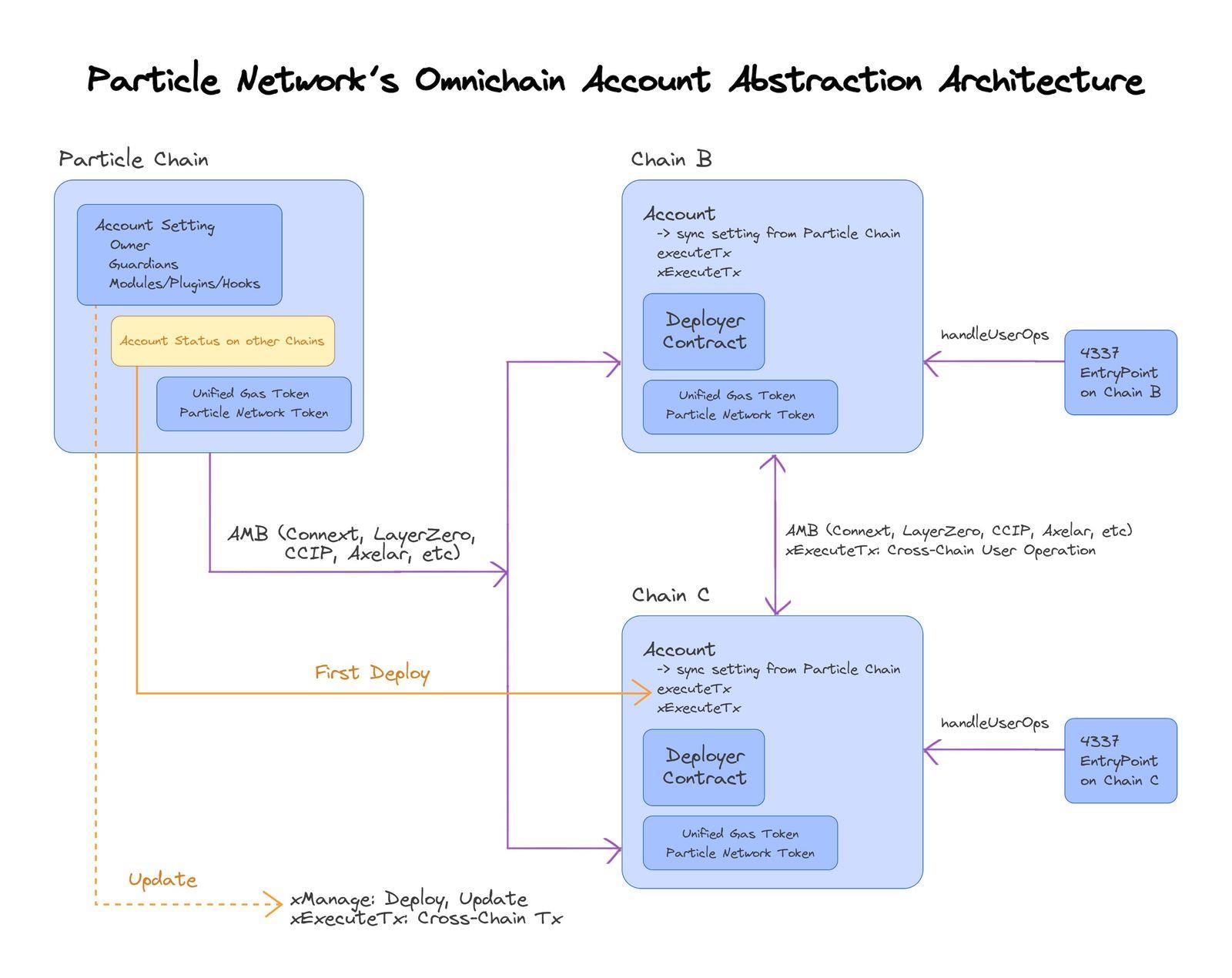
Particle Network's Omnichain Smart Account Abstraction Architecture
Particle Network’s Omnichain Account Abstraction enables users to have a unified smart contract account address across different EVM chains. To achieve this, our design involves deploying a set of Deployer Contracts on each chain. Users must generate a new account on Particle Network Chain, which triggers all Deployer Contracts across different chains, ensuring that the generated smart contract account addresses remain consistent across chains. Additionally, users can interact with multiple chains through contracts on Particle Chain without actively managing multiple addresses, and can use the Particle token as a unified fee payment method.
By executing transactions on target chains while paying corresponding gas fees on the source chain, Omnichain AA enables cross-chain UserOperations. For example, users can use USDC on Polygon to purchase an NFT on Base.
Omnichain AA indeed requires tight coordination between Deployer Contracts and cross-chain messaging components to synchronize multi-chain accounts with source chain storage. This places high demands on oracles or cross-chain message bridges—a common challenge in omnichain interoperability solutions. However, synchronizing users’ cross-chain accounts can be achieved through flexible configurations combining multiple message bridges rather than relying on a single one. For instance, a 2/3 strategy could be used—requiring confirmation from any two of LayerZero, Axelar, and Connext—to execute storage changes on the target chain, thereby eliminating single points of failure.
Particle Network also addresses another issue: enhancing compatibility among EVM-compatible chains, which often have differing AA implementations and thus cannot unify with ERC-4337 addresses.
4. Key Components of Omnichain Account Abstraction
Key components of Omnichain AA include Particle Chain, Deployer Contracts, cross-chain messaging, and tokens.
Particle Chain
By separating smart account management rights from account logic (which can be simplified as separation of storage and code<logic>), we need a secure blockchain to store users’ account management data (Storage/KeyStore). Thus, Particle Chain is the most critical component of the omnichain system. It stores user smart account data (Storage), coordinates Deployer Contracts across different chains, and handles cross-chain messaging components to ensure storage consistency and updates across users’ multi-chain smart accounts.
Deployer Contracts
Multi-chain smart accounts require a unified address, determined by Deployer Contracts (via Create2). Deployer Contracts and cross-chain messaging components together achieve unified storage across chains. For initial deployment of a smart account, Deployer Contracts reject deployments not originating from Particle Chain, ensuring identical Storage data at deployment.
Cross-chain Messaging
Updating account Storage on Particle Chain requires support from cross-chain messaging components. To this end, we directly adopt implementations like LayerZero. Whether during initial deployment or subsequent updates, users can call the xManage method on their smart account on Particle Chain to synchronize account state to any other chain. Users can also call xExecuteTx from any source chain where the smart account is deployed to initiate cross-chain UserOperations, ensuring correct execution on the target chain.
Tokens
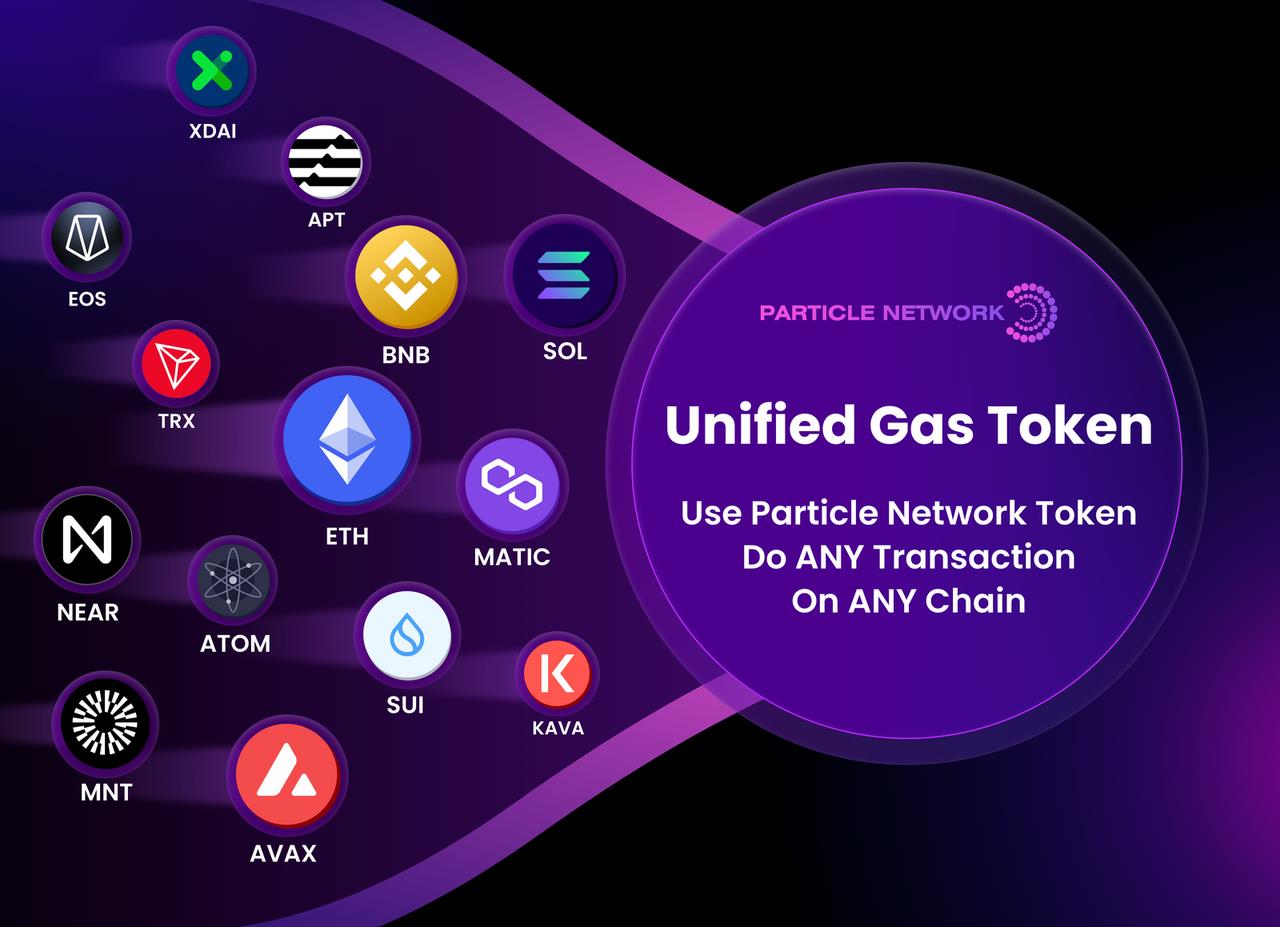
We also introduce the Particle Network token to address gas consumption issues during multi-chain execution, further improving execution efficiency and user experience. Paymasters in ERC-4337 ensure any ERC-20 token can be used to pay gas. In cross-chain transactions, Particle tokens from any chain can directly pay gas fees on other chains.
Providing a single payment token for cross-chain transactions greatly reduces the burden of managing multiple tokens. Currently, any cross-chain interaction requires at least two tokens to cover gas fees on different chains, and in daily use, users must hold as many token types as the number of chains they interact with.
For users, Omnichain Account Abstraction enables the following scenarios:
-
Alice initiates a UserOperation on Chain A, consuming Particle tokens on Chain A.
-
By calling xExecuteTx on her smart account on Chain A, she triggers cross-chain execution on Chain B, completing the intended operation there.
5. Future Roadmap and Particle Network v2
Since Particle’s Omnichain Account Abstraction is still under development, further improvements to the design are possible. For example, we are exploring optimistic cross-chain protocols to mitigate settlement latency and improve the speed of omnichain UserOperations. With Particle v2 launching Omnichain Account Abstraction, modularity and ecosystem adaptability will be key strategic elements of its release.
Particle Network v2 will also adopt an intent-centric approach, aiming to abstract away the complexities of handling different AA and smart account modules. In this architecture, ecosystems like Ethereum’s ERC-4337—or native account abstraction facilities on other chains like zkSync—can be viewed as specific instances under the Solver/Reactor model.
Particle v2 will launch within the zero-knowledge Wallet-as-a-Service (zkWaaS) ecosystem framework, where its zero-knowledge capabilities enhance user identity and transaction privacy. Thanks to v2’s user-friendly zkWaaS development experience and modular design, DApps integrating Particle can leverage consistent, optimized transaction flows, reducing development costs associated with transaction logic. The WaaS model aims to optimize user experience and seamless onboarding, enabling developers to focus on core application logic and innovative features.
Notably, some features in the v2 version serve dual purposes—beyond their primary function, they also reduce costs for users of Omnichain Account Abstraction. Three factors contribute to lowering user costs:
-
Private Paymaster/transaction bundling aggregates user activity: Particle v2’s Omnichain AA will enable transaction privacy via private Paymasters and reduce fees through transaction aggregation;
-
Intent-centric development drives continuous optimization: Particle v2’s intent-centric design will incentivize the Solver market to continuously improve the user experience of expressing intent, thereby saving users costs.
The multi-chain framework provided by the Omnichain Account Abstraction model is crucial for DApps operating in diverse ecosystems requiring AA flexibility. At the same time, the intent-centric design will transform how users interact with DApps.
Join TechFlow official community to stay tuned
Telegram:https://t.me/TechFlowDaily
X (Twitter):https://x.com/TechFlowPost
X (Twitter) EN:https://x.com/BlockFlow_News
 @ParticleNtwrk