Particle Network launches modular intelligent WaaS to boost account abstraction application boom
TechFlow Selected TechFlow Selected
Particle Network launches modular intelligent WaaS to boost account abstraction application boom
The advancements in intelligent WaaS introduced in this article present an opportunity for innovation and improved application performance.
 Navigating Web3 tides with focused insights
Authors: Carlos Maximiliano Cano, Ethan Francis, Particle Network
Translation: Babywhale, Foresight News
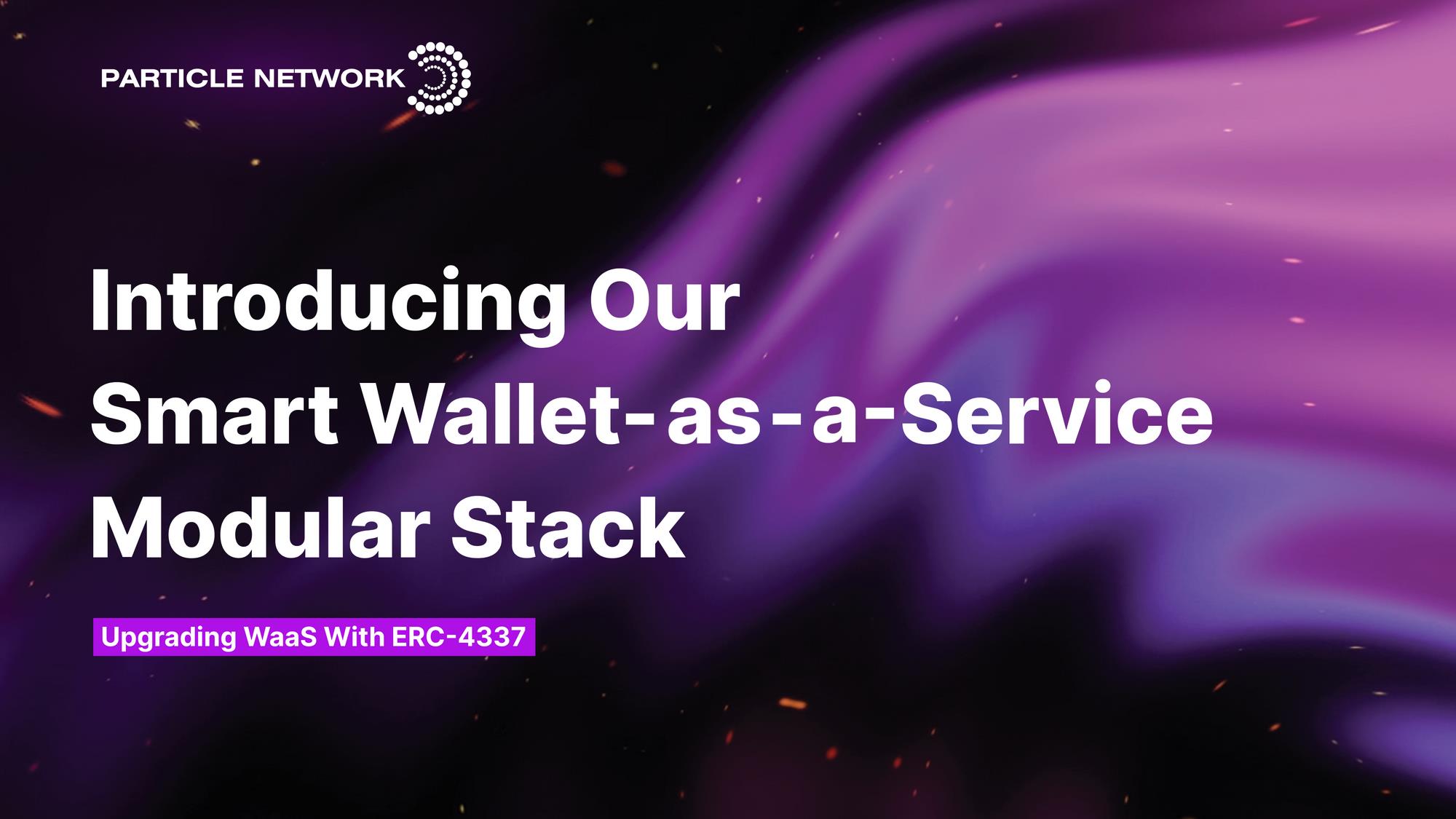
Account abstraction (AA) is Web3's bold bet on solving user experience challenges.
Currently, the Web3 industry is searching for better products to compete with traditional offerings. In this context, account abstraction (AA) has emerged as a solution that enables the construction of complex business scenarios and applications, delivering improved experiences for end users and greater flexibility for developers.
AA represents a significant improvement over the existing externally owned account (EOA) framework, which dominates the EVM ecosystem. However, AA adoption must be driven organically through decentralized growth, with no direct roadmap to implementation.
Meanwhile, WaaS tools allow end users to quickly create and manage wallets using only Web2 credentials. They also simplify interactions with DApps by enabling signing and other activities directly within applications. Additionally, thanks to technical solutions such as Particle Network’s MPC-TSS, these wallets can achieve both non-custodial security and usability.
Current WaaS tools offer a standalone, direct solution for seamlessly onboarding users into Web3. However, Particle Network believes integrating AA into WaaS products is a way to accelerate the adoption of account abstraction, enhance developers’ ability to build better applications, and upgrade Web3 infrastructure.
Therefore, we are proud to introduce Particle Network’s Smart Wallet-as-a-Service Modular Stack, designed to provide maximum flexibility for developers implementing AA in their applications. To present this product, let us first explore the motivation behind its release and the existing capabilities of WaaS tools. Then, we will introduce the features of the Smart WaaS Modular Stack and the benefits it brings to developers and the broader ecosystem.
Limitations of the EOA Framework
To better illustrate the differences between EOA-centric WaaS tools and Particle Network’s Smart Wallet-as-a-Service Modular Stack, it is essential to first understand the possibilities enabled by AA and how the EOA framework limits them.
The fundamental issue with the EOA framework is its inability to support application scenarios requiring advanced logic or multi-step procedures—capabilities critical for complex applications. For developers, this means redundant coding, lack of control over how users interact with their DApps, and a steep learning curve prone to errors.
AA addresses these challenges through programmability, allowing transactions to automatically respond to on-chain events, execute routine multi-signature authorizations for enhanced security, and enable more flexible and secure user authentication protocols directly within wallet infrastructure. For developers, this also means a more flexible development experience.
Currently, developing DApps for the following complex scenarios within the EOA framework is impractical, but AA makes them possible:
DeFi Aggregators: These aggregators can perform multiple functions, such as enabling users to interact simultaneously with multiple platforms, setting up recurring interaction strategies across platforms, and using various token types concurrently during activities. If the user experience is compelling enough and fiat on/off ramps are fully implemented, AA opens the possibility for non-custodial, fully decentralized, gasless platforms to completely replace centralized ones.
P2P Micropayment-Driven Social and Media Platforms: Even in low-fee L2 environments, EOAs make interactions with social platforms feel clunky. AA can optimize this, turning long-held design dreams into reality—for example, P2P micropayment platforms where viewers pay creators proportionally based on viewing time.
X-to-Earn, Gaming, and Income Democratization Platforms: AA facilitates seamless interactions via session keys, making it ideal for scenarios requiring continuous, rapid transactions. As a result, “X-to-Earn” and Web3 gaming experiences can become more practical and engaging. In such environments, democratized platforms that redistribute fees and revenue to users and token holders can thrive.
Regarding AA adoption, ERC-4337 is a key milestone, enabling functional AA applications. However, since ERC-4337 has not yet been recognized at the protocol level, AA development largely depends on organic, community-driven decentralization. In this context, WaaS tools can play a pivotal role in accelerating this process, even serving as intermediate steps toward recommended methods like voluntary migration (EIP-7377).
WaaS Tools and Their Transition Toward AA Models
WaaS tools enable developers to focus on designing better experiences and more easily manage underlying Web3 infrastructure. They achieve this by improving the user experience when setting up and using wallets—but as explained here, their potential goes far beyond that. Current WaaS tools can:
-
Simplify the wallet creation process for first-time Web3 users, allowing login via Web2 credentials for a seamless transition;
-
Streamline transaction signing by enabling direct signing within applications;
-
Provide modular stacks so developers can implement desired functionalities in their DApps, including built-in customization tools for appearance and real adaptability.
As the EVM ecosystem seeks to upgrade to an AA framework, natively adopting AA-enabled WaaS tools can accelerate this transition. The key to fully grasping this approach lies in understanding the main differences between native and non-native AA implementations at the WaaS layer.
Non-Native Account Abstraction Implementation
In non-native implementations, EOA-based WaaS providers act as signers (owners) of smart accounts. In this design, the signer relies on third-party applications to align with specific smart account implementations. The signer then manually verifies interactions with the smart account through an EOA accessible via the WaaS service. This may require manual account initialization and sometimes involve building/sponsoring/pushing user operations.
Refer to this example demonstrating smart account initialization using a non-native AA solution.
Native Account Abstraction Implementation
Native implementation of AA functionality supports both users and developers. In the case of Particle Network, this means allowing end users to choose between using an EOA or a smart account within the wallet. In this design, the EOA remains the signer of the smart account, but the allocation and unification of these two accounts are managed by the WaaS provider. In our native implementation, the smart account remains consistent across applications using the Particle Network Smart Wallet-as-a-Service stack. Compared to non-native implementations, this delivers a more streamlined experience and creates room for network effects.
For developers, native implementation is more natural and simpler. Particle Network’s AA SDK automatically handles account initialization, user operation construction, and other prerequisites, eliminating the common need for manual user operation and smart account management when integrating numerous third-party AA stack components.
For an example of implementation using the Particle Network AA SDK, refer to this link.
Native AA WaaS as a Driver of Broad Adoption
Given that AA is currently in an experimental phase, market leaders like MetaMask cannot widely integrate this technology due to their scale. Therefore, WaaS services currently have the strongest incentive and most direct path to implement these features, benefiting from their position as leaders in user-oriented solutions. With smooth onboarding and native support, WaaS tools are crucial for Web3 adoption.
Native support also means WaaS tools create an ideal framework for developers to explore integrating AA into their tools. This opens the door for modularity, allowing developers to decide:
-
Their preferred smart account implementation;
-
Which bundlers to use;
-
Whether to integrate other third-party tools.
Given the unique role WaaS tools play in accelerating AA adoption and enhancing Web3 user experience, we believe smart WaaS is a natural evolutionary step. In our vision, these tools empower developers to optimize their DApps with AA, enabling faster iteration in both quantity and quality, driving innovation and ultimately attracting more users to Web3 products. Considering all factors mentioned, the timeline for AA adoption might look like the chart below:
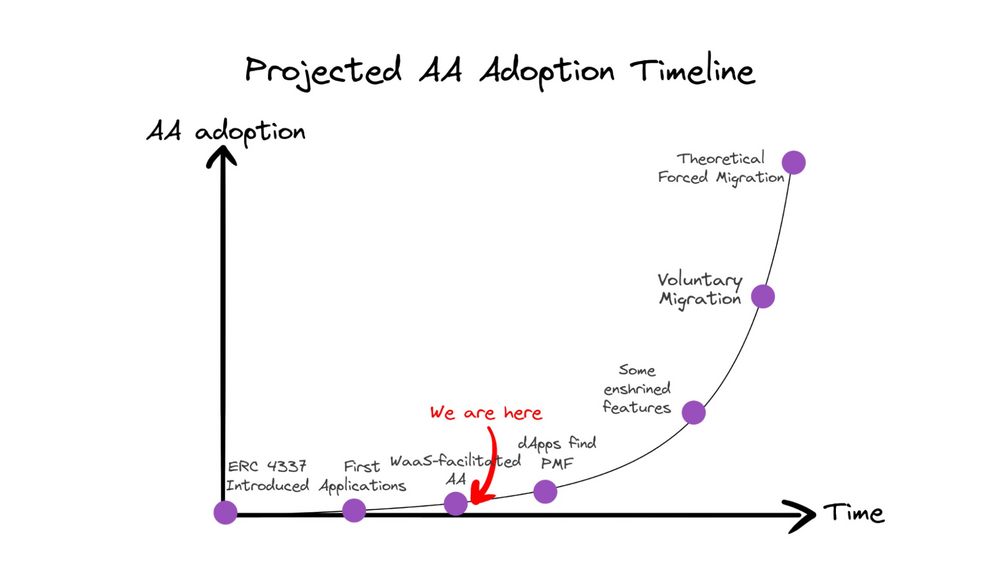
A possible AA adoption curve. Ideally, not only does AA adoption increase, but new Web3 users grow correspondingly.
Particle Network’s Smart Wallet-as-a-Service Modular Stack
Given all the points discussed above, Particle Network’s Smart Wallet-as-a-Service Modular Stack aims to deliver end-to-end adoption of ERC-4337 AA, enabling developers to build next-generation Web3 experiences. Particle Network’s goal is to create a flexible experience for developers, allowing native interaction with AA while being directly tied to a Particle Network WaaS instance.
Particle Network’s Smart WaaS is designed to give developers full access to the possibilities of “WaaS+AA,” regardless of complexity, functionality, backend implementation, etc. Ultimately, this allows them to select the best-suited services and tools for their applications. No matter how developers specifically intend to implement AA in a given application, we’ve built in the necessary modules to fully leverage Particle Network’s ERC-4337-powered AA SDK at any level of the underlying tech stack.
When building our Smart WaaS stack, we considered the following elements critical:
Seamless Use via WaaS and Non-Custodial Key Management: Particle Network’s existing WaaS implementation includes MPC-TSS private key management. Combined with social authentication, this ensures end users can join quickly and securely—regardless of their familiarity with Web3.
Leveraging AA Flexibility Without Sacrificing App Complexity: This enables developers to build diverse applications that fully utilize AA capabilities. Particle Network’s AA SDK supports programmatic interaction with smart accounts in familiar ways—such as familiar transaction structures, construction, and account management patterns—all seamlessly handled by the SDK. This means developers can start using AA without complex setup, leveraging Particle Network’s WaaS for onboarding and account management, then later adopt AA operations via Particle Network’s AA SDK, used in conjunction with WaaS.
Modular AA Through WaaS: Particle Network’s AA SDK allows developers to handle AA in a modular fashion, easily plugging in their preferred smart account implementations, bundlers, paymasters, etc. As a WaaS provider, Particle Network also supports inserting AA applications at any point—even if they were not originally built with our AA SDK. Thus, even non-native AA applications can leverage Particle Network’s WaaS for adoption. This creates a fully customizable development experience for both native and non-native applications.
The diagram below illustrates Particle Network’s modular AA architecture and overall implementation:
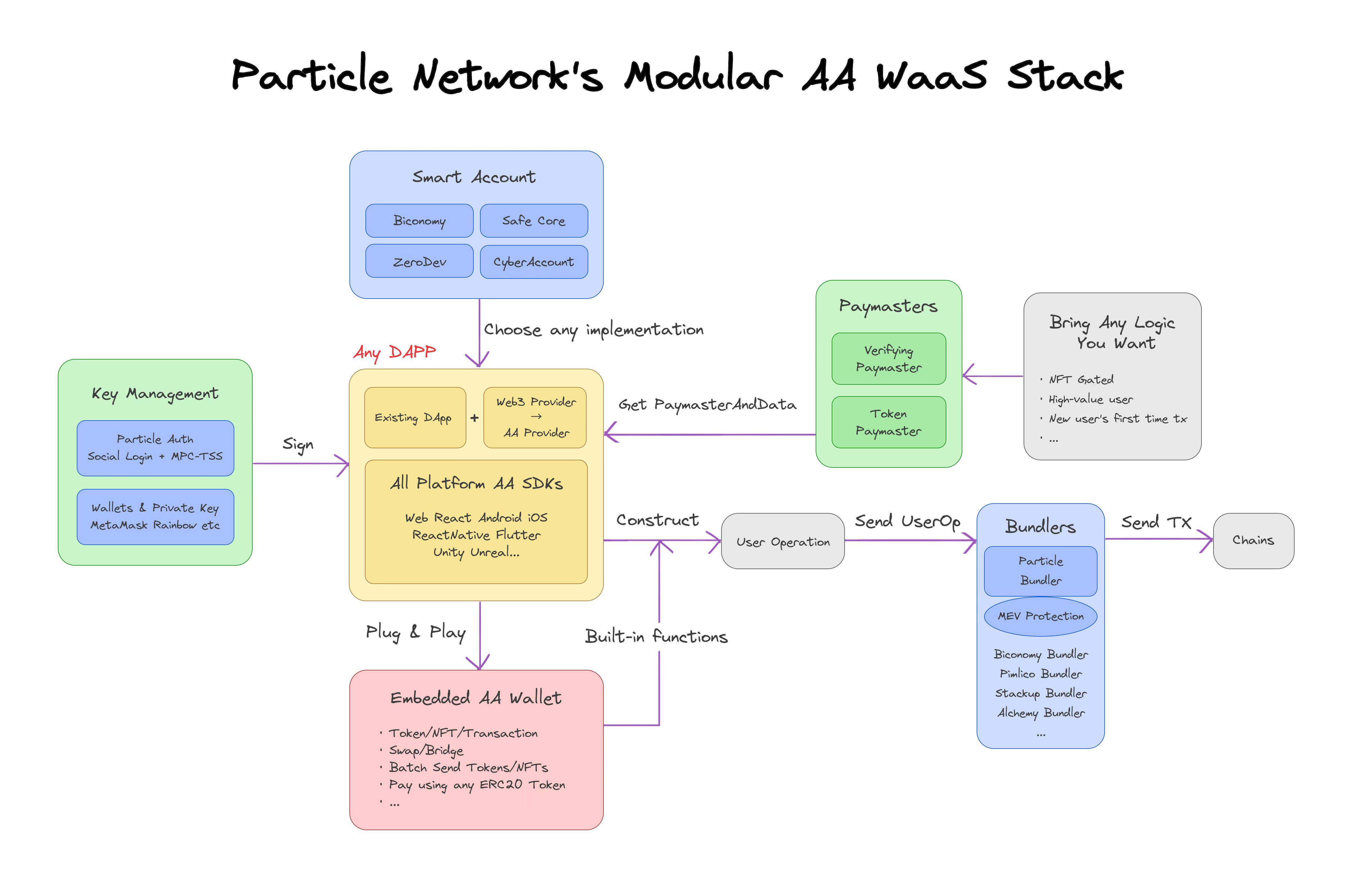
Particle Network’s Modular Stack
To dive deeper into this modular stack, watch the tutorial by Developer Relations lead Ethan Francis below, showing how to build apps with minimal code (including a gasless implementation example). In this video, Ethan uses our native AA SDK with built-in Biconomy support. You can view the example code from the video at this link.
AA is an emerging field with multiple smart account implementation options. Introducing a comprehensive modular stack ensures developers gain greater flexibility. Modularity means they can plug in preferred components while remaining accessible to developers with fewer customization needs.
Infrastructure Components of the Particle Network AA Stack

Particle Network’s AA stack ecosystem, with upcoming built-in support for additional implementations.
Currently, Particle Network officially supports Biconomy’s smart account for developers and users. However, to promote intrinsic modularity and cross-compatibility across the ecosystem, Particle Network will allow users and developers to select their preferred smart account implementation within our SDK and user interface—offering a sophisticated solution that does not default to a single provider.
Particle Network’s native modular AA support (via native SDK, Particle Network RPC, etc.) is powerful on its own, but due to Particle Network’s nature as a WaaS provider, it also maintains inherent cross-compatibility with other AA stack providers.
Below are several examples leveraging the Particle Network protocol stack:
-
Using Particle Network’s AA SDK for account management, then manually constructing, sponsoring, and pushing user operations via Pimlico’s Bundler and Paymaster (Demo);
Particle Bundler
Particle Network has also developed proprietary Paymaster and Bundler services. Particle Network’s Bundler is fully open-source and facilitates scalable, reliable ERC-4337 interactions. In fact, the Particle Bundler has already been widely adopted across multiple public chains through partner programs, facilitating hundreds of thousands of transactions on opBNB, Scroll Sepolia, and Combo Testnet.
The Particle Bundler simplifies user transactions by managing smart account nonces and automatically batching user operations. It streamlines deployment to new chains via a single command, supporting additional chains within five minutes. For developers, it offers features such as configurable bundler signers, automatic refills, and monitoring alerts. The Bundler efficiently handles high workloads, ensuring fast transaction processing. Supported by robust infrastructure, it maintains operational stability under various conditions.
Key features of the Particle Bundler include standard RPC support, configurable signers, multi-chain compatibility, duplicate user operation detection, concurrent user operation processing, integrated gas oracle, and a management system for multiple bundler signers. The Bundler also automatically replenishes bundler signer balances, retries failed transactions, and provides accurate transaction details even under MEV influence. More details can be found in its open-source announcement.
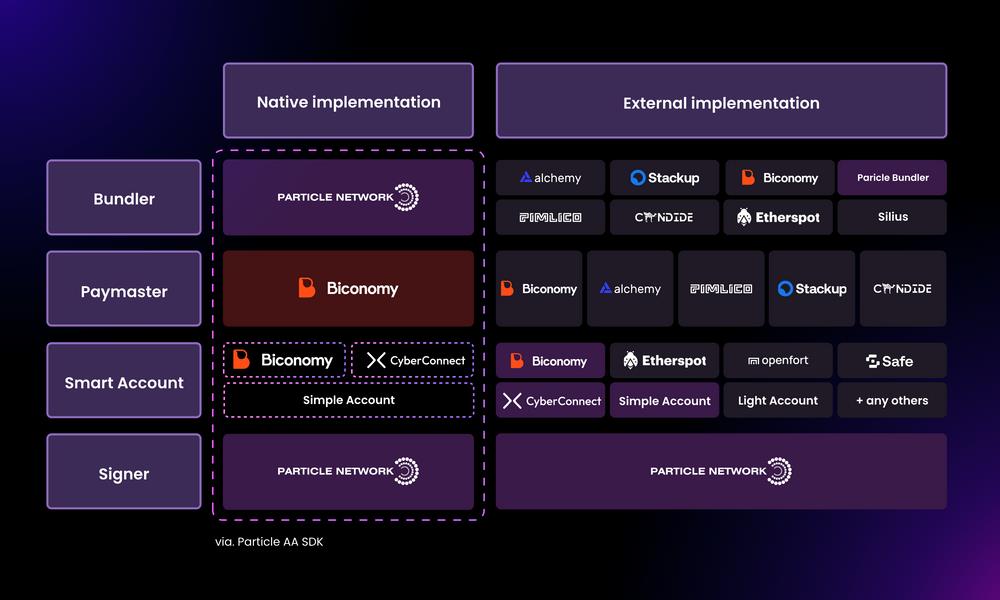
Internal and external integrations of Particle Network
Security
Particle Network’s Smart WaaS implementation also includes security features powered by MPC-TSS to protect user data and assets. These security considerations are illustrated in the diagram below:
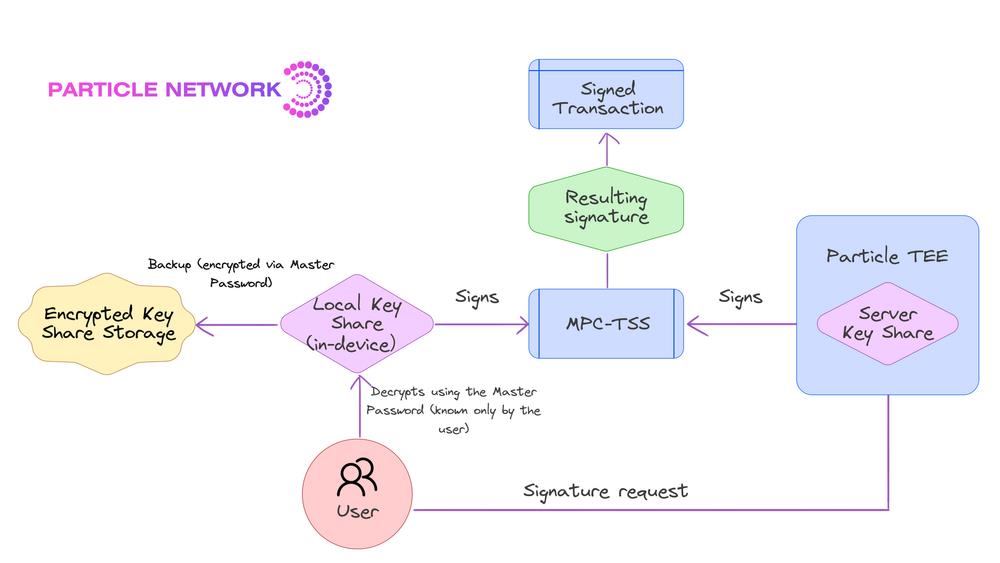
Particle Network’s MPC-TSS Security Setup
Particle Network employs an advanced 2/2 TSS scheme, ensuring that a user’s private key is never centralized at any point during its lifecycle. This method splits the key into two parts stored separately, ensuring neither part reveals any information about the complete key. Particle Network also allows users to set a master password to encrypt local key shards, securely storing them. This enables users to restore their wallets across devices in complete security. To learn more about this mechanism and why it is the safest choice for protecting user private keys in a non-custodial manner, see the article “How to Choose a WaaS”.
What’s Next for Particle Network and Smart Wallet-as-a-Service?
The combination of account abstraction (AA) and wallet-as-a-service (WaaS) solutions has the potential to transform the experience for Web3 developers and end users, making our ecosystem more appealing.
Particle Network’s Smart Wallet-as-a-Service Modular Stack is a major upgrade to an already compelling offering, emphasizing practicality and simplifying the process of building user-friendly applications with AA. In this regard, Particle Network’s integrated ecosystem is one of the primary advantages stemming from our guiding principle of flexibility.
In upcoming announcements, we will introduce Particle Network’s Omnichain Account Abstraction, which will play a central role in the token-centric design of Particle Network’s upcoming v2. Around this innovation, Particle Network will launch a new suite of products for developers and end users, creating a more integrated and feature-rich environment.
The advancements in Smart WaaS described in this article represent opportunities for innovation and improved application performance. If you’ve made it this far, we invite you to leverage Particle Network’s resources—including detailed tutorials and comprehensive documentation—to integrate these enhanced capabilities into your projects. As AA adoption grows, developers building AA-powered super DApps will undoubtedly play a crucial role in accelerating Web3 adoption.
Join TechFlow official community to stay tuned
Telegram:https://t.me/TechFlowDaily
X (Twitter):https://x.com/TechFlowPost
X (Twitter) EN:https://x.com/BlockFlow_News
 @ParticleNtwrk

![In-depth Analysis of Trade[XYZ]: How Were 92 Markets and 98% HIP-3 Trading Volume Established?](https://upload.techflowpost.com/upload/images/20260716/20260716061117965147.jpeg?x-oss-process=image/resize,p_50/quality,q_80)