What lessons can we learn from the collapse of USDR?
TechFlow Selected TechFlow Selected
What lessons can we learn from the collapse of USDR?
The more interesting aspect of USDR is that it's an algorithmic stablecoin.
 Navigating Web3 tides with focused insights
Written by: Samuel McCulloch
Compiled by: TechFlow

October 12, 2023—523 days after the UST collapse—we still don’t understand stablecoins.

USDR is a $60 million circulating “stablecoin,” mostly backed by UK real estate mortgages, which plummeted from $1 to $0.50 within hours. This was a classic bank run—a mismatch between the high liquidity of stablecoin liabilities and the low liquidity of its collateral.
It was issued by Tangible, a marketplace for buying and selling tokenized real-world assets (RWA). On this platform, USDR can be used to purchase tokenized real estate, watches, wine, and gold.
Real USD... Not Better Money
According to Tangible’s documentation, “Real USD (USDR) is a new type of rebasing, yield-bearing, over-collateralized stablecoin pegged to the US dollar. USDR is primarily backed by income-generating, tokenized real estate mortgages.”
All USDR can be redeemed 1:1 into DAI at any time with a 0.25% fee. The protocol maintains several million dollars in cash as a capital buffer to facilitate redemptions.
The depeg occurred when the reserve of $12 million worth of DAI, intended for USDR redemptions, was exhausted and holders began dumping the token on decentralized exchanges. Now, USDR holders must wait for the company’s financial assets to be distributed or liquidated to cover the collateral shortfall.
A more intriguing aspect of USDR is that it functions as an algorithmic stablecoin.
USDR can be minted 1:1 using either TNGBL or DAI. The protocol imposes a maximum 10% limit on the amount of USDR generated from TNGBL. Funds collected from swaps are then used to purchase homes in the UK. Tangible’s team states in their documentation that excess collateral above the loan-to-value ratio is used to acquire additional real estate collateral. However, they have told us they never did this—any over-collateralization was kept as reserves.

Real Estate Backing
Tangible offers two main justifications for using real estate to back USDR.
First, real estate generates yield. All properties owned by Tangible are rental units producing monthly rent, which flows back to USDR holders via buybacks.
Tangible only purchases properties in the UK market, yielding 6.39%. In comparison, the yield on one-month UK government bonds is 5.31%.
Second, the team highlights the long-term effect of real estate “price appreciation.” They claim real estate has a “predictable history of appreciation” and note that “the average sale price of a home in the United States rose from $27,000 in Q1 1970 to $383,000 in Q1 2020.”
Then, in their documentation, they assert that USDR is “better money” because it is a “true store of value,” with rising house prices protecting holders against inflation.
As if we learned nothing from the 2008 financial crisis.
Par on Demand
The biggest lie in crypto is how the three characteristics of money are presented. We’ve heard it countless times: money has three properties—medium of exchange, unit of account, and store of value. But these only relate to denomination.
Bitcoin can function as money because it preserves value, and platforms integrate it as a payment option. This applies to any commodity. Bitcoin can fluctuate 5%, 10%, or 15% daily without weakening its utility as a means of payment, because prices are relative to the dollar. They say 1 BTC = 1 BTC.
Debt denominated in dollars adheres to a higher standard. A dollar-pegged stablecoin should be redeemable for one dollar—or approximately one dollar—under all circumstances.
If not, it is not dollar-denominated money.
I say “approximately” because if you believe privately issued currencies should have a place in our society, they will always carry slight price sensitivity. Only government-issued currency can be considered perfectly price-insensitive, backed by the full faith of the printing press.
Stablecoins are imitations of the dollar. FRAX now falls into this category with the launch of v3. Our stablecoins can be sold for around $1 in exchange for USDC, but there is no guarantee. The Frax DAO’s mandate is to maintain a treasury of highly liquid assets to preserve the peg, but conditions can change, and portfolios must prepare for worst-case scenarios.
Notably, Tangible pursued a growth strategy on Curve during Q1 and Q2 of this year. Llama Risk raised concerns about their collateral backing. Meanwhile, Frax DAO voted to increase collateralization to 100%.

The correct perspective when evaluating stablecoins is: “If something happens, and the entire treasury must be sold at a discount, how much can I get back?” If redemption isn’t “on demand at par,” then referencing face value is misleading.
Considering the assets on Tangible’s balance sheet, we can make the following assumptions:
-
In the event of protocol failure, the TNGBL token, being equity-like, will be worthless. It adds no value to stablecoin backing.
-
The team-held insurance fund and POL will both be drawn down to near zero—or until redemptions are cut off—to preserve remaining collateral.
-
When Tangible sells properties at a discount to raise funds, they may have to sell below market prices due to uncertain future market conditions. Additionally, properties are spread globally, increasing currency risk in their sale.
Thus, the key question becomes: what discount should be applied to property valuations? With interest rates at 15-year highs, the liquidity of these valuations has evaporated.
Tangible's Action Plan
Given the USDR depeg, the team has proposed the following steps:
1. Asset Liquidation: Considering real estate and liquid assets, USDR currently has an 84% collateralization rate.
2. Introduce Baskets: Tangible will offer tokenized real estate pools—essentially real estate index funds—instead of a stablecoin. These baskets, such as UK Real Estate, will be proportionally distributed to USDR holders. Users can hold the index tokens, earn yield from rent collections, farm on Pearl, or sell them. If there is no demand for the baskets, Tangible will begin liquidating the real estate—but this process could take months.
3. USDR Redemption: Once basket assets are in place, Tangible will initiate the USDR redemption process. USDR will be redeemed in a combination of stablecoins, basket tokens, and locked 3,3+ TNGBL NFTs. If a collateral shortfall remains afterward, it will be covered by TNGBL 3,3+, locked for one year.
Assuming properties can be sold without significant discounts, each USDR holder will receive:
-
$0.052 in stablecoins (DAI);
-
$0.78 in real estate via baskets;
-
$0.168 in locked TNGBL earning yield from rents.
Every stablecoin bill discussed or passed requires issuers to hold only cash and short-term equivalents—and for good reason. Market conditions deteriorate; investors panic. Without sufficient liquid capital for redemptions, a depeg/run is inevitable. Illiquid debt exponentially increases convexity. At the first sign of illiquidity, markets immediately discount asset prices.
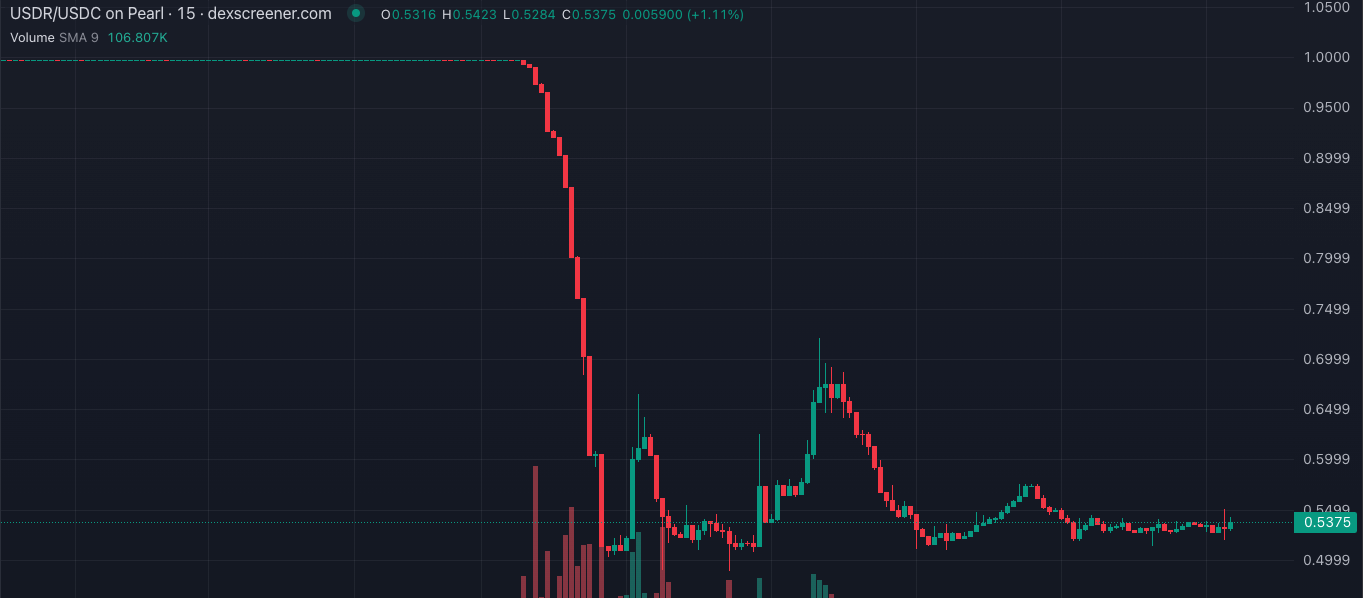
At the time of writing, USDR trades at $0.53. Even though the team claims 84% collateralization, the market knows that liquidating the treasury portfolio could take months—and has priced it accordingly.
After this process concludes, USDR will cease to exist. The stablecoin is dead after the run.
Let’s be clear... All stablecoins are a form of debt—an extremely liquid, fungible debt instrument in token form. Tangible believed they could issue millions in debt backed 78% by real estate, with zero duration risk. To some extent, pre-crash buffers of 30% cash and POL were deemed sufficient to provide liquidity during a run.
Today’s events have repeated countless times in traditional finance—when measures claimed to “protect customers” prove easily exploitable, the nature of the project is revealed. Tangible did not “try something new.” The team knowingly issued liquid, redeemable debt tokens against illiquid assets. Tangible marketed jargon to naive, non-institutional users.
What makes USDR’s collapse frustrating is that Llama Risk had already documented these risks, stating:
In summary, Tangible has built several mechanisms to support the USDR peg. They envisioned a promising method (pDAI) ensuring USDR holders can always redeem USDR for equivalent value. However, most measures are still new and untested, and some are fully centralized (e.g., real estate liquidation). In a bank run scenario, USDR’s ability to maintain its peg is questionable. Furthermore, the project added layers of complexity and potential vulnerabilities through its wUSDR token and cross-chain integrations. These factors undermine USDR’s stability.
Yet today, we’re still discussing the failure of yet another “stablecoin.” This is frustrating because these incidents are exactly what anti-crypto legislators cite when drafting harsh regulations and laws. Tangible’s collapse gives further ammunition to anti-crypto lobbyists arguing why our industry should be shut down.
It’s time to dispel the notion that any stablecoin can be 100% backed by anything other than cash or short-term equivalents. Real estate is good collateral, but allowing 100% loan-to-value lending against home equity in the form of stablecoins is clearly disastrous.
At Frax, we are committed to building a robust stablecoin ecosystem with minimal risk exposure. With the latest v3 launch, Frax also uses RWAs to generate yield for the DAO—but only allows the most liquid assets with the shortest duration: Treasury bills, overnight repos, dollars in Federal Reserve master accounts, and select money market funds. Nothing else.

Join TechFlow official community to stay tuned
Telegram:https://t.me/TechFlowDaily
X (Twitter):https://x.com/TechFlowPost
X (Twitter) EN:https://x.com/BlockFlow_News
 @FlywheelDeFi



![In-depth Analysis of Trade[XYZ]: How Were 92 Markets and 98% HIP-3 Trading Volume Established?](https://upload.techflowpost.com/upload/images/20260716/20260716061117965147.jpeg?x-oss-process=image/resize,p_50/quality,q_80)