A new FT protocol for Bitcoin emerges, and the founder of Ordinals has had enough with BRC
TechFlow Selected TechFlow Selected
A new FT protocol for Bitcoin emerges, and the founder of Ordinals has had enough with BRC
Is creating a new FT protocol for Bitcoin really a good idea?
 Navigating Web3 tides with focused insights
Today, Casey Rodarmor, the creator of the Bitcoin NFT protocol Ordinals, proposed a new conceptual design for a Bitcoin FT protocol called "Rune," also known as the "Runes" protocol.
How does this protocol differ from existing Bitcoin FT protocols such as BRC-20 and Taro/RGB on the Lightning Network? Why did Casey suddenly propose the idea of the Runes protocol? And what progress has been made in less than one day since its announcement?
BlockBeats will comprehensively walk you through all aspects of the Runes protocol to date.
The Design Principles Behind the Runes Protocol
Casey Rodarmor summarized the key feature of the Runes protocol in one sentence — a simple, UTXO-based fungible token (FT) protocol that offers good user experience for Bitcoin users.
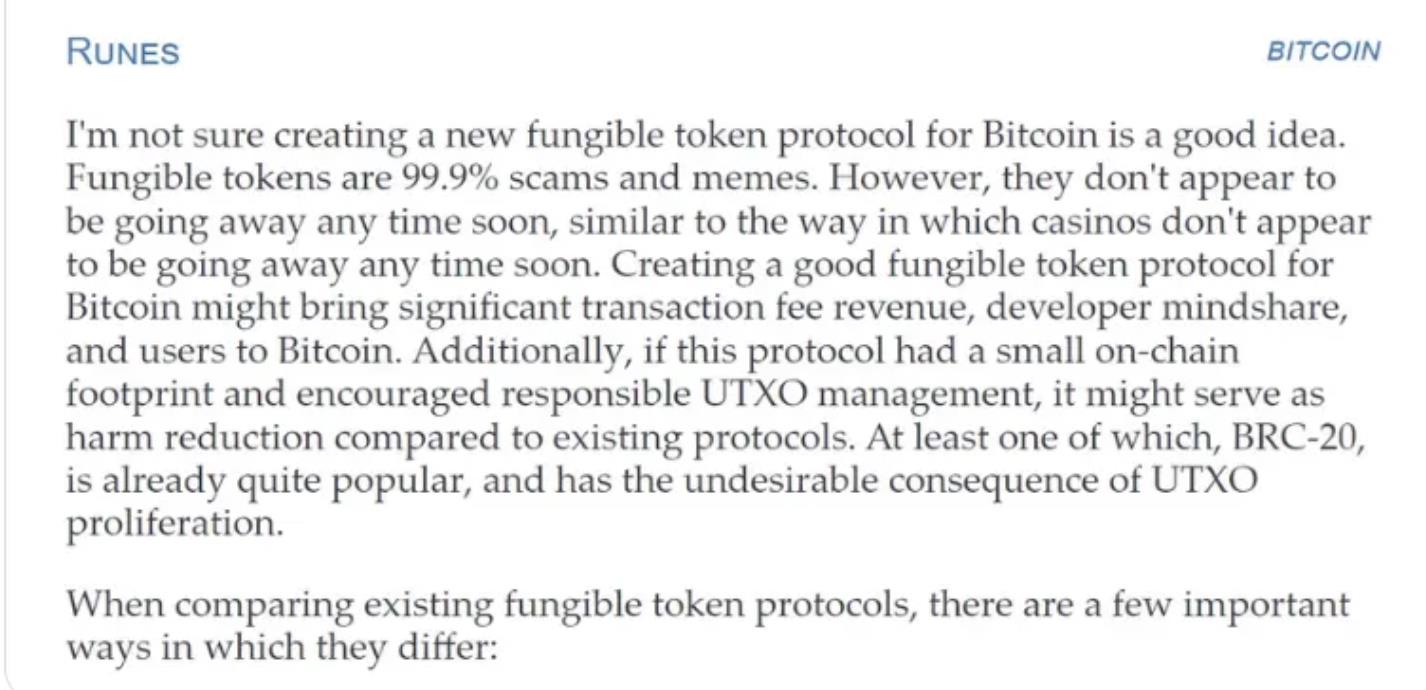
Casey believes that if the protocol leaves a small on-chain "footprint" and promotes trustworthy UTXO management, it may reduce the "harm" compared to existing Bitcoin FT protocols. At the very least, the current popularity of BRC-20 has already created a large number of "junk" UTXOs.
Casey compared the Runes protocol with other existing Bitcoin FT protocols across four dimensions:
- Complexity: How complex is the protocol? Is it easy to implement and widely adoptable?
- User Experience: Do any implementation details negatively affect user experience? In particular, protocols relying on off-chain data have lighter on-chain footprints but introduce significant complexity. Users either need to run their own servers or discover and interact with existing ones.
- State Model: UTXO-based protocols fit more naturally within Bitcoin and help minimize the UTXO set by avoiding the creation of "junk" UTXOs.
- Native Tokens: Protocols requiring native tokens for operations are cumbersome, extractive (i.e., require mining), and thus less likely to achieve broad adoption.
The comparison results are as follows:
- BRC-20: Not UTXO-based and relatively complex because it requires using the Ordinals protocol for certain operations.
- RGB: Highly complex, relies on off-chain data, has been under development for a long time without widespread adoption.
- Counterparty: Requires native tokens for certain operations and is not UTXO-based.
- Omni Layer: Requires native tokens for certain operations and is not UTXO-based.
- Taproot Assets (Taro): Somewhat complex and relies on off-chain data.
So how exactly will the Runes protocol address these pain points?
Implementation of the Runes Protocol
Overview
Balances of Runes tokens are directly embedded within UTXOs, and each UTXO can contain any number of Runes tokens.
A transaction contains a protocol message if it includes an output whose script pubkey contains an OP_RETURN followed by a data push representing the ASCII uppercase letter 'R'. The protocol message consists of all data pushes after the first one.
If invalid protocol messages or Runes tokens are inserted into a transaction, those Runes tokens will be burned. This mechanism allows the Runes protocol to upgrade in the future and correct allocation errors in previously issued Runes tokens under older versions of the protocol.
Integers are encoded using a prefix variable-length encoding, where the initial part determines the byte length of the Runes token identifier.
Transferring Runes Tokens
The first data push in the protocol message is decoded into a sequence of integers containing three types of information: “ID,” “OUTPUT,” and “AMOUNT.” If the total number of decoded integers is not a multiple of three, the protocol message is considered invalid.
ID: Specifies which Runes token is being transferred. Each Runes token is assigned an ID upon creation, starting from 1, with earlier-created tokens receiving smaller IDs.
OUTPUT: Determines which output receives the allocation.
AMOUNT: The quantity of Runes tokens to transfer. An AMOUNT value of 0 indicates all remaining Runes tokens in the account.
After processing all operations defined by the integer sequence, any leftover Runes tokens are assigned to the first non-OP_RETURN output. Additionally, sending Runes tokens to an OP_RETURN output containing a protocol message may result in burning them.
Creating Runes Tokens
If there is a second data push following the protocol message, the transaction constitutes a Runes token creation. This data push is decoded into two integers: “SYMBOL” and “DECIMALS.” Any additional integers render the message invalid.
SYMBOL: Equivalent to the ticker (token name) in BRC-20, supporting up to 26 characters using only A–Z letters.
DECIMALS: Precision level, determining how many decimal places the Runes token supports.
If the SYMBOL hasn’t been used before, the Runes token is assigned an ID (starting at 1). The names BITCOIN, BTC, and XBT are reserved and cannot be used. If the SYMBOL is already taken, the creation attempt fails. Thus, like BRC-20, the Runes protocol does not support creating tokens with duplicate names.
Displaying Bitcoin Balances in UTXOs
Within a UTXO, Bitcoin balances are represented as BITCOIN, BTC, or XBT, or alternatively via an ID value of 0.
Why Did Casey Suddenly Propose the Runes Protocol?
In the official manual for the Ordinals protocol, we can see that Casey originally envisioned Ordinals as a way to create "digital artifacts" — essentially NFTs — on Bitcoin. However, as the Ordinals ecosystem evolved, inscriptions related to BRC-20 now make up over 85% of all inscriptions.
Casey has long expressed dissatisfaction with BRC-20. His recent controversial tweets further highlight his negative stance toward BRC-20:
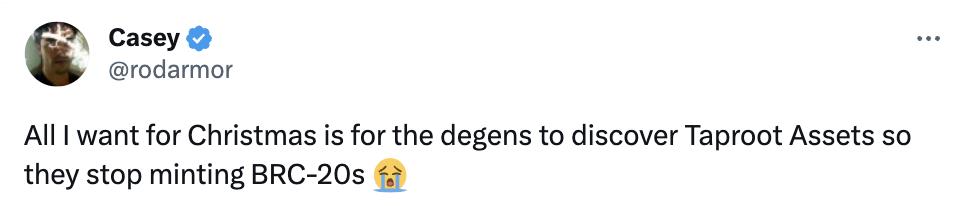
My Christmas wish is for speculators to discover Taproot Assets (Taro), so they can stop minting BRC-20 tokens
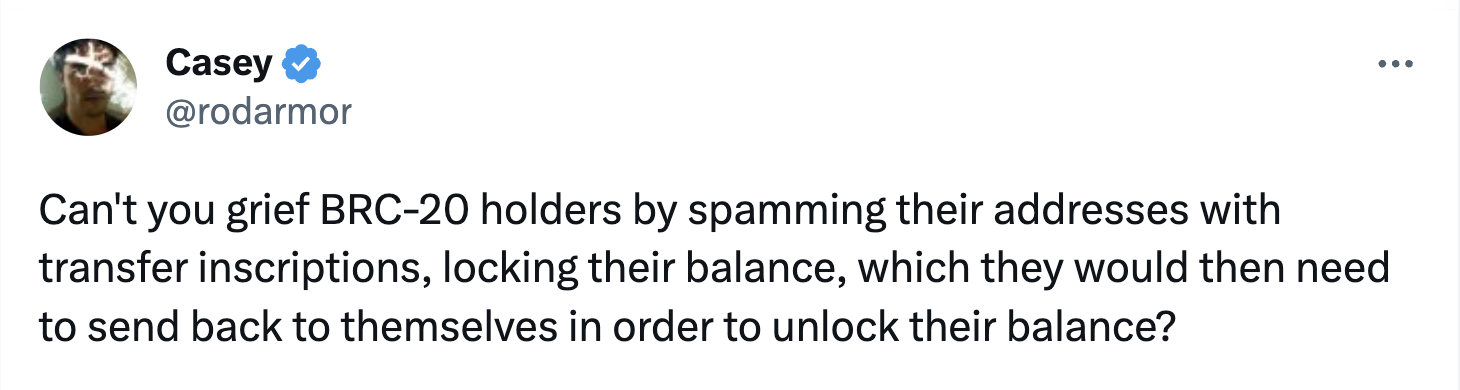
Can't we just inscribe "transfer inscriptions" to lock the balances of BRC-20 holders, forcing them to send the inscription back to themselves to unlock their funds?
To Casey, the "art gallery" he created has turned into a playground for speculators, which deeply troubles him. Beyond just seeing his vision corrupted, Casey holds a fundamentally negative view of FTs themselves:
 At the end of the blog post introducing the Rune protocol concept, Casey wrote: "The world of FTs is almost hopelessly a bottomless pit filled with deception and greed."
Proposing the Rune protocol concept amounts to Casey's act of "cutting the poison from the bone" regarding the Ordinals protocol — although as its creator, he lacks unilateral control to ban what he sees as parasitic "tumors" like BRC-20 built atop Ordinals. So instead, he throws out this idea: This is supposed to be an art gallery; if you still want to degenerate, I've got an idea — why don't you go play your games elsewhere? Is heading over to the "casino" acceptable?
That said, Casey has merely proposed the conceptual idea of the Rune protocol and has no intention himself of implementing it. Nevertheless, given Casey’s influence, we’ve already seen how excited the community has become within less than a day.
What Developments Have Occurred Around the Rune Protocol in Less Than One Day?
The Bitcoin NFT marketplace Ordinals Wallet announced the deployment of the first Rune token $RUNE at 3 PM.
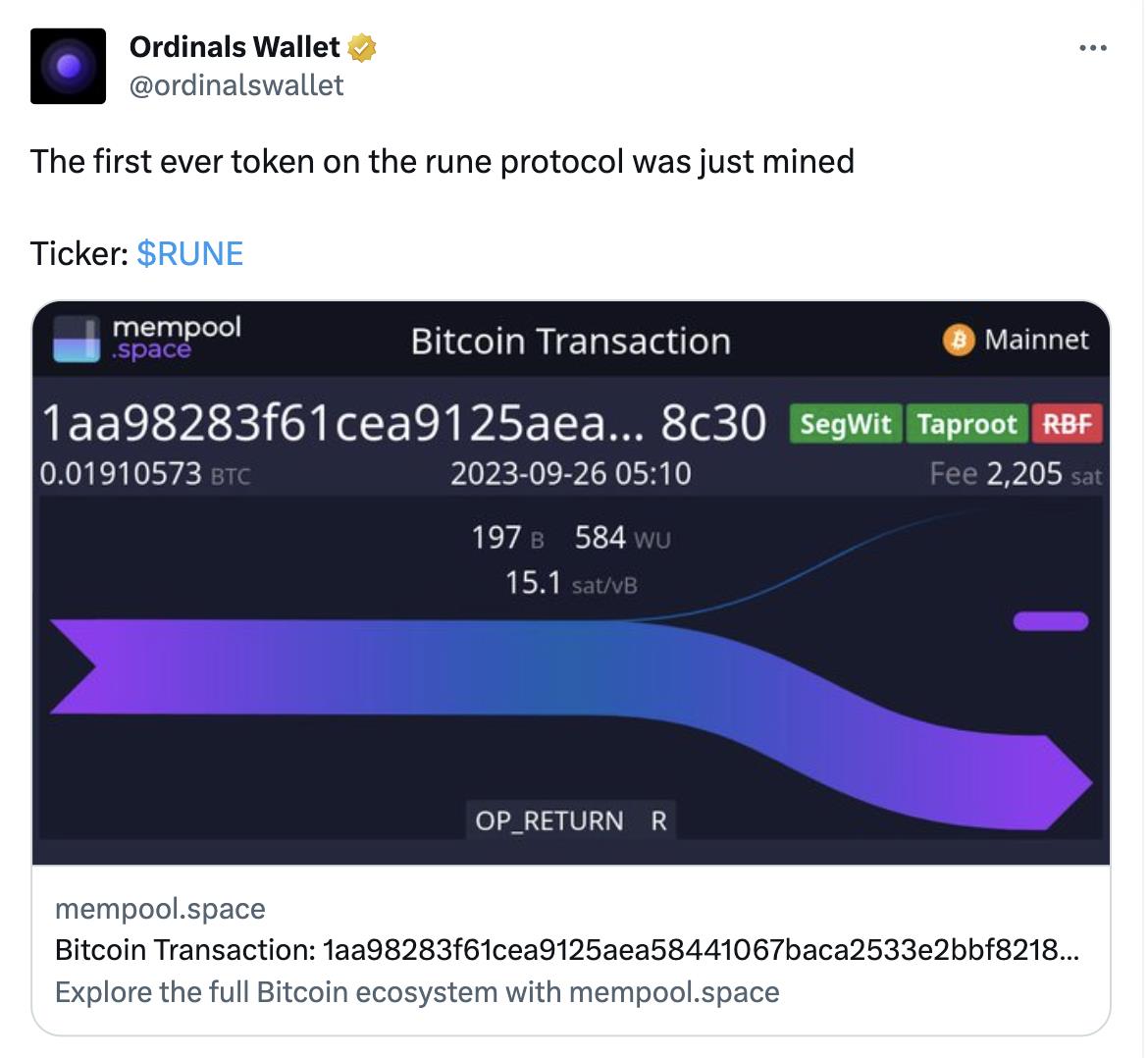
However, commenters pointed out that this appears to be an invalid deployment...

Additionally, @TO launched a public bounty offering $100,000 to the first team that builds a Rune protocol indexer.
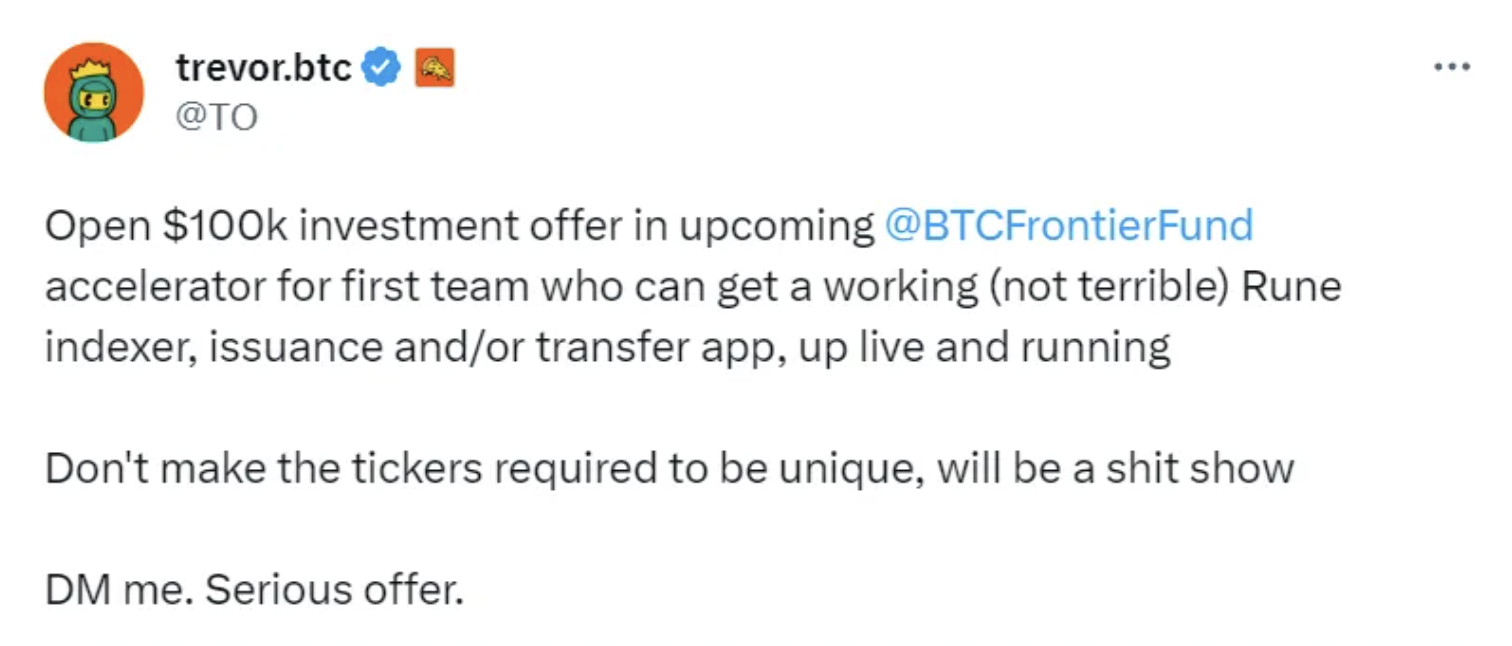
Please note carefully: There is currently no consensus on whether the $RUNE deployment is valid, as the protocol remains only a conceptual proposal from Casey with no finalized standards or published code. Beware of scams!
Conclusion
Casey’s proposal feels more like a resigned plea — “I have a better alternative to BRC-20; would you at least consider letting Ordinals return to its original purpose?”
Will BRC-20 die? Probably not, and there’s no need to be overly pessimistic. Over recent months, BRC-20 has attracted numerous teams building ecosystems around it, and these teams won’t abandon their work due to a single conceptual proposal. Moreover, BRC-20 itself continues evolving — could it integrate solutions like the Lightning Network to address current issues? That remains to be seen.
Finally, Casey’s soul-searching question lingers:
99.9% of FTs are memes and scams. I’m not sure — is creating a new FT protocol for Bitcoin really a good idea?
Join TechFlow official community to stay tuned
Telegram:https://t.me/TechFlowDaily
X (Twitter):https://x.com/TechFlowPost
X (Twitter) EN:https://x.com/BlockFlow_News
 @lonelyhorseme