








Price Halved After Minting Started: Is the New Rune from Ordinals Founder a Conspiracy?
TechFlow Selected TechFlow Selected
Price Halved After Minting Started: Is the New Rune from Ordinals Founder a Conspiracy?
Airdrop 50%, but the current price has dropped by 46%.
 Navigating Web3 tides with focused insights
By Golem, Odaily Planet Daily
At 10:30 AM today, MEMENTO•MORI, the new rune launched by Casey, founder of Ordinals and Runes, opened for fair minting and was fully minted within nine blocks. During this period, Bitcoin network transaction fees surged dramatically, with median fees exceeding 500 satoshis per byte. According to data from Magic Eden, MEMENTO•MORI currently has a market cap of $17 million, with trading volume surpassing 100 BTC—approximately $7.81 million.
Around the time of the MEMENTO•MORI airdrop and minting event, various reactions emerged within the community:
-
"Simple strategy—spent just $5 and received hundreds of dollars in airdropped tokens."
-
"The mint will definitely be competitive; we need to prepare in advance."
-
"Worried about getting buried during minting—better to buy some on the open market first."
-
"There must be insider allocations—this is all part of Casey’s scheme."
-
......
50% Airdropped in Advance, Early Participants Gain 100x Returns
MEMENTO•MORI was inscribed by Casey on October 22 atop his previously hard-coded Rune #0, UNCOMMON•GOODS. The total supply of the token is 100 million, but only 50% was made available through today's fair mint. The other 50% was pre-allocated by Casey and airdropped early this morning to subscribers of his podcast "Hell Money."
Unlike previous surprise airdrops in the Bitcoin ecosystem, this one was not entirely unexpected. On October 24, Casey explicitly announced on the Hell Money podcast that the reserved 50% would be fully distributed to subscribers, though he noted that the snapshot had not yet been taken. This served as a clear signal. Fortunately, subscribing to Hell Money wasn't expensive—starting at just $5 per month—prompting many users to subscribe in hopes of qualifying for the airdrop.
On October 30, lifofifo published a list on X revealing 2,907 addresses eligible for the MEMENTO•MORI airdrop. The amount each address received depended on subscription tier and duration. Even those who subscribed at the lowest tier ($5/month) after Casey’s announcement still received approximately 1,400 MEMENTO•MORI tokens.
Casey spent around $31,000 in fees to complete the airdrop. Following the distribution, according to Magic Eden data, both the floor price and trading volume of MEMENTO•MORI spiked sharply, with prices briefly exceeding 400 sats per token—over $350 per unit. Compared to the minimum $5 entry cost, early participants realized returns of dozens of times their investment.
Minting Fails to Meet Hype, Prices Decline Continuously
Given Casey’s status and influence within the Bitcoin ecosystem—and considering MEMENTO•MORI is symbolically his first self-created rune—community expectations were high. Many anticipated that Bitcoin network fees would soar into four-digit territory during the mint. As predicted by Bitcoin ecosystem commentator CG, if network fees exceeded 1,000 satoshis/byte, the cost per MEMENTO•MORI could reach $110, pushing the initial market cap above $10 million.
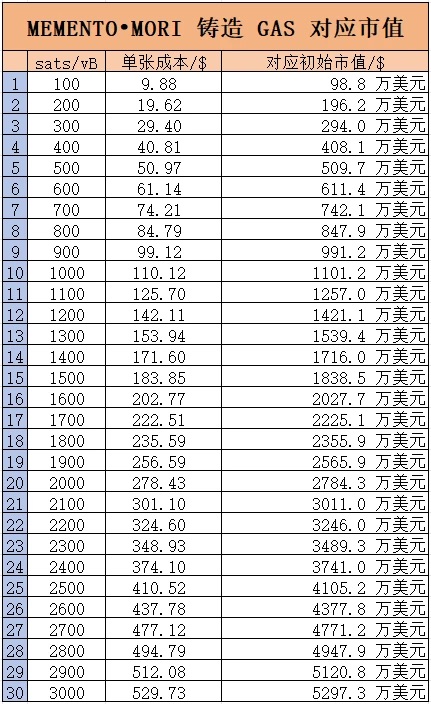
In reality, prior to the mint, MEMENTO•MORI was already trading on Magic Eden at a market cap exceeding $20 million. If cost competition intensified, community estimates suggested minting fees could surpass 1,500 satoshis/byte. As a result, some players prepared multiple addresses and ample fees in advance, while others opted to purchase tokens directly on the market, planning to profit from arbitrage when minting costs spiked.
Unexpectedly, although Bitcoin network fees did rise upon mint initiation, they failed to reach the anticipated peak of over 1,000 satoshis/byte. Miner fee medians hovered around 500 satoshis/byte. Meanwhile, the floor price of MEMENTO•MORI on Magic Eden steadily declined throughout the minting process. The latest traded price stands at 230 sats per token—about $160—representing a roughly 46% drop from pre-mint levels.
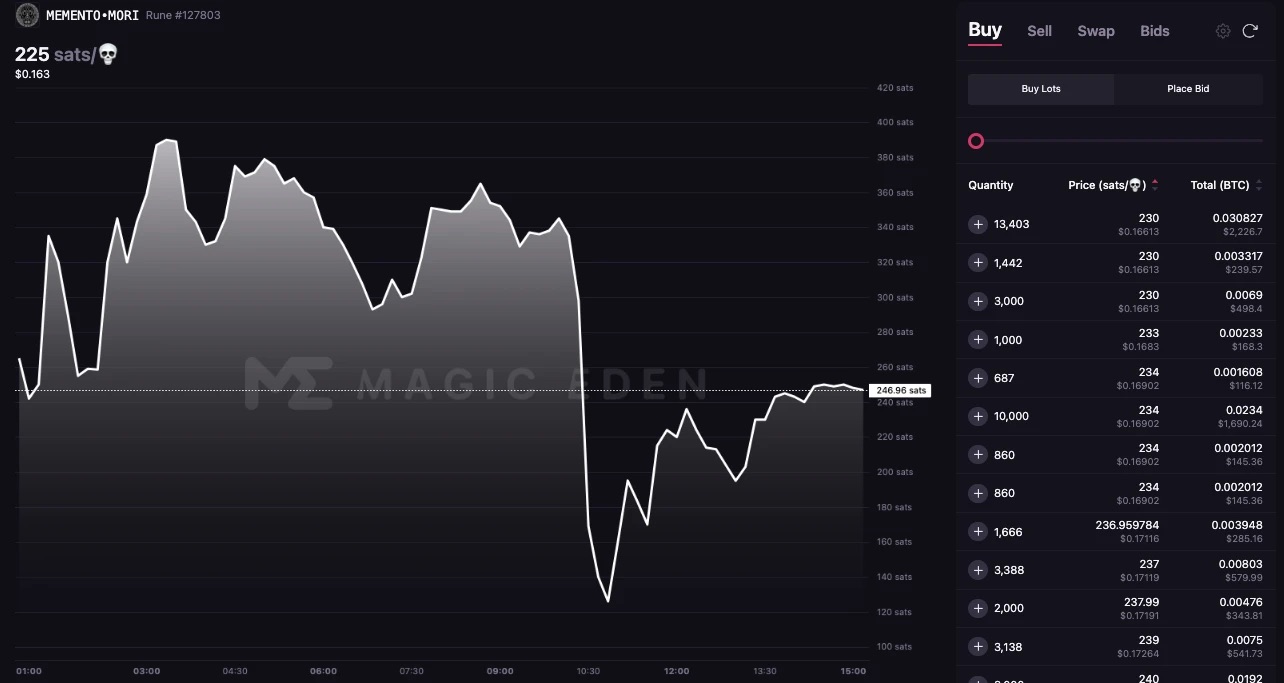
The market enthusiasm for MEMENTO•MORI fell short of expectations. Aside from early subscribers who benefited significantly from the airdrop, those who bought before or after the mint—and failed to promptly take profits—saw lackluster returns.
Was MEMENTO•MORI a Scheme Orchestrated by Casey?
While MEMENTO•MORI hasn’t yet broken below its initial value, the sharp spike in trading volume and price following the airdrop, followed by a rapid collapse in interest and price after the fair mint, combined with initially opaque and manipulable airdrop rules, have fueled suspicion. Many community members complained that despite having subscribed, they did not receive the airdrop—raising questions about potential manipulation behind the scenes.
Although the level of speculative competition (PVP) in Bitcoin's ecosystem doesn't match that of Solana meme coins, neither does the number of participants or capital involved. This has led to a unique form of on-chain speculative minting, where once a project is minted, its lifecycle often ends. Historically, fairness has been paramount in Bitcoin-based launches; excessive team allocations are seen as bearish. However, as competition intensifies and external capital inflows remain limited, attention toward fairly launched tokens and communities built purely on consensus has significantly waned.
Instead, investors are increasingly directing funds and attention toward assets issued by individuals with notable reputations or leading communities, hoping these figures' influence will generate wealth opportunities. Yet, more often than not, retail participants end up being the ones exploited.
Shortly after the MEMENTO•MORI mint began, Casey posted a disclaimer on X reiterating that MEMENTO•MORI holds no value and is merely a "shitcoin."

Casey previously discussed MEMENTO•MORI on his podcast, explaining it relates to death—meant to remind people of life’s brevity and the inevitability of mortality. It’s certainly a meaningful concept. However, most participants were drawn to MEMENTO•MORI primarily due to the “Casey effect.” Perhaps for him, this rune truly was an experiment or a game—not a conspiracy. But for most players, it remains nothing more than a once-beloved asset now left behind.
Join TechFlow official community to stay tuned
Telegram:https://t.me/TechFlowDaily
X (Twitter):https://x.com/TechFlowPost
X (Twitter) EN:https://x.com/BlockFlow_News
 Odaily


