EigenDA: Achieving Hyper-Scalable Data Availability for Rollups
TechFlow Selected TechFlow Selected
EigenDA: Achieving Hyper-Scalable Data Availability for Rollups
EigenDA is planned to be one of the first AVSs launched within the EigenLayer ecosystem.
 Navigating Web3 tides with focused insights
Authored: EigenLabs
Compiled: TechFlow
EigenDA is a secure, high-throughput, and decentralized data availability (DA) service built on Ethereum, leveraging the restaking primitives of EigenLayer. Developed by EigenLabs, EigenDA will be the first active validator service (AVS) to launch on EigenLayer. Once live, restakers will be able to delegate their staking rights to node operators performing validation tasks for EigenDA in exchange for service payments, while rollups will be able to publish data to EigenDA—achieving lower transaction costs, higher throughput, and composability within the EigenLayer ecosystem. Its security and throughput are designed to scale horizontally as more restakers and operator selections participate in serving the protocol.
We expect EigenDA to contribute the following to the Ethereum ecosystem:
-
Provide innovative DA solutions for rollups, contributing to Ethereum's ultimate scalability goals while deriving security and value from Ethereum stakers and validators. EigenDA is built upon core ideas and libraries central to Danksharding’s key upgrades, helping advance real-world testing of these technologies.
-
Set new standards for high throughput and low cost, enabling growth in novel on-chain applications such as multiplayer gaming, social networks, and video streaming, supported by flexible pricing models including variable and fixed fees.
-
Protect critical aspects of decentralization. In shared security systems like EigenLayer, if every node operator must download and store data from every chain using the system, few operators can keep up, leading to potential centralization. EigenDA is designed to counter this trend by distributing work across many participating nodes, requiring each operator to perform only a small fraction of the total workload while maintaining high performance.
-
Demonstrate the power of programmable trust. EigenDA aims to show that Ethereum stakers and validators can support essential Ethereum infrastructure beyond Ethereum consensus itself. AVSs like EigenDA—and AVS users such as rollups relying on EigenDA—can successfully build new business and token models based on modular trust rooted in Ethereum’s trust network.
We are excited to see several teams already planning to integrate EigenDA into their L2 infrastructures, including: Celo transitioning from L1 to Ethereum L2; Mantle and its suite of complementary products within the BitDAO ecosystem; Fluent providing a zkWASM execution layer; Offshore offering a Move execution layer; Layer N delivering a zk-OP hybrid rollup for financial applications, among others.
Technical Architecture
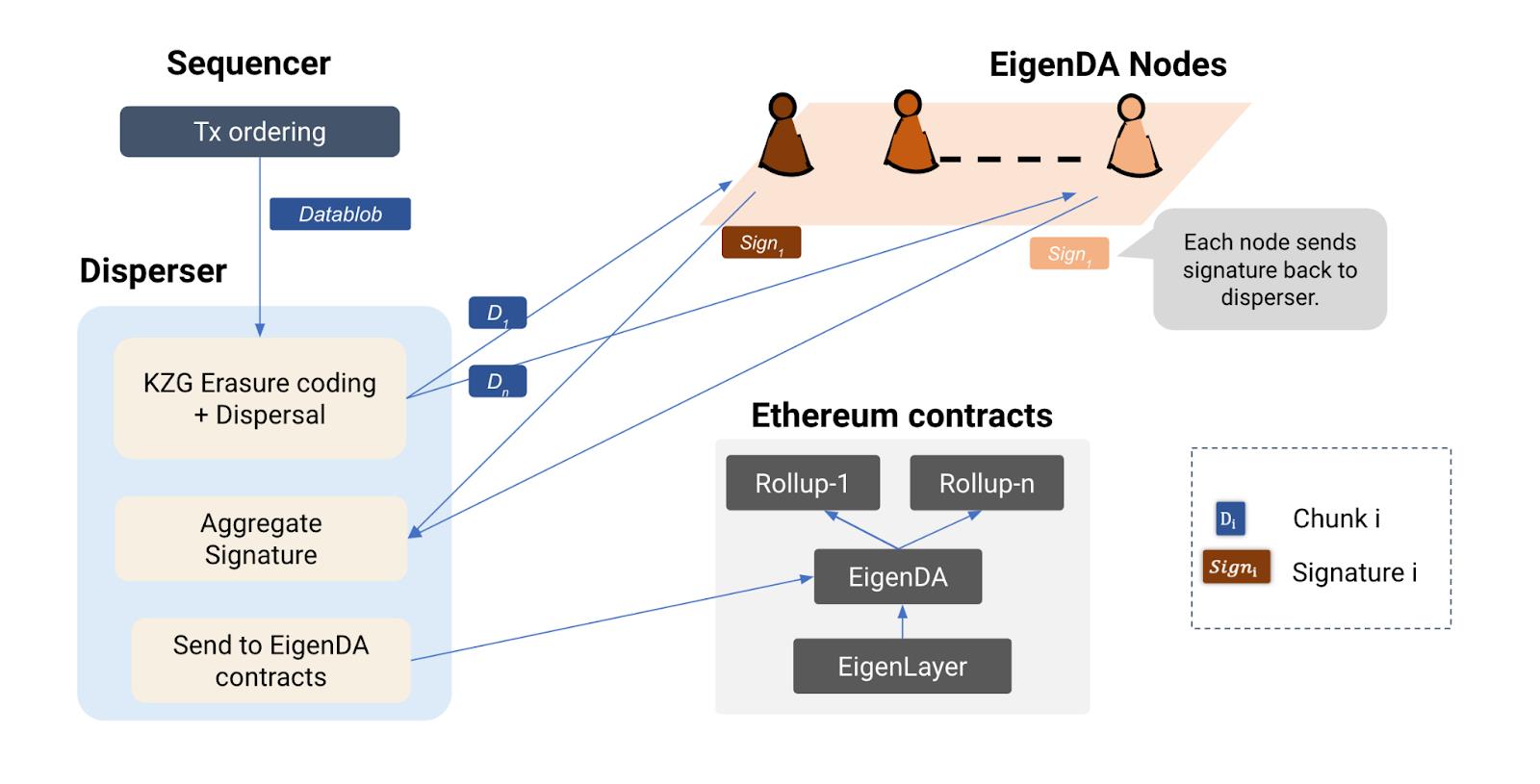
The diagram below illustrates the basic flow of data within EigenDA.
-
The rollup sequencer creates blocks with transactions and sends a request to disperse the data blob.
-
The disperser is responsible for encoding the data blob into smaller chunks using erasure coding, generating KZG commitments and KZG multi-reveal proofs, then sending the commitment, chunks, and proofs to EigenDA network operators.
-
Rollups can run their own disperser or use a third-party dispersion service (e.g., provided by EigenLabs), which offers convenience and spreads the cost of signature verification. Using a third-party service allows rollups to benefit from cost-sharing while retaining censorship resistance by switching to their own disperser as a backup in case of unresponsiveness or censorship.
-
EigenDA nodes verify received chunks against the KZG commitment using the multi-reveal proof, persist the data, and then generate and return signatures to the disperser for aggregation.
Technical Considerations
Now that we have a basic understanding of EigenDA’s architecture, let’s discuss the benefits and features the system aims to deliver. Below is a brief list of characteristics we believe are essential for a good and useful data availability layer for rollups:
-
Cost-efficiency
-
Throughput
-
Security
-
Customizability
We will now explain each of these characteristics from the perspective of EigenDA.
Cost-Efficiency
Today, many L2s use Ethereum as their data availability layer due to its cryptographic-economic security guarantees. However, this results in extremely high and volatile costs, as rollups compete with all other Ethereum users for limited block space under congestion-based pricing. For example, Arbitrum and Optimism have spent tens of millions of dollars this year alone on Ethereum data availability fees, with inconsistent monthly costs. A primary value proposition of a dedicated data availability system is drastically reducing these costs and offering rollups greater predictability in their cost structures.
Reducing Costs
Operating a data availability system incurs costs across three fundamental dimensions. Let us analyze how EigenDA minimizes the underlying cost structure in each dimension:
-
Cost of staked capital. To secure the DA layer, stakers may require a certain yield to offset opportunity costs. EigenDA reduces the cost of staked capital by leveraging EigenLayer’s shared security model, which allows the same stake to be reused across multiple applications, creating economies of scale.
-
Operational costs. Instead of requiring every node to download and store all data, EigenDA uses erasure coding to split data into smaller chunks and requires operators to download and store only one chunk—a fraction of the full data blob. This reduces per-operator storage costs, allowing many nodes to run EigenDA in a “lightweight” manner. As more nodes join the EigenDA network, the resource burden per node decreases further, enabling rich participation rather than scarcity.
-
Congestion costs. When blockchain bandwidth utilization approaches capacity, data costs rise. EigenDA mitigates congestion in two ways: 1. By achieving higher throughput, it makes congestion rare; 2. By supporting bandwidth reservations, EigenDA can guarantee reserved throughput for rollups at discounted rates. For flexibility, EigenDA also allows rollups to pay for additional throughput on-demand.
Rollup Economics
Rollup economics differ fundamentally from L1s—not only are data availability costs high and unpredictable, but they are paid in non-native tokens. This makes it difficult for rollups to offer price guarantees to users or subsidize early adoption, as they bear the “exchange rate risk” between their native rollup token and the token used to pay DA fees. In contrast, L1s pay a fixed inflation amount and can offer a baseline number of free transactions per second to attract users.
EigenDA is exploring mechanisms enabling rollups to pay stakers in their native rollup tokens at predictable long-term reservation rates, under terms acceptable to EigenLayer stakers. This combines the inherent scale advantages of shared security with the stability benefits of native token payments, helping drive rollup adoption.
Throughput
Throughput is another core value proposition of a data availability system. EigenDA is designed to scale horizontally—the more operators on the network, the higher the throughput. In private tests with 100 nodes exhibiting standard performance characteristics, EigenDA has demonstrated throughput as high as 10 MBps, with plans to scale toward 1 GBps. This opens the door for bandwidth-intensive Ethereum-based applications such as multiplayer gaming and video streaming.
EigenDA achieves high throughput through three foundational design pillars:
-
Decoupling DA from consensus. Existing DA systems bundle data blob availability proofs with data blob ordering into a monolithic architecture. Availability proofs can be processed in parallel, as nodes independently verify different data chunks; however, ordering requires serialization, causing significant consensus latency. While this coupling may enhance security for systems designed as final ordering sources, it is neither necessary nor beneficial for DA systems intended to complement Ethereum, which already provides its own ordering mechanism for settlement. By eliminating unnecessary complexity around ordering and designing a pure DA system, EigenDA achieves significant improvements in throughput and latency.
-
Erasure coding. EigenDA enables rollups to break data into smaller chunks and apply erasure coding before storage. Using KZG polynomial commitments (a core mathematical scheme in ZK proofs), EigenDA allows nodes to verify data availability by downloading only a small subset of the full data blob. Unlike systems relying on fraud proofs to detect malicious misencoding, EigenDA employs validity proofs in the form of KZG commitments, enabling nodes to cryptographically verify correct encoding.
-
Direct communication instead of P2P. Existing DA solutions use peer-to-peer (P2P) networks to transmit data blobs, where operators receive blobs from peers and rebroadcast them. This severely limits achievable DA rates. In EigenDA, the disperser sends data chunks directly to EigenDA operators. By relying on direct communication for data dispersion, EigenDA can confirm DA based on native network latency. This eliminates the significant “gossip penalty” of P2P networks and leads to faster data commitment times.
Security Properties
We use "security" broadly to encompass safety, liveness, decentralization, and censorship resistance. The following features illustrate EigenDA’s security posture:
-
EigenLayer. By utilizing restaking, EigenDA inherits two distinct security aspects from the EigenLayer system: 1) economic security; 2) decentralization. EigenDA is designed to leverage these two trust elements from the EigenLayer and Ethereum ecosystems in a synergistic way.
-
Proof of Custody. A key failure mode for operators in EigenDA is signing data without actually storing it for the required duration. To address this, EigenDA implements a mechanism called Proof of Custody, originally proposed by Justin Drake and Dankrad Feist of the Ethereum Foundation. With Proof of Custody, each operator must periodically compute and commit to a function whose value can only be derived if they have stored their assigned data chunk. If an operator signs data before computing this function, anyone with access to their data can slash their staked ETH.
-
Dual quorum model. EigenDA includes a feature called dual quorum, where two independent quorums can be required to attest to data availability. For instance, one quorum could consist of ETH restakers (ETH quorum), while a second quorum could be composed of stakers of a rollup’s native token.
-
Censorship resistance. Compared to coupled DA layers, EigenDA offers stronger immediate censorship resistance. Coupled DA architectures typically rely on a single leader or block proposer to linearly order data blobs, creating a transient censorship bottleneck. In contrast, in EigenDA, rollup nodes can directly disperse data and receive signatures from a majority of EigenDA nodes, raising censorship resistance to the level of the majority of EigenDA nodes rather than being constrained by a single leader.
Security Analysis
As previously discussed, EigenDA relies on ETH staking via EigenLayer and uses erasure coding with configurable coding ratios that can be set by rollups. Security analysis of blockchain systems like EigenDA can be approached from three distinct angles; we describe each and how it applies to EigenDA:
Byzantine Fault Tolerance (BFT): Assumes a portion of nodes are honest and fully follow the protocol, while others are malicious and can deviate arbitrarily.
-
EigenDA is secure—i.e., data can be retrieved—as long as X% of nodes are honest, where X ranges from 10% to 50% depending on the coding rate.
Nash Equilibrium Model: Analyzes economic incentives for each node or small colluding groups to follow the protocol, assuming independent behavior among non-colluding nodes.
-
As long as the colluding group is smaller than (1-X), storing and providing data to users constitutes a Nash equilibrium: Storage is enforced via Proof of Custody—nodes not storing data get slashed; data provisioning is ensured by dispersing data across many nodes, creating a competitive market for data delivery.
Pure Cryptoeconomic Model: Assumes all stake is controlled by a single entity and models the cost of economic corruption.
-
As long as data is available—or equivalently, as long as X% of nodes are honest—any node failing to custody data will have its staked ETH slashed. However, EigenDA does not offer unconditional cryptoeconomic security; if all nodes collude and withhold data, slashing may not occur. In the dual quorum model described earlier, even if ETH cannot be slashed, the rollup can still slash its native token when both ETH and native rollup tokens are staked.
As we can see, EigenDA operates on a trust model that depends not only on economic trust from ETH staking but also on the decentralization and independence of operators. Fortunately, EigenLayer enables EigenDA to borrow both of these trust mechanisms from Ethereum.
Customizability
Rollup developers can flexibly implement and tune parameters in EigenDA according to their needs. EigenDA’s modular design allows rollups to customize trade-offs in security/liveness, staking token models, erasure coding schemes, accepted payment tokens, and more.
As discussed earlier, some of the most important flexible decisions in EigenDA are economic. For example, a rollup may choose to use dual-quorum staking, pledging its own token to ensure data availability; or it may opt for on-demand versus reserved cost structures.
Strategic Considerations
Finally, we believe EigenDA offers strategic value to rollups beyond its technical attributes.
-
Ethereum stakers and validators are the driving force behind EigenLayer—and thus behind EigenDA. By adopting EigenDA, rollups align themselves with these Ethereum stakeholders who strongly value decentralization, censorship resistance, open-access software, and composable, permissionless innovation.
-
EigenDA is planned to be one of the first AVSs to launch in the growing EigenLayer ecosystem. We anticipate increasing composability benefits as more AVSs emerge, ultimately benefiting end users—including various types of rollups. Following EigenDA, we expect AVSs targeting use cases such as sequencing, fast finality, monitoring networks, bridging, fair ordering, and even artificial intelligence.
Join TechFlow official community to stay tuned
Telegram:https://t.me/TechFlowDaily
X (Twitter):https://x.com/TechFlowPost
X (Twitter) EN:https://x.com/BlockFlow_News
 @eigenlayer