Revisiting the Overlooked Decentralized Storage Sector from EthStorage
TechFlow Selected TechFlow Selected
Revisiting the Overlooked Decentralized Storage Sector from EthStorage
Storage is one of the three pillars of Web3 networks. Only with the implementation of decentralized storage can data ownership and sovereign networks be truly realized; otherwise, developing blockchain networks at the cost of centralized efficiency has little significance.
 Navigating Web3 tides with focused insights
Author: Alfred, LD Capital
One of the hottest sectors this year should be the L2 space focused on enhancing blockchain scalability. Once successfully implemented, faster speeds and lower fees will gradually drive the flourishing of Web3 applications, leading to an explosive demand for storage as vast amounts of data are generated in the future. This article focuses on EthStorage, the first-place winner at EDCON Super Demo 2023, revisiting the decentralized storage sector—an area that has recently drawn less market attention but holds immense potential.
1. Evolution of Network Storage
Consensus, computation, and storage are known as the three pillars and foundational infrastructure of web3. Wherever data and information are generated, storage is required. Since the birth of computers, storage technology has continuously evolved and broken through barriers. This article divides its development into four stages.
1. Centralized Storage: Centralized Storage + Centralized Management
Computers initially used paper tape to record data. Later, IBM manufactured the first hard disk in 1956 as a storage medium, ushering in the familiar computer storage method we know today.
While centralized storage devices have continuously iterated—hard drives, tapes, memory cards, SSDs, etc.—the storage architecture remains fixed. End devices can access and request data from storage resources via networks, but all data storage resources are concentrated in a single central location or server, under unified control and management.
2. Cloud Storage: Distributed Storage + Centralized Management
In 2006, Amazon AWS launched EC2 and S3 cloud storage services, marking the beginning of a new era in storage. Microsoft, Google, Alibaba, and others quickly followed, making this the most widely adopted storage method today.
Cloud storage employs a distributed storage architecture, using multiple servers to store data across locations, splitting and backing up data to reduce single points of failure while offering reduced redundancy and elastic scalability. However, the servers used in cloud storage are centrally managed by cloud service providers, meaning users do not actually retain control over their data.
3. Traditional Blockchain Storage: Distributed, Full-Node Storage + Decentralized Management
Since Bitcoin's inception, blockchain network storage has emerged as an alternative to centralized storage and management. Through distributed storage, consensus mechanisms, and transaction validation, blockchain ensures data security and immutability, meeting the requirements of both decentralized storage and management.
However, blockchains like Bitcoin and Ethereum suffer from high storage costs and low efficiency, primarily because these networks were not designed with storage as a primary goal. Every node must store a full copy of the data, and block space is limited. For example, storing a single image NFT like Bored Ape would cost hundreds of dollars on Bitcoin or Ethereum.
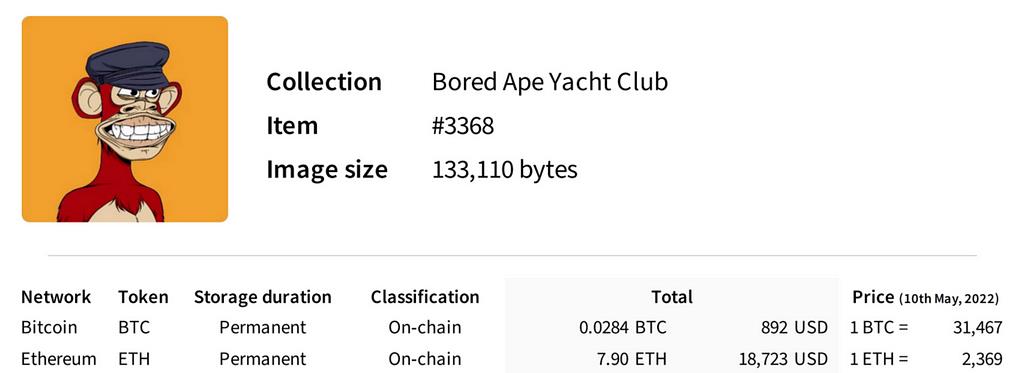
Source: Fundamental Labs
4. Web3 Decentralized Storage: Distributed, Multi-Node Storage + Decentralized Management
Because storing data directly on blockchains is extremely expensive, many Web3 decentralized storage solutions and projects have emerged, such as IPFS, Filecoin, Storj, Arweave, Swarm, and EthStorage. These projects aim to increase storage capacity and reduce costs while maintaining decentralization, leveraging techniques like data sharding, multi-node storage, and on-chain proofs.
2. Ethereum Modularization and the World Computer
2.1 Ethereum Modularization
Since Ethereum laid out its rollup-centric roadmap in 2021, modularization of the network has begun. This involves breaking down the layers of a monolithic blockchain, allowing different functions to be handled by separate modules or chains for scaling—a direction Vitalik refers to as the "endgame."
Ethereum-style blockchains divide the chain into four key layers:
(1) Execution Layer (*Execution Layer): Transaction processing, smart contract execution, and computation
(2) Settlement Layer (*Settlement Layer): Verification of execution results, dispute resolution, and state commitment settlement
(3) Consensus Layer (*Consensus Layer): Determining transaction order, validity, and node consistency
(4) Data Availability Layer (*Data Availability Layer): Ensuring data is usable, stored, and verifiable
With monolithic blockchains, a single chain handles all four functions, facing the blockchain "trilemma." Modularization separates these functions into specialized layers, each addressing distinct challenges.
After modularization, Ethereum’s mainnet becomes L1, upon which numerous L2s emerge primarily serving as Ethereum’s execution layer. Even OP Stack-based L2 technologies have developed modular architectures to enhance future scalability. Through modularization and rollups, Ethereum will focus mainly on the Data Availability (DA) and Consensus Layers, becoming the dominant and most secure base layer, while other functions are offloaded to additional chains and solutions, enabling ecosystem-wide expansion and improved scalability.
2.2 The World Computer
Ethereum aims to build a world supercomputer. While it excels in security, breakthroughs in scalability are still underway. Rollups represent a key path forward, and modularization helps address the blockchain trilemma to some extent. However, achieving a true supercomputer requires solving three core challenges: consensus, computation, and storage—each of which constrains the others.
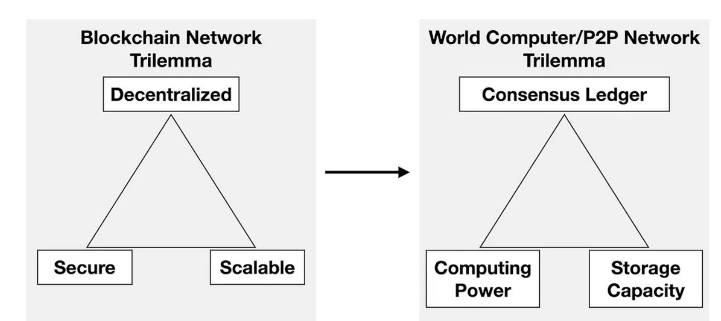
Source: “Towards World Supercomputer”
Different priorities within this trilemma lead to various trade-offs:
Strong Consensus Ledger: Requires redundant storage and computation, thus unsuitable for scaling storage and computing.
Strong Computational Power: Requires repeated use of consensus during heavy computation and proof tasks, thus unsuitable for large-scale storage.
Strong Storage Capacity: Requires repeated use of consensus during frequent random sampling and space proofs, thus unsuitable for computation.
Currently, traditional L2 solutions face issues balancing centralized sequencers with computational efficiency and cannot provide strong storage capabilities. The authors of “Towards World Supercomputer” propose functional partitioning of the world computer as a foundational architecture, expanding each component separately to overcome the trilemma.
Ultimately, the world supercomputer will consist of three topologically heterogeneous P2P networks. Similar to building a physical computer, zero-knowledge proof-based trustless buses (*connectors) link the consensus ledger, compute network, and storage network into a unified world supercomputer. Additional components can be added based on application needs. By appropriately selecting and connecting each module, a balance among consensus, computation, and storage—the three elements of the trilemma—can be achieved, ensuring the world supercomputer remains decentralized, high-performance, and secure. In this framework, EthStorage serves as the storage solution.

Source: “Towards World Supercomputer”
Based on this framework, a transaction process on Ethereum’s world supercomputer would proceed as follows:
(1) Consensus: Ethereum processes and reaches agreement on transactions.
(2) Computation: The zkOracle network executes relevant off-chain computations by rapidly verifying proofs and consensus data passed via the zkPoS bus.
(3) Consensus: In cases like automation and machine learning, the compute network returns data and transactions to Ethereum or EthStorage via proofs.
(4) Storage: For storing large volumes of data from Ethereum (*e.g., NFT metadata), zkPoS acts as a messenger between Ethereum smart contracts and EthStorage.
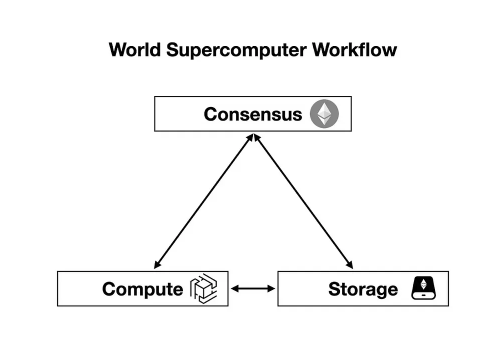
Source: “Towards World Supercomputer”
3. ETH Storage
3.1 Overview
EthStorage is the first Layer 2 solution built on Ethereum’s Data Availability (*Data Availability) that offers programmable dynamic storage. It enables programmable storage expansion to hundreds of terabytes or even petabytes at 1/100th to 1/1000th the cost.
The team has twice received grants from the Ethereum Foundation to support research on data availability and dynamic dataset storage proofs using Ethereum L1 contracts. It also won first place at EDCON Super Demo 2023.
3.2 Technical Features
(1) Deep Integration with Ethereum
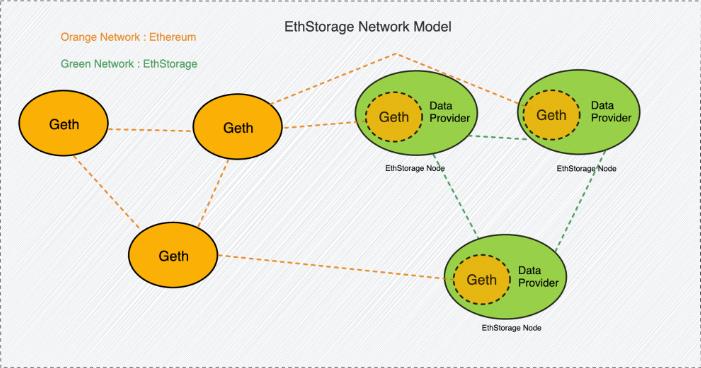
The EthStorage client is a superset of the Ethereum client Geth. This means nodes running EthStorage can still fully participate in Ethereum processes—each node can simultaneously serve as both an Ethereum validator and an EthStorage data node. Each EthStorage Node’s Data Provider module initiates connection requests to other EthStorage Nodes’ Data Providers. Once connected, they collectively form a decentralized storage network.
Source: “EthStorage – The First Ethereum Storage L2”
Users of EthStorage can directly use existing wallets to interact with all applications built on top of storage—NFTs, decentralized social networks, or games—minimizing entry barriers. Additionally, EVM compatibility ensures excellent interoperability for smart contracts. For instance, if User A wants to attach an image to their minted NFT, with EthStorage, they only need one Ethereum transaction. With Arweave, they’d need one Arweave transaction and two Ethereum transactions, and cannot execute synchronously as with EthStorage.

Source: “EthStorage – The First Ethereum Storage L2”
(2) L2 Decentralized Solution Based on DA Layer
EthStorage adopts an architecture similar to L2. An on-chain storage contract deployed on Ethereum serves as the entry point for EthStorage data operations. Proofs of off-chain stored data (*off-chain storage data) from data nodes must also be verified through this contract.
Comparison with current L2s:
Rollup (L2) stores state trees off-chain; the on-chain commitment (*commitment) is the state root. After receiving new data, Rollups must execute transactions off-chain to complete state transitions and generate new state trees.
EthStorage stores raw data off-chain; the on-chain commitment (*commitment) is proof of data storage. Upon receiving a request to update stored data, EthStorage regenerates new storage proofs for the updated data.
Thus, while Optimism Rollup or ZK-Rollup scale Ethereum’s computational capacity, EthStorage Rollup scales Ethereum’s data storage capability.
Moreover, EthStorage is a modular storage layer. As long as a chain has EVM and a DA layer to reduce storage costs, EthStorage can run on any blockchain (*though many Layer 1s currently lack a DA layer), even on Layer 2s. For example, EthStorage is exploring how to implement fraud proofs on Optimism and has already enabled a corresponding DA layer on Optimism.
(3) Enables Dynamic Storage
From a system design perspective, Filecoin and Arweave are better suited for static storage—large datasets can be uploaded to decentralized storage but cannot be modified or deleted, requiring re-upload for updates. Thanks to its key-value storage paradigm, EthStorage supports CRUD operations: creating, updating, reading, and deleting stored data. While trivial in centralized storage, this capability is currently unique to EthStorage in the decentralized storage space.

Source: Official EthStorage
(4) Creating an Ethereum Network Access Protocol
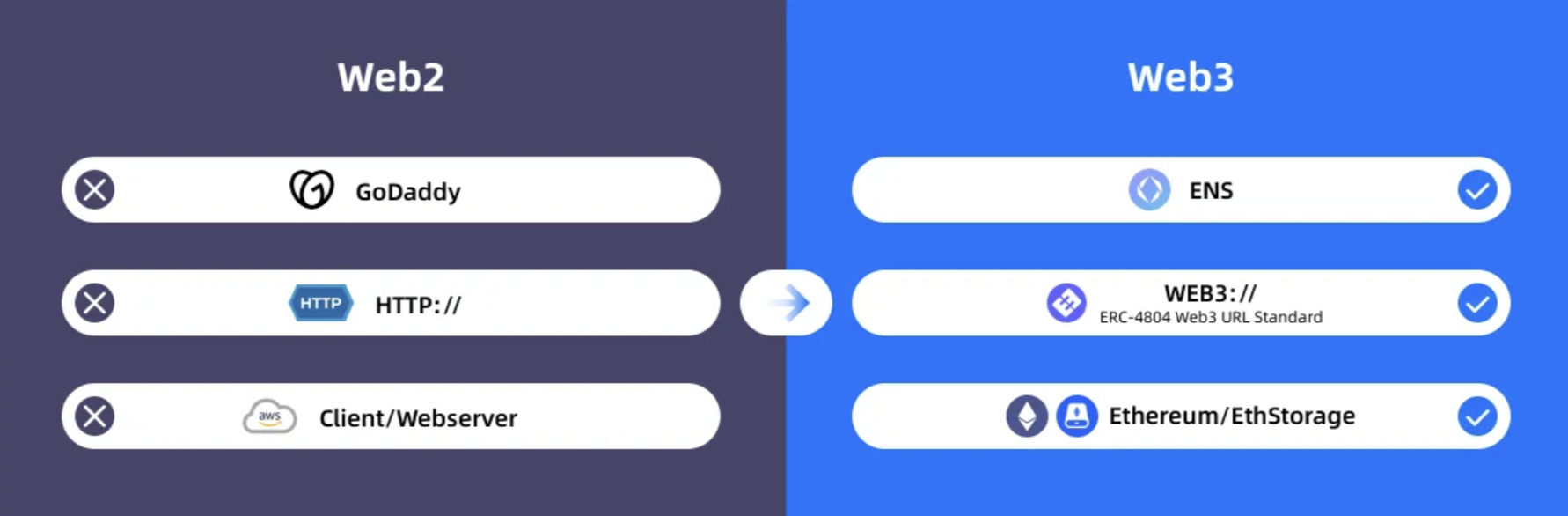
Browsing websites, sending emails, downloading files—all common activities on the Web2 internet—rely heavily on the HTTP protocol, one of the most prevalent protocols online. HTTP defines how clients and servers transfer and exchange resources, with URLs identifying resource locations. When entering a URL or clicking a link in a browser, an HTTP request is triggered, using the URL to identify the desired resource. The browser parses the URL and communicates with the server via HTTP to request the resource, then displays it upon response. HTTP and URLs work together to form the foundation of browsing, interaction, and resource transfer on the web. However, Web2 data is hosted on centralized servers. If hosting fees stop being paid, cloud services shut down and the data is deleted by the centralized provider.
EthStorage founder Zhou Qi proposed a Web3 network access protocol—ERC-4804—which has passed final EIP review and approval. ERC-4804, formally named "Web3 URL for EVM Call Interpretation," is an HTTP-style Web3 URL (*web3://) mapped to EVM calls—the first network access protocol on Ethereum. Unlike Web2’s server-based resource access, the web3:// access protocol uses Web3 URLs to directly render resources hosted on Ethereum smart contracts, including HTML, CSS, PDFs, and more.
Simply put, web3:// (*http://web3url.io) is a decentralized version of http://. It adds a decentralized presentation layer to Ethereum, allowing users to directly browse web content—pages, images, songs—on EVM, with EVM acting as the decentralized backend.

Source: Official EthStorage
3.3 Current Status and Roadmap
(1) Product Applications
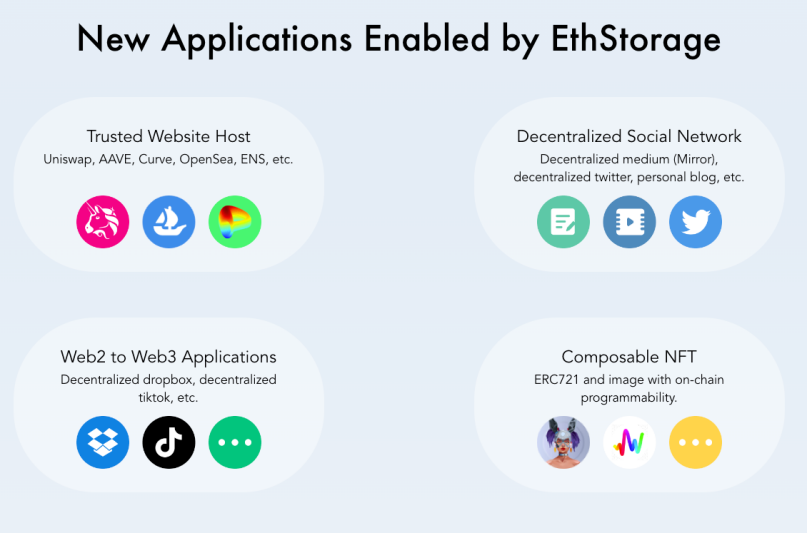
With EthStorage, internet applications can be rebuilt using decentralized storage as the foundation (*currently, many dApps still rely on centralized data storage), such as dynamic NFTs, on-chain music NFTs, personal websites, hostless wallets, dApps, and Deweb.
Source: Official EthStorage
Take DeWeb as an example:
We know Ethereum is a decentralized network hosting many decentralized dApps. Yet, these dApps are not fully decentralized—many still host their frontends on centralized cloud services. Incidents like Uniswap’s frontend going down, trading pairs being removed, or Tornado.Cash’s frontend being taken offline due to regulatory pressure stem from reliance on centralized servers, making them vulnerable to censorship. With EthStorage, webpage files and data are hosted in smart contracts, maintained and operated by a decentralized network, greatly enhancing censorship resistance. Programmable smart contracts enable innovative applications such as De-GitHub, De-Blog, and decentralized frontends for various dApps.

Source: Official EthStorage
Currently, EthStorage has not announced a token plan, but users can test and interact with the testnet using the test token W3Q.
(2) Roadmap
According to the roadmap released at EDCON, EthStorage remained in the testnet phase throughout 2023, aligning development and testing with Ethereum’s Cancun upgrade. Mainnet launch is expected in 2024, featuring full integration with Danksharding, CL+EL clients, and Web3 browser access.

Source: Official EthStorage
4. Overview of Other Storage Projects
(1) Filecoin: Filecoin is a decentralized storage network built atop IPFS with an incentive mechanism. IPFS uses a distributed hash table (*DHT)—a protocol for storing, addressing, and transferring data (*analogous to HTTP). Filecoin acts as IPFS’s incentive layer and an open storage marketplace. It uses contract-based models to ensure data persistence, combined with zero-knowledge proofs—specifically Proof-of-Spacetime and Proof-of-Replication. On March 14 this year, Filecoin officially launched its Virtual Machine (*FVM) to support smart contracts and user programmability.
Filecoin features: independent chain and incentive system; large-capacity, low-cost static storage; FVM virtual machine support post-upgrade.
(2) Arweave: Arweave adopts a "pay once, store forever" model, where a one-time payment covers permanent data storage, and data retrieval incurs no extra fees. Arweave uses succinct proofs for random access, creating a native data structure called Blockweave, where each block links to the previous block and a randomly selected historical Recall Block. For nodes, mining a new block requires syncing both a Recall Block and the latest block data.
Arweave features: independent chain and incentive system; on-chain, permanent storage; relatively weak interoperability with other chains.
(3) BNB Greenfield: Greenfield focuses on enabling decentralized data management and access, aiming to simplify data storage and link data ownership with the DeFi environment of BNB Smart Chain (*BSC). The complete BNB Greenfield system integrates seamlessly with the mature BSC public chain and BN community users. When users want to create and use data on Greenfield, they interact with BNB Greenfield core infrastructure via BNB Greenfield dApps (*decentralized applications).
BNB Greenfield features: the final piece of Binance’s "trinity" ecosystem, highly operable within the ecosystem with BNB circulating across chains; adopts Amazon S3 "bucket" storage structure; off-chain storage with on-chain verification.
5. Conclusion
Storage is one of the three pillars of the Web3 network. Only when decentralized storage is realized can true data ownership and sovereign networks be achieved; otherwise, developing blockchain networks at the cost of sacrificing centralized efficiency makes little sense. This sector, though foundational, holds great potential and significance.
Currently, compared to other sectors, decentralized storage has attracted less market attention—mainly due to early development stage and insufficient demand. As L2 advancements make dApp usage cheaper and faster, the accumulation of massive data and rising value demands will inevitably shift market focus toward decentralized storage.
As an emerging project, EthStorage benefits from Ethereum’s strong ecosystem and high interoperability, integrating well with L1s and L2s that have DA layers, offering new directions and solutions. Today, each decentralized storage project is advancing in its own niche. We look forward to the era when market momentum turns decisively toward the storage sector.
Join TechFlow official community to stay tuned
Telegram:https://t.me/TechFlowDaily
X (Twitter):https://x.com/TechFlowPost
X (Twitter) EN:https://x.com/BlockFlow_News
 Cycle Capital Research