On the Eve of the Cancun Upgrade: A Survey of the Ethereum zkEVM Landscape
TechFlow Selected TechFlow Selected
On the Eve of the Cancun Upgrade: A Survey of the Ethereum zkEVM Landscape
As various teams explore approaches to zkEVM—and even as Ethereum itself evolves—it's possible that all solutions may eventually achieve full equivalence to Ethereum.
 Navigating Web3 tides with focused insights
Author: 0xRJ.eth
Introduction
The upcoming major Ethereum upgrade—Cancun-Deneb Upgrade, expected to roll out in late 2023—is primarily aimed at enhancing the scalability, security, and usability of the Ethereum network, while significantly reducing gas fees on Layer 2 (L2) networks. If successfully implemented, this upgrade will directly benefit the Ethereum L2 scaling (L2 Rollups) ecosystem and could potentially catalyze a breakout across the entire L2 sector.
Within the L2 scaling landscape, zero-knowledge proof-based scaling solutions (ZK Rollups), particularly those with excellent data compression capabilities, are widely regarded as Ethereum’s medium- to long-term core strategy. In 2022, Ethereum co-founder Vitalik Buterin categorized various ZK Rollups based on their compatibility with the Ethereum Virtual Machine (EVM), establishing a foundational standard for zkEVM types.
This article is deeply inspired by Vitalik’s pioneering classification. Over the past year, significant progress has been made in the field. Building upon Vitalik’s insights, this piece aims to provide an updated and more detailed interpretation of the landscape, presented in clear logic and accessible language—even for technical beginners.
What is EVM?
The EVM (Ethereum Virtual Machine) is the first Turing-complete blockchain virtual machine. It can be understood as the runtime environment for code on Ethereum, specifically designed to execute smart contracts deployed on the Ethereum network. Through the EVM, smart contracts can achieve automated functionality on a decentralized network.
As the blockchain virtual machine launched in 2015 and the most battle-tested to date, the EVM is undoubtedly a critical infrastructure component of Ethereum. When evaluating other blockchains, EVM compatibility has become a key consideration dimension—not just because it implies support for smart contract execution environments and Ethereum tooling, but also due to the massive network effects and mature, complex ecosystems that come with it.
However, when the EVM was initially designed, no one anticipated that ZK Rollup L2s would eventually become Ethereum's core scaling solution. As such, the EVM wasn’t built with zero-knowledge proofs in mind, making the construction of a zero-knowledge-friendly EVM (zkEVM) extremely challenging.
What is zkEVM?
Due to the high difficulty of combining zero-knowledge proofs (Zero Knowledge Proof) with EVM compatibility, early ZK Rollups did not support EVM at all. They generally lacked the ability to execute smart contracts (or supported only specialized virtual machines), limiting them to relatively simple use cases such as token swaps and payments.
To address this limitation, many organizations and researchers have focused on creating zkEVMs (Zero-Knowledge Ethereum Virtual Machines). As the name suggests, a zkEVM generates zero-knowledge proofs for the execution process and results of smart contracts within the EVM.
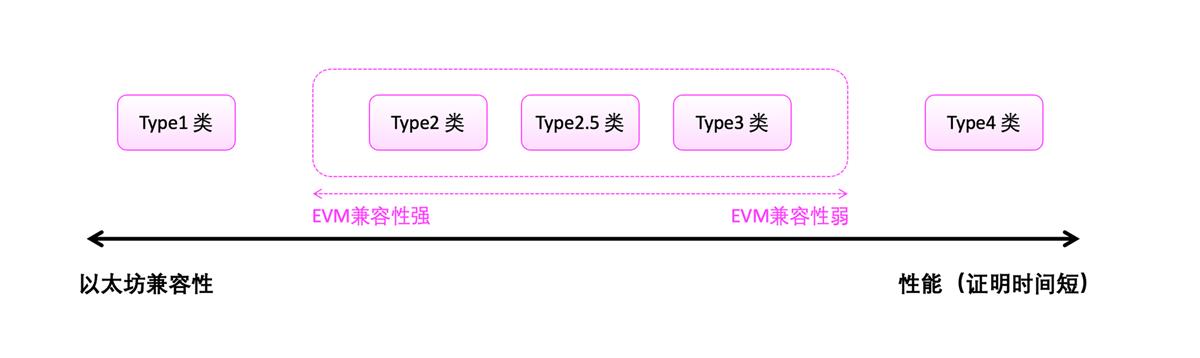
With increasing confidence in ZK Rollup scaling solutions and ongoing technological advancements, different zk scaling projects have developed distinct approaches to integrating EVM execution with zero-knowledge computation, balancing trade-offs between compatibility and performance (particularly proving time).
Different Types of zkEVM:
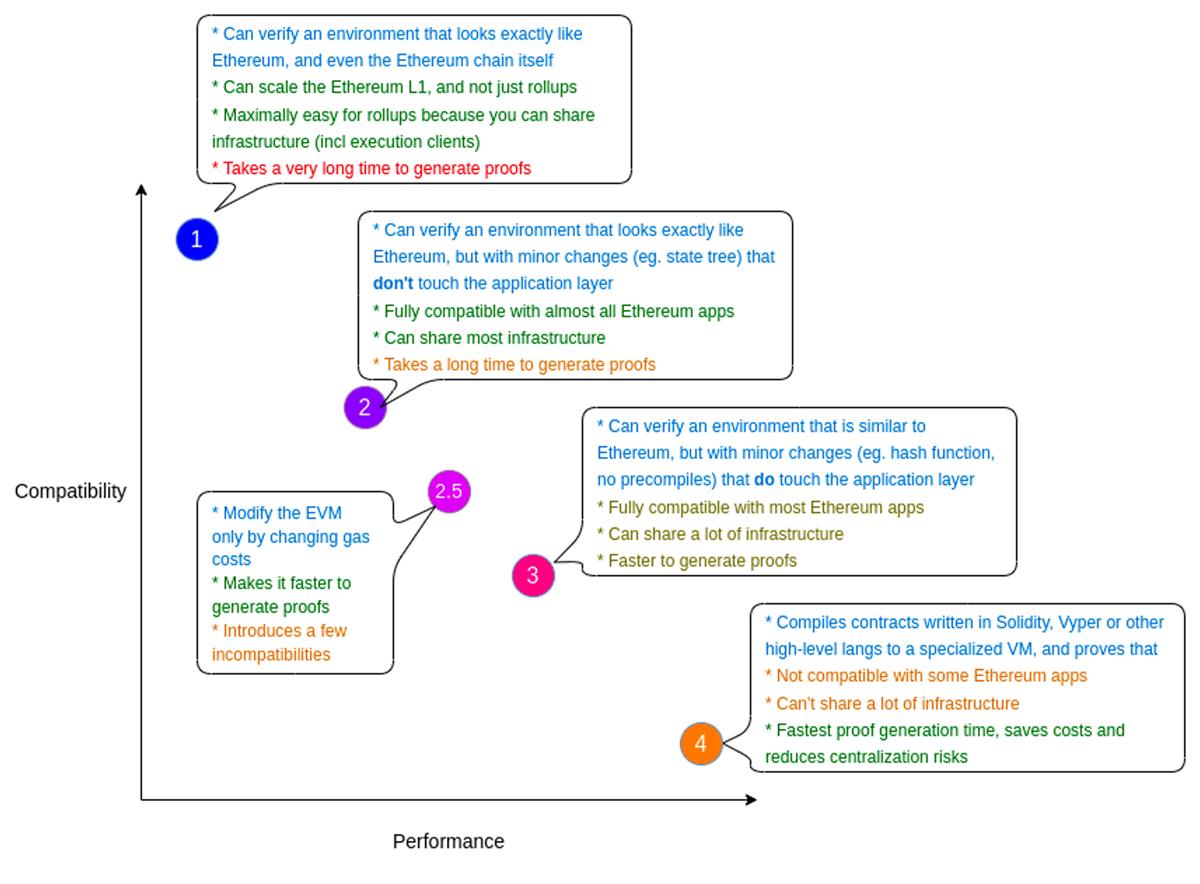
Source: Vitalik’s blog “The Different Types of ZK-EVMs”
In 2022, Vitalik published an article outlining the "different types of zkEVM", providing a broad classification and comparison of existing zk scaling projects.
Next, let’s break down the types of zkEVMs using plain language and clear logic, covering their technical architectures, advantages, and disadvantages.
Type 1 zkEVM: Fully equivalent to Ethereum
Type 2 zkEVM: Fully EVM-compatible (formerly including Type 2.5, which has now largely merged into Type 2)
Type 3 zkEVM: Mostly EVM-compatible
Type 4 zkEVM: High-level language compatible
Type 1 zkEVM—Fully Equivalent to Ethereum
Architecture:
-
Exactly identical to Ethereum, requiring no changes to any part of the Ethereum system environment.
-
Does not replace hashes, state trie, transaction trie, precompiles, or any other consensus logic.
-
Aims for full compatibility with existing applications, allowing developers to seamlessly migrate their applications without modification.
Advantages:
-
Offers the highest level of compatibility among all ZK Rollup types, making it the most developer-friendly option—existing code can be deployed to L2 without any modifications, since all consensus logic and system environments are fully equivalent to Ethereum.
-
Aligns closely with Ethereum’s own scaling direction; innovations in Type 1 zkEVMs could eventually be frictionlessly integrated into Ethereum itself, improving the scalability of Ethereum L1.
-
Allows Rollups to seamlessly reuse the vast existing Ethereum infrastructure (e.g., Ethereum execution clients can be used as-is to generate and process Rollup blocks; existing block explorers and block generation tools can also be smoothly deployed on L2).
-
Can verify Ethereum blocks just like current Ethereum does—or more precisely, verify the execution layer (including all transaction executions, smart contracts, and account logic, though currently excluding beacon chain consensus logic).
-
As previously mentioned, one major value of being fully Ethereum-equivalent is leveraging Ethereum’s massive network effects and mature, complex ecosystem.
Disadvantages:
-
Faces the same challenges as Ethereum when integrating zero-knowledge proofs (after all, it is Ethereum-equivalent, and Ethereum was not originally designed for zk functionalities).
-
The biggest issue is long proof generation times. Current industry solutions mainly involve large-scale parallelization through clever engineering or hardware optimization to accelerate proving.
Mainstream Projects:
-
Ethereum Foundation PSE (Privacy and Scaling Explorations) team
-
Taiko: Upgraded to Alpha-4 testnet in July this year, with mainnet launch expected in early 2024. From the beginning, Taiko prioritized decentralization and compatibility, becoming the first and currently only ZK Rollup to implement a decentralized proposer.
Type 2 zkEVM—Fully Compatible with EVM
Architecture:
-
Strives for full EVM compatibility but is not Ethereum-equivalent.
-
Compared to Ethereum’s native environment, this type of zkEVM modifies certain aspects such as block structure, state tree data structures, gas fee pricing logic (re-priced according to zk-friendliness), and data storage to make zk proof generation faster and cheaper.
-
Aims to maintain compatibility with the vast majority of existing applications, with only minor adjustments needed for some.
Advantages:
-
By re-pricing gas fees (making zk-unfriendly opcodes more expensive and vice versa) and removing parts of the Ethereum stack unfriendly to ZK, achieves faster verification times than Type 1.
-
Highly compatible with most existing Ethereum applications, so developers and users experience minimal friction.
-
Although Ethereum execution clients cannot be used directly without modification, existing EVM debugging tools and development infrastructure can still be supported with some tuning, enabling substantial leverage of Ethereum’s thriving ecosystem.
Disadvantages:
-
Although the scope of changes to the execution environment is small, there remain potential long-term development issues. For example, replacing Ethereum’s default hash function (Keccak) with another zk-friendly alternative (such as Poseidon) may cause compatibility problems for applications relying on Keccak (involving historical data), such as cross-chain bridges (which typically require proving historical actions on Chain A to trigger corresponding actions on Chain B using Keccak).
-
Changes to gas fee pricing rules (intended to “guide” developers away from zk-unfriendly opcodes by adjusting costs accordingly) can disrupt contracts already optimized for gas on Ethereum, as well as existing gas optimization tools.
-
While these modifications improve prover efficiency compared to Type 1 zkEVMs, proving time remains relatively slower compared to Type 4 zkEVMs.
Mainstream Projects:
-
Scroll: Launched Pre-Alpha testnet in September 2022, Alpha testnet in February 2023, with mainnet expected in August 2023. Initially classified as Type 3 zkEVM, Scroll is progressively enhancing EVM compatibility and transitioning toward Type 2.
-
Polygon zkEVM (Polygon team’s ZK Rollup solution): Launched mainnet beta in March 2023. Initially Type 3 zkEVM, currently transitioning toward Type 2.
Type 3 zkEVM—Mostly Compatible with EVM
Architecture:
-
As noted by Vitalik in his 2022 blog post, Type 3 zkEVMs are more transitional—either moving toward higher compatibility (evolving into Type 2/1) or sacrificing compatibility for better zk-friendliness (moving toward Type 4).
-
Nearly compatible with EVM. Further sacrifices in compatibility make zkEVM development easier and proof generation faster.
-
Removes more features difficult to implement in zkEVMs (e.g., precompiles).
-
Exhibits greater differences in handling contract code, memory, or stack operations.
-
Aims to remain compatible with most existing applications.
Advantages:
-
More zk-friendly than Type 1 and Type 2, resulting in shorter zk proof computation times.
-
Supports more existing Ethereum applications compared to Type 4 zkEVM.
Disadvantages:
-
Higher incompatibility and more compromises compared to Type 1 and Type 2 (less developer-friendly). This is why Type 3 is seen as transitional—projects in this category are likely to evolve toward Type 2 by improving compatibility.
-
Slower proving speed compared to Type 4 zkEVM.
Mainstream Projects:
-
Scroll: Launched Pre-Alpha testnet in September 2022, Alpha testnet in February 2023, mainnet expected in August 2023. Scroll belonged to this category a year ago but is now advancing toward Type 2 zkEVM by improving Ethereum compatibility.
-
Polygon zkEVM (Polygon team’s ZK Rollup solution): Launched mainnet beta in March 2023. Initially Type 3 zkEVM, currently transitioning toward Type 2.
Type 4 zkEVM—High-Level Language Compatible
Architecture:
-
This type is essentially a zkVM (zero-knowledge virtual machine, not strictly a zero-knowledge Ethereum virtual machine).
-
Can be understood as compatibility at the programming language level. The general idea is: developers continue writing smart contracts in familiar languages like Solidity. These projects use compilers to convert the high-level code into custom bytecode (e.g., Starkware uses the Warp compiler to translate Solidity into Cairo bytecode; zkSync uses LLVM to compile Solidity into LLVM-IR executable on its custom VM) and run them in a custom environment (e.g., Starknet’s Cairo VM or zkSync’s Sync VM).
-
Goal: low cost, high efficiency, and maximum zk-friendliness.
Advantages:
-
Extremely fast verification times.
-
Direct compilation from high-level languages significantly reduces costs (time, money, and computational effort).
-
Lowers the technical barrier to becoming a prover, enhancing decentralization.
-
Such zkEVMs can natively support account abstraction via their custom VMs. Chains that are EVM-equivalent cannot natively support account abstraction and must rely on Ethereum’s ERC-4337.
Disadvantages:
-
Many existing Ethereum applications cannot be directly ported to such zkVMs, or may encounter issues during migration—for example, contract addresses may differ between Type 4 zkVM systems and EVM; Type 4 zkEVMs do not support hand-written EVM bytecode (widely used today to save gas); and their compilers may not support certain Solidity features.
-
Ethereum developers deploying apps on such platforms require more complex adjustments. Thus, compared to earlier types, Type 4 projects are less developer-friendly, potentially affecting ecosystem growth and technical iteration speed.
-
Very difficult to leverage Ethereum’s existing rich, complex ecosystem and network effects.
Mainstream Projects:
-
zkSync Era (ZK Rollup solution by Matter Labs): Launched zkSync Lite (zkSync 1.0) in June 2020, supporting only simple payment and swap use cases without EVM-compatible smart contracts; launched zkSync Era (zkSync 2.0) in March 2023, achieving high-level language compatibility via the above architecture. zkSync never aimed for full EVM compatibility but rather for faster zero-knowledge proof generation.
-
Starknet (ZK Rollup solution by Starkware): Mainnet launched in November 2021, upgraded to v0.12.0 in July this year. Starknet itself belongs to Type 4 zkEVM and never targeted EVM compatibility. However, projects like Kakarot are now emerging on Starknet aiming to achieve compatibility levels similar to Type 2.5–3 zkEVM.
Based on Vitalik’s 2022 classification of different zkEVMs, combined with project developments (as of August 2023), we can summarize the current landscape as shown below:
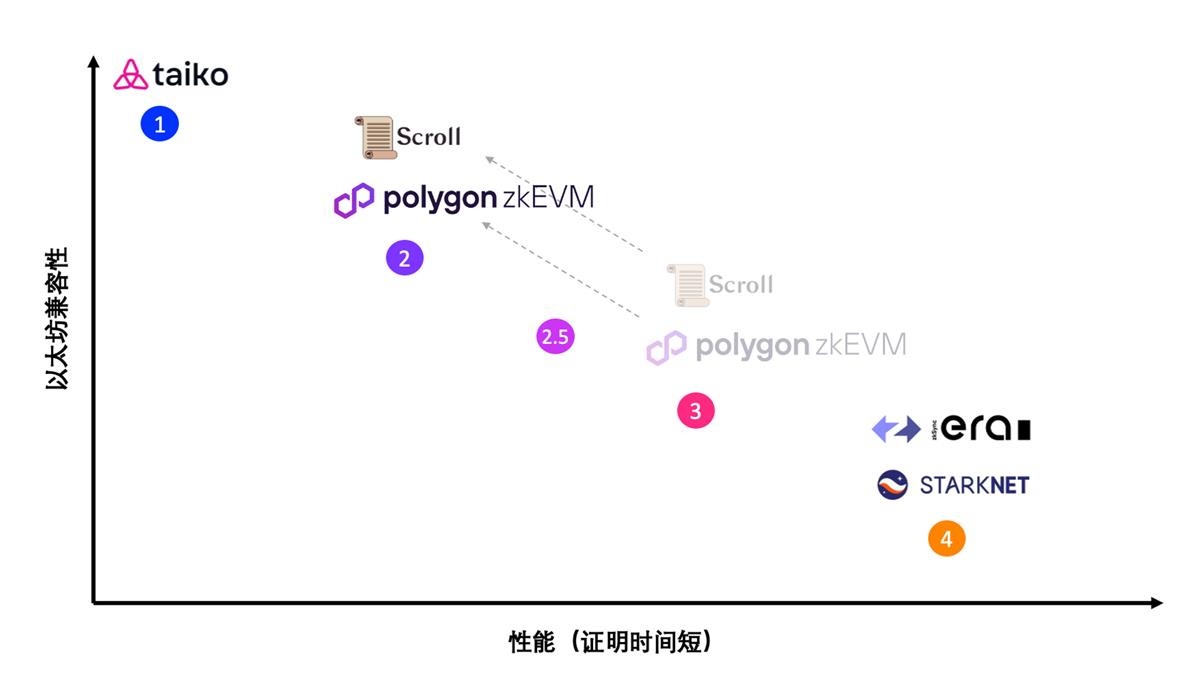
Classification of mainstream ZK Rollup projects
Overview of Mainstream zkEVM Projects
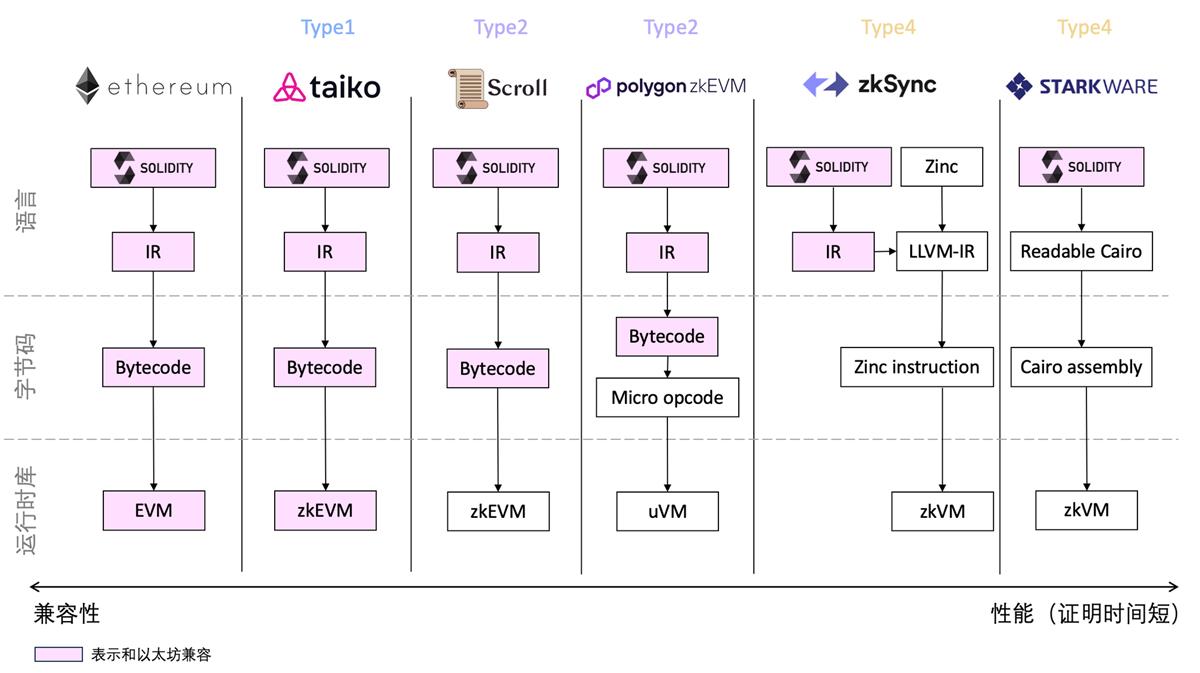
Comparison chart of mainstream ZK Rollup projects
At the end of his article, Vitalik summarized: “Personally, I hope that over time, through improvements in zkEVMs and Ethereum itself, Ethereum becomes friendlier to ZK-SNARKs, and ultimately everything converges into Type 1.”
In such a future, we would have multiple zkEVM implementations usable both for ZK Rollups and for verifying Ethereum itself. Theoretically, Ethereum doesn’t need a single standardized zkEVM specification for L1; different clients could adopt different proving methods, allowing us to continue benefiting from code-level redundancy.
However, reaching this future will take considerable time. In the meantime, we will see abundant innovation across different paths of Ethereum scaling and Ethereum-based ZK Rollups.
It should also be emphasized that although Vitalik’s 2022 classification (referenced in this article) is the dominant framework for categorizing mainstream zkEVMs, alternative classification standards exist. Regardless of classification method, these zkEVM types do not have absolute superiority or inferiority—they simply represent different trade-offs between compatibility and speed: Type 1 offers the highest Ethereum compatibility but slower proving speeds (within the ZK Rollup space); Type 4 offers lower compatibility but much faster verification speeds.
Of course, compatibility and speed are not the only factors developers consider when choosing which ZK Rollup to deploy on. Many other considerations influence their decisions, such as:
Decentralization of L2 Transaction Ordering: Whether sequencers/proposers are decentralized directly affects participant complexity and overall network security;
Fees: Which tokens are used to pay fees, and the economic model of the chain;
Proving Rules: Incentive mechanisms for provers, hardware standards for accelerating proof generation;
Self-Custody: Whether there are clear mechanisms ensuring users can recover assets on L1 in case of L2 failures;
Data Availability: Full data availability naturally incurs higher costs—whether one can accept lower-cost data availability models adopted by some ZK Rollups.
However, since most general-purpose ZK Rollup projects are still in testnet phase, many of these factors cannot yet be meaningfully compared side-by-side.
Finally, the type a given zkEVM project belongs to is not static. With continued exploration in zkEVM technology—and even improvements to Ethereum itself—it’s possible that all solutions may eventually converge toward Type 1 zkEVM functionality. At that point, we’ll have multiple zkEVM implementations serving both ZK Rollups and Ethereum chain verification.
Until then, let’s look forward to continuous innovation along diverse paths of Ethereum scaling and ZK Rollup development.
Join TechFlow official community to stay tuned
Telegram:https://t.me/TechFlowDaily
X (Twitter):https://x.com/TechFlowPost
X (Twitter) EN:https://x.com/BlockFlow_News
 @0xRJ_eth