From EIP-7987 to L1 zkEVM: Ethereum L1's Advanced Scaling Journey
TechFlow Selected TechFlow Selected
From EIP-7987 to L1 zkEVM: Ethereum L1's Advanced Scaling Journey
Scaling cannot rely solely on L2; the ultimate solution for Ethereum's scalability lies in the co-evolution of L1 and L2.
 Navigating Web3 tides with focused insights
Author: imToken
What is the most important thing for Ethereum in the next five years?
L1 scalability.
Starting this month, Vitalik Buterin and the Ethereum Foundation have made strong statements on multiple core topics: from the EIP-7987 proposal (initially referred to by the community as EIP-7983, now officially numbered EIP-7987), which attempts to set an upper limit per transaction, to L1 zkEVM officially entering the experimental phase, and further to increasing the block gas limit, all indicating that Ethereum L1 scaling is rapidly accelerating toward implementation.
It can be said that after achieving phased success in the L2 ecosystem, Ethereum has reached a point of refocusing on L1 scalability—Rollups are already fast enough, but L1 can become lighter, stronger, and more unified.
This article attempts to outline the technical trajectory behind these updates and briefly discuss how Ethereum L1 plans to achieve its next round of large-scale expansion.
1. Fragmentation and Reunification: From L2 Back to L1
Since Vitalik Buterin published "The Rollup-Centric Roadmap" in 2020, Rollup has become Ethereum's core scalability strategy, giving rise to a series of L2 projects such as Arbitrum and Optimism, which have become the "new frontier of Ethereum."
However, the problem with Rollups lies precisely here. As stated in the article Understanding ERC-7786: Is the Ethereum Ecosystem Stepping into a 'Great Unification' Era?, there are now over a hundred broadly defined L2s, causing transactions and value to become increasingly fragmented across L2s. Meanwhile, L1’s role as a data availability and final settlement layer is becoming ever more strained.
This inevitably places growing operational pressure on L1. High-gas transactions (such as blob submissions and zkProof verification) significantly increase computational and validation burdens on L1 nodes. Expanding state space affects node synchronization efficiency and on-chain storage costs. Additionally, increasing volatility in Ethereum block packing times harbors potential security and censorship resistance risks.
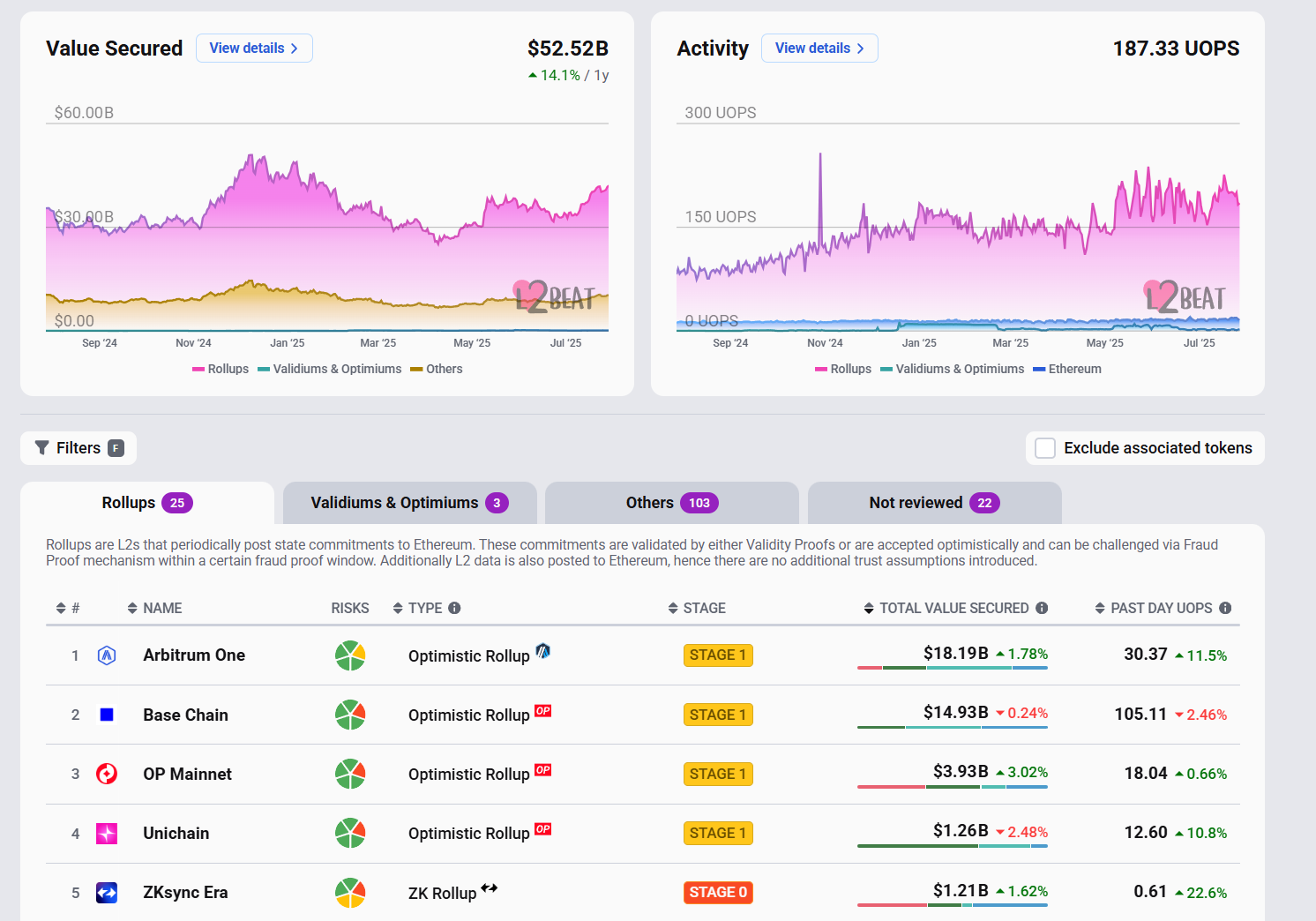
Source: L2Beat
In essence, the development trajectory of L2s over the past few years has also been a history of “building walls”—each Rollup carving out its own liquidity moat and striving to lock users and assets within their ecosystems. While these high walls have fostered local efficiency, they have weakened liquidity and unity across Ethereum as an integrated network.
As the saying goes, “what has been united long will divide, and what has divided long will unite.” Ethereum is currently at a major turning point transitioning from L2 fragmentation back to L1 reintegration—a certain degree of correction to the “L2-centric” phase:
The goal is to make the entire network feel like a unified ecosystem rather than a patchwork of dozens of isolated chains. This means future asset transfers, state sharing, and application switching across L1/L2 should be as seamless as operating on a single chain.
Therefore, from Based Rollup to ePBS and L1 zkEVM, the Ethereum Foundation's protocol research team and developer community are systematically advancing a series of structural optimizations at the L1 level, aiming to enhance the mainnet’s execution capability, usability, and resilience against external attacks without compromising security or decentralization.
2. EIP-7987 & zkEVM: Injecting Scalability Genes into the Mainnet
The two most closely watched core scalability initiatives in the market today are the EIP-7987 proposal and L1 zkEVM, representing two critical dimensions—from optimizing resource scheduling to restructuring the execution layer.
1. EIP-7987: Limiting Gas Per Transaction to Alleviate Block Resource Congestion
The first is the EIP-7987 proposal, jointly introduced this month by Vitalik Buterin and Toni Wahrstätter, suggesting a cap of 16.77 million gas per Ethereum transaction (note: this limit is not directly related to the total gas limit per block). The core idea is to impose a maximum gas usage of 16.77 million per transaction.
As is well known, every transaction on the Ethereum network—whether a transfer or contract interaction—consumes a certain amount of gas. Each Ethereum block has a fixed gas limit, meaning limited space. If a single transaction consumes too much gas, it easily occupies excessive block resources.
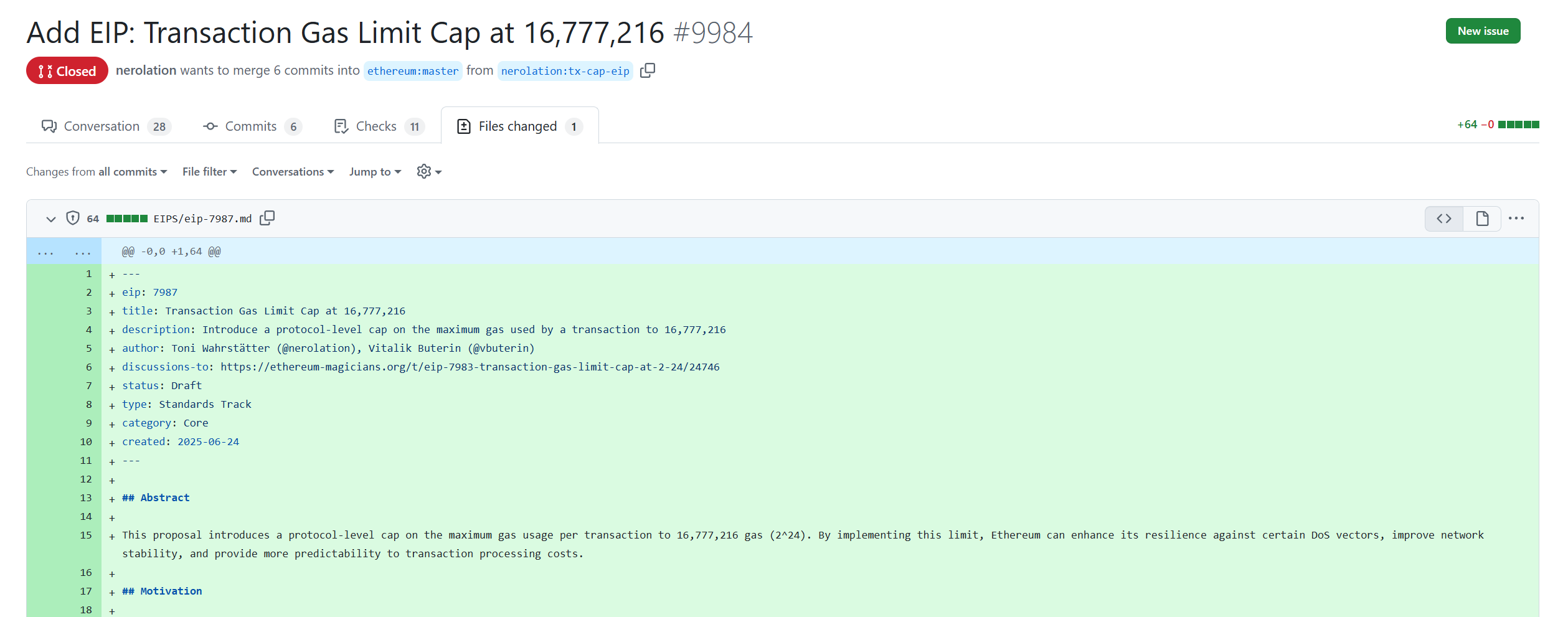
Source: Github
For example, high-load transactions (like zkProof verification or large contract deployments) often consume most of a block’s space. The purpose of this proposal is to prevent such high-gas operations (e.g., zkProof verification or massive contract deployment) from monopolizing block resources, causing node validation congestion—especially affecting parallel execution environments and light node synchronization:
By setting a cap, extremely large transactions are forced to split, avoiding excessive resource consumption by a single transaction. The change only introduces one restriction during transaction execution—if a transaction exceeds the cap before being included in a block, it will be rejected at the validation stage.
Beyond per-transaction gas limits, adjustments to Ethereum’s block-level gas limits are also underway. On July 21, Vitalik Buterin tweeted: “Almost exactly 50% of stakers voted to raise L1’s gas limit to 45 million. The gas limit is already increasing and currently stands at 37.3 million.”
Theoretically, expanding the block gas limit would directly boost Ethereum mainnet performance. However, given the rapid development of L2 and other pathways, Ethereum has historically taken a cautious approach—looking at Ethereum’s gas limit history reveals that after increasing from 8 million to 10 million in September 2019, it took six years until this year for the gas limit to grow from 8 million to 36 million.
But since this year, the Ethereum ecosystem has adopted a noticeably more aggressive stance on discussing gas limit increases. The EIP-9698 proposal even suggests “a tenfold increase every two years,” aiming to raise the gas limit to 3.6 billion by 2029—100 times the current level.
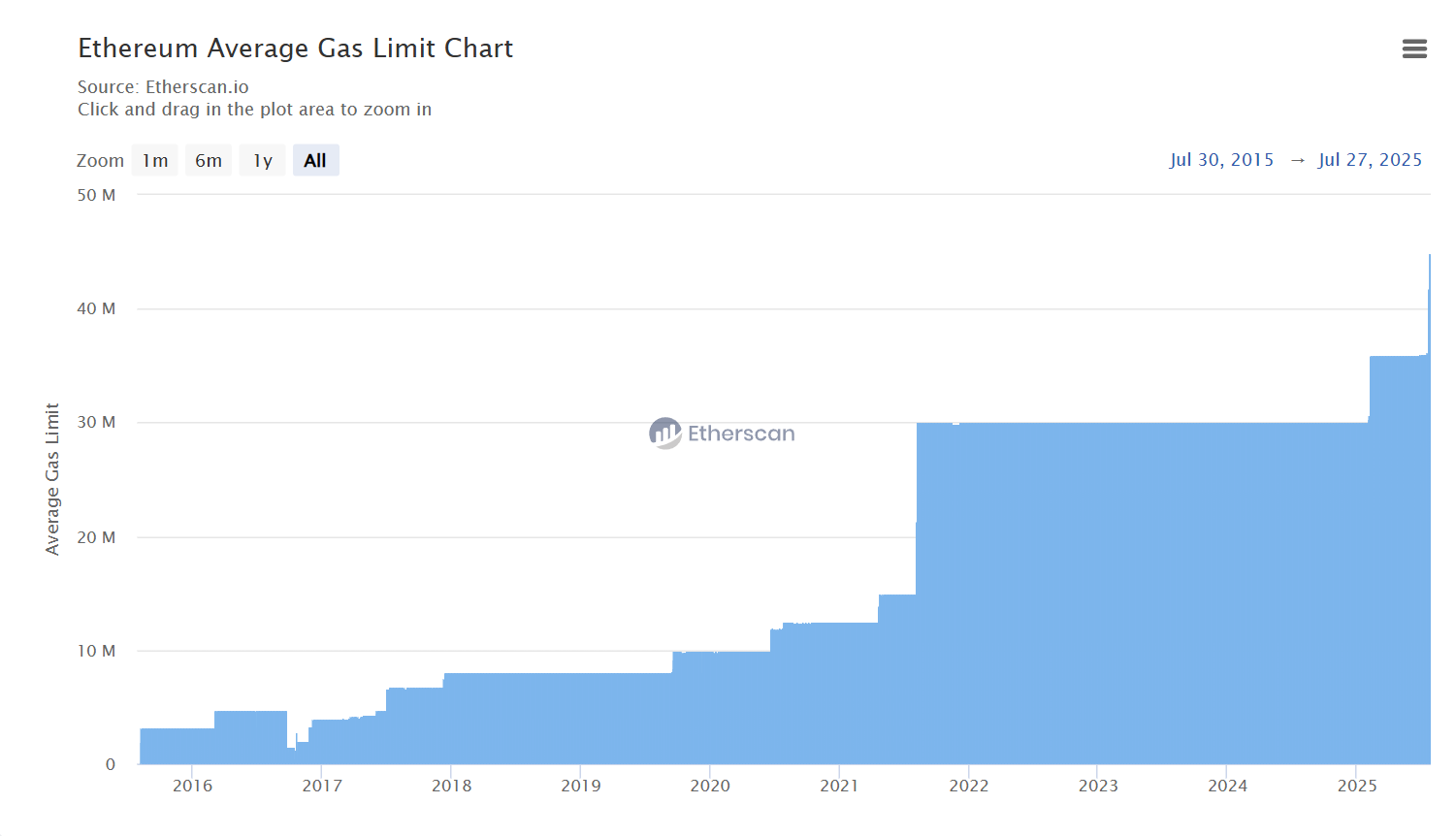
Source: Etherscan
These adjustments reflect both practical considerations regarding mainnet scalability pressures and lay the computational groundwork for the upcoming zkEVM execution layer upgrade.
2. L1 zkEVM: Restructuring the Execution Architecture with Zero-Knowledge Proofs
zkEVM has long been seen as one of the “endgames” for scaling Ethereum. The core design enables the Ethereum mainnet to support ZK circuit verification, allowing each block’s execution to generate verifiable zero-knowledge proofs that other nodes can quickly confirm.
Key advantages include nodes no longer needing to replay every transaction—instead, they verify zkProofs to confirm block validity. This effectively reduces full node burden, improves compatibility with light nodes and cross-chain validators, and enhances security boundaries and tamper resistance.
The concept of L1 zkEVM is now accelerating toward reality. On the 10th of this month, the Ethereum Foundation released real-time proof standards for L1 zkEVM, marking the first step in fully adopting zero-knowledge proof technology, gradually transitioning the Ethereum mainnet into an execution environment supporting zkEVM verification mechanisms.
According to its publicly disclosed roadmap, Ethereum L1 zkEVM will launch within a year, leveraging the succinctness of zk-proofs to securely scale Ethereum, and progressively integrating ZK proof mechanisms across various layers of the Ethereum protocol—an ultimate test of years of technical preparation and practical implementation.
This means the Ethereum mainnet will no longer just be a settlement layer, but a self-validating execution platform—the so-called “verifiable world computer.”
Overall, if EIP-7987 improves execution efficiency at the micro-scheduling level, L1 zkEVM brings about a qualitative leap at the macro-architectural level, potentially delivering 10x to 100x improvements in execution performance while reshaping Ethereum mainnet’s “value capture capability.”
Moving from merely a settlement layer to a verifiable execution engine, L1 itself will serve as a greater entry point for users, assets, and liquidity, and will be better equipped to directly compete with high-performance new public chains like Solana and Monad.
Of course, beyond transaction processing and execution architecture, Ethereum is also making comprehensive innovations in broader resource management and governance mechanisms.
3. Other Combined Measures for L1 Scaling
Beyond EIP-7987 and zkEVM, Ethereum’s mainnet scaling upgrades are comprehensively targeting multiple underlying modules to gradually build a high-performance, low-barrier, and fair on-chain execution environment.
For instance, the Ethereum Foundation is advancing an architectural optimization called ePBS, planning to completely separate the roles of block proposer and builder. This aims to systematically address imbalances in MEV extraction and builder centralization, enhancing fairness, censorship resistance, and transparency in block production at the mechanism level.
More importantly, ePBS is undergoing deep integration with another key component, FOCIL—whose primary goal is enabling light nodes to verify block and transaction execution results without maintaining the complete state online. Combined with ePBS, Ethereum’s future proposal, building, and validation processes will form a clear “separation of powers” architecture, significantly improving protocol flexibility.
This combination also opens up more possibilities for privacy transactions, light nodes, and mobile wallets, lowering participation barriers. It marks Ethereum’s gradual shift toward a “modular consensus architecture,” bringing greater composability and institutional elasticity to decentralized systems.
Another underappreciated yet highly valuable long-term scaling path is the stateless client (Stateless Ethereum) architecture, whose core idea is to completely reduce nodes’ dependence on the “entire chain state.” By introducing a witness (state proof) mechanism, nodes only need to download and verify data relevant to current transactions, dramatically reducing synchronization and validation costs.
To support this, EF is developing a visualization tool named bloatnet.info to quantitatively illustrate the uneven burdens caused by state bloat, providing foundational support for future state cleanup, streamlining mechanisms, and state leasing models.
In addition, the Ethereum research team previously focused on the Beam proposal, which sets independent pricing curves for different resource types such as computation, storage, and calls. Its goal is to introduce a more granular resource pricing mechanism, transforming Ethereum from a “single-dimensional billing system” into a “multi-dimensional resource market,” similar to traditional cloud computing resource scheduling systems.
Final Thoughts
To be honest, in today’s world where Rollup scaling has become mainstream and account abstraction is increasingly widespread, many may place all hopes for scalability on the L2 model of “off-chain execution + mainnet settlement.”
But the reality is, L1 evolution has never stopped—and cannot be replaced.
L2s can accommodate more users and free up execution space, while L1 provides unified settlement, security anchoring, and foundational resource governance. Only through coordinated evolution of both can we build a truly sustainable, high-performance, globally accessible Web3 value network.
The future Ethereum must achieve synergistic evolution between L1 and L2 to possibly become a truly unified world computer.
Join TechFlow official community to stay tuned
Telegram:https://t.me/TechFlowDaily
X (Twitter):https://x.com/TechFlowPost
X (Twitter) EN:https://x.com/BlockFlow_News
 @imTokenOfficial