EIP-7377: The Pioneer Paving the Way from EOA to Smart Contract Wallets
TechFlow Selected TechFlow Selected
EIP-7377: The Pioneer Paving the Way from EOA to Smart Contract Wallets
Who will ultimately drive users to migrate en masse from EOA to smart contract accounts?
 Navigating Web3 tides with focused insights
Author: David
Over the past few months, discussions around account abstraction and smart contract wallets have been heating up.
With the rapid development of the Ethereum ecosystem, achieving a unified and seamless user experience has become increasingly important. On Ethereum’s 2.0 roadmap, account abstraction is considered equally critical as The Merge and sharding.
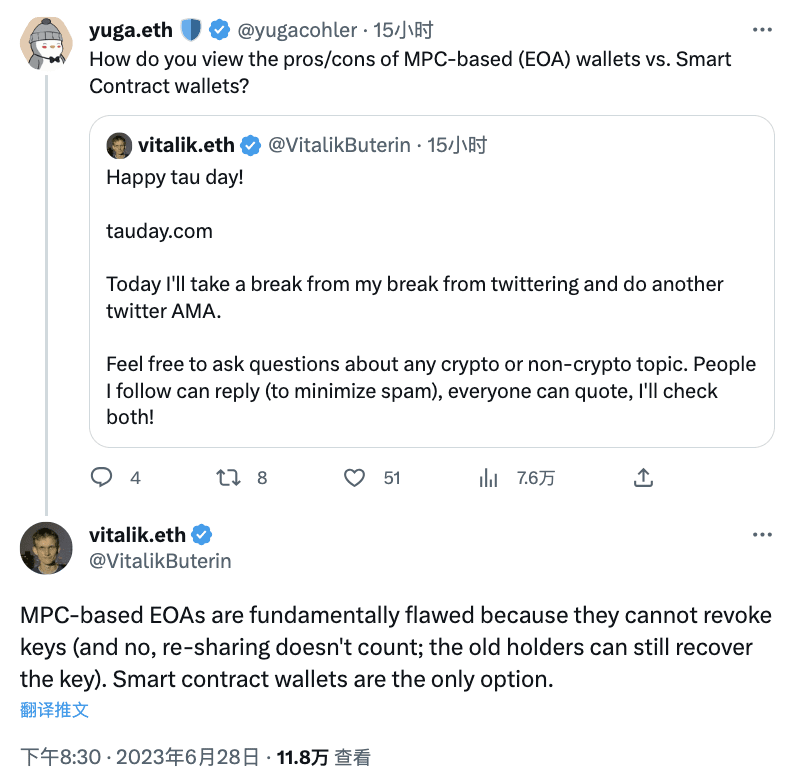
Vitalik Buterin has also tweeted that smart contract wallets offer a significantly better user experience compared to EOA wallets.
For experienced crypto users, using EOA wallets is second nature. However, from the perspective of attracting new users, EOA wallets still pose usability challenges: confusing signatures, sourcing gas fees, the rigid logic of “action = transaction,” and so on.
Therefore, the community has gradually reached a consensus that a smooth transition from EOA accounts to smart contract wallets is necessary—a view that has almost become a political imperative.
Yet in the crypto space, popular narratives often focus on the “why” rather than the “how”:
Assuming we all agree that smart contract wallets are superior to EOAs, the destination is clear—but how do we get there? Where is the bridge?
An even harder challenge lies in overcoming real-world path dependency: I already hold various assets in my EOA account—now you’re asking me to migrate them? How complicated and burdensome would that be?
How can we effectively execute this transition? And how can asset migration be made simple for users?
In this world, there is no path—unless someone lays it down first.
Recently, the EIP-7377 proposal has offered a potential solution. Proposed by Go Ethereum developer Matt Garnett, it aims to introduce a new transaction type that allows EOA accounts to permanently migrate to a smart contract wallet through a single transaction. This provides a viable pathway toward advancing Ethereum's account abstraction.
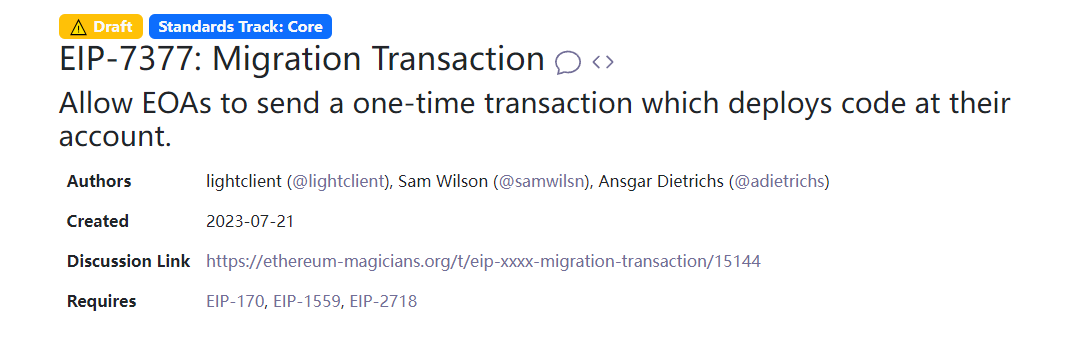
Motivation Behind EIP-7377
Since 2015, smart contract wallets have been seen as a key solution to improving Ethereum’s user experience. Compared to EOA accounts, they offer greater programmability, enabling complex mechanism designs, enhanced security, and improved usability.
However, due to historical reasons, only a small fraction of Ethereum users currently use smart contract wallets, with the majority of assets still held in EOAs. This has become a bottleneck for Ethereum’s evolution.
As users accumulate more assets, manually migrating all their holdings from an EOA to a new smart contract address becomes prohibitively expensive and operationally cumbersome.
Hence, EIP-7377 aims to address this practical need by introducing a protocol-level mechanism for migrating from EOAs to smart contract wallets, enabling a smooth transition. This could significantly boost existing users’ willingness to migrate, while offering new users a pragmatic EOA-to-contract migration path before full account abstraction becomes mainstream.
A Layman’s Guide to EIP-7377’s Technical Implementation
So, how exactly does this proposal enable the transfer from EOA to a smart contract wallet?
In the original technical forum post, the author provided a brief explanation:

In essence, EIP-7377 introduces a new transaction type, 0x04, specifically designated as a "migration transaction."
To quote the technical description:
“It sets the code field of the sender account in the state trie to a pointer referencing specified code stored in code storage. Additionally, the migration transaction can directly set the storage values of the sender account. The storage field in the transaction will be written as key-value pairs into the sender’s storage trie. Furthermore, code storage uses pointers instead of inlined code. This approach enables code reuse, reduces redundancy, and optimizes the size of the state trie.”
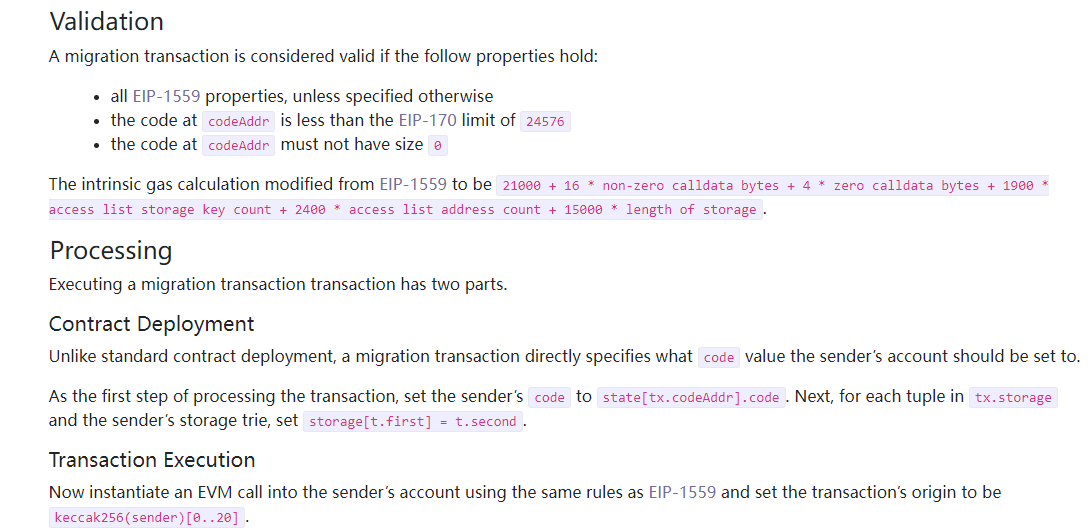
This technical jargon may seem opaque to non-developers. After consulting technical experts and public resources, we attempt to simplify the details through analogy to help quickly grasp EIP-7377:
-
EIP-7377 introduces a special transaction type—think of it as a “migration card.”
-
Users simply initiate this migration transaction to move their assets from an EOA to a smart contract wallet.
-
Imagine your current online account contains a username, password, avatar, etc. (analogous to token names, balances, chain info, gas limits in your EOA). But the platform’s features are limited, so you want to fully migrate to a new one.
-
To make migration easier, the new site offers a “migration card.” By submitting this card, your account data is automatically transferred—the old and new accounts are seamlessly connected. Much easier than manually copying everything over.
-
For security, the “migration card” can only be used once—no repeated migrations or data replay attacks. Also, the new account inherits certain validation rules from the old one, so other users can’t distinguish between migrated and native users.
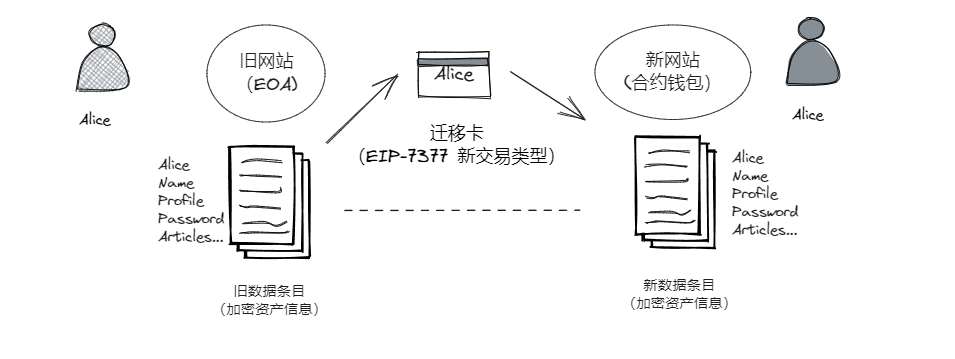
This is essentially what EIP-7377 aims to achieve technically: using a special “migration transaction” card to securely and efficiently transform an EOA into a smart contract wallet by directly modifying account code and storage.
Of course, the actual data being migrated isn’t usernames or avatars—it includes all information tied to cryptographic assets:
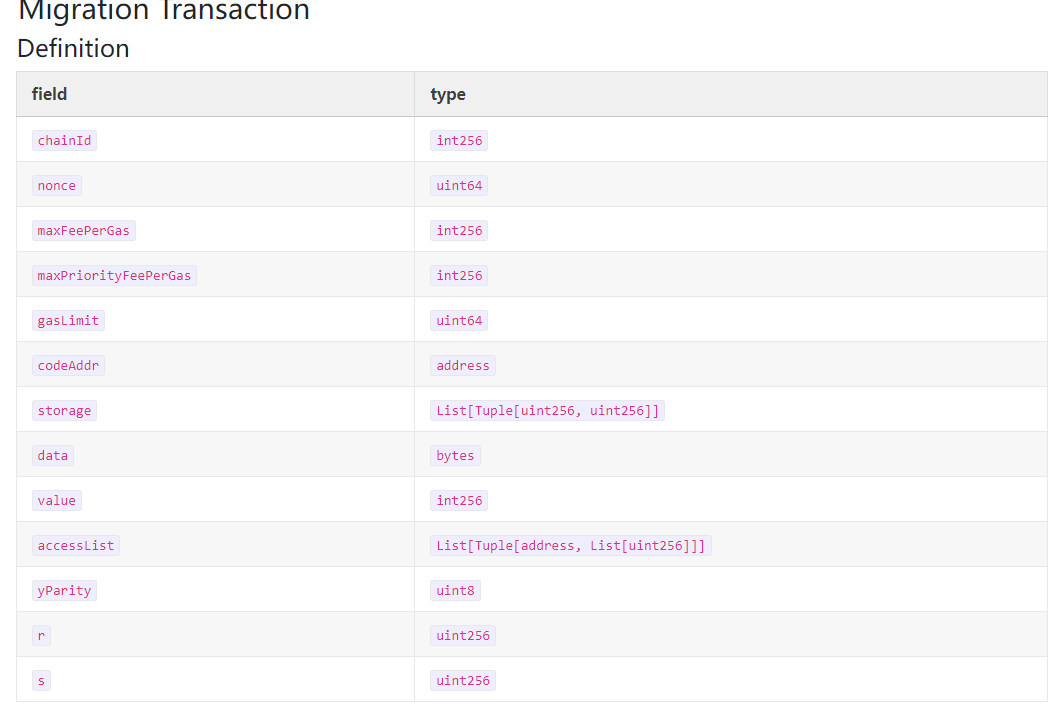
(Note: Due to lack of technical background, the author cannot fully grasp all aspects of this proposal. Corrections and additions from technical experts are welcome. Original post: https://eips.ethereum.org/EIPS/eip-7377?ref=newsletter.ether.fm)
Potential Impact, Significance, and Risks of EIP-7377
The EIP-7377 proposal for migrating EOAs to smart contract accounts could have positive long-term implications for the Ethereum ecosystem. We believe it may serve as a crucial step toward realizing account abstraction.
By supporting smooth migration at the protocol level, it greatly reduces the difficulty and path dependency associated with moving to smart contract wallets. Most crypto users aren’t technically savvy and prioritize asset safety over innovation. If the base protocol supports a “one-click migration,” combined with proper incentives and user-friendly frontend integration, migration willingness should theoretically increase substantially.
However, we must also be alert to potential misuse of this new functionality. Possible attack vectors include, but are not limited to:
-
Phishing attacks: Fraudulent migration transactions could be created and sent via phishing links, tricking users into approving them and thereby losing their assets.
-
Malicious code injection: Attackers might tamper with the migration code to implant backdoors, gaining control over the migrated account.
-
Duplicate migration theft: Exploiting the one-time execution rule, hackers could claim a legitimate migration failed, prompting users to re-approve another transaction and thus stealing their funds.
In the world of crypto, no single protocol upgrade can instantly fulfill a grand vision. In this dark forest environment, protocol upgrades must be accompanied by enhanced auditing, trusted source verification, bug bounties, and other safeguards to ensure the security of migration transactions.
Finally, we must ask:
Infrastructure and protocol shifts require strong ecosystem momentum. Who will drive mass migration from EOAs to smart contract accounts? Who will bear the technical risks and responsibility for asset security during migration?
In a decentralized and freedom-loving crypto world, how can such systemic upgrades build consensus and collective action?
Ethereum’s ecosystem is vast, with many stakeholders. While this shift brings benefits, it may also face skepticism and resistance from various groups. Transition planning and implementation details must be carefully designed to gain community support and protect user interests.
From ideal to reality, from concept to execution—the road ahead remains long.
Join TechFlow official community to stay tuned
Telegram:https://t.me/TechFlowDaily
X (Twitter):https://x.com/TechFlowPost
X (Twitter) EN:https://x.com/BlockFlow_News
 深潮TechFlow