LSD Competitors: Five Rising Challengers to Lido's Dominance
TechFlow Selected TechFlow Selected
LSD Competitors: Five Rising Challengers to Lido's Dominance
In this article, we will focus on five early contenders aiming to make a name for themselves by offering novel solutions in the LSD space.
 Navigating Web3 tides with focused insights
Author: 563
Compilation: TechFlow
In 2023, liquid staking derivatives (LSD) became one of the hottest topics. These protocols accept deposited ETH, stake it to secure network safety, and pass staking rewards on to users holding their LSD (after deducting fees). This greatly simplifies the staking process for users while also allowing them to utilize their LSD within DeFi.
Today, we examine several promising LSD projects that are directly competing with market leader Lido in terms of technology, economics, and simplicity.

Lido's leading position is primarily due to its first-mover advantage and ability to leverage network effects, making it the "safest" choice for users entering the world of ETH staking.
So how can other protocols compete?
Market participants generally act in their own best interests, even though some purists might be reluctant to believe this. To dethrone this king (or weaken its dominance), these new challengers must offer something significantly better than Lido.

In our view, such advantages could include:
-
Higher returns;
-
Easier onboarding;
-
Greater composability and/or security;
-
Innovation.
In this article, we will focus on five early-stage competitors aiming to make their mark by offering novel solutions in the LSD space.
1. Prisma
Prisma made waves with its debut Mirror article, branding itself as the "endgame for liquid staking tokens." Prisma aims to drive broad adoption of its stablecoin (acUSD) by leveraging the Curve flywheel. Similar to projects like Gravita and Lybra, Prisma uses Liquity’s model but adapts it so acUSD can be minted against the top five LSDs—Lido’s stETH, Coinbase’s cbETH, Rocket Pool’s rETH, Frax’s frxETH, and Binance’s WBETH. Weights and future integrations have yet to be finalized.
In theory, holding acUSD incentivizes more users to stake their ETH using liquid staking tokens.
-
In addition to trading fees, acUSD liquidity providers will earn CRV, CVX, and PRISMA tokens, along with standard ETH staking rewards;
-
Prisma will launch with key integrations including Curve, Convex, Frax, Conic, and LlamaNodes.
2. Swell
Swell’s swETH LSD has attracted significant community attention due to its current Voyage incentive program, surpassing $50 million in total value locked (TVL). Positioned as a platform aligned with Ethereum values, Swell aims to provide a simpler onboarding experience for new users.
-
Users can purchase ETH directly via Google/Apple Pay, credit card, or bank account.
-
Partner integrations allow users to earn swETH yields directly through providing liquidity.
3. unshETH
unshETH aims to promote healthy competition in the LSD space by offering a diversified LSD composed of a basket of underlying LSDs. Basket weights are balanced through governance and currently include Lido’s wstETH, RocketPool’s rETH, Coinbase’s cbETH, Frax’s sfrxETH, Ankr’s ankrETH, and Swell’s swETH. Since arbitrageurs are incentivized to balance the underlying LSD weights within unshETH, economic activity will inevitably follow each governance decision.
-
In addition to standard staking rewards from the underlying LSD basket, unshETH earns extra yield through rebalancing fees.
-
Built on LayerZero, unshETH enables cross-chain transfers, opening up possibilities for entirely new liquidity strategies.
-
Inclusion in unshETH creates new buying pressure for emerging LSD projects, making unshETH a clear potential partner.
4. Origin Ether
By combining automated yield-generating strategies with Ethereum staking rewards, Origin Ether offers attractive returns for depositors. Like other LSDs mentioned, OETH is backed 1:1 by deposited ETH and seeks yield through diversified DeFi investments. Currently, yield comes from the following sources (in order of weight):
-
ETH-OETH Convex liquidity pool;
-
Rocket Pool’s rETH;
-
Frax’s sfrxETH;
-
Lido’s stETH.
High yields enabled Origin Ether to accumulate approximately $35 million in TVL within just one month.
-
Over the past 30 days, Origin Ether delivered an annualized yield of around 9%, roughly double that of some competitors.
-
Origin’s automated strategy eliminates user confusion, removing the need to hunt across platforms for the highest yields.
5. Diva
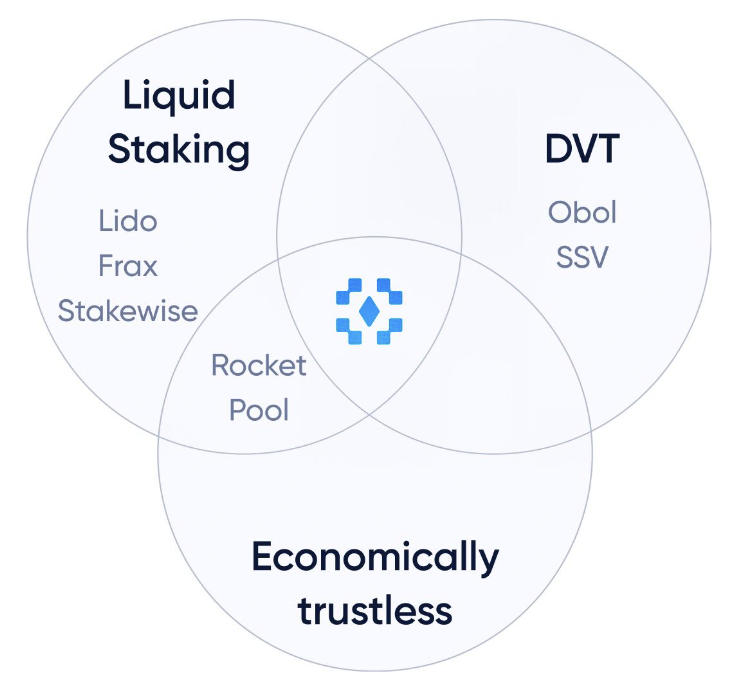
Diva seeks to combine the composability of liquid staking with the decentralization brought by distributed validator technology (DVT). In short, DVT enables verifiable distribution of validator private keys through minimal-trust key sharing. Practically, this allows users to enjoy most of the decentralization benefits of running their own ETH node alongside the composability of LSDs—without requiring minimum staking amounts.
-
DVT is an emerging technology that brings further decentralization to ETH staking.
-
DVT enables node redundancy and improved uptime, contributing to stable rewards.
The story is far from over
Let’s take a step back and look at the bigger picture—despite the completion of The Merge, ETH staking remains in its early stages. Compared to other proof-of-stake (PoS) layer-1 networks, less than 20% of ETH is currently staked.
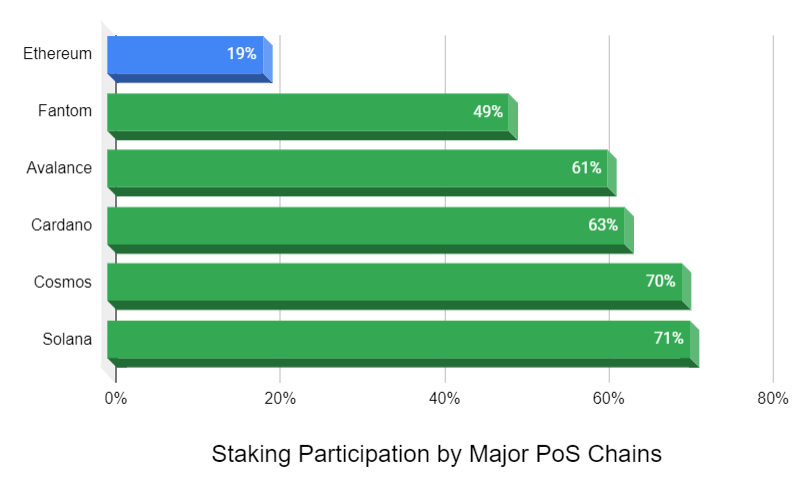
If we assume ETH staking will eventually align with the majority of PoS networks, then staking protocols still have ample time to carve out their niche in the market. The projects highlighted here offer unique approaches to liquid staking—whether through easier onboarding, new technologies, novel use cases, or higher annualized yields. There’s still plenty of excitement ahead in LSDfi.
Join TechFlow official community to stay tuned
Telegram:https://t.me/TechFlowDaily
X (Twitter):https://x.com/TechFlowPost
X (Twitter) EN:https://x.com/BlockFlow_News
 Bankless