








A Deep Dive into $UORE: A V4 Hook Project That Packs Mining, Lotteries, and NFTs into a Single Transaction
TechFlow Selected TechFlow Selected
A Deep Dive into $UORE: A V4 Hook Project That Packs Mining, Lotteries, and NFTs into a Single Transaction
Another V4 Hook mining farm has opened—but the gas fee might be more expensive than the mined tokens…
 Navigating Web3 tides with focused insights
Kuli, TechFlow
Still FOMO-ing yesterday’s hot Ethereum-based project Slonk? A new narrative has actually emerged:
V4 Hooks.
Over the past two weeks, Uniswap V4’s Hook mechanism suddenly surged in popularity. SATO used Hooks to implement an on-chain bonding curve, pushing its market cap to $40 million. uPEG leveraged a viral “rejected draft” story tied to Uniswap’s naming process to reach over $30 million in just two weeks. Slonks embedded AI models directly into smart contracts to mimic CryptoPunks—and generated $586 ETH in trading volume within six days of launch.
Although these three projects differ in execution, they all rely on Uniswap V4’s infrastructure.
Now, the fourth has arrived.
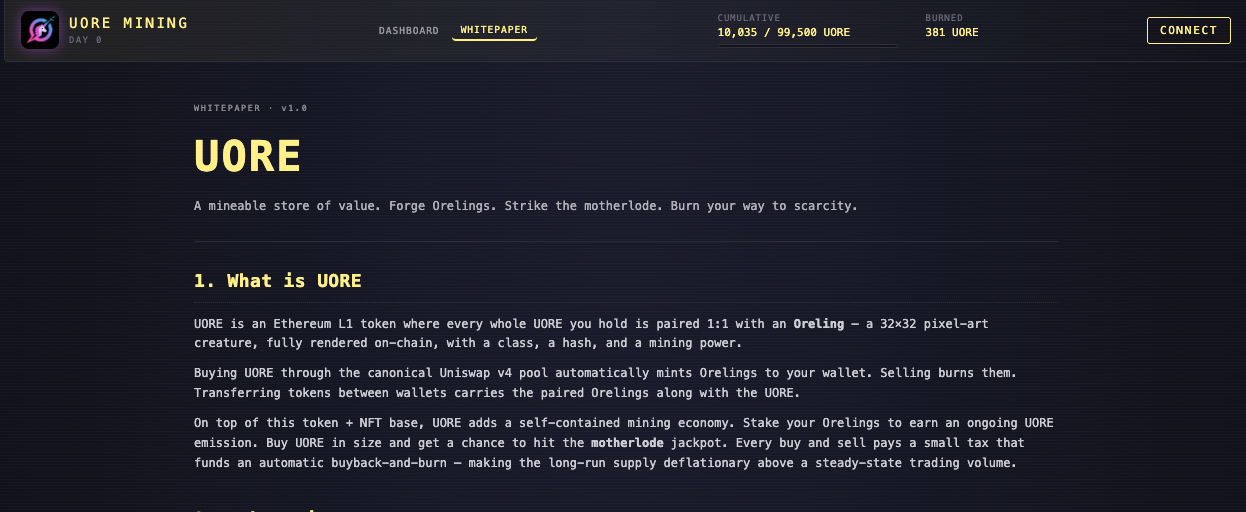
The new project is called $UORE—launched just yesterday. In one sentence: It bundles on-chain mining, token-buying lotteries, procedurally generated pixel NFTs, and deflationary burn mechanics—all into a single Uniswap V4 pool.
Because every purchase you make in this pool triggers all six of those functions simultaneously in the background, gas consumption per transaction is two to three times higher than a standard swap...
Right now, checking CoinGecko (CT), you’ll find users complaining bitterly about this high gas cost.
As for the token: According to GMGN data at time of writing, $UORE briefly spiked to a $1.2 million market cap within hours of launch, then rapidly dropped to $440,000. Liquidity in the pool stands at only $64,000—but 24-hour trading volume reached $1.2 million, meaning the pool’s capital turned over nearly twenty times.
Yet there are only 741 unique holders, and total supply remains under 10,000 tokens.
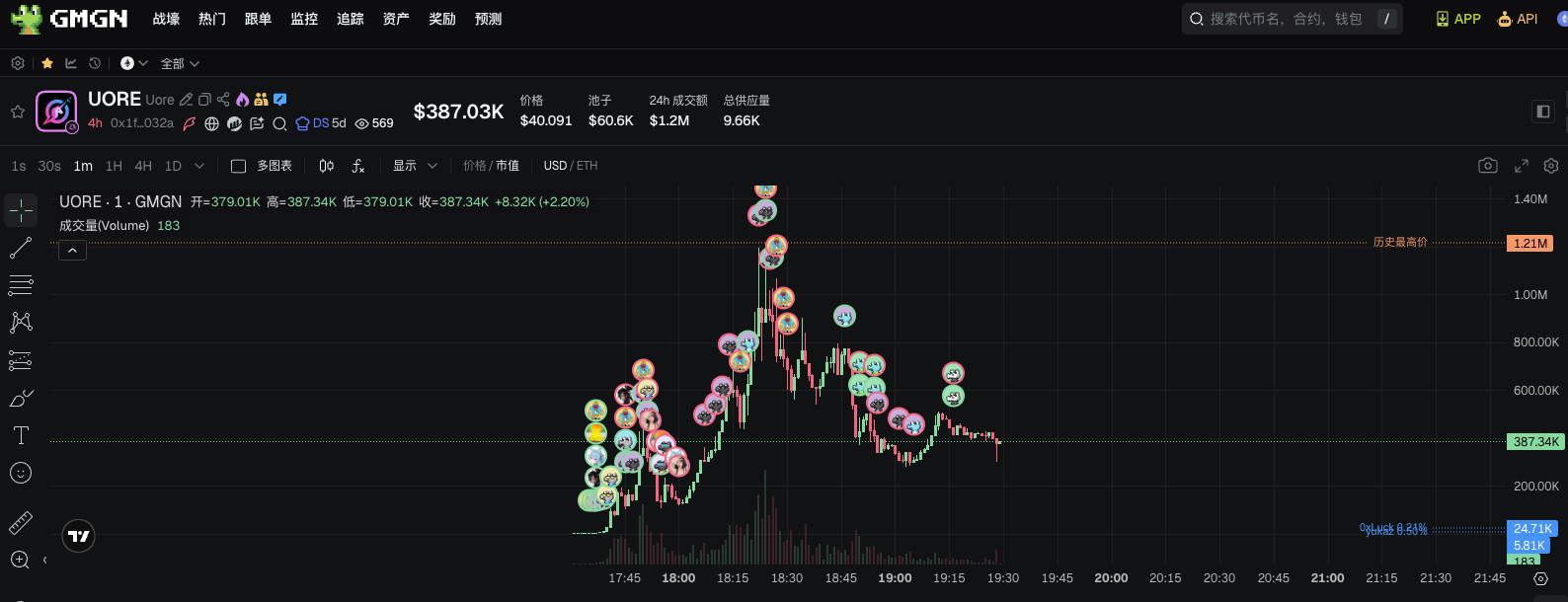
Risk appears extremely high at first glance. After a quick review, I’d say UORE is currently the most complex mechanism among all V4 Hook projects (this wave of on-chain innovations seems deliberately designed to baffle users…).
It functions simultaneously as a token, an NFT collection, a staking mine, and a lottery system—and these four components aren’t separate; they’re welded together.
A Four-in-One Mining Farm
In most NFT projects, tokens and NFTs are distinct assets—bought and sold separately.
UORE isn’t like that. Its NFTs are called Orelings—32×32-pixel miner avatars embedded directly into the token itself. For every whole UORE token you hold in your wallet, you automatically own one Oreling.
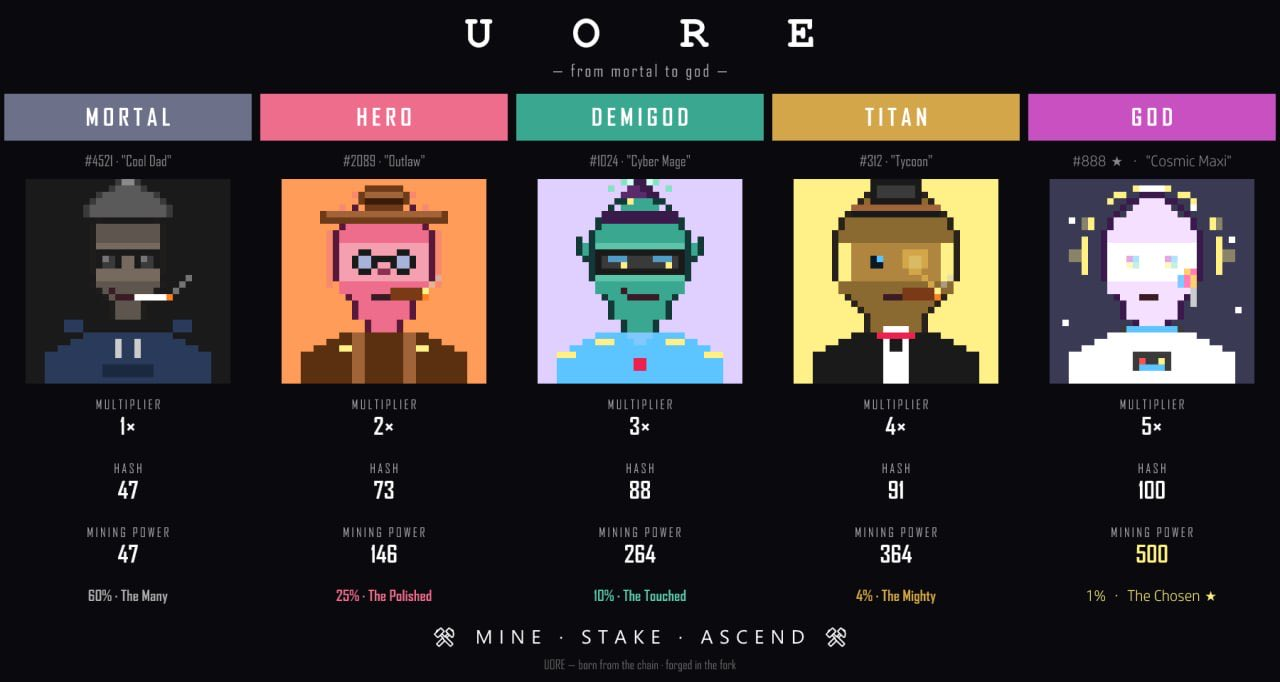
Orelings are minted automatically when you buy UORE, burned automatically when you sell, and transferred along with your tokens during wallet transfers. You cannot purchase an Oreling separately, nor can you detach it from its UORE token.
Each Oreling’s traits are determined instantly upon minting by the hash of the next block—meaning neither you nor any validator can preview what kind of character you’ll receive before purchasing.
Differences among Orelings go beyond mere aesthetics.
Each Oreling has a Class (rarity tier) and a Hash (a random integer from 1 to 100). Their product determines its Mining Power—the computational weight used in mining calculations.
The most common class, Mortal, accounts for 60% of all Orelings and carries a 1x multiplier. The rarest, God, appears with only 1% probability and carries a 5x multiplier. If you happen to draw a God-class Oreling with a Hash value of 100, its Mining Power reaches 500—over ten times that of a standard miner.
So what’s Mining Power good for? The classic play: staking.
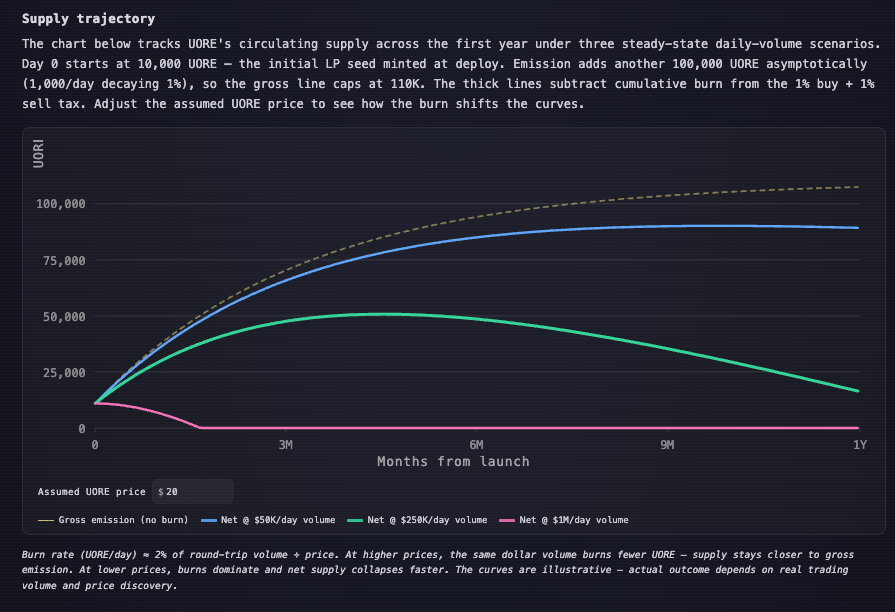
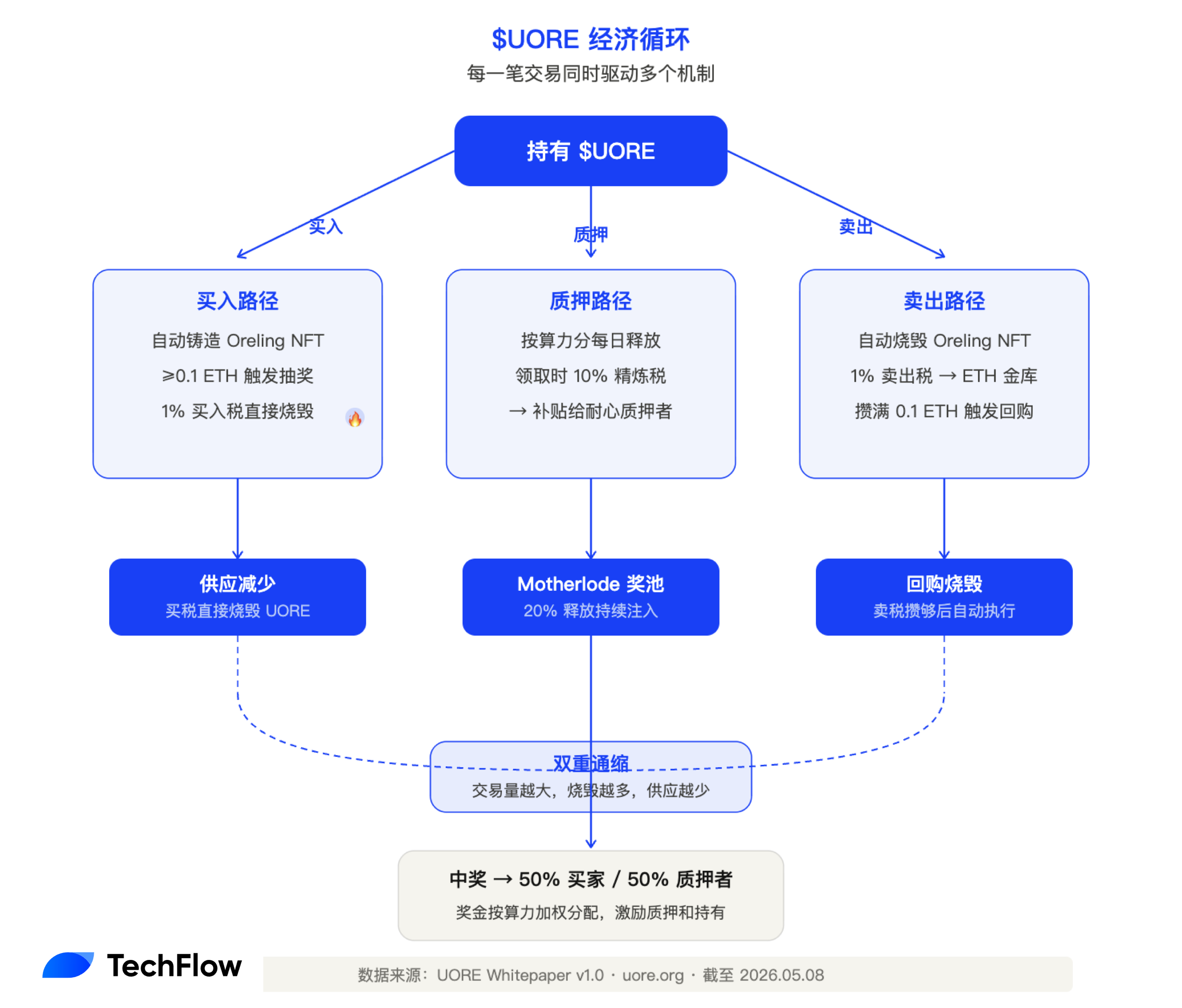
Stake your Oreling into the mining pool, and you begin earning daily UORE emissions proportional to your share of total Mining Power. Per the official whitepaper, Day 1 releases 1,000 UORE tokens, declining by 1% each day thereafter—yielding a half-life of approximately 69 days. Of the daily emission, 80% goes to stakers, while 20% flows into the Motherlode prize pool.
This decay rate implies ~97% of the total supply will be released within one year. The earlier you stake, the larger your share of the pie.
One notable design detail applies when claiming rewards: a 10% “refining tax” is withheld and redistributed proportionally among all stakers who have *not yet claimed* their rewards. The whitepaper calls this the “refined-ore boost.”
In plain English: Late claimers benefit from taxes paid by early claimers. Impatient users subsidize patient ones.
Then there’s the Motherlode—the “mother lode prize.”
Every official purchase of ≥0.1 ETH worth of UORE automatically grants you one lottery ticket. Winning odds scale linearly with purchase size: ~1/600 chance for 0.1 ETH, ~1/200 for 0.5 ETH, capping at 1% for purchases of ≥1 ETH (to prevent whales from gaming probabilities).
If you win, the prize pool splits evenly: 50% goes directly to the buyer, and 50% is distributed randomly among stakers—weighted by Mining Power. As of publication, only four wins have occurred historically, with the largest payout being 6.4 UORE tokens.
Finally, the deflationary flywheel.
A 1% tax on buys is burned immediately; a 1% tax on sells goes into a buyback treasury. Once the treasury accumulates ≥0.1 ETH, anyone can trigger an automatic buyback—purchasing UORE on the open market and burning all acquired tokens. As of publication, 58 such buybacks have been executed, burning a cumulative 358 UORE tokens.
Across the entire design, minor innovations appear in tokenomics and NFT mechanics, but scarcity-generation tactics follow well-worn patterns—and the underlying economic model resembles a Ponzi structure.
The code is forked; the mechanics are stitched together
UORE wasn’t built from scratch.
Community members reviewing the source code discovered a folder named reference/unipeg-hook-source/. Founder Noah didn’t hide this either—he openly stated on X (formerly Twitter) that UORE’s contracts forked uPEG’s codebase and fixed two known issues in uPEG: duplicate NFT minting and flash-loan-based rarity manipulation attacks.
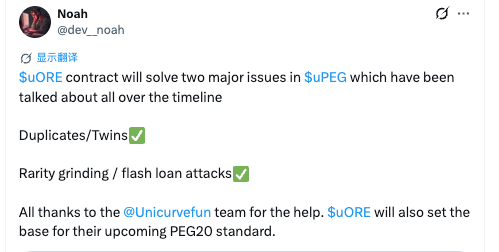
A quick look at the founder’s profile shows his bio reads: “Ethereum dev & BAYC holder.” On May 2nd, he posted his first tweet about UORE, describing the project as a fusion of Solana’s ORE mining logic with uPEG’s V4 Hook architecture.
He even proactively tagged Unicurvefun and Openpeg, asking whether they could support Oreling trading once UORE launched on their platforms.
From these public clues, UORE’s lineage is clear:
Solana’s ORE provided the “on-chain mining + lottery” gameplay template; uPEG supplied the V4 Hook code skeleton; Noah improved and integrated both.
Forking itself isn’t inherently problematic. What concerns me more are the following points:
- Gas costs. Users on CT report each UORE transaction executes six steps inside the Hook, consuming two to three times the gas of a standard swap. Frequent trading may leave little or no profit after fees.
- Timing window. The V4 Hook narrative has already suffered from uPEG’s downturn, meaning subsequent projects face diminishing ceilings. UORE is the fourth in this Hook wave—and the hype around the first three is already cooling. Attention windows in crypto move fast.
- Complexity. UORE may be the most intricate of the four projects. An average user must grasp the full interplay between Oreling rarity tiers, Mining Power calculations, staking decay schedules, refining tax mechanics, Motherlode odds, and buyback triggers—a steep learning curve. Worse still, the official website reads like an enigma.
The project’s whitepaper also contains an interesting line:
“Read the contracts and understand the mechanics before deploying capital.”
Translated loosely: “Understand it first—or don’t blame us if you don’t.”
Taking the broader picture across recent Hook projects, we see a consistent pattern: highly complex mechanisms paired with massive information asymmetry—offering alpha potential, but with ever-shortening shelf lives.
SATO offered roughly one week; uPEG lasted just days; by UORE’s launch, you may have only hours to decipher the rules…
By the time you do, the rally may already be over.
Join TechFlow official community to stay tuned
Telegram:https://t.me/TechFlowDaily
X (Twitter):https://x.com/TechFlowPost
X (Twitter) EN:https://x.com/BlockFlow_News
 深潮TechFlow


