








Hook Narrative Reinvention Creates Overnight Wealth Opportunities—How to Seize the Next One?
TechFlow Selected TechFlow Selected
Hook Narrative Reinvention Creates Overnight Wealth Opportunities—How to Seize the Next One?
How Did SATO, uPEG, and Slonks Popularize Uniswap V4 Hooks?
 Navigating Web3 tides with focused insights
Authors: Jaleel (Jia Liu), Cookie
If no one in your group chats is yet discussing $SATO, $uPEG, and Slonks, it may be time to join new groups.
Slonks launched with a mint price under 0.004 ETH—less than ¥70 RMB—and its floor price surged to 0.123 ETH within six days, a 60x increase. uPEG trades at $982 per token; it reached a $34.44 million market cap in just two weeks. When SATO’s market cap dipped below $3 million, some users capitalized on its on-chain bonding curve to buy in at the bottom—opening positions of 260,000 SATO tokens. The project later soared to a $40 million market cap, delivering an immediate paper profit of $360,000.
These are not ordinary memecoin rags-to-riches stories. They all point to a single emerging sector: Uniswap V4 Hooks. In just two and a half weeks, these three projects catapulted the V4 Hook ecosystem from “an internal toy for DeFi nerds” into mainstream awareness. Related reading: “Bull Market, New Coins—Could ‘Hooks’ Be the Narrative That Kicks Off the Bull Run?”
For retail investors who missed the early entry into $SATO, $uPEG, and Slonks, how can we identify the next potential breakout opportunity? Before answering that, let’s first briefly recap how the V4 Hook narrative gained traction.
How Did the V4 Hook Narrative Catch Fire?
In the pre-V3 world, Uniswap functioned like a simple currency exchange counter: you swapped ETH for USDC, and pricing followed the x*y=k formula—end of story. With V4, however, “hooks” were embedded directly into the swap lifecycle, enabling anyone to inject custom code before or after a swap—or at the exact moment liquidity is added.
In fact, Uniswap V4 officially launched as far back as January 30 last year. Yet it wasn’t until recent projects like $SATO, $uPEG, and Slonks emerged that hooks began attracting widespread discussion among retail participants.
Of the three, SATO was the earliest breakout—launching around mid-April, roughly one week before uPEG. It had no KOL-driven hype cycle, nor any heavyweight endorsement like Adam Hollander’s. Its growth path leaned heavily into the degen community: keywords like “pure on-chain,” “fair launch,” “no team allocation,” and “self-executing contract” resonated strongly with V4 enthusiasts and bonding-curve veterans.
The true explosion point for the V4 Hook narrative came with Unipeg (UPEG), whose name carries powerful symbolic weight tied directly to Uniswap’s origins—and thus arrived with built-in narrative momentum and attention.
In 2019, Hayden Adams published a blog post titled “Uniswap Birthday Blog—V0”, recounting how he initially wanted to name the protocol “Unipeg”—a portmanteau of “Unicorn” and “Pegasus.” Vitalik Buterin reportedly glanced at it and remarked, “Unipeg? Sounds more like Uniswap.” So Hayden settled on “Uniswap.”
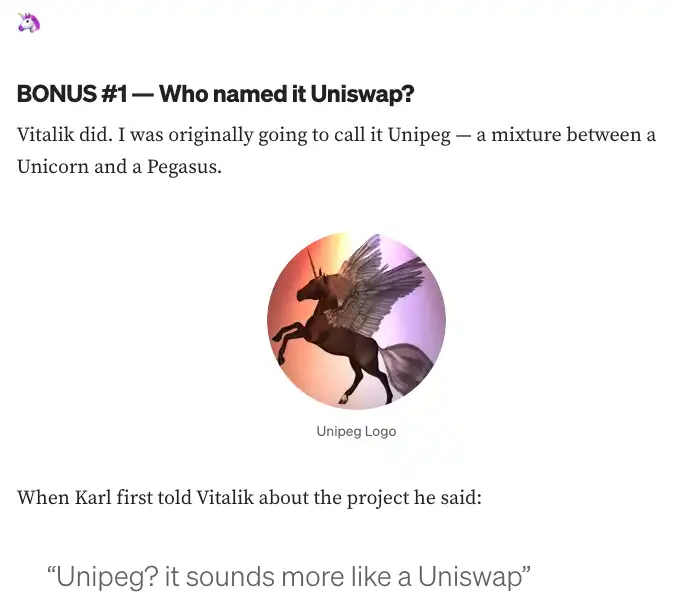
“Uniswap” replaced “Unipeg” to become the name of a $7 billion DeFi blue chip.
Eight years later, in April 2026, an anonymous developer (Twitter handle @unipegv4, reportedly linked to the 0xHadrian blog) revived the discarded name, redefining it as Uni + JPEG = uPEG. Since NFT communities jokingly refer to images as “JPEGs,” and since this token originated in a Uniswap pool, it became “Uniswap’s JPEG.”
This origin story itself is inherently viral—intertwining Hayden’s personal anecdote, Vitalik’s offhand remark, NFT slang, and V4’s novel architecture into a tightly closed narrative loop—all embodied in a single name.
The “uPEG” story is easy to tell—and even easier to spread. It quickly attracted OpenSea CMO Adam Hollander, who tweeted on April 25: “I’m intrigued by this concept—bought a little to try it out.”
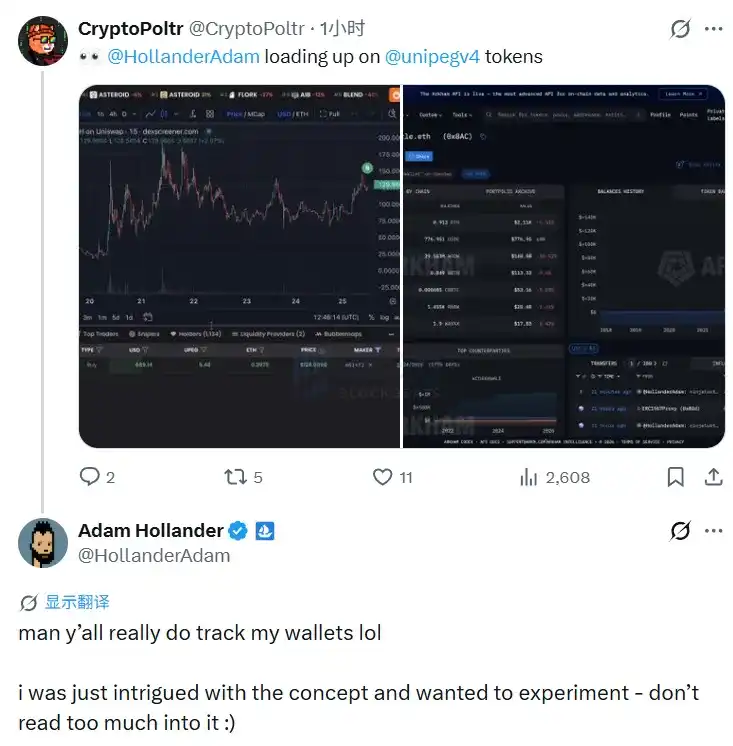
That same evening, uPEG surged 3x. Soon after, Uniswap team member Niko, Ouroboros co-founder Nafay, and memecoin KOL pow shared their uPEG holdings on X. Within two weeks, uPEG rocketed from $0 to a $34.44 million market cap at $982 per token. Related reading: “Market Cap Surpasses $23 Million, Hits New High—What’s the Magic Behind the New JPEG Meme Coin Unipeg?”
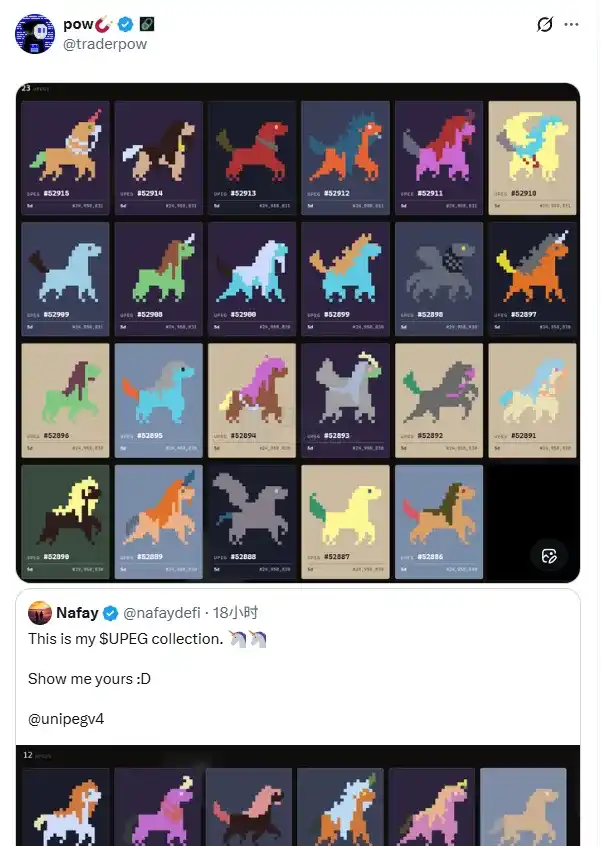
Memecoin KOL pow promoting uPEG
Right after uPEG came Slonks, launching on May 1.
Developer Hirsch did something seemingly incongruous: he embedded an AI image-generation model—just 214KB in size (roughly the size of a low-res smartphone wallpaper)—directly into an Ethereum smart contract. Its task? To replicate 10,000 CryptoPunks.
But a 214KB model cannot memorize 10,000 faces. Each image contains 576 pixels; the model misdraws about 24 pixels on average—a ~4% distortion rate. Only 32 of the 10,000 Punk reproductions are perfect; the rest are “distorted punks.”
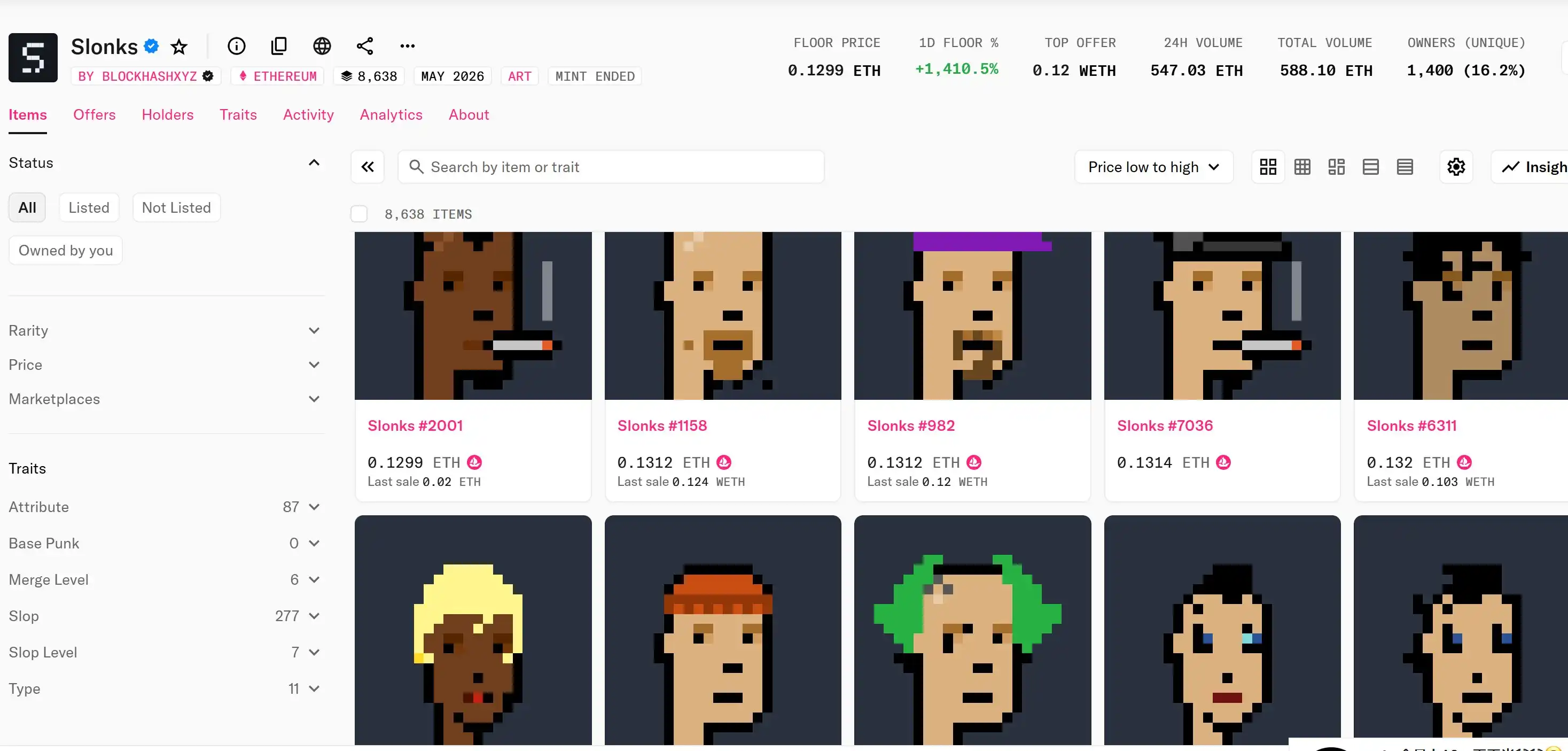
Example slop image
Hirsch dubbed these pixel-level errors “slop.” On Twitter, he declared the project’s ethos: “The slop is not a bug. It is the medium.” (Distortion isn’t a flaw—it’s the artistic medium.)
Its entire economic model rests on the principle: “The more distortion, the more valuable.” Two Slonks of the same tier can merge—one gets burned, the other upgraded—with the new image’s slop level only increasing, never decreasing. Any Slonk can be sent to the void to mint future $SLOP tokens (not yet live) at a 1:1 ratio based on its slop count. Every action is executed via V4 hooks—and fully verifiable on-chain.
Slonks didn’t ignite immediately upon launch. During its first few days, it was nearly invisible beneath uPEG’s $30 million market cap spotlight. Its floor price hovered around 0.005 ETH, and there was little discussion on OpenSea—until veteran NFT figures like the “798” crew began circulating tweets on X, turning “distortion is art” into a shareable meme. Concurrently, on-chain smart money stepped in, KOLs and media amplified coverage, and OpenSea’s homepage Trending section provided crucial traffic distribution—propelling Slonks to a 60x surge in five days.
SATO’s significance lies in proving, at the foundational level, that “V4 hooks can power entirely new economic models”—a prerequisite that enabled both uPEG and Slonks to emerge.
uPEG’s contribution was translating the DeFi-centric concept of V4 hooks for the NFT community. Retail users suddenly realized hooks weren’t just toys for DeFi engineers—they could produce things they themselves wanted to own.
Building on uPEG’s attention dividend, Slonks crafted an even stronger narrative hook and a uniquely engaging economic model—further accelerating the V4 Hook narrative.
What Should You Watch for the Next Opportunity?
For tracking the core Western V4 Hook ecosystem, BlockBeats recommends following these key accounts:
1. Hayden Adams (@haydenzadams), Uniswap’s founder—no further explanation needed.
2. saucepoint (@saucepoint), the “godfather of hooks” at the Uniswap Foundation and author of v4-template—the foundational boilerplate code used by nearly every hook project.
3. Uniswap Official (@Uniswap) and Uniswap Foundation (@UniswapFND): Their weekly “Builder Update,” released every Wednesday or Thursday, is the most important official signal source for the sector.
4. niko (@niko_eth), a Uniswap Labs team member—his endorsement marked a pivotal early handoff in the uPEG KOL relay.
5. horsefacts (@horsefacts_eth), one of the earliest V4 hook builders and a technical thought leader.
6. Adam Hollander (@AdamHollander), OpenSea’s CMO—whose deeper background includes early ecosystem advocacy for Hashmasks and Pudgy Penguins, making him a critical bridge between DeFi and NFT circles.
7. Project accounts: uPEG Official (@unipegv4), Unimon Official (@unimonapp), Slonks Official, SATO Official (@Satothedog). Monitoring who they follow and engage with often reveals promising hook projects before they’re widely named.
Beyond social accounts, here are key V4 hook and Uniswap-related websites to monitor:
1. HookRank.io is currently the cleanest V4 hook explorer—featuring over 1,300 hooks sorted by TVL, volume, and fees, with “New” and “Trending” tags. This is where you’ll spot hooks gaining traction on-chain before they surface on Twitter.
2. HookAtlas.com serves as a curated directory of hook projects with descriptions—ideal for ecosystem mapping.
3. Uniswap Foundation Builder Updates are published weekly on their blog (Wednesdays or Thursdays). Core Uniswap ecosystem participants won’t miss the hottest narratives.
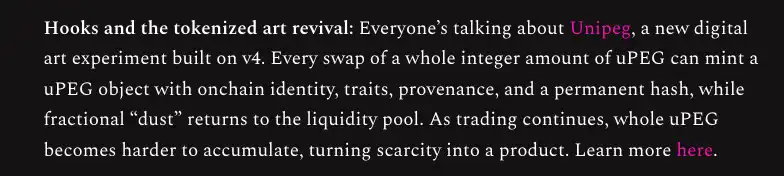
The latest blog post also highlights community updates including “Hooks” and “Unipeg.”
4. The Unichain Infinite Hackathon: Winning projects are almost always early-stage gems—ideal for spotting core Unichain initiatives.
5. Dune Uniswap V4 Tracker: Tracks total hook count, TVL distribution, and chain-by-chain adoption metrics.
6. DexScreener—no introduction needed. A staple charting tool for traders, especially useful for monitoring newly created V4 pairs. Sudden spikes in holder counts (e.g., uPEG’s jump from 200 to 4,000+ addresses in 24 hours) serve as strong early signals—even without KOL backing.
7. OpenSea and Magic Eden Trending lists: Slonks appeared on OpenSea Trending the day after launch—a feat that typically takes ordinary NFT projects weeks of marketing. Moreover, Slonks hit $575 ETH in daily trading volume on May 8—surpassing CryptoPunks’ $129 ETH—signaling sector-wide momentum whenever a new project exceeds CryptoPunks’ contemporaneous volume.
8. The GitHub repository awesome-uniswap-hooks catalogs experimental hook projects—including many pre-token, conceptually compelling early-stage ideas worth discovering.
The Next Phase of the V4 Hook Narrative
Based on speculative, unverified analysis by BlockBeats editors, if the V4 Hook narrative doesn’t fizzle out immediately, its next evolution will likely unfold along three timelines: short-term—SATO’s “bug-fix” forks; mid-term—hook composability; long-term—Unichain becoming the sector’s central hub.
First, the short-term “SATO bug-fix” wave is already visible across group chats today.
The emergence of “sat1”—a SATO fork marketed as a “fix”—stems directly from SATO’s hook contract design. Any V4 hook aiming to replace Uniswap’s standard pricing must maintain its own internal ledger of “how much value resides in the pool,” which feeds its custom pricing curve. Meanwhile, Uniswap’s PoolManager maintains the authoritative ledger. These dual ledgers must be synchronized on every swap—if synchronization logic is imprecise, values gradually diverge. In the hook engineering community, this phenomenon is known as “dual-state drift.”
Drift creates arbitrage opportunities. At certain moments, the hook’s internal state might claim 1 SATO is worth X ETH, while the pool’s real reserves indicate Y ETH. Whoever spots the gap first captures the difference. Those two addresses with $360,000 paper gains weren’t riding market sentiment—they exploited an accounting vulnerability in the contract.
sat1 markets itself as “one curve, single-state”—using only one ledger, eliminating drift. While technically sound, its narrative is strategically calculated: it tells retail users “SATO has a bug—this is the correct version,” aiming to seize legitimacy.
This playbook predates V4: Bitcoin saw ORDI, SATS, and 1000SATS; ERC-404 brought Pandora, DN404, and ERC-404 V2; pump.fun spawned BankrFun and ClankerFun—each claiming to “fix the flaws of its predecessor.”
Bug-fix forks aren’t truly about technical fixes—they’re about narrative capture. They don’t need to fix anything real; they only need to make “the original has bugs” a consensus on Twitter, and liquidity will migrate.
V4 hooks have lowered the cost of executing this script to unprecedented lows: hooks are open-source, so forking and modifying just three lines of code is enough to deploy a new version. Every successful hook project ships with its own clone generator. SATO/sat1 is merely the first pair—uPEG2, Slinks, and others are inevitable.
Mid-term, expect breakthroughs in hook composability.
Currently, each V4 pool supports only one hook. But developers are already building “meta-hooks”—hooks that internally orchestrate multiple sub-hooks to achieve compound behaviors.
Once proven, this means uPEG’s image generation, Slonks’ NFT-token redemption, and SATO’s bonding curve could all coexist in a single pool. One swap would simultaneously trigger image generation, update the pricing curve, and mint an NFT.
Future directions are vast: swaps triggering music/audio generation (replacing SVG with MIDI—audio spreads faster than images); swaps functioning as identity/reputation systems (updating soul-bound points with each trade); prediction-market hooks (treating swaps as bets, Polymarket-style, running inside LP positions); time-based hooks (lower sell tax the longer you hold); cross-collection fusion (e.g., using hooks to blend Pudgy Penguins and Azuki into hybrid forms—especially viable among CC0 projects).
BlockBeats believes composability—not isolated mechanisms—is the sector’s true ceiling. Single-feature hooks are merely demos.
Longer term, Unichain may emerge as the next hotchain.
Not because of superior technology—but because of Uniswap Foundation funding, traffic, and whitelist advantages. Hook projects deployed on Unichain enjoy a tenfold higher probability of official Builder Update exposure compared to those on Ethereum mainnet.
To catch the earliest signals, BlockBeats suggests setting up dedicated Unichain monitoring: track hook deployment numbers on Dune’s Unichain dashboard, TVL and active address metrics on L2Beat, and new tool releases via the official builder toolkit.
Join TechFlow official community to stay tuned
Telegram:https://t.me/TechFlowDaily
X (Twitter):https://x.com/TechFlowPost
X (Twitter) EN:https://x.com/BlockFlow_News
 BlockBeats


