








The Growth History of U.S. Stocks Is, in Essence, a History of U.S. Wars
TechFlow Selected TechFlow Selected
The Growth History of U.S. Stocks Is, in Essence, a History of U.S. Wars
Since the late 19th century, the United States has transitioned from “opportunistic intervention” to actively provoking and participating in numerous wars. In most cases, U.S. stock markets surged—during the Afghanistan War, which spanned the 2008 financial crisis, the Dow Jones Industrial Average nearly doubled.
 Navigating Web3 tides with focused insights
By: Li Jia
Source: WallStreetCN
When the cannons roar, gold flows in abundance. While markets debate whether the Middle East conflict will drag down the global economy, the S&P 500 and Nasdaq indices have both hit new all-time highs. What does war truly mean for U.S. equities?
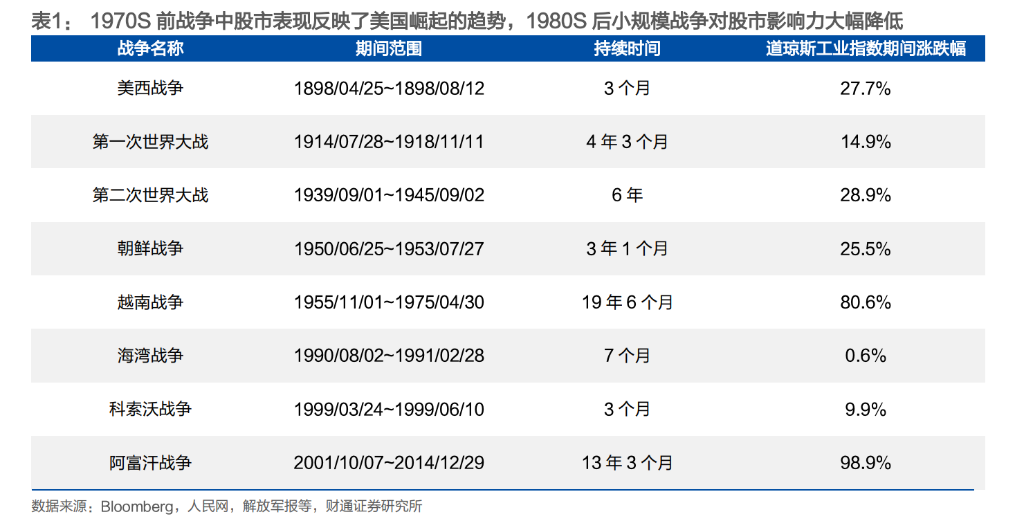
A report by China Fortune Securities offers a straightforward answer: War and the long-term bull market in U.S. equities are not mutually exclusive—they are, rather, nearly symbiotic. Historical performance of the Dow Jones Industrial Average supports this view: It rose 28% during the Spanish-American War, 26% during the Korean War, over 80% across the 19-year Vietnam War, and nearly doubled during the Afghanistan War—which spanned the 2008 financial crisis.
Since becoming the world’s largest economy at the end of the 19th century, the U.S. has reaped tangible benefits from most wars it has fought—except Vietnam. From seizing Spain’s colonial territories during the Spanish-American War, to profiting massively from both World Wars, to launching smaller-scale conflicts centered on oil resources—including the Gulf War—the U.S. evolved from a “war participant” into a “war instigator.”
The U.S. equity market’s response pattern amid warfare is also clearly traceable: Before and during WWII, war primarily affected markets through sentiment shocks; starting with the Korean War, this direct effect gradually weakened, and war increasingly influenced equities via economic channels—such as inflation, oil prices, and fiscal deficits.
The Vietnam War stands as the sole U.S. conflict that ended in net loss—and profoundly reshaped its strategic logic of warfare. Since then, every U.S.-initiated conflict has shared three defining features: short duration, limited geographic scope, and focus on oil—each ultimately achieving its stated objectives.
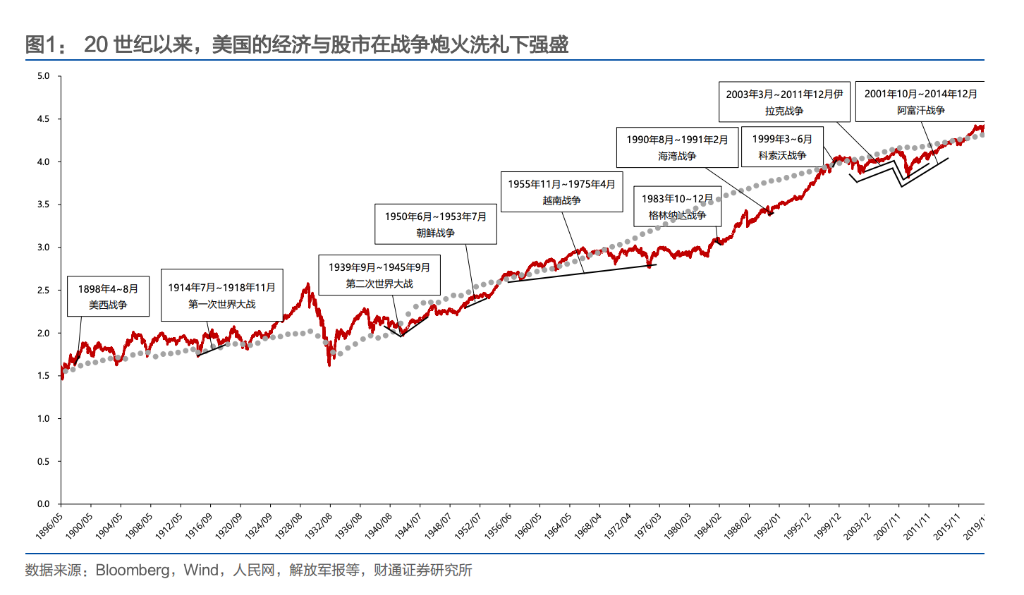
From “Opportunistic Exploitation” to Proactive Provocation: Three Turning Points in U.S. War Strategy
The 1898 Spanish-American War marked America’s first major war of deliberate provocation. At the time, domestic monopolistic financial conglomerates urgently needed new markets, investment venues, and sources of raw materials—making Spain’s crumbling colonial empire the ideal target. After the war, the U.S. gained control over Cuba and acquired the Philippines, Guam, and Puerto Rico. The Dow Jones Industrial Average rose 28% during the three-month conflict—rising in lockstep with battlefield victories.
When World War I broke out, the U.S. initially maintained neutrality. During the market closure in July 1914, investors quickly recognized that America would become the greatest beneficiary of Europe’s conflict—its homeland, safely removed from battlefields, could sustain production and export arms to Europe. By 1917, U.S. banks—including J.P. Morgan—had extended $10 billion in loans to Britain and France to finance weapons purchases. Though the stock index fell nearly 10% after the U.S. formally entered the war in April 1917, the industrial index had already surged approximately 107% from its 1914 low point to March 1917.
World War II was the decisive conflict that cemented America’s status as the global hegemon. In early September 1939, at the outbreak of war, U.S. equities briefly declined due to the “excess profits tax,” which dampened corporate earnings expectations—the U.S. Congress imposed tiered taxes of up to 95% on corporate profits exceeding $5,000, severely constraining the dividend discount model’s numerator. Only after the pivotal Coral Sea and Midway battles in May 1942 turned the tide did investors swiftly anticipate the shift in war momentum—and U.S. equities bottomed and rebounded ahead of schedule. The industrial index rose 82% in the second half of the war, transport rose 127%, and utilities soared 203%.
The Korean War marked America’s first “unwon” war. Although surging arms demand stimulated the post-WWII sluggish economy, U.S. forces failed to achieve their stated objectives. Nevertheless, the Dow Jones Industrial Average still rose 26% overall, while the transport index surged 86%.
The Vietnam War became the watershed—a conflict in which the U.S. suffered its only outright defeat without material gain.
U.S. defense spending ballooned from $49.6 billion in 1961 to $81.9 billion in 1968 (43.3% of the federal budget), the fiscal deficit swelled from $3.7 billion to $25 billion, and inflation climbed from 1.5% to 4.7%. America’s share of global GDP fell from 34% to under 30%. Post-war, U.S. war strategy underwent a complete overhaul: large-scale ground warfare was abandoned in favor of short-duration, low-casualty, air-centric “proxy-style” conflicts.
Subsequent conflicts—the Gulf War, Kosovo War, Afghanistan War, and Iraq War—were all initiated by the U.S., leveraging local disputes or black-swan events. These wars were concentrated mainly in the Middle East and Balkans, with core objectives revolving around oil resource control and arms demand.
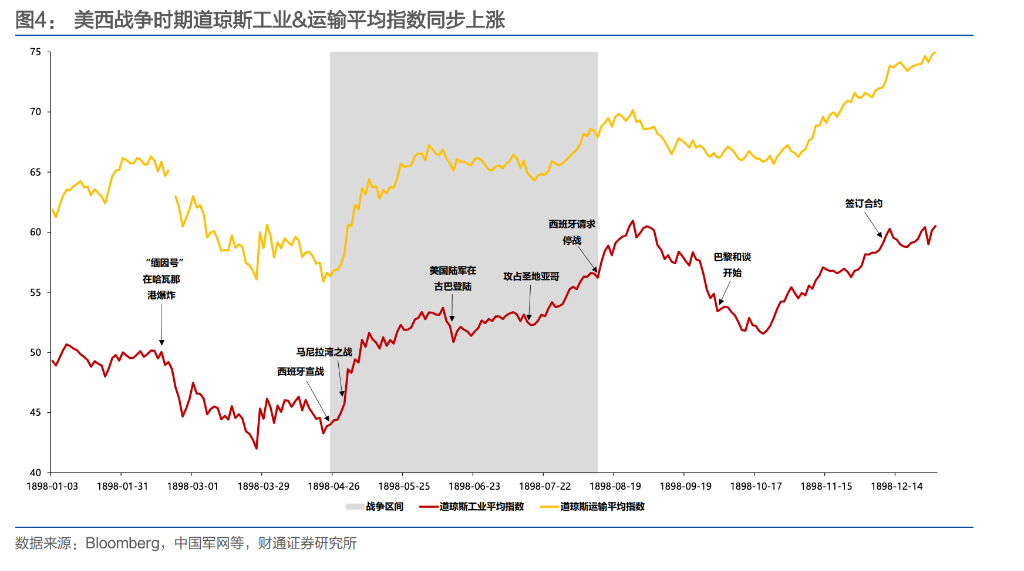
How War Affects Equities Has Changed: From Sentiment-Driven to Economics-Driven
Before and during WWII, war events directly impacted investor sentiment. During the Spanish-American War, victories at Manila Bay and Santiago Bay each triggered ~10% index gains within ten days; similarly, news of U.S. entry into both World Wars often sparked panic-driven sell-offs.
But beginning with the Korean War, such direct impacts gradually faded. From November 1950 to February 1951, as U.S.-South Korean forces suffered successive defeats, U.S. equities continued rising—because the post-WWII stagnant economy reignited during the Korean War: Real U.S. GDP growth reached ~8.7% in 1950 and remained above 8% in 1951. Fiscal expansion driven by war, in fact, acted as a catalyst for economic recovery.
This shift became even more pronounced during the Vietnam War. The November 1965 Battle of the Ia Drang—the first large-scale U.S. engagement in Vietnam—had no discernible impact on equities; nor did North Vietnam’s “Tet Offensive” in early 1968 prevent U.S. equities from hitting new highs. Instead, what truly drove markets were the Federal Reserve’s tightening of credit conditions in 1966 to counter Vietnam-related expenditures—and the recessions of 1969–1970 and 1973–1975. War sentiment had yielded entirely to macroeconomic policy and corporate earnings.
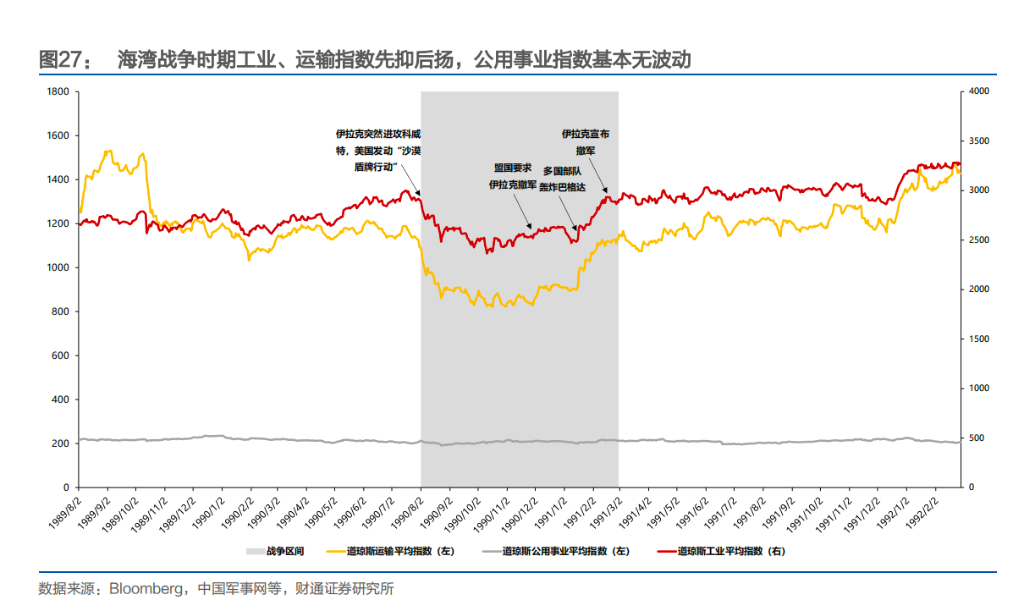
The Gulf War provided the clearest case study of “economic transmission.” After Iraq invaded Kuwait in August 1990, oil prices spiked, prompting market fears of a U.S. recession—and the S&P 500’s valuation hit bottom. When the multinational coalition bombed Baghdad in January 1991, oil prices promptly fell back to pre-war levels, and equities rebounded in tandem. Throughout the conflict, the Dow Jones Index and crude oil prices moved almost perfectly inversely—markets traded the trade-off between inflation and growth.
The 2001 Afghanistan War and 2003 Iraq War further validated this pattern. Most symbolically, when Osama bin Laden was killed in May 2011—the single most breakthrough moment of the Afghanistan War—the Dow edged down just 0.02% the next day, and the S&P 500 fell only 0.18%. Markets virtually ignored the news.
In summary, U.S. equities’ reaction to war has followed a clear evolutionary path: from “sentiment-driven” to “economics-driven.” Early wars directly shook markets via battlefield outcomes; since the Korean War, however, equities have grown increasingly focused on real economic variables—fiscal expansion, inflation expectations, oil price volatility, and monetary policy.
War itself is no longer a reason for market moves; rather, how war affects growth and costs has become the market’s true pricing object.
Which Industries Profit During War? The Answer Evolves
During WWII, coal was the lifeblood of war: anthracite’s share of total coal output rose from 43.8% pre-war to 48.9%, and the sector surged 415% cumulatively.
During the Korean War, oil took over as the new protagonist—crude oil extraction and refining claimed the top two spots in sectoral gains, with returns climbing steadily from mid-1950 through the first half of 1952. During the Vietnam War, the collapse of the Bretton Woods system forced the dollar to depreciate; OPEC was granted permission to raise prices to offset losses—triggering an explosion in oil extraction stocks during the dollar crisis from late 1970 to early 1973, with cumulative wartime gains reaching 1,378%.
The Kosovo War continued this pattern, with raw materials and energy sectors delivering the strongest returns.
The Gulf War stands as the sole exception—its transmission mechanism shifted to the indirect “oil price → economic expectations” channel, temporarily boosting consumer staples and healthcare, while energy, raw materials, and industrials—capital-intensive sectors—underperformed.
A notable trend: As the U.S. economy has expanded in scale, the defense industry has transitioned from a growth engine into a foundational pillar of the economy. The marginal contribution of any single war to aggregate GDP has continuously declined, and equity market drivers have increasingly yielded to macroeconomic variables—such as inflation, interest rates, and fiscal deficits.
Join TechFlow official community to stay tuned
Telegram:https://t.me/TechFlowDaily
X (Twitter):https://x.com/TechFlowPost
X (Twitter) EN:https://x.com/BlockFlow_News


